
AI Trends Report: AI Mentions on Resumes Have More Than Tripled in 2 Years

Mentions of AI have more than tripled since 2023 as professionals highlight tech fluency.
Updated:
|

6 min read

Table of Contents


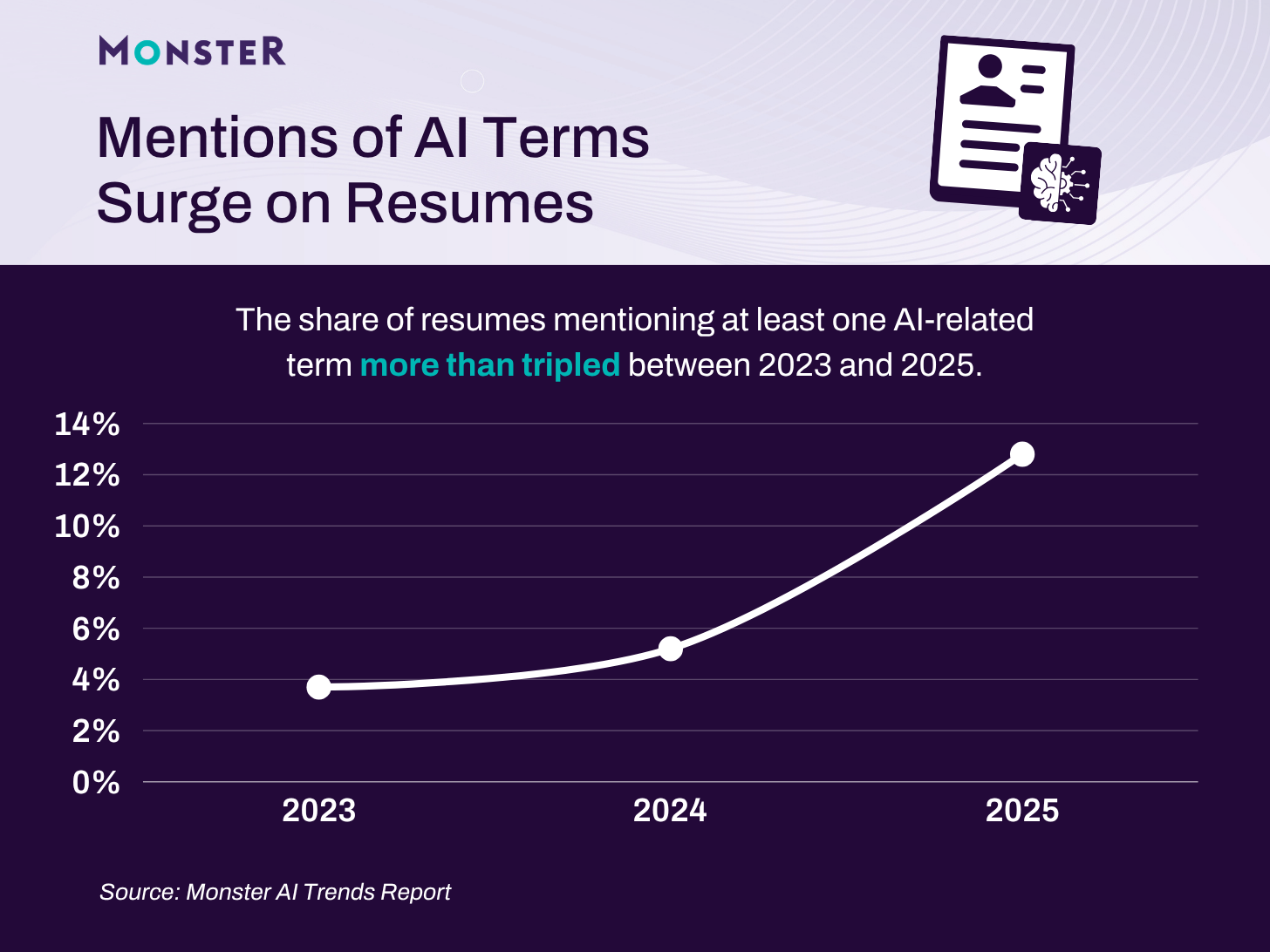
Artificial intelligence (AI) isn’t just transforming workplaces; it’s increasingly showing up on resumes. According to Monster’s AI Resume Trends Report, the percentage of resumes including at least one AI-related term skyrocketed from just 3.7% in 2023 to 12.8% in 2025.
That means 1 in 8 resumes are now listing at least one AI term. That surge, more than threefold in two years, underscores how professionals are signaling AI fluency as a career advantage.
Whether you’re actively job searching or hiring talent, understanding the emergence of AI skills on resumes can help you read between the lines of today’s job market.
Key Findings
- AI has surged across resumes. The share of resumes listing at least one AI-related term jumped from 3.7% in 2023 to 12.8% in 2025.
- 2025 marks a clear acceleration point. Growth from 2024 to 2025 (+7.6 points) far outpaced gains from 2023 to 2024 (+1.5 points).
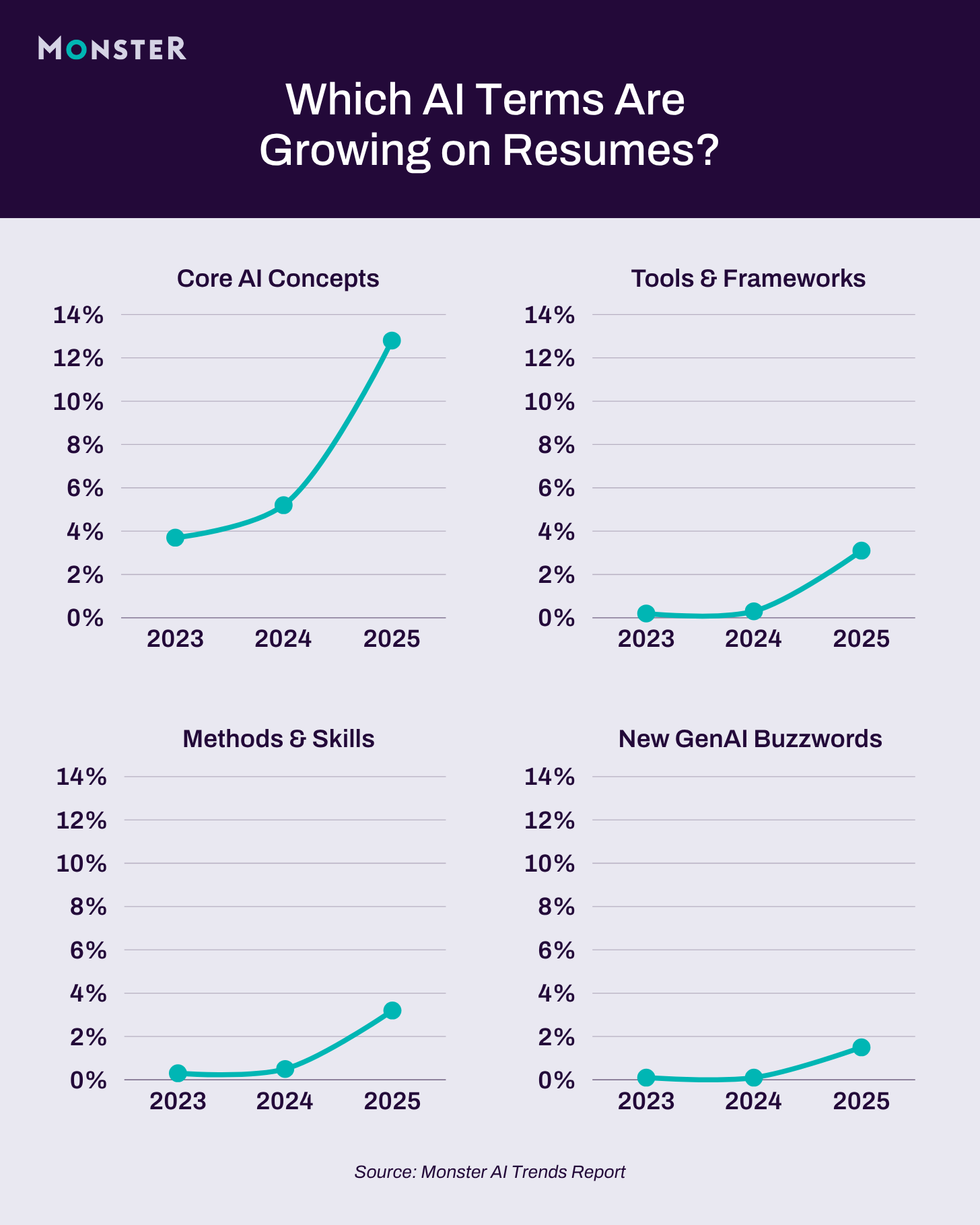
- Core AI skills are driving the increase. Foundational terms show the largest gains, with mentions of artificial intelligence rising from 0.5% to 6.3% and machine learning (ML) from 0.6% to 5.7%. Each now appears on roughly 1 in 16 resumes.
- Tools are rising but remain early-stage. Mentions of major AI frameworks climbed from 0.2% to 3.1%.
- Applied AI methods are breaking out. Skills like natural language processing (NLP) increased from 0.2% to 1.7%, contributing to a broader jump in methods-related terms from 0.3% to 3.2%.
- Generative AI is visible but not dominant. Newer terms rose from near zero to 1.5% of resumes, with ChatGPT/OpenAI at 1% and prompt engineering at 0.6%.
- Growth does not equal saturation. Despite rapid increases, most individual AI terms still appear on fewer than 5% of resumes.
AI Mentions Are Growing Rapidly
The percentage of resumes with at least one AI term jumped from 3.7% in 2023 to 12.8% in 2025, a 9.1 percentage-point increase, as the chart below shows. The growth was most dramatic from 2024 to 2025 (+7.6 points), signaling a real acceleration.
Core AI Skills Lead the Way
Workers are increasingly highlighting fundamental AI expertise:
- Artificial intelligence appeared on 6.3% of resumes in 2025 (up from 0.5% in 2023).
- Machine learning appeared on 5.7% (up from 0.6%).
Together, these foundational terms are now among the most common ways professionals show AI experience.
Tools & Frameworks Are Emerging
Mentions of popular AI tools like the following increased:
- scikit-learn
- TensorFlow
- PyTorch
- Keras
- Hugging Face
While still below single-digit prevalence, their rise suggests more candidates are applying hands-on technical skills.
Applied Skills & Methods Are on the Rise
Methods like NLP saw notable increases—from 0.2% to 1.7%—aligning with broader interest in real-world application of AI.
Generative AI Terms Are Emerging, But Not Yet Mainstream
Newer generative AI buzzwords like ChatGPT/OpenAI and prompt engineering rose from near-zero mentions to measurable footing, but they still trail core AI/ML skills in resume prevalence.
The graphic below illustrates this growth in AI mentions across resumes:
What This Means for Job Seekers
Knowing how to list AI skills on resumes can help you stand out. Be sure to:
- Highlight real AI experience, not just AI buzzwords. Focus on specific projects, platforms, and outcomes.
- Prioritize foundational skills first. Employers still look for broad competencies like AI and ML.
- Be thoughtful with niche terms. Emerging AI concepts can help you stand out, but only if you can back them up with experience.
Employers, meanwhile, can use these trends as a lens into the candidate landscape: More applicants are claiming AI skills, but depth and context still vary widely.
Bottom Line
AI skills on resumes are quickly becoming a staple, with 1 in 8 career documents now listing at least one AI term. While adoption is rising fast, most specific skills still appear on a small share of resumes, which gives you room to stand out with real, results-driven experience.
If you’re updating your resume to reflect new AI skills, make sure you’re highlighting measurable impact, relevant tools, and real-world applications, not just buzzwords. If you need help, Monster’s Resume Builder helps you showcase in-demand skills in a way that’s tailored, polished, and optimized, so your resume stands out to employers.
Methodology
Monster analyzed a stratified keyword taxonomy of AI-related skills and terms across a random sample of 25,000 resumes per year (2023–2025). Mentions were identified through standardized term matching and grouped into four categories: Core AI Concepts, Tools & Frameworks, Methods & Skills, and Emerging Buzzwords. Results are reported as the percentage of resumes containing each term and as category-level incidence (the share of resumes containing at least one term in a category).
About Monster
Monster is a global leader in online job searching, resume building, and employment solutions. For over 30 years, the company has been a trusted authority for both job seekers and companies. Beyond the job search, Monster provides an intuitive Resume Builder and hundreds of resume templates to help candidates stand out against the competition while offering employers a comprehensive resume database to source top talent. As a G2 category leader, Monster has been featured in Forbes, CNBC, CNN, and USA Today, sharing the career advice needed to bridge the gap between job seekers and hiring managers. Follow Monster on LinkedIn, Facebook, X, Instagram, and Pinterest for the latest employment trends.

Vicki Salemi is a nationally recognized career expert who helps professionals navigate the hiring landscape and find the right fit on Monster. With over 15 years of experience in corporate recruiting and HR, she offers expert guidance on job search strategies, interview preparation, and career development to help candidates land their next role.
See More From Vicki SalemiManage Your Career Like an Expert
Take control of your professional journey with Monster’s expert resources. Explore advice, research, and tips to make informed decisions and advance your career with confidence.

Job Search
Discover strategies to get noticed, network effectively, and streamline your job search process.

Resumes
Get practical tips to create a resume or CV that stands out to employers and wins interviews.

Cover Letters
Learn how to craft a compelling cover letter that highlights your experience and fit for the role.

Career Paths
Explore career paths, industry trends, and growth opportunities to plan your next move.

Interviewing
Prepare for interviews with tips on answering common questions and following up effectively.

Career Development
Develop key skills and knowledge to grow in your current role or pivot to new opportunities.

Leaving a Job
Navigate job changes and career transitions with practical advice and planning resources.