
The Summer of Staycations Is Here: 52% of Workers Are Staying Home as Costs Rise

Economic pressures are impacting how Americans spend, travel, and work this summer.
Updated:
|

7 min read

Table of Contents


A more expensive economic environment is reshaping how Americans approach summer. Recently released research from Monster reveals a growing “staycation summer” trend, where workers are scaling back travel, opting for lower-cost activities, and rethinking how they spend their time off in response to rising living costs.
What is a staycation summer?
A staycation summer is a shift away from traditional travel toward more affordable, local, or home-based ways of taking time off. Rather than booking trips or taking extended vacations, workers are choosing to stay closer to home, reduce discretionary spending, and prioritize financial stability.
This shift is largely driven by sustained financial pressure. As the cost of living continues to rise, workers are making more cautious decisions about how they allocate both time and money, especially during peak spending seasons like summer.
Key Findings From Monster’s Staycation Summer Report
- Staycations are on the rise. 52% of workers say rising living costs are causing them to stay home more often this summer.
- Travel plans are being scaled back. 39% are cutting back on vacations or trips.
- Workers are seeking affordability. 37% are looking for lower-cost leisure activities.
- Savings are taking priority. 28% are prioritizing saving money over leisure spending.
- Work is replacing time off. 23% plan to work more this summer to keep up financially.
- Few remain unaffected. Only 17% say their summer plans have not changed.
Summer Is Being Shaped by Financial Trade-Offs
Summer has traditionally been associated with travel and leisure, but for many workers, that expectation is shifting. Instead of vacations, many are choosing more practical, budget-conscious alternatives, reflecting the cost-of-living impact on travel plans.
In Monster’s survey highlighting summer travel statistics, more than half (52%) of workers report staying home more often, while 39% are cutting back on travel altogether. Even among those still planning time off, the focus has shifted toward affordability, with more than one-third (37%) actively seeking lower-cost ways to spend their time.
At the same time, financial priorities are influencing how workers approach leisure. More than a quarter (28%) say they’re prioritizing saving money over spending on summer activities, reflecting a broader shift toward financial caution.
Spending Habits Are Reinforcing the Staycation Trend
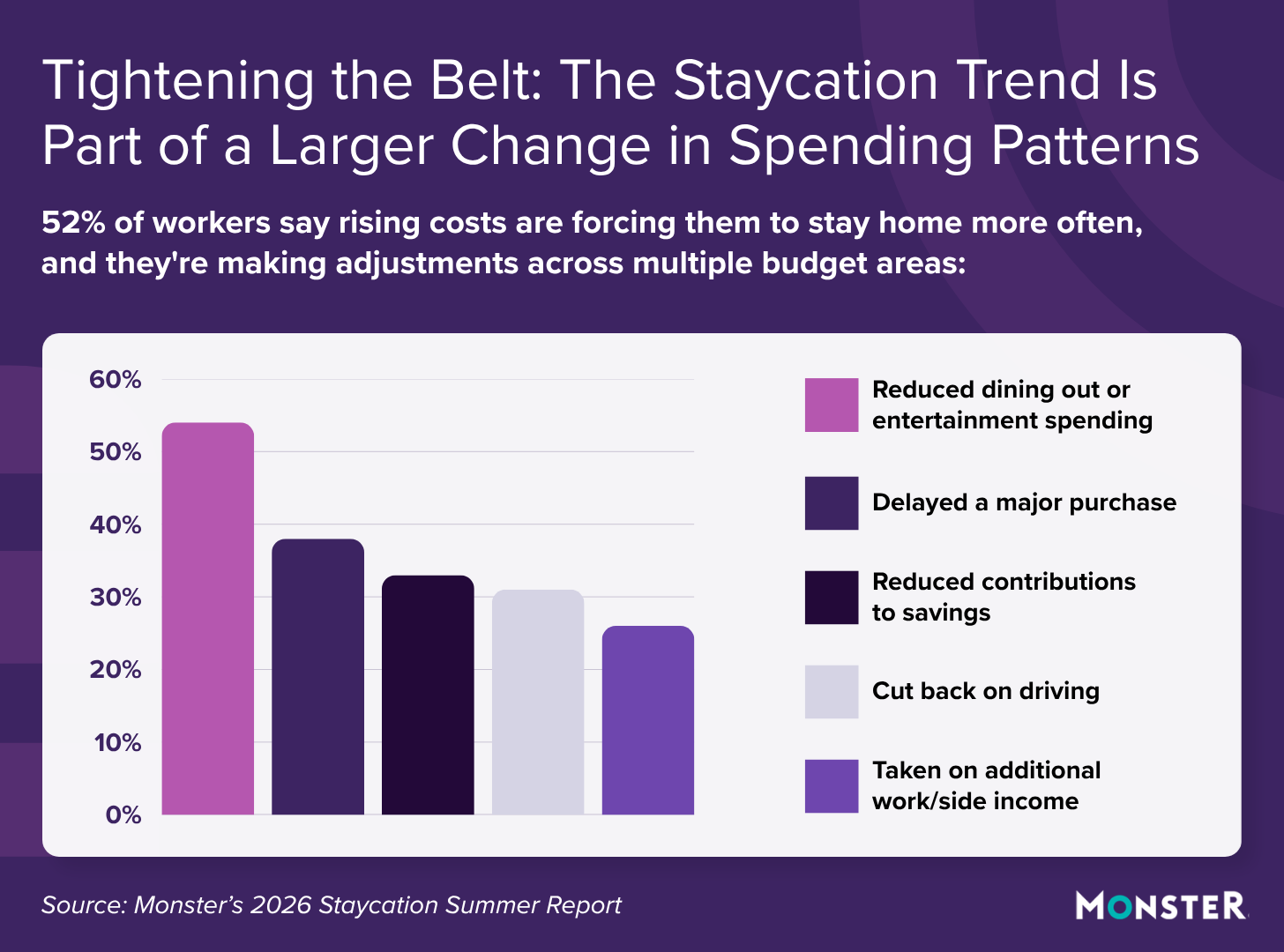
The move toward summer staycations is part of a larger pattern of reduced discretionary spending. As costs rise, workers are making adjustments across multiple areas of their budgets.
According to the survey:
- 54% have reduced dining out or entertainment spending.
- 38% have delayed a major purchase.
- 33% have reduced savings contributions.
- 31% have cut back on driving.
- 26% have taken on additional work or side income.
These changes highlight how summer travel decisions are closely tied to broader financial trade-offs. For many, cutting back on travel is just one part of a larger effort to manage rising expenses.
What’s Different About This Summer?
The staycation trend isn’t just about travel. It reflects a deeper shift in how workers are navigating financial and economic pressures. Many are balancing the desire for time off with the reality of higher costs, leading to more intentional and restrained choices.
In some cases, that means replacing trips with local activities. In others, it means working more instead of taking time off. And for a portion of workers, it means putting summer plans on hold altogether.
2026 Is the Summer of Staycations
This year is shaping up to be the summer of staycations. Rising living costs are pushing workers to scale back travel, prioritize savings, and seek more affordable ways to enjoy their time off. Rather than abandoning summer, Americans are redefining it, as many trade vacations for staycations and make the shift toward a more cost-conscious approach to leisure.
For press inquiries, please contact Shanna Briggs at shanna.briggs@bold.com.
Methodology
The findings presented in this report are based on a survey conducted by Monster using SurveyMonkey from April 20, 2026, through May 4, 2026. The survey collected responses from 1,005 U.S. respondents. Respondents answered a series of single-selection and multiple-choice questions about financial pressure, cost of living, employment decisions, commuting costs, and how rising expenses are influencing work behavior, job preferences, and lifestyle choices.
Demographic Breakdown
The sample included respondents across a range of age groups, genders, and employment statuses. Gender distribution was 47% male, 52% female, 1% nonbinary, and less than 1% who preferred not to say. Age distribution included 18–24 (12%), 25–34 (17%), 35–44 (19%), 45–54 (15%), 55–64 (17%), and 65+ (19%).
About Monster
Monster is a global leader in online job searching, resume building, and employment solutions. For over 30 years, the company has been a trusted authority for both job seekers and companies. Beyond the job search, Monster provides an intuitive Resume Builder and hundreds of resume templates to help candidates stand out against the competition, while offering employers a comprehensive resume database to source top talent. As a G2 category leader, Monster has been featured in Forbes, CNBC, CNN, and USA Today, sharing the career advice needed to bridge the gap between job seekers and hiring managers. Follow Monster on LinkedIn, Facebook, Instagram, and TikTok for the latest employment trends.

Vicki Salemi is a nationally recognized career expert who helps professionals navigate the hiring landscape and find the right fit on Monster. With over 15 years of experience in corporate recruiting and HR, she offers expert guidance on job search strategies, interview preparation, and career development to help candidates land their next role.
See More From Vicki SalemiExplore Related Career Advice



20 Companies That Pay 100% Health Insurance & Other Top Benefits

Updated:
Sep 10, 2026
|
14 min read


How Long of a Commute Is Too Long? 49% Have Turned Down a Job Due to the Commute
Updated:
Sep 8, 2026
|
11 min read


Beauty Bias at Work Statistics: 88% Say Attractive People Have an Advantage
Updated:
Aug 31, 2026
|
8 min read


How to Put Transferable Skills on Your Resume: 120 Skills, Examples, & Tips
Updated:
Aug 27, 2026
|
16 min read
Manage Your Career Like an Expert
Take control of your professional journey with Monster’s expert resources. Explore advice, research, and tips to make informed decisions and advance your career with confidence.

Job Search
Discover strategies to get noticed, network effectively, and streamline your job search process.

Resumes
Get practical tips to create a resume or CV that stands out to employers and wins interviews.

Cover Letters
Learn how to craft a compelling cover letter that highlights your experience and fit for the role.

Career Paths
Explore career paths, industry trends, and growth opportunities to plan your next move.

Interviewing
Prepare for interviews with tips on answering common questions and following up effectively.

Career Development
Develop key skills and knowledge to grow in your current role or pivot to new opportunities.

Leaving a Job
Navigate job changes and career transitions with practical advice and planning resources.