

Am I Underpaid? How to Find Out & What to Do About It

Tenure, bias, or overlooked contributions can leave you underpaid. But you don’t have to settle for less than your work is worth.
Updated:
|

14 min read

Table of Contents


What You’ll Learn
- Being underpaid means earning less than the market rate for your role, experience, skills, and location, but it isn’t necessarily illegal.
- Higher salaries for new hires, increased responsibilities without raises, and job postings advertising better pay can signal that you’re underpaid.
- Salary calculators, government wage data, job postings, and conversations with industry peers can help you assess whether your compensation is competitive.
- Most private-sector employees have the legal right to discuss wages with coworkers, and employers generally can’t retaliate against protected pay discussions.
- If you’re underpaid, you can request a raise, negotiate additional benefits, develop new skills, or pursue a higher-paying position.
You’ve worked hard, gained experience, and taken on new responsibilities, but is your paycheck keeping up? If you’ve wondered, “Am I underpaid at work?” you’re not alone.
Salaries vary by employer, location, and experience, making it hard to know if you’re earning what you’re worth. We’ll break down the warning signs of underpayment, ways to compare your salary with market rates, and practical ways to advocate for fair compensation.
Want to see how your pay compares? Use Monster’s Salary Calculator to check average salaries and pay ranges for your job title and location.
What Does It Mean to Be Underpaid?
Being underpaid means earning less than the market rate for your job, experience, skills, and location.
In other words, if your salary or hourly wage falls below what employers generally pay workers with similar qualifications and responsibilities, you’re underpaid. And while earning less than a coworker doesn’t automatically mean you’re underpaid, significant pay differences for comparable work may be worth investigating.
Underpaid vs Paid Illegally: What’s the Difference?
It’s also important to distinguish between being underpaid and being paid illegally. Earning less than the market rate isn’t necessarily illegal, but paying employees less than the applicable minimum wage, failing to pay legally required overtime, and unlawful pay discrimination can violate federal or state law.
For more information about your rights, consult your state labor department or the U.S. Equal Employment Opportunity Commission (EEOC).
What Are the Signs You’re Underpaid?
Signs you’re underpaid at work include earning less than new hires, seeing higher salaries in similar job postings, taking on more responsibilities without a raise, and receiving pay increases that don’t keep up with inflation.
Here are 10 common warning signs that you might be earning less than you’re worth:
- 1.
New hires earn more than you. Your employer offers higher salaries to new employees in the same or similar roles, potentially indicating salary compression.
- 2.
Similar job postings advertise higher salaries. Comparable positions consistently list pay ranges above your current salary.
- 3.
Your responsibilities have increased without a raise. You’ve taken on additional duties, larger projects, or leadership responsibilities without corresponding compensation.
- 4.
Your raises haven’t kept up with inflation. Your salary has increased, but your purchasing power has declined because raises haven’t kept pace with inflation.
- 5.
You haven’t had a pay review in over a year. Your employer hasn’t reassessed your compensation despite changes in market rates, responsibilities, or experience.
- 6.
Recruiters are offering higher salaries. You’re regularly contacted about comparable positions that offer significantly more than your current pay.
- 7.
Industry peers earn more for similar work. Professionals with comparable qualifications, experience, and responsibilities report earning higher salaries.
- 8.
Your company has high employee turnover. Experienced coworkers often leave for higher-paying opportunities, which may signal broader compensation issues.
- 9.
Your performance exceeds expectations, but your pay doesn’t reflect it. You consistently deliver strong results or exceed performance goals without corresponding pay increases.
- 10.
You’ve gained new skills or credentials without a pay adjustment. You’ve earned certifications or developed valuable skills that increase your market value, but your compensation hasn’t changed.
How Can You Find Out If You’re Underpaid?
To find out whether you’re underpaid, compare your current salary or hourly wage with market rates for similar roles, accounting for your experience, skills, responsibilities, and location.
Here are five ways to determine if you’re being paid fairly:

Use a salary calculator. Tools like Monster’s Salary Calculator can help you estimate the typical pay range for your job title and location. Compare the results to your current compensation to identify potential gaps.

Check similar job postings with pay ranges. Compare listings for roles with similar responsibilities, qualifications, and locations, and look for consistent salary differences rather than relying on a single posting. In states and localities with pay transparency laws, employers may be required to disclose salary ranges in job postings.

Look up government salary data. The U.S. Bureau of Labor Statistics (BLS) publishes wage estimates by occupation and geographic area. Use this data to compare your earnings against broader industry benchmarks.

Talk to recruiters and industry peers. Recruiters can offer insight into current salary expectations, while professionals in your field can share what employers are paying for similar skills and experience.

Talk to coworkers about pay. Comparing compensation with colleagues in similar roles and responsibilities can reveal pay disparities. Remember to account for differences in experience, tenure, and qualifications.
How to Talk to Coworkers About Pay
You can talk to coworkers about your salary, and most private-sector employees have the legal right to discuss wages under the National Labor Relations Act (NLRA). Employers generally can’t prohibit protected pay discussions or retaliate against employees for having them, although some workers aren’t covered by the law.
If you’re comfortable discussing compensation with a colleague, here are a few tips for approaching the conversation:
- Choose someone you trust. Start with a coworker who has similar responsibilities, experience, or qualifications.
- Keep the conversation voluntary. Share your own salary or pay range first, and make it clear that your coworker doesn’t have to disclose theirs.
- Ask about compensation, not just base pay. Bonuses, commissions, benefits, and other compensation can affect how your earnings compare.
- Focus on understanding pay differences. Use what you learn to evaluate your compensation rather than making assumptions about why someone earns more.
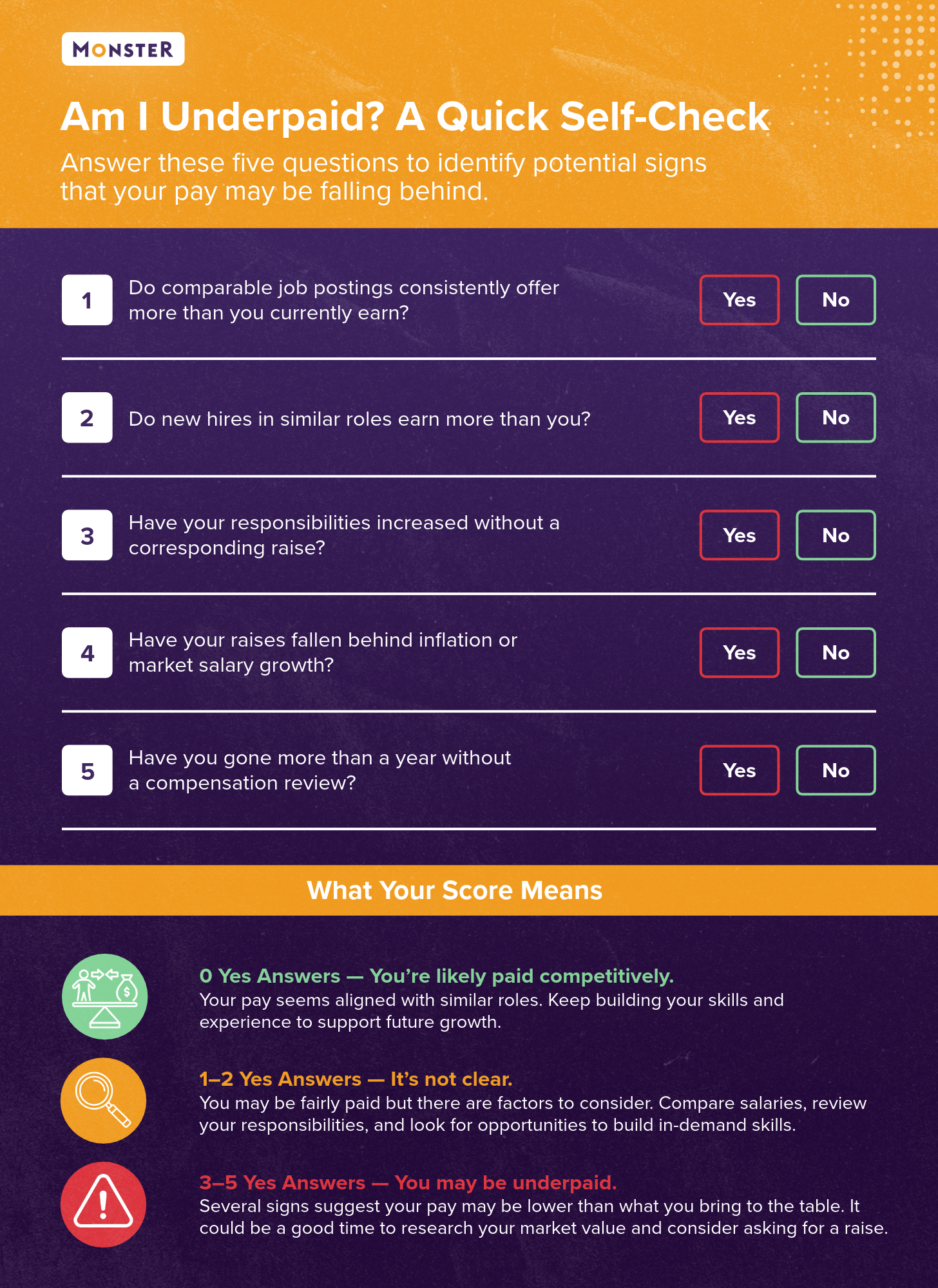
Am I Underpaid? A Quick Self-Check
Answer these five yes-or-no questions to check for signs that you may be underpaid:
- Do comparable job postings consistently offer more than you currently earn?
- Do new hires in similar roles earn more than you?
- Have your responsibilities increased without a corresponding raise?
- Have your raises fallen behind inflation or market salary growth?
- Have you gone more than a year without a compensation review?
Several “yes” answers are a reason to investigate your pay, not proof that you’re underpaid. Compare multiple salary sources before deciding on next steps.
Why Companies Underpay Employees
Companies may underpay employees because of outdated salary benchmarks, salary compression, budget constraints, or pay bias. In some cases, compensation simply isn’t adjusted as employees gain experience, take on new responsibilities, or as market rates rise.
Common reasons for underpayment include:
- Outdated salary benchmarks: Employers set pay when someone is hired but don’t adjust it as market rates change.
- Salary compression: New hires earn similar salaries to, or more than, experienced employees in comparable roles.
- Budget constraints: Limited budgets or salary freezes prevent employers from offering competitive raises.
- Missed opportunities to negotiate: Employees who don’t request pay reviews or negotiate offers may remain at lower salary levels, even as their skills and responsibilities grow.
- Pay bias or discrimination: Bias in hiring, promotions, or compensation decisions can contribute to unjustified pay disparities.
These factors can help explain why pay falls behind the market, but they don’t automatically establish that an employer has acted unlawfully. If you suspect discrimination or a wage violation, review your rights and the applicable laws.
What Should You Do If You’re Underpaid?
If you’re underpaid at work, start by documenting your contributions and researching market salaries. From there, you can negotiate a raise, explore other compensation options, or look for a higher-paying job. If your employer is violating wage laws, you may also have grounds to file a complaint.
- Step 1:
Gather Evidence & Build Your Case
Before approaching your employer, collect evidence showing why your compensation deserves a second look. Focus on objective information that supports your request, including:
- Salary data for comparable positions in your industry and location
- Recent accomplishments, performance reviews, and measurable results
- New skills, certifications, or qualifications you’ve earned
- Additional responsibilities you’ve taken on since your last pay increase, including any promotions without a raise
Use this information to identify a realistic salary target and explain how your contributions support a pay increase.
- Step 2:
Ask for a Raise
Once you’ve built your case, schedule a meeting with your manager to discuss your compensation and ask for a raise. Focus on your contributions and current market rates, rather than comparing yourself directly to coworkers.
Be specific about the increase you’re requesting, and prepare to explain why it’s justified. If your employer can’t approve a raise immediately, ask what you need to do to qualify and when you can revisit the conversation.
- Step 3:
Negotiate Beyond Salary
If a salary increase isn’t possible, consider negotiating other compensation or benefits that improve your overall employment package.
Depending on your role and employer, options might include:
- Additional paid time off
- Flexible scheduling or remote work arrangements
- Performance bonuses or additional commissions
- Professional development or certification reimbursement
- Retirement contributions or other benefits
These alternatives may not fully close a salary gap, but they can provide additional value while you work toward higher pay.
- Step 4:
Set Boundaries & Protect Your Time
Being underpaid doesn’t mean you have to keep taking on more work without additional compensation. If you’re feeling taken advantage of at work, setting professional boundaries can help you protect your time, manage stress, and prevent burnout.
To protect your time and energy, learn to say no when your workload is full, ask your manager to reprioritize tasks when you’re overloaded, and disconnect from work emails and messages outside your scheduled hours.
- Step 5:
Focus on Your Professional Development
If you’re underpaid, building new skills and qualifications can strengthen your case for a raise or help you qualify for higher-paying jobs.
Consider earning industry-recognized certifications, taking online courses, attending workshops, or seeking mentorship opportunities. Focus on in-demand skills that align with your career goals, and ask your employer about professional development or tuition reimbursement programs.
- Step 6:
Consider Looking for a Higher-Paying Job
If you’ve done your research and advocated for yourself professionally but still see no path to earning a fair market rate, finding a new job may be the most effective way to increase your earnings.
Use your salary research to target positions that offer competitive compensation, and update your resume to highlight the accomplishments, skills, and experience that demonstrate your value. When evaluating opportunities, consider the full compensation package, including benefits, bonuses, and advancement potential.
Most importantly, don’t let your current salary determine what you ask for next. Base your salary expectations and negotiations on the market value of the role and what you bring to it.
- Step 7:
Report Illegal Underpayment
Being paid below-market rates isn’t automatically illegal. But if your employer violates minimum wage or overtime laws, withholds wages you’re legally owed, or engages in unlawful pay discrimination, you may have grounds to file a complaint.
Depending on the violation, you can contact the U.S. Department of Labor’s Wage and Hour Division, the EEOC, or your state labor department.
Keep copies of relevant pay stubs, time records, employment agreements, and communications. These documents may help support your complaint.
Legal disclaimer: The information provided in this article is for general informational purposes only and does not constitute legal advice from Monster. Employment laws vary by jurisdiction and individual circumstances. Consult a qualified employment attorney for guidance specific to your situation.
Take the Next Step Toward Fair Pay
Being underpaid can be frustrating, especially when you’ve invested time, effort, and expertise into your work. But your current salary doesn’t define your value or limit your future earning potential. You deserve compensation that reflects your skills, experience, and contributions, and knowing your worth puts you in a stronger position to advocate for it, whether with your current employer or somewhere new.
Frequently Asked Questions
How far below market pay counts as underpaid?
No universal percentage determines when you’re underpaid. Earning below the typical market rate for comparable roles may indicate underpayment, especially when multiple reliable salary sources show a consistent gap. To assess your pay, compare roles with similar responsibilities, experience requirements, and locations, and consider total compensation, including bonuses and benefits.
Is it legal to discuss salary with coworkers?
Yes, most private-sector employees in the U.S. can legally discuss their salaries with coworkers under the National Labor Relations Act (NLRA). Generally, employers can’t prohibit protected wage discussions or retaliate against employees for participating. Some workers aren’t covered by the NLRA, but other federal or state protections may apply.
What’s the difference between being underpaid and wage theft?
Being underpaid means earning less than the market rate for comparable work, while wage theft occurs when an employer fails to pay wages legally owed to an employee. Examples include unpaid overtime, minimum wage violations, and withheld wages. Earning below-market rates isn’t automatically illegal, but failing to pay legally owed wages can violate the law.
Should I tell my boss I’m underpaid?
Yes, you can tell your boss you believe you’re underpaid, but it’s best to approach the conversation with evidence. Research market salaries, document your accomplishments, and request a meeting to discuss compensation. Focus on your contributions and a reasonable salary adjustment rather than making accusations or comparisons.
Is being underpaid a good reason to quit?
Yes, being underpaid can be a valid reason to quit, especially if your employer won’t address a significant pay gap or offer a realistic path toward fair compensation. Before resigning, consider your financial situation, career goals, and available opportunities. Securing a position with better pay and growth potential may be preferable to leaving without a plan.

Kirsten Chorpenning is a career advice writer who empowers job seekers to take control of their career paths using Monster’s comprehensive job search and resume tools. She specializes in helping job seekers find rewarding jobs in today’s dynamic work environment.
See More From Kirsten ChorpenningExplore Related Career Advice

Monster Livelihood Index Q3 2026: Only 39% Could Maintain Living Standards for 3 Months After Income Loss

Updated:
Oct 28, 2026
|
7 min read


Cashier Career Paths: Monster Workforce Mobility Report (Volume 2)
Updated:
Oct 19, 2026
|
9 min read

Highest Paying Medical Jobs: 35 Top Healthcare Careers by Salary
Updated:
Oct 16, 2026
|
18 min read

How to Ask for a Raise at Work: Steps, Scripts, & Email Templates
Updated:
Oct 15, 2026
|
20 min read

Job Hugging Statistics: Nearly 9 in 10 Workers Have “Hugged” a Job
Updated:
Oct 13, 2026
|
9 min read

Nearly 3 in 10 LinkedIn Users Have Updated a Past Job After Leaving It
Updated:
Oct 7, 2026
|
7 min read

Employee Loyalty Statistics: 90% Say Companies Expect More Than They Give
Updated:
Oct 5, 2026
|
7 min read

Manage Your Career Like an Expert
Take control of your professional journey with Monster’s expert resources. Explore advice, research, and tips to make informed decisions and advance your career with confidence.

Job Search
Discover strategies to get noticed, network effectively, and streamline your job search process.

Resumes
Get practical tips to create a resume or CV that stands out to employers and wins interviews.

Cover Letters
Learn how to craft a compelling cover letter that highlights your experience and fit for the role.

Career Paths
Explore career paths, industry trends, and growth opportunities to plan your next move.

Interviewing
Prepare for interviews with tips on answering common questions and following up effectively.

Career Development
Develop key skills and knowledge to grow in your current role or pivot to new opportunities.

Leaving a Job
Navigate job changes and career transitions with practical advice and planning resources.