
Career Pivots Are Rising: 64% of Job Seekers Apply Outside Their Industry

The traditional career path is fading as workers prioritize pay, stability, and flexibility. And it’s changing how employers evaluate experience.
Updated:
|

7 min read

Table of Contents


The linear career path is quickly becoming outdated. Most candidates aren’t just looking for new jobs—they’re looking for a better life, even if that means switching to a field they’ve never worked in before.
According to Monster’s Career Pivot Report, which surveyed over 1,000 U.S. workers, the majority of job seekers are now looking beyond their current expertise, motivated by factors like higher pay, stability, and flexibility.
Key Findings
- Most job seekers are no longer staying in their lane. 64% say they’ve applied to jobs outside their industry or typical role.
- A growing share are actively trying to switch careers. 20% say they’re intentionally trying to change industries or career paths.
- Money and security are driving decisions. Better pay (33%) and job stability (29%) are the top reasons for exploring new industries.
- Job seekers are willing to make real trade-offs. Nearly one-third (32%) say they’d take a pay cut to secure employment, while others report being willing to give up title, remote work, or hours.
What Is a Career Pivot? Meaning & Definition
A career pivot is a change in professional direction that uses your existing skills in a new role, industry, or type of work. A career switch like this centers on using your existing skills and experience in a new way, as opposed to starting your career from scratch.
What’s Driving Career Pivoting?
For today’s job seekers, the decision to pursue roles outside their typical career path is less about reinvention and more about practicality. Candidates are responding to changing economic conditions, uneven hiring trends, and evolving workplace priorities.
Rather than waiting for the ideal role in their field, many are exploring career switches where their skills can transfer and where better opportunities may exist.
Workers Are Moving First & Figuring It Out Later
Many candidates aren’t waiting for a perfect transition plan. Instead, they’re applying broadly and testing what opportunities are available outside their experience, as these career change statistics show:
- 20% are actively trying to pivot.
- 44% have applied to at least some roles outside their field.
- 36% are staying within their industry.
Why this matters: Candidates are becoming more confident in the value of their transferable skills. If they can bring strengths like leadership, project management, or critical thinking into a new field, they’re more willing to make the jump. For employers, that means strong candidates may come from outside their usual talent pool, including candidates from different industries.
Pay & Stability Are Outweighing Career Loyalty
For many job seekers, the decision to pivot is driven by tangible needs. Better compensation and job security outweigh other considerations like career loyalty:
- Better pay: 33%
- Need for job stability: 29%
- Work-life balance: 23%
- Remote flexibility: 20%
- Fewer opportunities in their industry: 17%
- Burnout: 16%
Why this matters: Career loyalty is becoming more conditional as workers place greater emphasis on the return they get from their careers. If they don’t see enough value in pay, stability, or schedule, they’re more willing to leave their industry altogether. For employers, that makes retention harder and the competition for talent stronger.
Trade-Offs Are Part of the Equation
Pivoting careers often comes with compromises, and many job seekers are willing to make them to get a new job.
- 23% would give up full-time hours.
- 18% would give up title or seniority.
- 15% would give up remote work.
Nearly one-third say they’d accept a pay cut to secure a role:
- 13% would accept a pay cut of up to 10%.
- 11% would accept up to a 20% cut.
- 8% would accept up to a 30% cut.
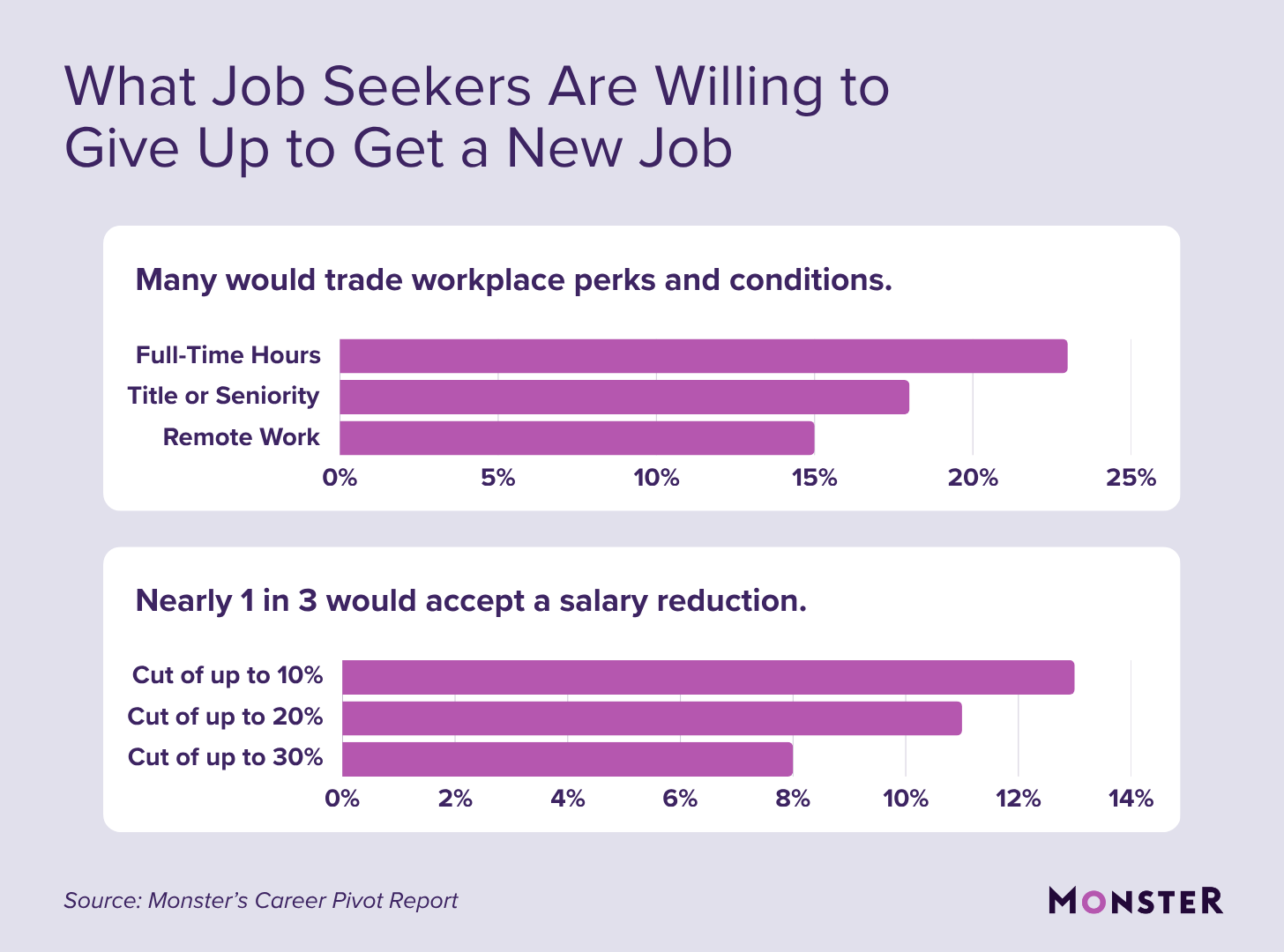
Why this matters: This challenges the idea that candidates are “quiet quitting” or expecting too much from employers. In reality, a third of the workforce is so eager for a fresh start that they’re willing to deprioritize their job title, status, and income. For hiring managers, that creates an opportunity to connect with experienced candidates who are open to learning, growing, and contributing in a new role.
The Bottom Line
With so many job seekers looking outside their industry for their next role, employers need to look beyond job titles and recognize transferable skills. Candidates, meanwhile, need to understand how to make a career pivot by updating their resumes to highlight adaptability, relevant experience, and cross-functional strengths.
A nonlinear work history isn’t a liability. In a volatile economy, it can be a survival strategy. In the coming years, the most successful professionals may not be those who stayed in one lane, but those who had the confidence to switch.
For press inquiries, please contact Shanna Briggs at shanna.briggs@bold.com.
Methodology
The findings in this report are based on a survey conducted by Monster using the Pollfish platform among 1,002 U.S. job seekers on April 17, 2026. Respondents answered a series of single-selection and multiple-choice questions about their current job search, motivations for seeking new employment, and how their search compares with earlier experiences. The sample included job seekers across a range of industries, age groups, genders, and education levels to reflect the diversity of the U.S. workforce.
About Monster
Monster is a global leader in online job searching, resume building, and employment solutions. For over 30 years, the company has been a trusted authority for both job seekers and companies. Beyond the job search, Monster provides an intuitive Resume Builder and hundreds of resume templates to help candidates stand out against the competition, while offering employers a comprehensive resume database to source top talent. As a G2 category leader, Monster has been featured in Forbes, CNBC, CNN, and USA Today, sharing the career advice needed to bridge the gap between job seekers and hiring managers. Follow Monster on LinkedIn, Facebook, Instagram, and TikTok for the latest employment trends.

Vicki Salemi is a nationally recognized career expert who helps professionals navigate the hiring landscape and find the right fit on Monster. With over 15 years of experience in corporate recruiting and HR, she offers expert guidance on job search strategies, interview preparation, and career development to help candidates land their next role.
See More From Vicki SalemiExplore Related Career Advice
Cashier Career Paths: Monster Workforce Mobility Report (Volume 2)
Updated:
Oct 19, 2026
|
9 min read

Highest Paying Medical Jobs: 35 Top Healthcare Careers by Salary

Updated:
Oct 16, 2026
|
18 min read

How to Ask for a Raise at Work: Steps, Scripts, & Email Templates
Updated:
Oct 15, 2026
|
20 min read

Job Hugging Statistics: Nearly 9 in 10 Workers Have “Hugged” a Job
Updated:
Oct 13, 2026
|
9 min read

Nearly 3 in 10 LinkedIn Users Have Updated a Past Job After Leaving It
Updated:
Oct 7, 2026
|
7 min read

Employee Loyalty Statistics: 90% Say Companies Expect More Than They Give
Updated:
Oct 5, 2026
|
7 min read


Overqualified Hiring Stats: 57% Would Cut Resume Experience to Get Hired
Updated:
Sep 28, 2026
|
9 min read

20 First Job Interview Questions & Sample Answers: Tips to Land Your First Job
Updated:
Sep 24, 2026
|
20 min read
Manage Your Career Like an Expert
Take control of your professional journey with Monster’s expert resources. Explore advice, research, and tips to make informed decisions and advance your career with confidence.

Job Search
Discover strategies to get noticed, network effectively, and streamline your job search process.

Resumes
Get practical tips to create a resume or CV that stands out to employers and wins interviews.

Cover Letters
Learn how to craft a compelling cover letter that highlights your experience and fit for the role.

Career Paths
Explore career paths, industry trends, and growth opportunities to plan your next move.

Interviewing
Prepare for interviews with tips on answering common questions and following up effectively.

Career Development
Develop key skills and knowledge to grow in your current role or pivot to new opportunities.

Leaving a Job
Navigate job changes and career transitions with practical advice and planning resources.