
20 First Job Interview Questions & Sample Answers: Tips to Land Your First Job

First job interview nerves? Know what questions to expect, arrive prepared, and stay calm to impress the interviewer.
Updated:
|

20 min read

Table of Contents


What You’ll Learn
- First job interview questions typically cover your background, strengths and weaknesses, skills, goals, availability, and how you’d handle different situations, including common questions like “Tell me about yourself” and “Why should we hire you?”
- If you don’t have work experience, you can answer interview questions with examples from school, sports, clubs, volunteering, and other responsibilities.
- Consider using the STAR method to structure answers to behavioral interview questions by explaining a situation, task, action, and result.
- To prepare for your first job interview, research the employer, practice answers out loud, choose what to wear, plan your arrival, and know what to bring.
- Teens interviewing for their first job should be ready to discuss their school schedule, availability, transportation, and any employment documents they may need.
You don’t need work experience to answer first job interview questions well. Employers can assess your communication skills, reliability, enthusiasm, and potential through school, extracurricular, volunteer, and other experiences.
Below, you’ll find 20 common first job interview questions and sample answers, plus guidance on what to expect, how to prepare, what to bring, and how to make a strong first impression.
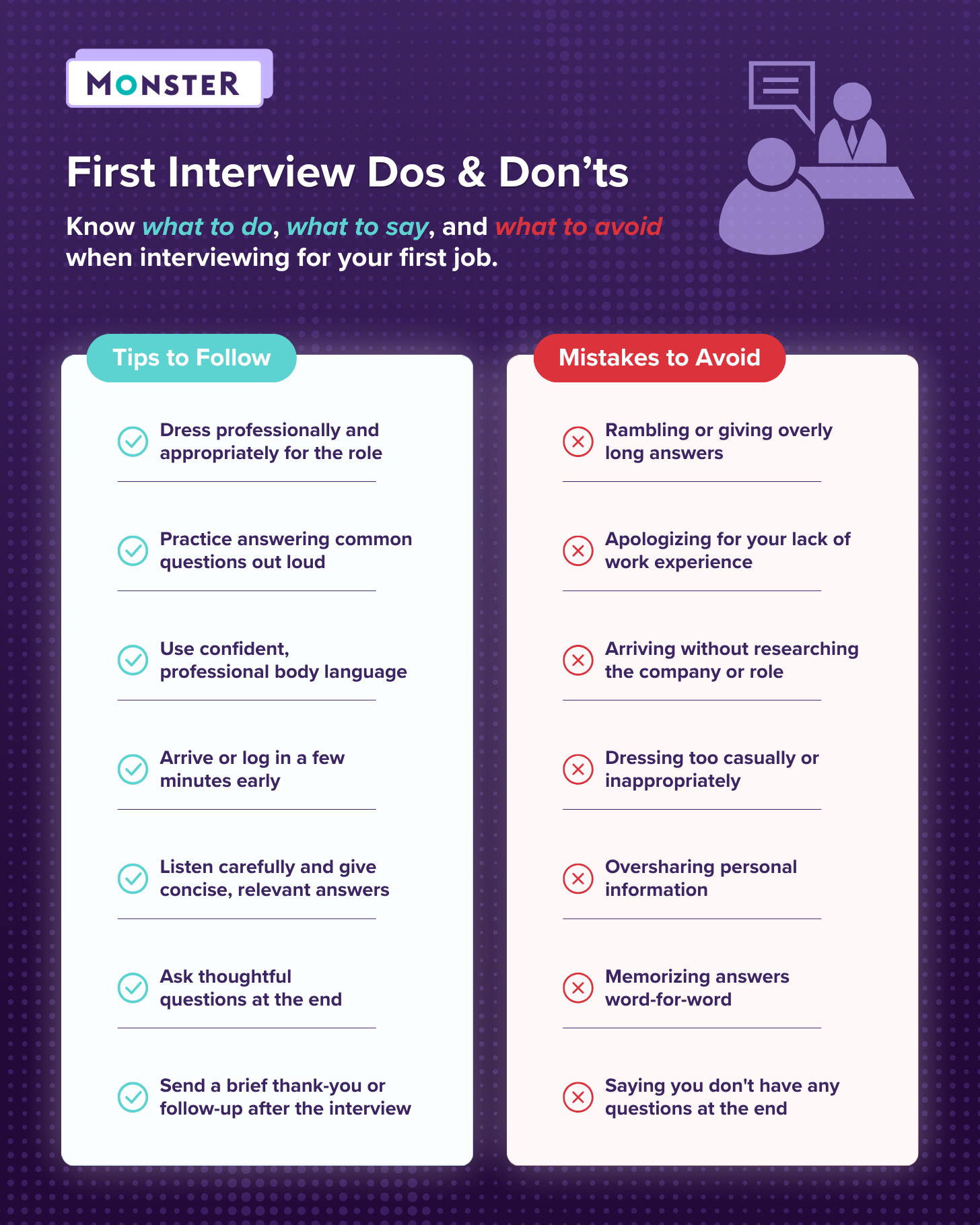
Quick Guide: First Job Interview Tips & Mistakes to Avoid
First job interview tips include researching the company, practicing common questions, dressing professionally, arriving on time, and following up afterward. Common interview mistakes, on the other hand, include rambling, oversharing, apologizing for a lack of experience, and showing up unprepared.
What to Expect in Your First Job Interview
Interviews may take place in person, over the phone, or via video. You might meet one-on-one with a hiring manager or speak with several people in a panel interview.
Most first job interviews follow a similar structure:
- 1.
Arrival and greeting: You’ll check in at the front desk or join the call, then meet your interviewer. For an in-person interview, they may greet you in the lobby with a handshake, offer you water, make some small talk, and walk you to an office or meeting room before getting started.
- 2.
Introductions and resume review: The interviewer may start with “Tell me about yourself” or briefly review your resume. They may already have a copy, but for an in-person interview, bring a few copies just in case.
- 3.
Interview questions: Most of the interview will cover your interest in the job, strengths, goals, availability, and how you’d handle different situations. The interviewer may take notes or ask follow-up questions as you answer.
- 4.
Your questions: Near the end, the interviewer will usually ask whether you have any questions. This is typically your opportunity to ask about the role, training, workplace, expectations, or hiring process.
- 5.
Closing and next steps: The interviewer may explain what happens next and when you can expect to hear back. The conversation will typically wrap up with a thank-you and goodbye before you leave or end the call.
- 6.
Your follow-up: After the interview, it’s customary to send a brief thank-you email within 24 hours. If you don’t hear back within the time frame the interviewer provided, you may follow up about the hiring decision next.
20 First Job Interview Questions & Sample Answers for First-Time Job Seekers
Below are 20 common first job interview questions, organized by topic, with insight into why employers ask them, what they want to learn, and sample answers to help you prepare.
5 Common First Job Interview Questions
Common first job interview questions ask about your background, interest in the role, strengths and weaknesses, goals, and what you can bring to the job.
- 1.
Tell me about yourself.
- Why they ask: To get to know you beyond what’s on your resume
- What they want to learn: Your background, relevant strengths or interests, and why you’re interested in the opportunity
Sample answer:
I’m a high school senior, and I’m involved in student council and our school’s volunteer club. Those experiences have helped me become organized, dependable, and comfortable working with different people. I’m looking for my first job where I can contribute to a team, learn new skills, and gain professional experience.
- 2.
Why do you want to work here?
- Why they ask: To understand why you’re interested in this particular job and employer
- What they want to learn: Your knowledge of the company, interest in the role, and reasons for applying
Sample answer:
I’ve had good experiences here as a customer, and I like that the company emphasizes customer service. This position stood out to me because I enjoy working with people, and I’d like to build those skills while learning how the business works.
- 3.
What are your greatest strengths and weaknesses?
- Why they ask: To see how well you understand your strengths and areas for improvement
- What they want to learn: Your self-awareness, relevant strengths, and willingness to grow
Sample answer:
One of my biggest strengths is that I’m dependable. If I commit to something, I follow through. One weakness I’m working on is speaking up in larger groups. I’ve been participating more in class discussions and presentations, and that’s helped me become more confident.
- 4.
Where do you see yourself in five years?
- Why they ask: To understand your goals and how this job might fit into them
- What they want to learn: Your motivation, willingness to learn, and general direction for the future
Sample answer:
In five years, I hope to have more experience, stronger professional skills, and a better idea of the career I want to pursue. I’m still figuring out my long-term plans, so right now I’m focused on learning, taking on new responsibilities, and building a strong foundation.
- 5.
Why should we hire you?
- Why they ask: To understand what you could bring to the role despite having limited work experience
- What they want to learn: Your relevant strengths, enthusiasm, reliability, and potential to succeed in the position
Sample answer:
Even though this would be my first job, I’m dependable, willing to learn, and comfortable working with others. I take my responsibilities seriously, show up prepared, and ask questions when I’m unsure. I’d bring that same attitude to this job and work hard to become someone the team can rely on.
Behavioral & Situational First Job Interview Questions
Behavioral and situational first job interview questions ask how you’ve handled past experiences or how you would respond to situations on the job.
- 1.
Tell me about a time you worked as part of a team.
- Why they ask: To understand how you collaborate with others and contribute toward a shared goal
- What they want to learn: Your ability to communicate, cooperate, take responsibility, and contribute as a team member
Sample answer:
For a group project at school, my team had to research a topic and give a presentation. We divided the work based on everyone’s strengths, and I volunteered to organize our shared notes and keep track of what still needed to be finished. When one person needed help completing their section, I worked with them so we could stay on schedule. We finished on time and received a good grade.
- 2.
Tell me about a time you had to solve a problem.
- Why they ask: To see how you approach challenges and work toward a solution
- What they want to learn: Your ability to think through problems, take initiative, and make reasonable decisions
Sample answer:
While helping with a school fundraiser, we realized we were running low on supplies much earlier than expected. I checked what we had left, told the faculty advisor, and helped adjust how we were using the remaining supplies until someone could get more. We kept the fundraiser running without having to stop.
- 3.
Tell me about a time you made a mistake. How did you handle it?
- Why they ask: To see how you respond when something goes wrong and whether you take responsibility
- What they want to learn: Your accountability, problem-solving skills, and ability to learn from mistakes
Sample answer:
I once wrote down the wrong due date for a school assignment and realized my mistake the night before it was due. I reorganized my evening, finished the assignment on time, and took responsibility for not double-checking the deadline. Since then, I’ve started adding assignments to my calendar as soon as I get them and checking upcoming deadlines each week.
- 4.
How do you handle feedback or criticism?
- Why they ask: To understand how you respond to direction and constructive feedback
- What they want to learn: Your ability to listen, stay professional, and use feedback to improve
Sample answer:
I try to listen carefully, ask questions if I don’t understand the feedback, and use it to improve. For example, a teacher told me that my presentations had good information but too much text on the slides. For my next presentation, I simplified the slides and practiced explaining the information instead. It made the presentation much stronger.
- 5.
How would you handle a difficult customer or coworker?
- Why they ask: To see how you might handle conflict or stressful interactions at work
- What they want to learn: Your ability to stay calm, communicate respectfully, solve problems, and ask for help when needed
Sample answer:
I’d stay calm, listen to what they’re saying, and try to understand the problem before responding. If there was something I could reasonably do to help, I’d focus on finding a solution. If I wasn’t sure what to do or the situation needed someone with more authority, I’d ask a manager or supervisor for help.
- 6.
What would you do if you didn’t know how to complete a task?
- Why they ask: To understand how you approach unfamiliar tasks
- What they want to learn: Your willingness to take initiative, ask questions, and learn how to do the task correctly
Sample answer:
I’d first make sure I understood the instructions and check whether there were directions or resources I could use. If I still wasn’t sure, I’d ask my supervisor or a coworker to clarify what I should do. I’d rather ask a question and learn the right way than guess and risk making a mistake.
Questions About Your Skills & Strengths
Skills and strengths questions ask what abilities and qualities you would bring to the job.
- 1.
What skills would you bring to this job?
- Why they ask: To understand what abilities you could contribute to the role
- What they want to learn: Your relevant skills, strengths, and understanding of what the job requires
Sample answer:
I’m organized, dependable, and good at communicating with different people. School and volunteering have also taught me how to manage deadlines, work as part of a team, and follow through on responsibilities. I think those skills would help me learn the job quickly and be a reliable team member.
- 2.
How do you stay organized and manage your time?
- Why they ask: To understand how you keep track of tasks and responsibilities
- What they want to learn: Your organization, time management, reliability, and ability to meet deadlines
Sample answer:
I keep track of deadlines, activities, and appointments in a calendar so I know what’s coming up. For bigger projects, I break the work into smaller tasks and give myself deadlines for each step. That helps me prioritize what needs to be done and avoid leaving everything until the last minute.
- 3.
What accomplishment are you proud of?
- Why they ask: To learn what you value and what you consider a meaningful achievement
- What they want to learn: Your motivation, strengths, effort, and ability to follow through on a goal
Sample answer:
I’m proud of improving my grade in a class I struggled with at the beginning of the year. I started asking more questions, meeting with my teacher when I needed help, and setting aside extra time to study each week. By the end of the year, I had raised my grade significantly. I was proud of the result, but I was even more proud that I didn’t give up when the class was difficult.
- 4.
What skills would you like to improve?
- Why they ask: To understand where you see opportunities to grow
- What they want to learn: Your self-awareness, willingness to learn, and interest in developing new skills
Sample answer:
I’d like to become more confident communicating with people I don’t know. School presentations and volunteering have helped, but I know a job would give me more opportunities to practice talking with customers, coworkers, and managers. It’s a skill I’d like to keep developing because I know it will be useful in almost any career.
Questions About Your Goals, Education, Availability, & Next Steps
Employers may ask about your goals, education, availability, and next steps to better understand your plans, background, and schedule.
- 1.
What are you looking for in your first job?
- Why they ask: To understand what you hope to gain from your first work experience
- What they want to learn: Your expectations, motivation, and interest in the opportunity
Sample answer:
I’m looking for a job where I can gain experience, learn how to work in a professional environment, and take on more responsibility. I’d also like to work somewhere I can contribute to a team, build new skills, and become more independent.
- 2.
What are your goals for the future?
- Why they ask: To learn more about your interests and longer-term plans
- What they want to learn: Your motivation, direction, and interest in developing your skills
Sample answer:
Right now, my goal is to gain experience and develop skills that will be useful wherever my career takes me. I’m still exploring what I want to do long-term, so I’m interested in trying new things, learning what I’m good at, and taking on more responsibility as I gain experience.
- 3.
What is your availability?
- Why they ask: To determine whether your schedule meets the employer’s staffing needs
- What they want to learn: When you can reliably work and whether you have any scheduling limitations
Sample answer:
I’m available after 4 p.m. on weekdays and anytime on Saturdays and Sundays. I do have school during the week, so I can’t work before then, but those hours are consistent, and I’d let my manager know as early as possible if something unusual affected my availability.
- 4.
How would you balance work with school or other responsibilities?
- Why they ask: To understand how you plan to manage work alongside your other commitments
- What they want to learn: Your time management, reliability, and ability to maintain a realistic schedule
Sample answer:
I already use a calendar to keep track of school deadlines, activities, and other commitments, so I’d add my work schedule to it as well. I’d only commit to hours I know I can reliably work and plan ahead during busy school weeks. If I saw a scheduling conflict coming up, I’d communicate it as early as possible.
- 5.
Do you have any questions for me?
- Why they ask: To give you a chance to learn more about the job and employer
- What they want to learn: Your interest in the opportunity, preparation, and engagement in the conversation
Sample answer:
Yes. What does a typical shift look like for someone in this position? I’d also like to know what training new employees receive and what you’d want someone in this role to accomplish during their first few months.
How to Answer First Job Interview Questions With No Work Experience
If you have no work experience, answer first job interview questions with examples from school, sports, clubs, volunteering, or other responsibilities. Focus on experiences that show relevant skills, such as teamwork, reliability, communication, and problem-solving.
For questions about specific experiences, use the STAR method to structure your answer:
- Situation
- Task
- Action
- Result
For example, if asked about a time you solved a problem, you could explain that your group was behind on a school project (situation), needed to meet a deadline (task), created a schedule and divided the remaining work (action), and submitted the project on time (result).
How to Prepare for Your First Job Interview: 7 Steps
To prepare for your first job interview, research the employer and role, practice common questions, prepare examples of your skills, choose what to wear, and plan your arrival. You’ll also want to know what to bring to your first job interview and have a few questions ready for the interviewer.
Take these steps ahead of time to feel prepared and confident:
- Step 1:
Research the company and read the job listing. Review the employer’s website and reread the job posting. Know what the company does, what the role involves, and which skills and qualities the employer is looking for.
- Step 2:
Practice common first job interview questions. Practice answering questions out loud so you’re comfortable talking about your skills, interests, and experience. Focus on your main points rather than memorizing answers word for word.
- Step 3:
Prepare examples from school and other experience. Have a few examples from school, sports, clubs, volunteering, or other responsibilities that show teamwork, problem-solving, reliability, communication, and other relevant skills.
- Step 4:
Choose what you’ll wear. Pick clean, neat clothing that fits the workplace and role. Lay out your interview outfit ahead of time so you aren’t deciding what to wear at the last minute.
- Step 5:
Plan when and how you’ll get there. Check the location, route, transportation, and travel time in advance. For a virtual interview, test your technology and choose a quiet, distraction-free location.
- Step 6:
Gather what you need to bring. Pack copies of your resume, a list of references, a notepad and pen, and the interviewer’s contact information. If the employer requests identification, work authorization documents, or other paperwork, have those ready.
- Step 7:
Prepare questions to ask the interviewer. Have a few questions ready about the role, training, team, expectations, or next steps. You’ll usually have an opportunity to ask them near the end of the interview.
First Job Interview Tips for Teens
First job interview questions for teens may cover your school schedule, availability, transportation, and experience from sports, clubs, volunteering, or other activities. Depending on your age and location, you may also need employment documents.
- Use school, sports, clubs, and activities as experience. Class projects, extracurriculars, volunteering, and other responsibilities can demonstrate teamwork, communication, leadership, reliability, and problem-solving. Focus on examples that relate to the job.
- Be ready to explain your availability. Know when you can work around school, activities, and other commitments. Be clear about your weekday, weekend, and seasonal availability rather than promising hours you can’t consistently work.
- Know your transportation plan. Employers may want to know that you can reliably get to your scheduled shifts. Whether you drive, take public transportation, or get rides from a parent or someone else, know your plan before the interview.
- Check whether you need working papers or other documents. Employment requirements for minors vary by state and age. Check your state’s requirements before starting a job so you know whether you’ll need a work permit, proof of age, or other documentation.
5 Questions to Ask at the End of Your First Job Interview
Good questions to ask at the end of your first job interview focus on the role, training, expectations, workplace, and hiring process. Having a few prepared can also show the interviewer that you’re interested and engaged.
- What does a typical day or shift look like in this role?
- What kind of training would I receive when I start?
- What qualities help someone succeed in this position?
- What do you enjoy most about working here?
- What are the next steps in the hiring process?
Get Ready for Your First Job Interview
Your first job interview is a chance to show employers what you can bring to the role, even if you haven’t worked before. Prepare a few strong examples, know what you want to ask, and focus on showing that you’re reliable, interested, and ready to learn. Each interview also gives you experience that can make the next one feel easier.
Frequently Asked Questions
What should you bring to your first job interview?
Bring at least two copies of your resume, a list of references, a notepad and pen, and the interviewer’s name and contact information. Depending on the job, you may also need identification, work authorization documents, or other paperwork the employer requests.
What should you wear to a first job interview?
Wear clean, neat clothing that fits the workplace and position. You don’t necessarily need a suit for every first job interview, but your outfit should look polished and professional for the environment. When in doubt, dressing slightly more professionally is generally better than dressing too casually.
How long does a first job interview usually last?
A first job interview may last anywhere from about 15 minutes to an hour, depending on the employer, position, and interview format. Interviews for entry-level, retail, food service, or seasonal jobs may be relatively brief, while more structured interviews can take longer.

Kirsten Chorpenning is a career advice writer who empowers job seekers to take control of their career paths using Monster’s comprehensive job search and resume tools. She specializes in helping job seekers find rewarding jobs in today’s dynamic work environment.
See More From Kirsten ChorpenningExplore Related Career Advice

Overqualified Hiring Stats: 57% Would Cut Resume Experience to Get Hired
Updated:
Sep 28, 2026
|
9 min read

“Do You Have Any Questions for Me?” How to Answer in an Interview (30 Examples)
Updated:
Sep 18, 2026
|
14 min read



20 Companies That Pay 100% Health Insurance & Other Top Benefits
Updated:
Sep 10, 2026
|
14 min read


How Long of a Commute Is Too Long? 49% Have Turned Down a Job Due to the Commute
Updated:
Sep 8, 2026
|
11 min read


Beauty Bias at Work Statistics: 88% Say Attractive People Have an Advantage
Updated:
Aug 31, 2026
|
8 min read
Manage Your Career Like an Expert
Take control of your professional journey with Monster’s expert resources. Explore advice, research, and tips to make informed decisions and advance your career with confidence.

Job Search
Discover strategies to get noticed, network effectively, and streamline your job search process.

Resumes
Get practical tips to create a resume or CV that stands out to employers and wins interviews.

Cover Letters
Learn how to craft a compelling cover letter that highlights your experience and fit for the role.

Career Paths
Explore career paths, industry trends, and growth opportunities to plan your next move.

Interviewing
Prepare for interviews with tips on answering common questions and following up effectively.

Career Development
Develop key skills and knowledge to grow in your current role or pivot to new opportunities.

Leaving a Job
Navigate job changes and career transitions with practical advice and planning resources.