

Soft Skills vs Hard Skills: What’s the Difference? (75 Examples)

Unsure how to explain your skills to employers? Learn the difference between hard skills vs soft skills and how to highlight them effectively.
Updated:
|

16 min read

Table of Contents


Some job seekers stand out while others struggle because they don’t clearly understand or communicate their skills when applying for jobs. Knowing the difference between soft skills vs hard skills is essential for writing resumes, preparing for interviews, and planning long-term career growth.
In this guide, you’ll learn what hard skills and soft skills are, how they differ, why employers value both, and practical ways to highlight them on your resume and in interviews. You’ll also find examples and tips for developing each skill type.
What Are Soft vs Hard Skills? Definitions & Key Distinctions
Hard skills and soft skills play different but equally important roles in your career. Understanding the distinction helps you present yourself more effectively to employers.
Hard Skills Defined
Hard skills are technical abilities that can be taught, practiced, and measured. They demonstrate to employers that you have the technical foundation to perform specific tasks.
Soft Skills Defined
Soft skills are personal and interpersonal qualities that shape how you communicate, collaborate, and solve problems. They show employers how you approach work, interact with others, and adapt to challenges.
Key Differences Between Hard & Soft Skills
While hard skills and soft skills often work together, they’re evaluated and developed differently. Understanding the distinction helps you identify your strengths, spot gaps, and tailor your resume and interview responses.
This comparison table breaks down how hard skills and soft skills differ in how they’re learned, measured, and applied in the workplace:
| Overview | Hard Skills | Soft Skills |
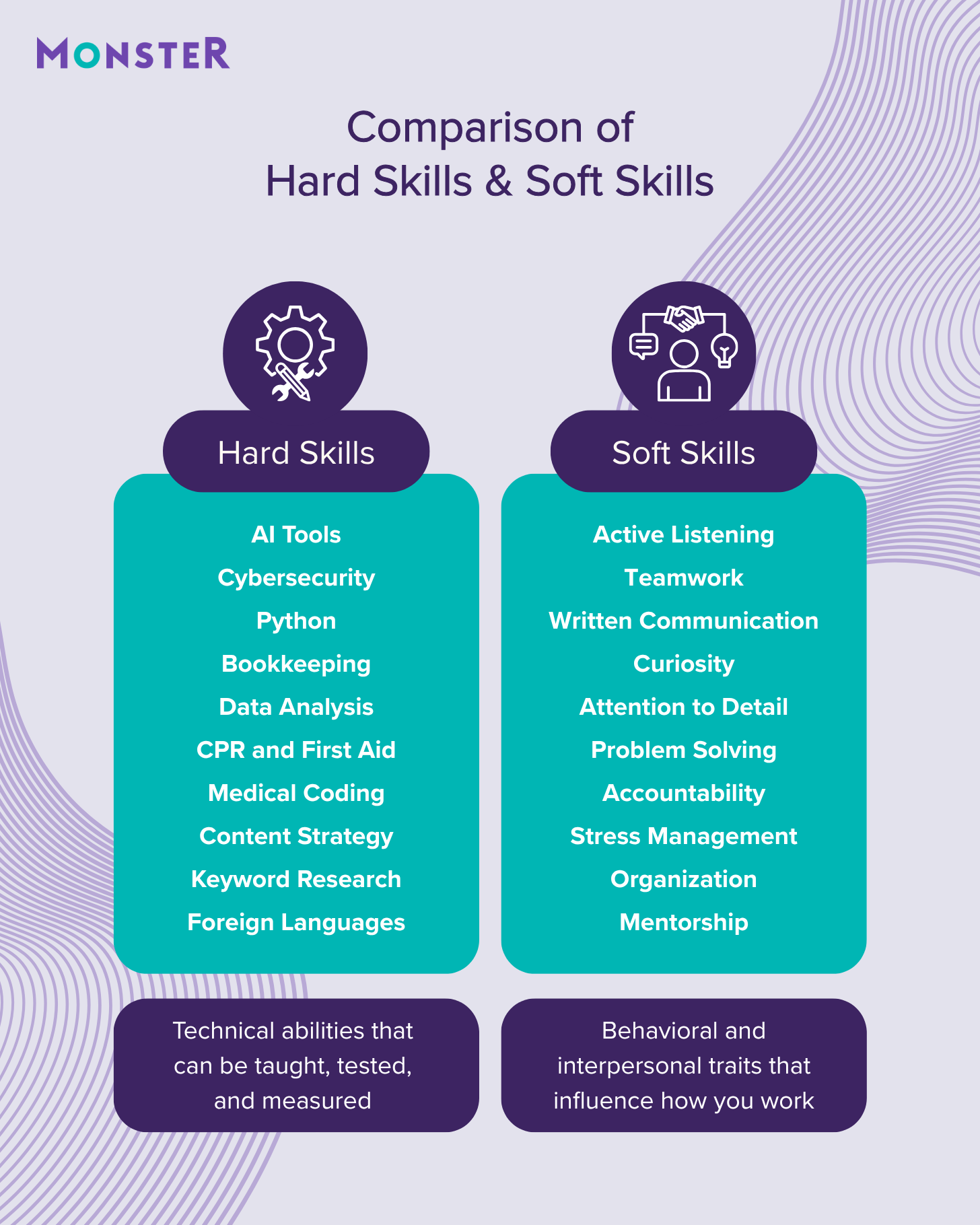
| Definition | Technical abilities that can be taught, tested, and measured | Behavioral and interpersonal traits that influence how you work |
| How they’re applied | To complete specific job tasks, operate tools, or perform technical functions | To communicate, collaborate, lead, adapt, and solve problems |
| How they’re developed | Structured education and skill-based training, such as formal coursework, certification programs, technical workshops, hands-on projects, and job-specific instruction | Real-world experience, feedback, reflection, observation, mentorship, and repeated practice in professional settings |
| How they’re evaluated | Exams, certifications, portfolios, technical tests, and measurable output | Behavior, communication style, teamwork, decision-making, and interpersonal effectiveness |
| Examples | Coding in Python, financial modeling, medical coding, search engine optimization (SEO), data analysis | Communication, adaptability, teamwork, problem-solving, leadership |
And here’s a side-by-side illustration comparing hard and soft skills:
Why Employers Value Both Hard & Soft Skills
Together, hard and soft skills demonstrate what you can do and how you do it. Employers want both because hard skills show capability, while soft skills show potential.
According to LinkedIn’s 2024 Global Talent Trends report, 69% of U.S. executives intend to prioritize hiring candidates with soft and transferable skills that can be applied to different roles. Plus, major companies like Amazon are investing heavily in skills training programs to help employers learn new technical skills and develop soft skills.
The takeaway? Hard skills get you in the door; soft skills help you grow and advance.
75 Hard Skills vs Soft Skills Examples
Most roles require a mix of hard and soft skills to be successful. Use these lists to help you build a focused skills section and tailor your resume to each job description.
45 Hard Skills Examples
Below are 45 hard skills examples, organized by industry.
Technology Hard Skills
These are technical skills for working with systems, tools, and programming languages:
- AI tools
- C++
- Cloud computing
- Cybersecurity
- Data visualization (e.g., Tableau, Power BI)
- JavaScript
- Network administration
- Python
- Quality assurance (QA) testing
- Software development
- Structured Query Language (SQL)
- User experience (UX) or user interface (UI) design
Business & Finance Hard Skills
These are analytical and technical skills for managing data, budgets, and financial performance:
- Accounting principles
- Advanced Excel
- Bookkeeping
- Budget forecasting
- Customer relationship management (CRM) tools
- Data analysis
- Enterprise resource planning (ERP) systems
- Financial modeling
- Market research
- Risk assessment
- Sales reporting and point-of-sale (POS) systems
Healthcare Hard Skills
These are specialized technical skills that support patient care, safety, and compliance:
- CPR and first aid
- Diagnostic equipment basics
- Electronic health records (e.g., Epic, Cerner)
- HIPAA compliance practices
- Medical coding (e.g., ICD-10, CPT)
- Medication administration
- Phlebotomy
Marketing Hard Skills
These are creative and analytical skills for planning, executing, and measuring campaigns:
- Content strategy
- Copywriting, editing, and proofreading
- Email marketing software
- Google Analytics
- Graphic design tools (e.g., Adobe, Canva)
- Keyword research
- Paid ad management
- Search engine marketing (SEM)
- Social media analytics
Transferable Hard Skills
These are technical skills that apply across industries and roles:
- Foreign languages
- Project management tools (Asana, Trello)
- Research methodology
- Statistical analysis
- Supply chain management
- Technical writing
30 Soft Skills Examples
Below are 30 soft skills examples, organized by category.
Communication & Collaboration Skills
These skills affect how well you share ideas, work with others, and contribute to team goals:
- Active listening
- Facilitating discussions
- Giving constructive feedback
- Presentation skills
- Teamwork
- Verbal communication
- Written communication
Cognitive Soft Skills
These skills relate to how you think, analyze information, and make decisions at work:
- Attention to detail
- Creativity
- Critical thinking
- Curiosity
- Decision-making
- Perseverance
- Problem-solving
- Strategic thinking
Personal Effectiveness Skills
These skills reflect how well you manage your time, responsibilities, and energy on the job:
- Accountability
- Adaptability
- Organization
- Self-awareness
- Self-confidence
- Stress management
- Time management
- Work ethic
Leadership & Relationship Skills
These skills influence how you motivate others, handle conflict, and build trust to strengthen professional relationships:
- Conflict resolution
- Delegation
- Empathy
- Mentorship
- Motivating others
- Negotiation
- Relationship-building
Real-World Examples of Hard & Soft Skills Across Industries
Hard skills and soft skills rarely operate in isolation. In most industries, success depends on how well technical skills are applied using interpersonal and behavioral strengths.
For instance, data analysts need strong technical skills and the ability to communicate insights clearly. Nurses need clinical skills and empathy when delivering patient care. Project managers need to use planning tools and leverage leadership strengths to guide projects to completion.
These hard skills vs soft skills examples show how both skills work together in various fields:
- Customer service: Product knowledge and ticketing systems resolve issues; communication and emotional intelligence build trust and satisfaction.
- Education: Subject matter expertise and curriculum planning support instruction; communication, patience, and adaptability engage learners.
- Finance: Financial modeling and accounting knowledge support accurate analysis; communication and attention to detail help explain insights and maintain compliance.
- Healthcare: Clinical or administrative expertise ensures proper care and documentation; empathy, teamwork, and adaptability improve patient experiences and outcomes.
- Human resources: Knowledge of compliance and HR systems ensures accuracy; empathy, discretion, and conflict resolution support employees.
- Marketing: Data analysis and platform expertise guide strategy; creativity, storytelling, and collaboration bring campaigns to life.
- Operations: Process optimization and data tracking improve efficiency; problem-solving and teamwork help teams respond to challenges.
- Project management: Scheduling tools and budgeting skills keep projects on track; leadership, organization, and communication align stakeholders.
- Sales: Product knowledge and customer relationship management (CRM) tools streamline sales; negotiation and relationship-building drive conversions.
- Technology: Programming and systems knowledge enable development; problem-solving and collaboration help teams build and maintain effective solutions.
These examples show why employers hire people with a combination of capabilities, not just technical strengths alone.
How to Showcase Hard & Soft Skills on Resumes & in Interviews
You can strengthen your resume by learning how to present each skill type in the right place. These same skills also come up in interviews, where employers expect you to explain how you’ve applied them in real situations, not just list them on paper.
Choose & Balance Skills Based on Relevance & Career Stage
Start by reviewing the job description carefully. Employers often signal top priorities through repeated keywords, which guide the hard and soft skills you should highlight on your resume and be prepared to discuss in interviews.
Once you identify the most relevant skills, decide which to emphasize now and which to develop over time. Your focus will naturally shift depending on your career stage:
Entry-level roles focus on foundational hard skills and key soft skills, like communication, adaptability, and coachability. On your resume, highlight technical competencies with examples of teamwork or problem-solving. In interviews, be ready to discuss how you learn new skills, apply feedback, and contribute to team efforts.
Example:
Used Excel and basic SQL queries to analyze internship data while collaborating with team members to present findings to department leadership.
Mid-career roles emphasize a balance of technical depth and interpersonal impact. On your resume, use accomplishment-based examples that show results. In interviews, highlight problem-solving, decision-making, and adaptability.
Example:
Led a cross-functional system upgrade by applying database optimization expertise while coordinating timelines and stakeholder expectations.
Senior-level roles prioritize soft skills, such as leadership, communication, and strategic thinking, to reinforce the credibility of your hard skills. On your resume, highlight initiatives where you set direction, mentored others, or led organizational change. In interviews, focus on impact, leadership style, and how your decisions influenced teams and long-term outcomes.
Example:
Directed enterprise-wide technology strategy by aligning technical teams with executive priorities, improving scalability, and reducing operational risk.
Tailor your resume and interview answers to the specific role, mentioning a mix of both hard and soft skills required in the job description.
Showcase Your Skills in Key Resume Sections
Your resume should clearly connect your skills to real outcomes. Instead of relying on a single skills list, reinforce your qualifications across multiple sections so both applicant tracking systems (ATS) and hiring managers can quickly see how you provide value.
In your resume summary or objective, highlight a few core skills that define your value for the role. Focus on your hard skills and the soft skills that support them, such as analysis, communication, or leadership.
Example:
Data analyst with experience in SQL, Python, and data visualization tools, supporting business decisions through actionable insights.
In your work history section, show how you applied your expertise to produce results. Emphasize specific actions, tools, and outcomes rather than listing responsibilities.
Example:
Built financial models in Excel to forecast quarterly revenue, improving budget accuracy by 15%.
In your skills section, list role-relevant tools, technologies, and competencies using language from the job description, when accurate.
Example:
Python, SQL, Tableau, Excel, Google Analytics
In your education section, list degrees, programs, or relevant coursework, particularly if you’re early in your career or transitioning into a new field.
Example:
Relevant coursework: Data Structures, Financial Accounting, Digital Marketing Analytics
In your certification section (if applicable), include licenses, certifications, or formal training that validate your skills. This section is especially important in fields such as finance, healthcare, and technology.
Example:
Certified ScrumMaster (CSM), Google Data Analytics Certificate
Across all sections, avoid vague statements, such as “I have strong communication skills.” Instead, describe what you did and why it mattered. Prioritize the skills most relevant to the job you’re applying for, reinforce key skills in different sections, and tailor them by mirroring keywords from the job description to improve ATS compatibility.
Demonstrate Your Skills in Interviews Using the STAR Method
Interviews give employers a chance to see how you think, communicate, and apply your skills in real situations. Rather than simply listing abilities, focus on telling concise but impactful stories that show how your actions led to results.
The most effective way to do this is by using the STAR method to clearly connect both hard and soft skills in one structured answer. STAR stands for situation, task, action, and result.
When answering interview questions, walk the interviewer through:
- The situation or challenge you faced
- The task or responsibility you were accountable for
- The action you took, including the tools, techniques, or interpersonal skills you used
- The result or outcome, such as an improvement, resolution, or lesson learned
Example:
During a system outage that affected our customer dashboard (situation), I was responsible for coordinating the response (task). I worked with our IT team to troubleshoot the issue, communicated timelines to customers, and kept leadership informed (action). The system was restored in under two hours with no escalations and positive client feedback (result).
This approach allows you to demonstrate technical knowledge, communication, teamwork, and leadership in a single, clear answer. Showing how the same skill appears across different roles, such as communication through presentations, documentation, or stakeholder coordination, further strengthens your credibility.
How to Develop Hard & Soft Skills
Developing both hard and soft skills is essential for long-term career growth. Understanding how to develop each helps you stay competitive and adaptable as roles evolve.
How to Develop Hard Skills
Hard skills can be gained through formal or structured learning and hands-on practice.
You can strengthen your technical abilities through:
- Education programs or college courses related to your field
- Certifications or licenses that validate specialized knowledge
- Online courses and tutorials focused on specific tools or technologies
- On-the-job training, apprenticeships, and role-specific instruction
- Hands-on application through projects, internships, or volunteering
- Industry workshops, bootcamps, or professional training sessions
If you’re unsure where to begin, review job descriptions for roles you’re targeting and look for recurring technical requirements. These patterns show which hard skills employers consistently expect and which are worth prioritizing.
How to Develop Soft Skills
Soft skills develop through experience, reflection, and intentional practice. Improving them can significantly influence career progression and leadership readiness.
To build stronger soft skills:
- Enroll in free or low-cost courses on platforms like Coursera and LinkedIn Learning.
- Participate in company-provided training or professional development programs.
- Ask for regular feedback from managers, peers, or mentors.
- Volunteer to lead meetings, projects, or cross-team initiatives.
- Practice clear communication in writing and presentations.
- Observe effective leaders and model their approaches.
- Engage in team-based activities that require collaboration.
The more consistently you practice these behaviors, the more naturally soft skills show up in your daily work, interviews, and leadership opportunities.
Key Takeaways
- Hard skills and soft skills serve different purposes, but both matter.
- Employers expect to see both skill types on resumes and in interviews.
- Job description keywords should guide how you choose and prioritize skills.
- The balance between soft skills shifts as your career progresses.
- Hard skills should be clearly listed and supported with evidence.
- Soft skills should be demonstrated, not simply stated.
- Both skill types can be developed over time.
Put Your Skills to Work in Your Job Search
Understanding the difference between hard skills and soft skills gives you a clearer path for your resume, your interviews, and your long-term growth. When you know which skills to highlight and how to show them through real examples, you can tailor your resume, speak with confidence in interviews, and make more intentional decisions about your career development.
Using what you’ve learned, take time to review your resume and identify where you can better showcase both skill types, especially the ones most relevant to your target roles. If you want support along the way, Monster offers a Resume Builder and a variety of professional resume templates designed to help you highlight your strengths and move forward with confidence.

Megan Dawkins is a career industry editor who empowers job seekers to take control of their career paths using Monster’s comprehensive job search and resume tools. She specializes in helping job seekers navigate the flexible job market.
See More From Megan DawkinsExplore Related Career Advice

Cashier Career Paths: Monster Workforce Mobility Report (Volume 2)

Updated:
Oct 19, 2026
|
9 min read

Highest Paying Medical Jobs: 35 Top Healthcare Careers by Salary

Updated:
Oct 16, 2026
|
18 min read

How to Ask for a Raise at Work: Steps, Scripts, & Email Templates
Updated:
Oct 15, 2026
|
20 min read

Job Hugging Statistics: Nearly 9 in 10 Workers Have “Hugged” a Job
Updated:
Oct 13, 2026
|
9 min read

Nearly 3 in 10 LinkedIn Users Have Updated a Past Job After Leaving It
Updated:
Oct 7, 2026
|
7 min read

Employee Loyalty Statistics: 90% Say Companies Expect More Than They Give
Updated:
Oct 5, 2026
|
7 min read


Overqualified Hiring Stats: 57% Would Cut Resume Experience to Get Hired
Updated:
Sep 28, 2026
|
9 min read
Manage Your Career Like an Expert
Take control of your professional journey with Monster’s expert resources. Explore advice, research, and tips to make informed decisions and advance your career with confidence.

Job Search
Discover strategies to get noticed, network effectively, and streamline your job search process.

Resumes
Get practical tips to create a resume or CV that stands out to employers and wins interviews.

Cover Letters
Learn how to craft a compelling cover letter that highlights your experience and fit for the role.

Career Paths
Explore career paths, industry trends, and growth opportunities to plan your next move.

Interviewing
Prepare for interviews with tips on answering common questions and following up effectively.

Career Development
Develop key skills and knowledge to grow in your current role or pivot to new opportunities.

Leaving a Job
Navigate job changes and career transitions with practical advice and planning resources.