
How to Write a Resume for Internal Positions: Tips, Template, & Examples

Show internal growth, impact, and progression with this step-by-step guide to writing a resume for an internal position.
Updated:
|

17 min read
Table of Contents


To write a resume for internal positions, focus on highlighting your company-specific achievements, internal experience, and measurable impact to show you’re ready for the next role.
Applying for a role at your current company comes with different expectations. Instead of proving you can adapt to a new environment, your goal is to demonstrate how your growth, results, and understanding of the organization make you the right choice.
This guide walks you through exactly how to do that, with step-by-step tips, examples, and a template you can use to prepare for your next move.
What Is the Meaning of an Internal Resume & How Is It Different?
An internal resume is a resume you submit when applying for a new role within your current company. It focuses on your existing contributions, growth, and impact inside the organization.
Unlike a resume for an external job, an internal resume assumes the employer already knows your company, systems, and culture. Your goal is to show how your experience within the company makes you a strong fit for a new role.
How Are Internal Resumes Different From External Resumes?
While the structure may look similar, the content and strategy behind an internal resume are different. You’re not proving you can succeed in a new company—you’re showing how you’ve already delivered results and can grow within this one.
Here’s how they compare:
| What Changes on the Resume | Internal Resume (Applying Within Your Current Company) | External Resume (Applying to a New Company) |
| What the Resume Focuses On | Highlights your contributions, results, and impact within the company you already work for | Highlights your overall experience and transferable skills across different roles and companies |
| How Work Experience Is Presented | Emphasizes roles within the same company, including promotions, expanded responsibilities, and internal projects | Highlights roles across multiple companies with clear context for each position |
| Type of Language Used | Uses internal terminology, tools, systems, and project names that the company already recognizes | Uses standardized, industry-wide language that any employer can understand |
| How Much Context Is Included | Assumes the reader understands the company, so it includes less explanation of teams, tools, or processes | Provides full context about companies, roles, tools, and responsibilities for an outside reader |
| How Company Knowledge Is Used | Leverages familiarity with company culture, workflows, goals, and internal processes to show readiness | Demonstrates ability to learn new systems, adapt to new environments, and succeed at a different company |
| How Projects and Examples Are Described | References specific teams, clients, initiatives, or systems by name to show direct internal impact | Keeps examples more general or explains them so they make sense outside the company |
| How the Candidate Is Positioned | Presents you as a known, proven contributor who is ready to grow, transition, or take on more responsibility internally | Presents you as a strong external candidate who can bring value to a new organization |
What Do You Include in Internal Resumes?
To stand out as an internal candidate, your resume should clearly reflect:
- Company-specific accomplishments: Reference real projects, teams, clients, and systems you’ve worked with.
- Internal language and context: Use terminology, tools, and processes your company already recognizes.
- Alignment with company goals: Show how your work contributed to business outcomes like revenue, efficiency, or team performance.
- Understanding of culture and values: Reinforce that you already operate within the company’s expectations and environment.
- Institutional knowledge: Highlight your familiarity with workflows, stakeholders, and internal processes.
How to Write a Resume for an Internal Position in 8 Steps (With Examples)
To write a resume for an internal position, update your existing resume sections to highlight your company-specific achievements, internal experience, and measurable impact, showing you’re ready for the next role.
- Step 1:
Review the Role & Align Your Experience
Start the same way you would for any job—by carefully reviewing the job description.
Pay attention to required skills, responsibilities, and how the role is described. Then, map those requirements to your current work:
- What responsibilities already overlap?
- Where have you done similar work, even if it’s informal?
- Which projects or results align most closely?
Pull exact language from the job posting where it fits naturally. This helps your resume align with internal expectations and any applicant tracking system (ATS) your company uses.
- Step 2:
Identify Your Company-Specific Achievements
This step is about what to include, not how to write it yet. Focus on the accomplishments that only an internal candidate can fully leverage:
- Named projects, campaigns, or initiatives
- Specific teams, departments, or stakeholders
- Internal systems, tools, or workflows
- Clients or accounts (if appropriate to name internally)
Use your performance reviews, past feedback, or notes from your manager as a source. These will ultimately reflect how your company defines success.
Also, look for ways to tie your work to company goals:
- Did your work improve efficiency?
- Increase revenue or retention?
- Support a key initiative or launch?
- Step 3:
Create a Targeted Professional Profile
Your professional profile (or summary) should immediately position you as a strong internal candidate. Rather than providing a generic overview, focus on your current role, your core strengths, and how your experience aligns with the new position.
This is also where you can subtly reinforce your internal advantage. Reference your familiarity with company systems or workflows, your collaboration with key teams or stakeholders, and your understanding of company priorities or culture.
Example of a targeted internal profile:
Customer support specialist with 3+ years of experience supporting enterprise accounts at Helpful Solutions Co., recognized for improving response times and contributing to retention initiatives. Partnered with product and onboarding teams to support new feature rollouts and client adoption. Experienced with Salesforce and internal ticketing systems, with a strong understanding of company service standards and client expectations.
- Step 4:
Highlight Internal Experience in Your Work History
Now, structure your experience clearly and chronologically in your work history section.
Since you’re likely working within one company, show:
- Promotions or title changes
- Expanded responsibilities
- Movement across teams or functions
You can list your company once, then break out roles underneath it.
Here’s an example:
Helpful Solutions Co.
Customer Support Specialist | 2023–Present
Customer Support Associate | 2021–2023
This step is about where and how your experience appears, not the depth of each bullet (yet).
- Step 5:
Write Achievement Bullets & Quantify Your Impact
This is where your resume becomes persuasive.
Focus on measurable impact tied to company goals and use the problem-action-result (PAR) method to structure your bullets:
- Problem: What challenge, goal, or need existed?
- Action: What did you do?
- Result: What was the outcome?
Here’s how a bullet point looks before and after applying the PAR method:
Before PAR Method After PAR Method Handled customer issues and supported ticket resolution. Resolved high-volume customer support tickets using internal systems, reducing average response time by 25% and contributing to improved customer satisfaction scores. Whenever possible, quantify your results to show clear impact, such as percent improvements, time saved, revenue influenced, or the volume of work handled.
Here’s the example above with effective resume bullets beneath each role:
Helpful Solutions Co.
Customer Support Specialist | 2023–Present
- Reduce average response time by 25% by improving internal ticket routing and prioritization workflows.
- Partner with product and engineering teams to identify recurring system issues, helping decrease repeat tickets.
- Support rollout of a new product feature, assisting onboarding efforts and improving early customer adoption.
Customer Support Associate | 2021–2023
- Managed 40–50 daily support tickets while maintaining consistent customer satisfaction ratings.
- Contributed to internal knowledge base updates, improving team efficiency, and reducing duplicate inquiries.
- Assisted cross-functional teams during product launches to support increased customer demand.
- Step 6:
Add Relevant Skills & Internal Tools
Your skills section should reinforce that you’re ready to step into the role with minimal ramp-up. Focus on the skills and tools that directly align with the job description, especially those you already use within the company.
Include a mix of role-specific skills, cross-functional capabilities, and internal systems or platforms. This might include tools like Salesforce or your company’s internal customer relationship management (CRM) platform, project management platforms, reporting dashboards, or collaboration tools.
The advantage here is familiarity. You already know how the company operates, which makes you a faster, lower-risk transition into the new role.
Here’s an example:
Skills- Salesforce CRM
- Internal ticketing and support systems
- Customer retention and account support strategies
- Cross-functional collaboration with product, engineering, and onboarding teams
- Data reporting, performance tracking, and KPI analysis
- Project management and workflow coordination tools
- Internal communication and collaboration platforms (Slack, Microsoft Teams)
- Step 7:
Include Education, Certifications, & Professional Development
This section is your chance to show how you’ve grown within the company and prepared for the next step. Beyond formal education, include:
- Relevant internal programs
- Certifications you earned on the job
- Any workshops, courses, or mentorship experiences that support your transition
- Stretch assignments or special projects that helped you build skills aligned with the new role
For example:
EducationBA in Communications | Temple University
Philadelphia, PA | May 2022Certifications & Professional Development
- Certified Customer Success Manager (CCSM) | SuccessCOACHING | 2024
- Cross-Functional Leadership Workshop | 2023
- Selected for internal mentorship program focused on client retention strategies
- Step 8:
Finalize Your Resume
Before submitting, review your resume with a focus on clarity, alignment, and positioning.
Ask yourself:
- Does this clearly show I’m ready for this role?
- Are my most relevant achievements easy to find?
- Am I using language that matches the job description?
 Pro Tip
Use tools like Monster’s Resume Builder to create a polished, ATS-friendly resume with consistent formatting and clear structure. It can help you organize your experience and present it professionally without overcomplicating the design.
Internal Resume Template & Example
Use the internal resume template and example in this section to structure your experience, highlight your growth within the company, and make it clear you’re ready for your next role.
Resume Template for Internal Positions
Use this internal resume template to structure your experience clearly while highlighting your growth, impact, and familiarity with the company:
Example of Internal Resume
Here’s an example of how an internal resume might look when applying for a new role within the same company:
Maya Singh
Philadelphia, PA | 555-123-4567 | maya.singh@email.com | linkedin.com/in/mayasingh
Professional Profile
Project manager with 4+ years at Best Results Solutions, known for leading cross-functional initiatives and improving project delivery timelines. Experienced in campaign coordination, stakeholder management, and workflow optimization, with a strong understanding of company processes and client expectations. Seeking to transition into a senior marketing project manager role to drive strategic campaign execution and team performance.
Experience
Best Results Solutions
Project Manager | 2023–Present
- Lead cross-functional marketing and operations projects from planning through execution, improving on-time delivery rates by 20%.
- Manage project workflows using internal project management systems, collaborating with marketing, creative, and product teams to streamline campaign execution.
- Oversee stakeholder communication and reporting, ensuring alignment on priorities and contributing to improved client satisfaction scores.
Project Coordinator | 2021–2023
- Supported project planning and execution for marketing campaigns, coordinating timelines, resources, and deliverables across teams.
- Improved internal tracking processes, increasing visibility into project status and reducing delays.
- Assisted cross-functional teams during high-volume campaign launches, ensuring deadlines and quality standards were met.
Marketing Assistant
Effective Marketing LLC., New York, NY | 2019–2021
- Supported campaign execution and content coordination, contributing to on-time project delivery.
- Assisted with marketing reporting and performance tracking, helping identify areas for campaign optimization.
- Collaborated with account and creative teams to support client deliverables and campaign materials.
Skills
- Project management and workflow optimization
- Marketing campaign planning and execution
- Stakeholder communication and cross-functional collaboration
- Project management tools (Asana, Monday.com, internal systems)
- Performance tracking and reporting
- Process improvement and timeline management
- Team coordination and leadership
- Problem-solving and organizational skills
Education
Bachelor of Arts in Marketing | Temple University
Philadelphia, PA | May 2019
Certifications & Professional Development
- Project Management Professional (PMP), PMI | 2023
- Internal leadership development program, Best Results Solutions | 2022
- Advanced project management tools training | 2021
3 More Internal Resume Examples by Scenario
These additional examples show how to tailor your internal resume based on your specific situation, whether you’re aiming for a promotion, a lateral move, or a career change within your company.
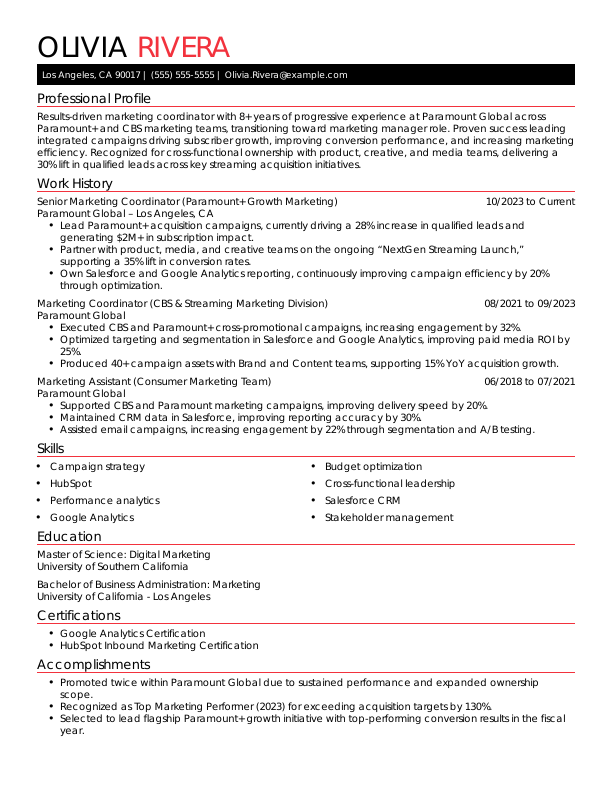
Internal Resume for Promotion
This sample resume for promotion within the same company shows how to highlight internal growth, increased responsibility, and measurable impact to prove you’re prepared to advance.
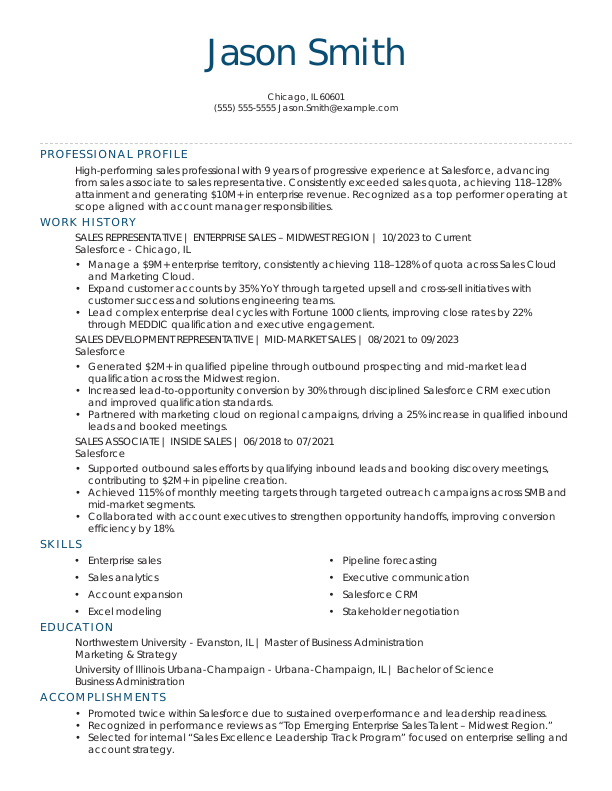
Internal Resume for Lateral Move
This example shows how to reframe your experience to align with a new team or function, focusing on transferable skills and cross-functional work.
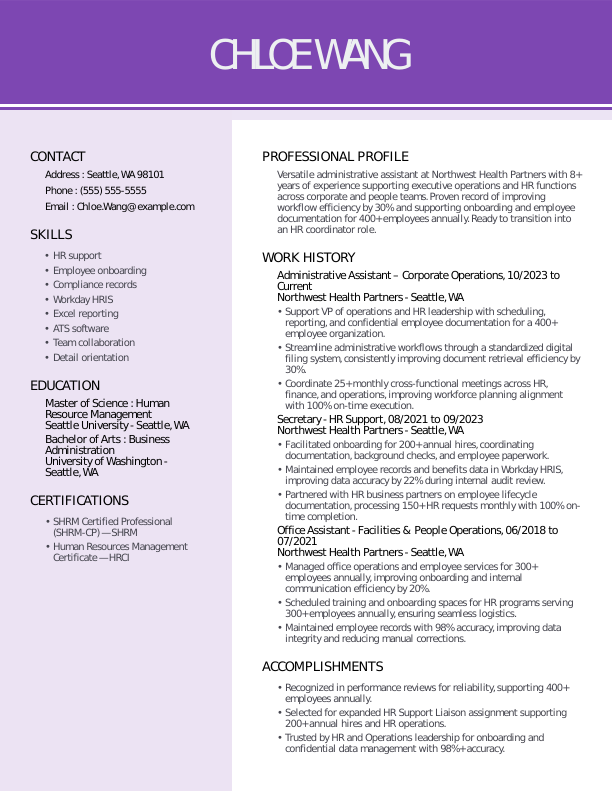
Internal Resume for Department/Career Change
This example demonstrates how to position transferable skills, internal projects, and professional development when transitioning to a new department or career path within the same company.
What’s Next? Tips to Land Internal Positions
A strong resume is only one part of the process. To land an internal role, you also need to show interest, communicate clearly, and navigate internal relationships strategically.

Express Interest in the Role
To express interest in an internal position, communicate clearly and professionally with the right people before or during the application process.
Start by letting your manager know you’re interested, especially if your company encourages internal mobility. Then, reach out to the hiring manager or recruiter to confirm your interest and learn more about the role.
Keep it simple and direct:
- State the role you’re interested in.
- Briefly highlight your current position and relevant experience.
- Ask a thoughtful question or express interest in learning more.
Example message:
Hi [Manager’s Name], I saw the opening for the senior marketing project manager role and wanted to share my interest. In my current role as a project manager, I’ve led cross-functional initiatives and supported campaign execution, and I’d love to learn more about how my experience could align with the team’s needs.

Write a Cover Letter for an Internal Position
Even for internal roles, a cover letter can strengthen your application.
Use your internal cover letter to connect your experience directly to the role and explain why you’re interested in making a move within the company.
Focus on:
- Why you’re interested in this specific role or team
- How your internal experience prepares you for it
- What you want to contribute to the new position

Follow Up
Following up helps keep your application visible and shows continued interest.
If you haven’t heard back within a reasonable time frame (typically five to seven days), send a brief message to the recruiter or hiring manager. Reaffirm your interest and ask if there’s anything else you can provide.
Keep your tone professional and concise. A simple check-in can reinforce your enthusiasm without feeling pushy.

Connect With Key Stakeholders
Internal hiring is often influenced by visibility and relationships, so connecting with the right people can make a meaningful difference.
Before applying, consider:
- Talking to HR to better understand role requirements and expectations
- Reaching out to the hiring manager to learn about team priorities
- Connecting with current team members for insight into day-to-day work
- Asking for internal recommendations or referrals from colleagues or leaders who can speak to your work.
Approach these conversations with curiosity, not just the intent to apply. Ask thoughtful questions, show genuine interest, and look for ways to demonstrate alignment with the team’s goals.
Make Your Move
Maybe you’re eyeing up a promotion or a new, exciting role on your team. Perhaps you want to make a career change but stay with the organization you’re at now. Regardless of your motivations, a strong internal resume can get you one step closer to the role you want.
Tie your experience and impact within the company, highlight measurable results, and show how you can contribute quickly. When you pair that with clear communication and support from key stakeholders, you’ll stand out as the natural choice for the opportunity.

Kirsten Chorpenning is a career advice writer who empowers job seekers to take control of their career paths using Monster’s comprehensive job search and resume tools. She specializes in helping job seekers find rewarding jobs in today’s dynamic work environment.
See More From Kirsten ChorpenningExplore Related Career Advice

Nearly 3 in 10 LinkedIn Users Have Updated a Past Job After Leaving It

Updated:
Oct 7, 2026
|
7 min read

Employee Loyalty Statistics: 90% Say Companies Expect More Than They Give
Updated:
Oct 5, 2026
|
7 min read


Overqualified Hiring Stats: 57% Would Cut Resume Experience to Get Hired
Updated:
Sep 28, 2026
|
9 min read

20 First Job Interview Questions & Sample Answers: Tips to Land Your First Job
Updated:
Sep 24, 2026
|
20 min read

“Do You Have Any Questions for Me?” How to Answer in an Interview (30 Examples)
Updated:
Sep 18, 2026
|
14 min read



20 Companies That Pay 100% Health Insurance & Other Top Benefits
Updated:
Sep 10, 2026
|
14 min read
Manage Your Career Like an Expert
Take control of your professional journey with Monster’s expert resources. Explore advice, research, and tips to make informed decisions and advance your career with confidence.

Job Search
Discover strategies to get noticed, network effectively, and streamline your job search process.

Resumes
Get practical tips to create a resume or CV that stands out to employers and wins interviews.

Cover Letters
Learn how to craft a compelling cover letter that highlights your experience and fit for the role.

Career Paths
Explore career paths, industry trends, and growth opportunities to plan your next move.

Interviewing
Prepare for interviews with tips on answering common questions and following up effectively.

Career Development
Develop key skills and knowledge to grow in your current role or pivot to new opportunities.

Leaving a Job
Navigate job changes and career transitions with practical advice and planning resources.