
Job Security Statistics: 54% Would Accept a Pay Cut for Greater Job Security

As economic uncertainty continues, workers are increasingly willing to sacrifice salary, benefits, and flexibility in exchange for more stability.
Updated:
|

8 min read

Table of Contents


According to Monster’s 2026 Job Security Report, more than half of U.S. workers (54%) say they’d accept a pay cut in exchange for greater job security. Even more notably, 61% say they’d be willing to give up at least one aspect of their compensation or workplace experience if it meant feeling more secure in their role.
The findings suggest that for many employees, stability now carries as much weight as traditional workplace benefits. Rather than simply chasing higher pay, workers are weighing long-term security against salary, bonuses, benefits, and workplace flexibility.
Monster’s report explores how much workers value stability, and what they’re willing to give up to get it.
Key Findings
- More than half would take a pay cut. 54% of workers say they’d accept a lower salary in exchange for greater job security.
- Many would accept significant reductions. While 26% would take a pay cut of up to 5%, another 28% would accept a reduction of 5% or more, including 11% who would accept a pay cut greater than 10%.
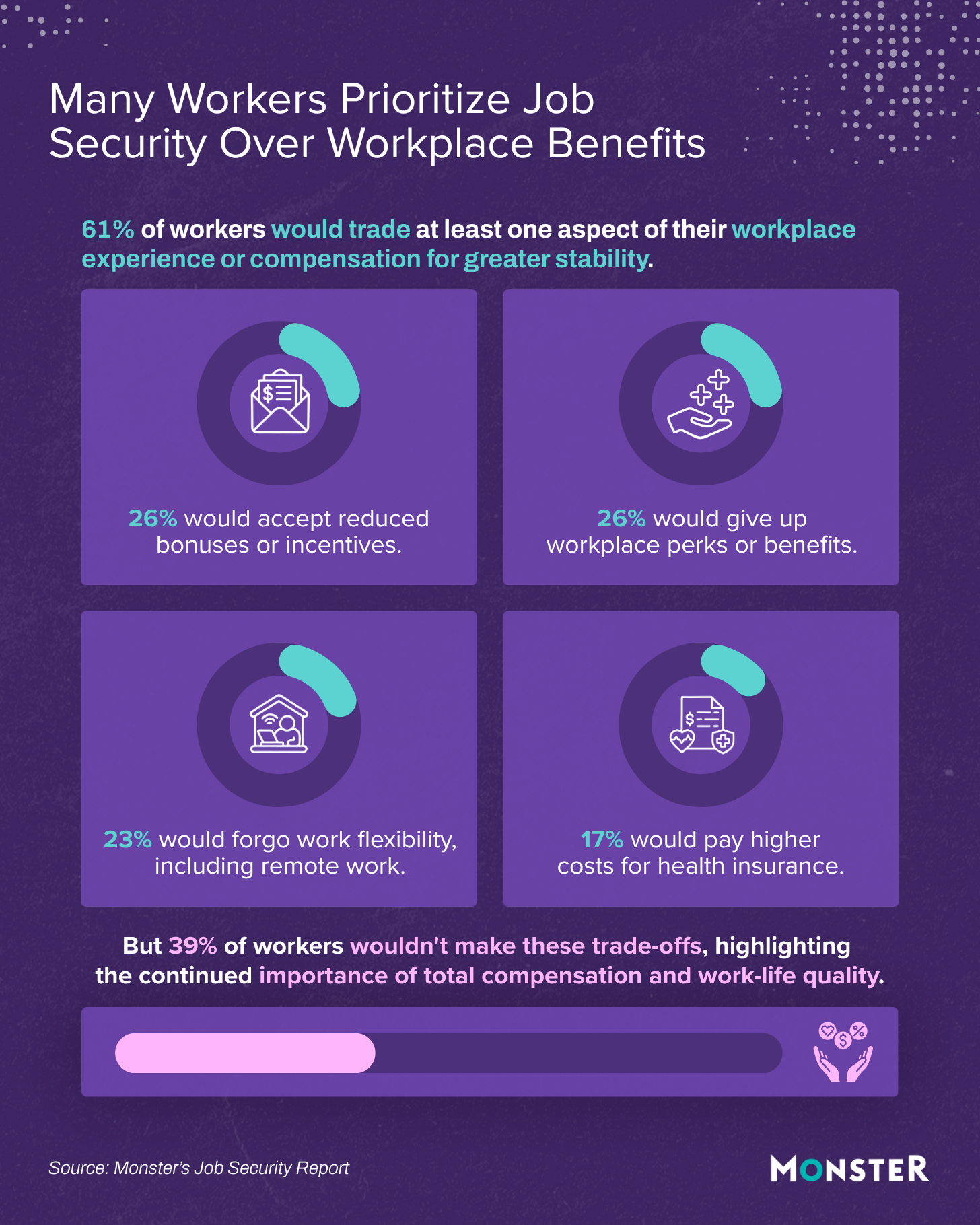
- Workers would trade more than salary. 26% would give up bonuses or incentives, 26% would sacrifice workplace perks or benefits, 23% would give up workplace flexibility, and 17% would accept higher health insurance costs for greater job security.
- Most workers would make at least one trade-off. While 39% say they wouldn’t give up anything, 61% would sacrifice at least one aspect of their compensation or workplace experience for greater stability.
Job Security vs Salary: Workers Choose Stability Over Pay
For many workers, job security isn’t simply a nice-to-have benefit—it’s a deciding factor in how they evaluate their careers. Monster’s latest job security survey reveals that more than half of workers would willingly earn less if it meant feeling more confident that their job would last.
The data also shows that workers aren’t just willing to make small compromises. More than one in four (28%) would accept a salary reduction of at least 5%, including 11% who would take a pay cut of more than 10%.
The findings suggest that in today’s labor market, predictability and stability may outweigh the promise of higher earnings for many professionals.
Workers Are Willing to Give Up More Than Pay
Salary isn’t the only area where workers are willing to compromise. When asked what they’d sacrifice for greater job security, workers pointed to several aspects of their overall compensation package and workplace experience:
- Reduced bonuses or incentives: 26%
- Workplace perks or benefits: 26%
- Workplace flexibility, including remote work options: 23%
- Higher health insurance costs: 17%
These responses reinforce that workers consider job security valuable enough to outweigh benefits that have become increasingly important in recent years, including flexibility and financial incentives.
At the same time, 39% say they wouldn’t be willing to make any of these trade-offs, highlighting that workers continue to place significant value on their overall compensation and quality of life.
How Can Employers Respond to Priorities Around Job Security?
The findings point to a shift in what workers value most. Competitive salaries remain important, but many employees are increasingly prioritizing confidence that their role and employer can provide long-term stability, even if it means accepting a pay cut for job security.
Organizations that communicate clearly about business performance, invest in employee retention, and provide a strong overall employee experience may be better positioned to attract and retain talent.
Job security has become part of the value proposition workers consider alongside compensation, benefits, and workplace flexibility.
How to Evaluate Job Security During Your Job Search: 5 Steps
If job security is one of your top priorities, there are steps you can take in your job search to better assess prospective employers before accepting an offer.
- Step 1:
Research the Company’s Financial Health
Review recent news, earnings reports (if publicly available), hiring trends, and employee reviews to understand how the organization is performing and whether it has experienced recent layoffs or restructuring.
- Step 2:
Ask About Business Priorities
During interviews, ask thoughtful questions about company growth, team expansion, organizational goals, and how success is measured. The answers can provide insight into the company’s long-term outlook.
- Step 3:
Look Beyond Salary
Evaluate the entire offer, including benefits, career development, management quality, flexibility, and company culture. A slightly lower salary may be worthwhile if the role offers greater long-term stability and growth.
- Step 4:
Pay Attention to Employee Retention
Research employee tenure and turnover where possible. Organizations with strong retention often provide a more stable work environment and clearer career paths.
- Step 5:
Balance Security With Career Growth
Job security matters, but so do opportunities to learn new skills and advance your career. Look for employers that offer both stability and room for professional development.
Keeping These Job Security Statistics In Mind
Every job comes with trade-offs, and the right balance will look different for every worker. While salary often drives career decisions, this report highlights the importance of considering the full picture, including long-term stability, growth opportunities, benefits, and workplace culture. Weighing these factors together can help you make more confident career decisions going forward.
For press inquiries, please contact Shanna Briggs at shanna.briggs@bold.com.
Methodology
The findings presented in this report are based on a survey conducted by Pollfish on July 17, 2026, among 1,020 currently employed U.S. workers. Respondents answered a series of multiple-choice questions exploring attitudes toward job security, willingness to make workplace trade-offs, compensation preferences, and career decision-making.
Demographic Breakdown
The sample included employed adults across a range of industries, company sizes, and work arrangements throughout the United States. Respondents identified their gender as 52% female and 48% male. Age distribution included 10% ages 18–24, 20% ages 25–34, 19% ages 35–44, 18% ages 45–54, 20% ages 55–64, and 13% age 65 or older. Twenty-six percent worked at companies with 1–49 employees, 18% at companies with 50–249 employees, 20% at companies with 250–999 employees, 17% at companies with 1,000–4,999 employees, 6% at companies with 5,000–9,999 employees, and 13% at companies with 10,000 or more employees. Respondents reported working fully remote (18%), hybrid (22%), or fully in office (60%).
About Monster
Monster is a global leader in online job searching, resume building, and employment solutions. For over 30 years, the company has been a trusted authority for both job seekers and companies. Beyond the job search, Monster provides an intuitive Resume Builder and hundreds of resume templates to help candidates stand out against the competition, while offering employers a comprehensive resume database to source top talent. As a G2 category leader, Monster has been featured in Forbes, CNBC, CNN, and USA Today, sharing the career advice needed to bridge the gap between job seekers and hiring managers. Follow Monster on LinkedIn, Facebook, Instagram, and TikTok for the latest employment trends.

Vicki Salemi is a nationally recognized career expert who helps professionals navigate the hiring landscape and find the right fit on Monster. With over 15 years of experience in corporate recruiting and HR, she offers expert guidance on job search strategies, interview preparation, and career development to help candidates land their next role.
See More From Vicki SalemiExplore Related Career Advice



20 Companies That Pay 100% Health Insurance & Other Top Benefits

Updated:
Sep 10, 2026
|
14 min read


How Long of a Commute Is Too Long? 49% Have Turned Down a Job Due to the Commute
Updated:
Sep 8, 2026
|
11 min read


Beauty Bias at Work Statistics: 88% Say Attractive People Have an Advantage
Updated:
Aug 31, 2026
|
8 min read


How to Put Transferable Skills on Your Resume: 120 Skills, Examples, & Tips
Updated:
Aug 27, 2026
|
16 min read
Manage Your Career Like an Expert
Take control of your professional journey with Monster’s expert resources. Explore advice, research, and tips to make informed decisions and advance your career with confidence.

Job Search
Discover strategies to get noticed, network effectively, and streamline your job search process.

Resumes
Get practical tips to create a resume or CV that stands out to employers and wins interviews.

Cover Letters
Learn how to craft a compelling cover letter that highlights your experience and fit for the role.

Career Paths
Explore career paths, industry trends, and growth opportunities to plan your next move.

Interviewing
Prepare for interviews with tips on answering common questions and following up effectively.

Career Development
Develop key skills and knowledge to grow in your current role or pivot to new opportunities.

Leaving a Job
Navigate job changes and career transitions with practical advice and planning resources.