
How to Write a Motivation Letter: Examples & Tips

A breakdown of how to communicate your motivation, goals, and potential impact to employers, scholarship reviewers, or admissions teams.
Updated:
|

19 min read

Table of Contents


The best motivation letter examples give readers a clear sense of what you want to do, why you want to do it, and how your background supports that goal in a specific context, whether you’re applying to college or university, a scholarship, a volunteer role, or a job.
This guide explains how to write a motivation letter with a step-by-step breakdown, practical tips, a template, and motivation letter examples for different scenarios.
What Is a Motivation Letter?
A motivation letter is a formal document that explains your goals, interests, and qualifications for a specific opportunity. It focuses on why you’re applying and what drives you, giving context to your experience and helping reviewers understand your direction, values, and potential fit.
Motivation Letters vs Cover Letters
While it’s often compared to a cover letter, a motivation letter is typically more focused on long-term goals, personal motivation, and alignment with a program or organization, rather than just job-specific experience.
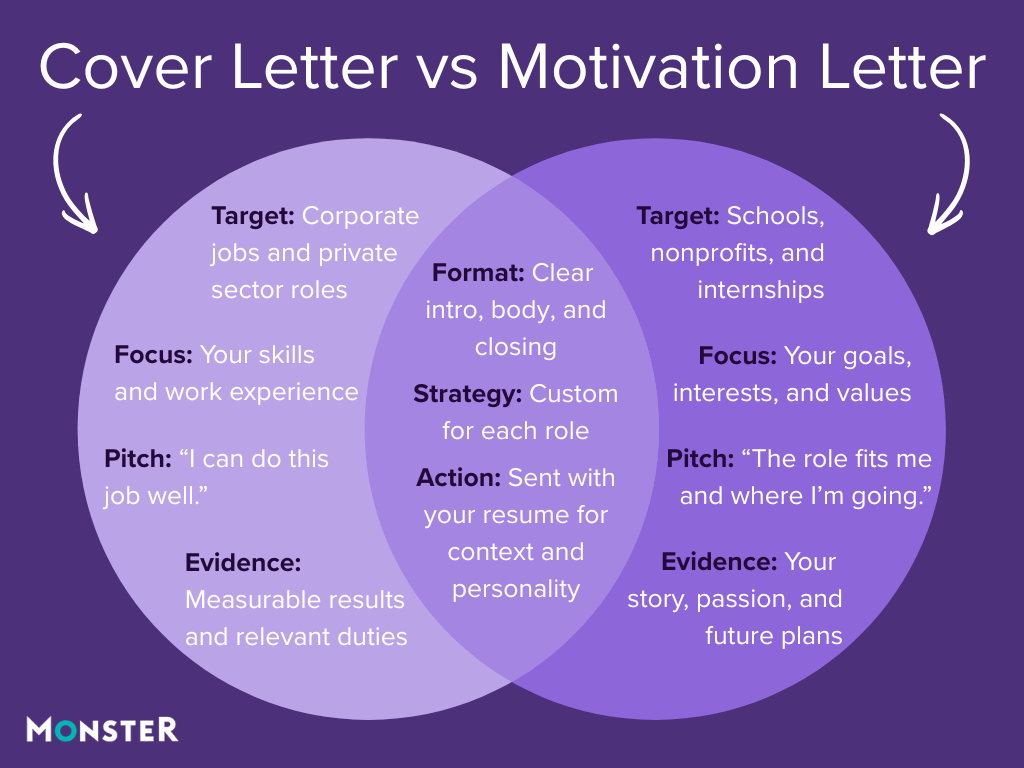
The list and diagram below cover the differences and similarities between these application documents.
- Cover letters focus on job-specific qualifications, experience, and achievements, showing how your skills match a specific role and company. Common in corporate and private-sector applications, they’re typically expected alongside a resume.
- Motivation letters focus on your goals, interests, and long-term direction, explaining what drives you and why you’re applying. Often used for academic, scholarship, nonprofit, or internship opportunities, they emphasize purpose and fit over specific job results.
- Both documents are submitted with a resume and tailored to a specific opportunity, but you’re usually asked for one or the other—not both. Each uses a professional structure with an introduction, body, and conclusion to explain why you’re a strong fit while adding context beyond your resume.
How a Motivation Letter Works Alongside Your Resume
A motivation letter complements your resume. While your resume outlines your skills, experience, and results, a motivation letter provides context by explaining your goals, interests, and direction. Together, they offer a more complete view of your background and what you’re working toward.
 Pro Tip
A strong application starts with a clear, well-structured resume. Using resume templates, creating an ATS-friendly version with Monster’s Resume Builder, and refining your content for consistency can help your experience and motivation align seamlessly.
When to Include vs Skip a Motivation Letter
Use this as a quick guide to decide whether a motivation letter belongs in your application.
- Include one when the application explicitly asks for one or when the opportunity focuses on your goals, interests, and long-term direction. This is most common for college or university applications, scholarships, internships, volunteer roles, and certain academic or nonprofit positions. In these cases, the letter is typically required, and skipping it can hurt your application.
- Don’t include one when the application only asks for a resume or a cover letter. This is standard for most corporate or private-sector jobs, where a cover letter is the expected format. Submitting a motivation letter instead can come across as misaligned or unnecessary.
- It’s optional to include one when it’s not required, but it adds something that your resume or cover letter doesn’t. This can include explaining a career shift, providing context for your experience, or showing clear alignment with a mission, program, or field. If it’s just repeating what’s already in your application, it’s better to leave it out.
How to Write a Motivation Letter in 7 Steps
To write a motivation letter, start with a clear structure and build each section around your qualifications, goals, and alignment with the opportunity. If you’re wondering how to write a good motivation letter, the best example of motivation is one that clearly explains what drives you, connects your experience to the opportunity, and shows how you can contribute.
The steps below break down exactly how to organize your letter and what to include in each section.
- Step 1:
Write an Outline With the Essential Components
Before you start writing, outline your motivation letter so each section has a clear purpose and flow. A well-structured letter makes it easier for the reader to quickly understand who you are, what you want, and why you’re a strong fit.
Most motivation letters follow a simple, consistent structure:
- Header with contact details
- Personalized greeting
- Introduction
- Body paragraphs
- Conclusion with call to action (CTA)
- Professional sign-off
- Step 2:
Define Your Skills, Interests, & Direction
Before you start drafting, pause and decide what your letter is going to say. You should establish a clear angle to keep your motivation letter from feeling scattered or generic.
To do this, define three core elements:
- What you bring: List two to three skills or experiences that directly connect to the opportunity that you can support with examples.
- What you’re drawn to: Pinpoint what draws you in, such as the type of work, the impact, the subject matter, or the organization itself.
- Where you’re heading: Define your direction in terms of how this opportunity fits into your next step and your longer-term path.
For example, in a university application, you might define what you bring as research and writing experience from a climate policy capstone project. What you’re drawn to could be a focused interest in environmental policy. Where you’re heading might be pursuing a career in public policy or sustainability.
- Step 3:
Write the Header & Personalized Greeting
Start your motivation letter with a clear header and a personalized greeting. It should include your basic contact information, along with the date and the recipient’s details if available.
After the header, open with a personalized greeting. Whenever possible, address the reviewer by name instead of using a generic salutation. If you can’t find a specific name, use a relevant group or title, such as “Dear Admissions Committee” or “Dear Hiring Manager,” rather than a vague opening like “To Whom It May Concern.”
Example:
Jordan Lee
Philadelphia, PA
555-555-5555
jordan.lee@email.comApril 23, 2026
Dr. Maria Alvarez
Admissions Committee
School of Public Policy
University of ConnecticutDear Dr. Alvarez,
- Step 4:
Write an Effective Introduction
So, how do you start a letter of motivation? By quickly establishing your purpose and setting the direction for the rest of your letter.
In your opening sentences, be direct and specific. Avoid generic phrases and instead connect your interest to the opportunity in a way that feels intentional.
Include:
- What you’re applying for
- Why you’re interested in this specific opportunity
- A brief preview of your motivation, goals, or relevant background
Example:
I’m applying to the Environmental Policy master’s program with a strong interest in climate legislation, developed through my undergraduate research on local sustainability initiatives. I’m particularly drawn to this program’s focus on policy implementation and hope to build a career shaping environmental policy at the state level.
- Step 5:
Develop Strong Body Paragraphs
The body of your motivation letter is where you connect what you bring, what you’re drawn to, and where you’re heading in a way that feels specific and credible.
Focus on a few key experiences and explain them with purpose. Each paragraph should build on your overall message and show how your background aligns with the opportunity.
Aim to structure your body paragraphs around:
- Relevant skills and education or work experience with brief context
- What you learned or developed from those experiences
- How that connects to the opportunity or your goals
Avoid repeating your resume. Instead, use your body paragraphs to add meaning by explaining why your experience matters and how it shaped your direction.
Example:
I developed a strong foundation in environmental research through my capstone project, where I analyzed how local sustainability initiatives influenced policy outcomes in my community. This included reviewing municipal data, conducting interviews with local stakeholders, and evaluating the effectiveness of existing programs. Through this work, I strengthened my ability to interpret data, synthesize findings, and communicate complex information clearly.
At the same time, the project deepened my interest in how policy decisions are shaped at the community level, particularly the gap between research and implementation. Seeing how data can inform real-world decisions reinforced my goal of working in environmental policy, especially in roles that connect research insights with practical policy action.
- Step 6:
Craft a Conclusion With a CTA & Sign-Off
Your conclusion should briefly reinforce your interest and leave a clear, professional final impression. This is not the place to introduce new information. Instead, summarize your motivation and signal what you hope happens next.
Keep it concise and focused. Reaffirm your alignment with the opportunity, restate your interest, and include a simple call to action, such as expressing openness to further discussion or consideration.
End with a professional sign-off followed by your name.
Example:
Thank you for considering my application. I’m excited about the opportunity to contribute to your program and further develop my focus in environmental policy. I would welcome the opportunity to discuss my application in more detail.
Sincerely,
Jordan Lee - Step 7:
Proofread & Finalize
Before submitting your motivation letter, take time to review and refine it. Small errors or unclear phrasing can weaken an otherwise strong application.
Read through your letter to check for grammar, spelling, and formatting issues. Make sure your ideas flow logically and that each section supports your overall message. It can also help to read your letter out loud or step away and revisit it with fresh eyes.
If possible, have someone else review it to catch anything you may have missed.
Complete example:
Jordan Lee
Philadelphia, PA
555-555-5555
jordan.lee@email.comApril 23, 2026
Dr. Maria Alvarez
Admissions Committee
School of Public Policy
University of ConnecticutDear Dr. Alvarez,
I’m applying to the Environmental Policy master’s program with a strong interest in climate legislation, developed through my undergraduate research on local sustainability initiatives. I’m particularly drawn to this program’s focus on policy implementation and hope to build a career shaping environmental policy at the state level.
I developed a strong foundation in environmental research through my capstone project, where I analyzed how local sustainability initiatives influenced policy outcomes in my community. This included reviewing municipal data, conducting interviews with local stakeholders, and evaluating the effectiveness of existing programs. Through this work, I strengthened my ability to interpret data, synthesize findings, and communicate complex information clearly.
At the same time, the project deepened my interest in how policy decisions are shaped at the community level, particularly the gap between research and implementation. Seeing how data can inform real-world decisions reinforced my goal of working in environmental policy, especially in roles that connect research insights with practical policy action.
Thank you for considering my application. I’m excited about the opportunity to contribute to your program and further develop my focus in environmental policy. I would welcome the opportunity to discuss my application in more detail.
Sincerely,
Jordan Lee
Tips to Make Your Motivation Letter Stand Out
A strong motivation letter stands out when it feels personal, specific, and clearly tailored to the opportunity. The goal is to show both your strengths and your genuine interest in a natural, credible way.

Write With Personality
Your letter should sound like you, not a template. Keep the tone professional, but don’t strip out your voice. A natural, confident tone makes your motivation more believable and engaging.

Use Accessible Language
Avoid overly complex or formal wording. Clear, straightforward language is easier to read and helps your ideas come across more effectively. If a sentence feels complicated, simplify it.

Focus on Your Strengths
Highlight the skills and experiences that are most relevant instead of trying to include everything. Go deeper on a few strong points rather than listing too many surface-level details.

Address Specific Requirements
Pay attention to what the program, role, or organization is asking for and respond directly. Align your skills, interests, and goals with those requirements so your letter feels tailored.

Be Honest
Be realistic about your experience and goals. Strong motivation letters are built on clarity and sincerity, not exaggeration. Focus on what you genuinely bring and where you’re headed.

Avoid Common Mistakes
What are common mistakes in motivation letters? These can include:
Over- or under-formatting
- Being too generic or vague
- Repeating your resume without adding context or meaning
- Failing to clearly explain your motivation
- Writing excessively long paragraphs
- Not tailoring the letter to the specific opportunity
- Going over one page
Motivation Letter Template
Use this template as a starting point, then customize each section to reflect your goals, experience, and the specific opportunity.
Motivation Letter Examples for Different Scenarios
So, what’s a good example of a motivation letter? A strong example clearly explains what you’re applying for, what motivates you, and how your background connects to the opportunity.
The examples below show how that can look across different situations.
College Application Motivation Letter Example
This motivation letter for university applications shows how to connect your academic background, interests, and long-term goals to a specific program.
Mia Martinez
Austin, TX
555-555-5555
ava.martinez@email.com
April 23, 2026
Admissions Committee
School of Public Affairs
University of Texas at Austin
Dear Admissions Committee,
I’m applying to the Master of Public Affairs program with a strong interest in environmental policy, developed through my undergraduate coursework and research on regional water conservation efforts. I’m particularly drawn to UT Austin’s focus on data-driven policy and community impact.
During my senior thesis, I analyzed the effectiveness of local water management programs across central Texas. This project required extensive data analysis, stakeholder interviews, and policy evaluation, which strengthened my research and communication skills. It also deepened my understanding of how environmental policy decisions directly affect communities.
I’m excited to continue developing these skills in a program that emphasizes both analytical rigor and real-world application. My long-term goal is to work in environmental policy at the state level, helping design and implement sustainable resource management strategies.
Thank you for your time and consideration. I would welcome the opportunity to contribute to and learn from your program.
Sincerely,
Mia Martinez
Scholarship Motivation Letter Example
This motivation letter for scholarship applications demonstrates how to highlight academic achievements, financial need, and future goals in a clear, focused way.
Ethan Brooks
Columbus, OH
555-555-5555
ethan.brooks@email.com
April 23, 2026
Selection Committee
Coca-Cola Scholars Foundation
Dear Selection Committee,
I’m applying for the Coca-Cola Scholars Program to support my pursuit of a degree in education policy. My academic work and leadership experience have been centered on expanding access to educational resources in underserved communities.
As a student leader, I founded a peer tutoring initiative at my high school that provided free academic support to over 50 students each semester. In addition, I’ve maintained a strong academic record while balancing part-time work to contribute to my family’s expenses. These experiences have strengthened my leadership, time management, and commitment to service.
Receiving this scholarship would allow me to focus more fully on my studies and continue building programs that support equitable access to education. My long-term goal is to work in education policy, developing initiatives that improve outcomes for students in under-resourced school systems.
Thank you for your consideration. I’d appreciate the opportunity to further discuss my goals and how this scholarship would support them.
Sincerely,
Ethan Brooks
Volunteer Position Motivation Letter Example
This example shows how to express genuine interest in an organization’s mission while connecting your skills and availability to the role.
Priya Desai
San Jose, CA
555-555-5555
priya.desai@email.com
April 23, 2026
Volunteer Coordinator
Second Harvest of Silicon Valley
Dear Volunteer Coordinator,
I’m writing to express my interest in volunteering with Second Harvest of Silicon Valley, as I strongly support your mission to address food insecurity in local communities. I’m especially interested in contributing to your outreach and distribution efforts.
Through previous volunteer work, I’ve developed strong organizational and communication skills. I’ve helped coordinate food distribution events, manage volunteer schedules, and support outreach initiatives that connect families with essential resources.
I’m eager to contribute my time and skills to an organization making a meaningful impact, while also gaining more experience in community-based nonprofit work.
Thank you for your time and consideration. I’d welcome the opportunity to get involved and support your team’s efforts.
Sincerely,
Priya Desai
Job Application Motivation Letter Example
This example of how to write a motivation letter for a job shows how to align your experience, skills, and career goals with a specific role or company—even if you don’t have direct experience.
Marcus Nguyen
Seattle, WA
555-555-5555
marcus.nguyen@email.com
April 23, 2026
Hiring Manager
Patagonia
Ventura, CA
Dear Hiring Manager,
I’m applying for the Sustainability Coordinator role at Patagonia with a strong interest in supporting environmental initiatives that align with your mission. My background in project coordination and environmental research has prepared me to contribute to sustainability-focused programs.
In my previous role, I supported cross-functional teams on projects related to environmental impact reporting and operational efficiency. I analyzed data, coordinated timelines, and communicated findings to stakeholders, which strengthened my ability to manage projects and translate insights into action.
I’m particularly drawn to Patagonia’s leadership in sustainable business practices and its commitment to environmental responsibility. My goal is to build a career in sustainability, and I’m excited about the opportunity to contribute to a company focused on measurable impact.
Thank you for your consideration. I’d welcome the opportunity to discuss how my experience and interests align with your team’s needs.
Sincerely,
Marcus Nguyen
Feeling Motivated?
You have a unique perspective, skill set, and direction that can help you stand out in any application. A strong motivation letter makes that clear by connecting what drives you to the opportunity in a focused, intentional way.
Keep your message specific, tie your experience to your goals, and let your voice come through. When your letter clearly shows what you bring and where you’re headed, it becomes much easier for readers to see your potential and say yes to what’s next.

Kirsten Chorpenning is a career advice writer who empowers job seekers to take control of their career paths using Monster’s comprehensive job search and resume tools. She specializes in helping job seekers find rewarding jobs in today’s dynamic work environment.
See More From Kirsten ChorpenningExplore Related Career Advice



20 Companies That Pay 100% Health Insurance & Other Top Benefits
Updated:
Sep 10, 2026
|
14 min read


How Long of a Commute Is Too Long? 49% Have Turned Down a Job Due to the Commute

Updated:
Sep 8, 2026
|
11 min read


Beauty Bias at Work Statistics: 88% Say Attractive People Have an Advantage
Updated:
Aug 31, 2026
|
8 min read


How to Put Transferable Skills on Your Resume: 120 Skills, Examples, & Tips
Updated:
Aug 27, 2026
|
16 min read
Manage Your Career Like an Expert
Take control of your professional journey with Monster’s expert resources. Explore advice, research, and tips to make informed decisions and advance your career with confidence.

Job Search
Discover strategies to get noticed, network effectively, and streamline your job search process.

Resumes
Get practical tips to create a resume or CV that stands out to employers and wins interviews.

Cover Letters
Learn how to craft a compelling cover letter that highlights your experience and fit for the role.

Career Paths
Explore career paths, industry trends, and growth opportunities to plan your next move.

Interviewing
Prepare for interviews with tips on answering common questions and following up effectively.

Career Development
Develop key skills and knowledge to grow in your current role or pivot to new opportunities.

Leaving a Job
Navigate job changes and career transitions with practical advice and planning resources.