
Doomjobbing Report: 48% of Job Seekers Apply Without Reading the Full Job Description

Job seekers are blindly applying to more jobs in hopes of improving their odds. And in today’s competitive market, it’s easy to see why.
Updated:
|

7 min read

Table of Contents


A faster, more competitive landscape is changing how candidates search for new jobs. Recently released research from Monster reveals a growing pattern of “doomjobbing,” where job seekers apply rapidly to multiple jobs with minimal vetting, treating the process more like a numbers game than a well-thought-out and curated approach.
What Is Doomjobbing?
Doomjobbing is a high-volume, fast-paced application strategy where candidates apply to numerous roles in rapid succession with minimal vetting. In many cases, this behavior stems from the frustrations of a prolonged search, lack of employer feedback, and uncertainty around what truly captures a recruiter’s attention.
The meaning of doomjobbing is reminiscent of “doomscrolling,” an activity characterized by obsessive consumption of negative news on social media and other media outlets, often fueled by anxiety. Harvard Medical School research indicates that these actions are more likely to make stress and decision fatigue worse over time.
Key Findings
- Doomjobbing is widespread. 42% of job seekers apply to four or more jobs per search session.
- Minimal time is spent reviewing roles. 32% of job seekers spend one minute or less reviewing a job posting before applying.
- Candidates skip key details. 48% admit they apply to jobs without reading the full job description.
- Volume is a core strategy. 47% balance quantity and fit, 32% focus on strong matches, and 21% prioritize applying to as many roles as possible.
A Job Search Driven by Volume
The job application process has become increasingly transactional rather than thoughtful. Candidates often rush from one job posting to the next, frequently without fully understanding the role or its requirements.
According to our findings:
- 58% of job seekers apply to one to three jobs per session.
- 42% apply to four or more jobs, with some submitting as many as 16 applications in a single sitting.
As job searches last longer, candidates are adopting more aggressive strategies. Those who have been searching for months are especially likely to increase the number of applications they submit, even if it means compromising on job fit.
In fact, 47% of candidates say they aim to balance quality and fit, 32% search for strong matches, and 21% apply to as many jobs as possible.
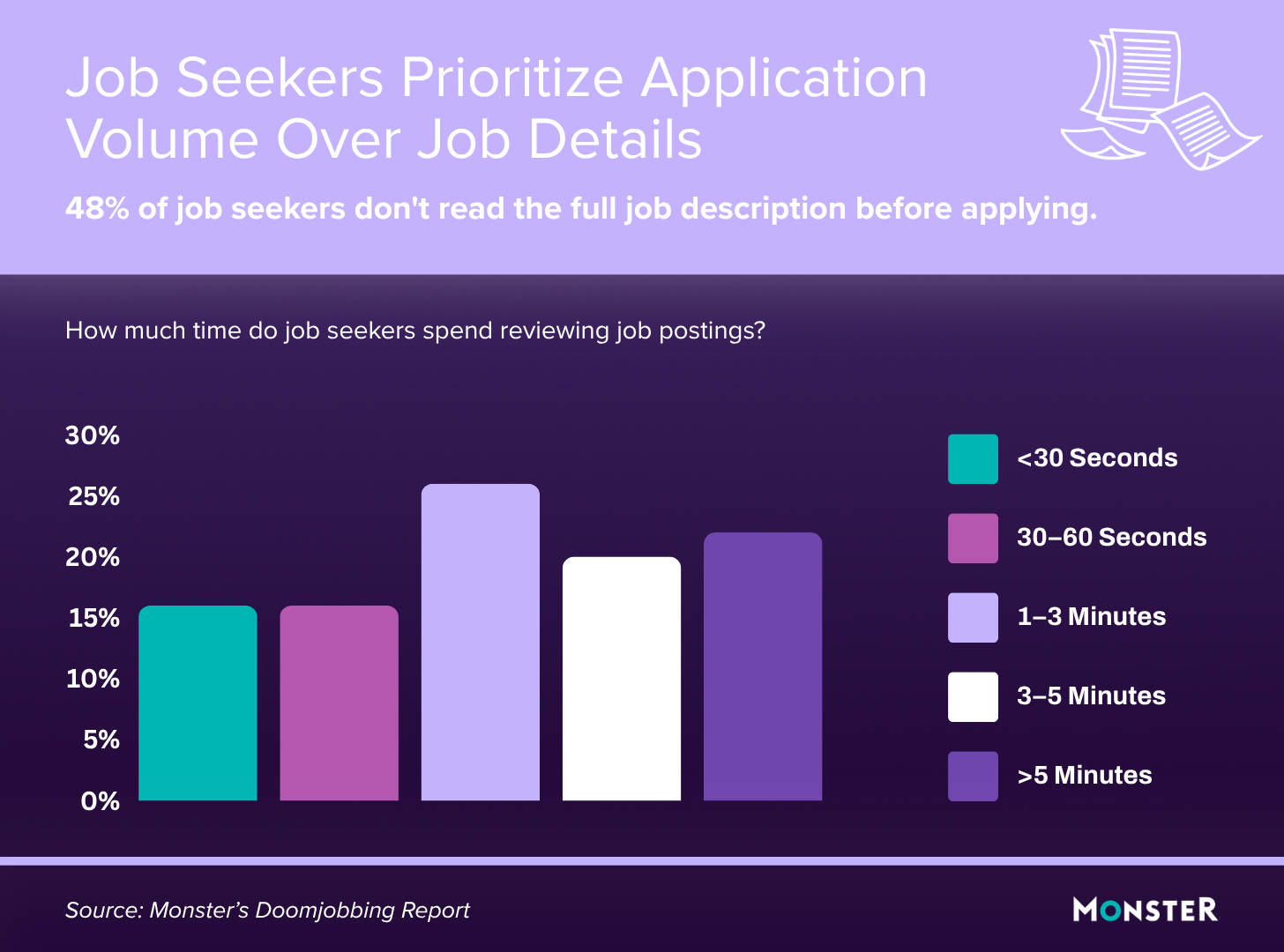
Most Job Seekers Spend Under 5 Minutes Reviewing Job Posts
Nearly half of job seekers admit that they don’t read the entire job description when applying for positions, with 32% saying they spend less than a minute reviewing job postings.
- 16% spend less than 30 seconds
- 16% spend between 30 seconds and 1 minute
- 26% spend 1–3 minutes
- 20% spend 3–5 minutes
- 22% spend more than 5 minutes
The amount of time candidates take to find jobs varies significantly:
- 36% find roles in under a month.
- 26% find a new position in 1–3 months.
- 25% remain searching for 6 months or longer, including 18% for over a year.
Doomjobbing Increases Application Volume but Makes Hiring Harder
Job seekers aren’t the only ones affected by doomjobbing. More applications don’t necessarily mean better candidates. Instead, hiring teams face higher volumes of less relevant submissions, making it harder to identify strong matches.
This creates inefficiencies on both sides:
- Candidates feel ignored.
- Employers feel overwhelmed.
- The hiring process slows down.
How Many Jobs Should I Apply to Per Day or Week?
Focus on quality over quantity. Set a realistic daily or weekly target you can sustain that allows you to fully read each job description, tailor your resume, and apply only to relevant roles. This approach can lead to stronger matches with potential employers and better long-term outcomes.
The Bottom Line
Doomjobbing is indicative of a job market under strain. Candidates are applying faster and with less attention to detail, not because they want to, but because they feel they have to. As volume increases and precision declines, the hiring process risks becoming slower and less effective for everyone involved.
Breaking this cycle will require more transparency, better communication, and a hiring experience that rewards quality over quantity.
For press inquiries, please contact Shanna Briggs at shanna.briggs@monster.com.
Methodology
The findings in this report are based on a survey conducted by Monster using the Pollfish platform among 1,006 U.S. job seekers on April 28, 2026. Respondents answered a series of single-selection and multiple-choice questions about their experiences with the hiring process, including confidence in job search outcomes, perceptions of transparency in job postings, trust in employers, and overall views on how the hiring system has changed over time.
Demographic Breakdown
The survey included job seekers across a range of industries, age groups, genders, and education levels to reflect the diversity of the U.S. workforce. Respondents identified their gender as 37% male and 63% female, with less than 1% preferring not to say. Age distribution included 18–24 (9%), 25–34 (16%), 35–44 (20%), 45–54 (14%), 55–64 (19%), and 65+ (21%).
About Monster
Monster is a global leader in online job searching, resume building, and employment solutions. For over 30 years, the company has been a trusted authority for both job seekers and companies. Beyond the job search, Monster provides an intuitive Resume Builder and hundreds of resume templates to help candidates stand out against the competition, while offering employers a comprehensive resume database to source top talent. As a G2 category leader, Monster has been featured in Forbes, CNBC, CNN, and USA Today, sharing the career advice needed to bridge the gap between job seekers and hiring managers. Follow Monster on LinkedIn, Facebook, Instagram, and TikTok for the latest employment trends.

Vicki Salemi is a nationally recognized career expert who helps professionals navigate the hiring landscape and find the right fit on Monster. With over 15 years of experience in corporate recruiting and HR, she offers expert guidance on job search strategies, interview preparation, and career development to help candidates land their next role.
See More From Vicki SalemiExplore Related Career Advice
Cashier Career Paths: Monster Workforce Mobility Report (Volume 2)
Updated:
Oct 19, 2026
|
9 min read

Highest Paying Medical Jobs: 35 Top Healthcare Careers by Salary

Updated:
Oct 16, 2026
|
18 min read

How to Ask for a Raise at Work: Steps, Scripts, & Email Templates
Updated:
Oct 15, 2026
|
20 min read
Job Hugging Statistics: Nearly 9 in 10 Workers Have “Hugged” a Job
Updated:
Oct 13, 2026
|
9 min read

Nearly 3 in 10 LinkedIn Users Have Updated a Past Job After Leaving It
Updated:
Oct 7, 2026
|
7 min read

Employee Loyalty Statistics: 90% Say Companies Expect More Than They Give
Updated:
Oct 5, 2026
|
7 min read


Overqualified Hiring Stats: 57% Would Cut Resume Experience to Get Hired
Updated:
Sep 28, 2026
|
9 min read

20 First Job Interview Questions & Sample Answers: Tips to Land Your First Job
Updated:
Sep 24, 2026
|
20 min read
Manage Your Career Like an Expert
Take control of your professional journey with Monster’s expert resources. Explore advice, research, and tips to make informed decisions and advance your career with confidence.

Job Search
Discover strategies to get noticed, network effectively, and streamline your job search process.

Resumes
Get practical tips to create a resume or CV that stands out to employers and wins interviews.

Cover Letters
Learn how to craft a compelling cover letter that highlights your experience and fit for the role.

Career Paths
Explore career paths, industry trends, and growth opportunities to plan your next move.

Interviewing
Prepare for interviews with tips on answering common questions and following up effectively.

Career Development
Develop key skills and knowledge to grow in your current role or pivot to new opportunities.

Leaving a Job
Navigate job changes and career transitions with practical advice and planning resources.