
When & How to Put Your GPA on Resumes: Tips, Templates, & Examples

Should you put your GPA on your resume or leave it off? Here’s how to decide and make it work for you.
Updated:
|

12 min read

Table of Contents


You should include your GPA on your resume if you’re a student or recent graduate, your GPA is 3.5 or higher, or the employer specifically requests it. Otherwise, it’s usually better to leave it off and focus your resume space on experience and achievements.
This guide explains exactly when to include your GPA, how to format it correctly, and how to decide whether it strengthens or weakens your application.
Should I Put My GPA on My Resume? When to Include vs Skip It
Include your GPA on resumes if you’re early in your career, it’s strong (3.5+), or the employer asks for it. The table below presents a variety of scenarios and whether you should put your GPA on resumes.
| Include Your GPA If… | Leave Your GPA Off If… |
| You’re a student or recent graduate (0–2 years of experience) | You have 3+ years of professional experience |
| Your GPA is 3.5 or higher | Your GPA is below 3.5 (unless required) |
| The job posting explicitly requests it | The employer doesn’t mention GPA |
| You don’t have stronger signals like Latin honors or awards | Your experience and achievements are stronger than your academic record |
| Your major GPA is stronger and relevant to the role | Your GPA doesn’t strengthen your application |
| You’re applying to competitive entry-level fields (finance, consulting, etc.) | Your work experience outweighs academic performance |
Cumulative GPA vs Major GPA: Which Should You List?
You may see two GPAs on your transcript: Cumulative and major. You should list one (or both) depending on your specific situation.
Here’s the difference between them and which to include when you write your resume:
- Cumulative GPA: Your overall GPA across all classes; this is the most common and expected option. List this when your GPA is 3.5+, your performance is consistent, or the job doesn’t specify otherwise.
- Major GPA: Your GPA in courses related to your major; this can highlight strength in your field. List this when your major GPA is higher than your cumulative GPA or when you’re applying to a role directly related to your studies.
You should list both only when each tells a different story: Cumulative GPA shows overall consistency, while major GPA highlights performance in your field.
Formatting examples:
- GPA: 3.7
- GPA: 3.7/4.0
- Major GPA: 3.8
- GPA: 3.6 | Major GPA: 3.8
Where Should You Put GPA on a Resume?
Put your GPA in the education section of your resume. Place it next to your degree or directly below it so it’s easy to find and clearly tied to your academic background, like so:
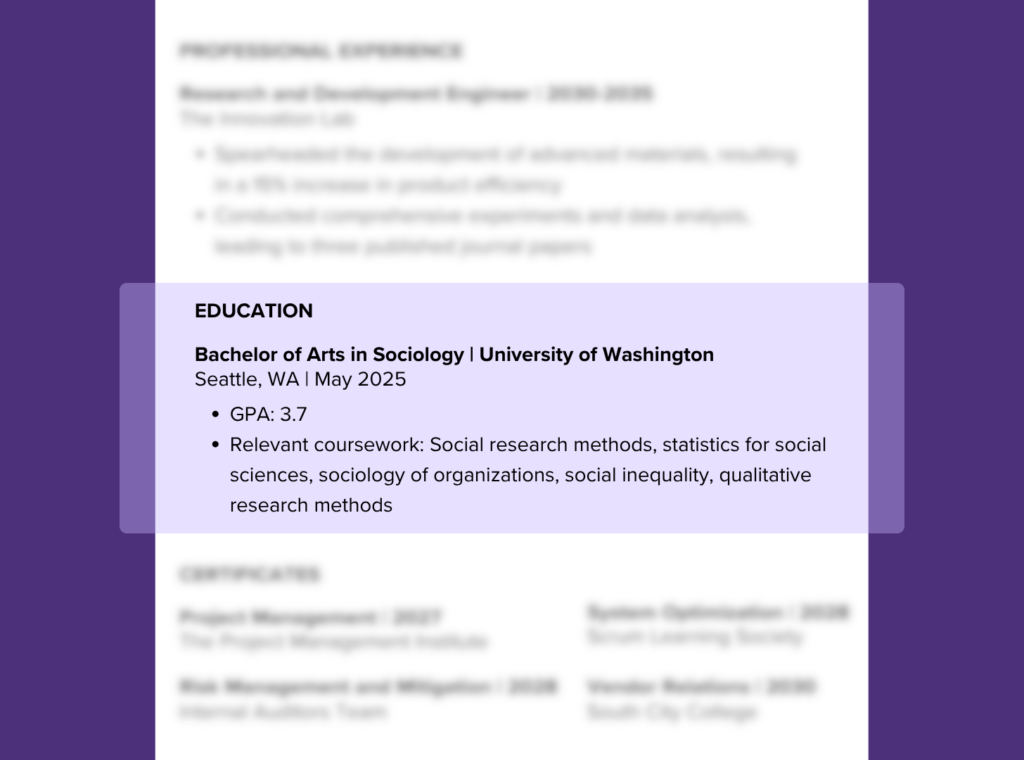
Bachelor of Arts in Sociology | University of Washington
Seattle, WA | May 2025
- GPA: 3.7
- Relevant coursework: Social research methods, statistics for social sciences, sociology of organizations, social inequality, qualitative research methods
How to Format Your GPA on a Resume (With Examples)
Your GPA should be formatted clearly within your education section so it’s easy to scan and understand. What that looks like depends on what you’re highlighting.
Standard GPA Format
Use this when you’re simply listing your cumulative GPA.
Example:
Bachelor of Science in Chemistry | Temple University
Philadelphia, PA | May 2025
- GPA: 3.7
GPA With Scale (Out of 4.0)
Use this if you want to add clarity or if your school uses a different grading scale.
Example:
Bachelor of Arts in Psychology | University of Texas at Austin
Austin, TX | May 2025
- GPA: 3.7/4.0
GPA With Latin Honors
Use this if you graduated with honors and want to show both your distinction and GPA.
Example:
Bachelor of Arts in English | University of Michigan
Ann Arbor, MI | May 2025
- Magna cum laude (GPA: 3.6)
Major GPA Only
Use this when your major GPA is stronger than your cumulative GPA or is more relevant to the job.
Example:
Bachelor of Science in Computer Science | University of Florida
Gainesville, FL | May 2025
- Major GPA: 3.8
Both Cumulative & Major GPA
Use this when both GPAs are strong, and you want to show overall and subject-specific performance.
Example:
Bachelor of Business Administration in Finance | Penn State University
University Park, PA | May 2025
- GPA: 3.6 | Major GPA: 3.9
 Pro Tip
If you want to make formatting easier, you can build your resume with Monster’s Resume Builder to structure your education section and include your GPA correctly without overthinking it.
How Accurate Does Your GPA Need to Be on a Resume?
Your GPA should always match your transcript exactly, and yes, employers can check it. Inaccuracies can raise red flags and hurt your credibility if they’re discovered during the hiring process.
Can You Round Up Your GPA on a Resume?
No. Even small changes, like rounding a 3.46 to a 3.5, can be seen as inaccurate. Your resume should reflect your official academic record, and misrepresenting it can cost you the opportunity or lead to consequences later.
Do Employers Actually Check GPA?
Yes, some employers check GPA, but usually only in specific early-career or structured hiring situations.
Employers are most likely to review GPA for:
- Entry-level roles with limited work experience
- Internships and graduate programs
- Competitive fields like finance, consulting, or engineering
- Structured corporate hiring pipelines
In these cases, GPA acts as a quick screening signal when other experience signals are limited.
If checked, GPA is typically verified through:
- Official transcripts
- Education background checks
- Employer onboarding documentation
Verification is uncommon for mid-level or senior roles unless explicitly required.
Your GPA should always match your transcript exactly. Even small discrepancies can:
- Delay hiring decisions
- Create credibility concerns
- Lead to rescinded offers in strict screening environments
What to Include Instead of a GPA on Your Resume (or In Addition To)
If your GPA isn’t your strongest asset, your education section can still stand out by highlighting other academic achievements.
Maybe you have a long list of academic accomplishments you want to highlight. Maybe your GPA is close to a cutoff but not quite there, or the job requires a GPA, and yours isn’t as strong as you’d like.
Thankfully, you can strengthen your education section in other ways. Instead of including your GPA alone, support your academic background with:
- Latin honors: Cum laude, magna cum laude, or summa cum laude
- Dean’s List: Include semesters or years if relevant
- Academic scholarships and awards: Merit-based achievements stand out
- Relevant coursework: Especially helpful if it aligns with the job
- Standardized test scores: Useful for recent high school grads or specific roles
- Thesis or capstone projects: Highlight if they’re relevant to the position
Common Mistakes to Avoid When Listing Your GPA on Resumes
When listing your GPA on your resume, these common mistakes can weaken your application or raise red flags:

Inflating or rounding up your GPA: Your GPA should match your transcript exactly. Even small changes can come across as misleading if verified.
Listing a GPA below 3.5: In most cases, a lower GPA doesn’t add value and can hurt your overall impression. That said, if the employer requires a GPA, include it.
Keeping your GPA on your resume too long: After two to three years in the workforce, your experience should take priority over academics.
Putting GPA in the wrong section: Your GPA belongs in the education section, not in your summary, skills, or awards.
Listing Latin honors with a low GPA: Honors already signal strong performance. Pairing them with a lower GPA can confuse employers or dilute the impact, unless the GPA is required.
Skipping your GPA when it’s required: This overrides the above. If an application asks for your GPA, include it no matter what.
Template to Put GPA on Resumes
Use these simple resume templates to add your GPA to your resume correctly, based on what you want to highlight and how your academic performance supports your application.
Basic GPA
GPA With Latin Honors
Major GPA Only
Both Cumulative & Major GPA
GPA on Resume Examples
Here are real-world examples of how to list (or not list) your GPA based on different situations:
New Grad (Simple)
Bachelor of Science in Business Administration | University of Florida
Gainesville, FL | May 2025
- GPA: 3.7
Only Major GPA Listed (When Cumulative Is Weaker)
Bachelor of Science in Computer Science | Arizona State University
Tempe, AZ | May 2025
- Major GPA: 3.8
GPA With Latin Honors
Bachelor of Arts in Psychology | University of Wisconsin-Madison
Madison, WI | May 2024
- Magna cum laude (GPA: 3.6)
Both Cumulative & Major GPAs Listed
Bachelor of Business Administration in Finance | Penn State University
University Park, PA | May 2025
- GPA: 3.6 | Major GPA: 3.8
Education Section Without GPA Listed
Bachelor of Arts in Communications | University of Colorado Boulder
Boulder, CO | May 2021
High School Student With Standardized Test Scores
High School Diploma | Central High School
Denver, CO | Expected June 2026
- GPA: 3.8
- SAT: 1350
You Worked For It—Show It Off!
Above all, be honest and intentional. Include your GPA when it helps, leave it off when it doesn’t, and keep your education section clean and easy to read.
When your resume is ready to go, you can upload it to Monster to get matched with jobs that are perfect for you. Happy searching!
Frequently Asked Questions
How do you write GPA on a resume?
To write GPA on a resume in your education section, include it as “GPA: 3.7” or “GPA: 3.7/4.0,” depending on how much detail you want to show. These are examples, so use the format that matches your actual GPA and keeps it easy to read.
What GPA should you put on a resume?
You should put a GPA on a resume if it’s 3.5 or higher, you’re a student or recent grad, or the employer asks for it.
Should I put a 3.3 or 3.4 GPA on my resume?
You can include a 3.3 or 3.4 GPA on your resume if you’re early in your career or the employer requests it, but it’s usually optional since it falls below the common 3.5 threshold.
Is it okay to put my high school GPA on my resume?
It’s okay to put your high school GPA on your resume if you’re a current student or have limited experience. Remove it once you have college or work experience, unless the employer requires you to include it.
Can I leave my GPA off if it’s required in the job description?
You should not leave your GPA off if it’s required in the job description, even if it’s lower than you’d like.
Should I include credits earned or a GPA breakdown on my resume?
You don’t need to include credits earned or detailed GPA breakdowns on your resume. Employers only expect your cumulative GPA, major GPA, or Latin honors if relevant. Additional academic credit details are typically unnecessary unless specifically requested.

Kirsten Chorpenning is a career advice writer who empowers job seekers to take control of their career paths using Monster’s comprehensive job search and resume tools. She specializes in helping job seekers find rewarding jobs in today’s dynamic work environment.
See More From Kirsten ChorpenningExplore Related Career Advice

Nearly 3 in 10 LinkedIn Users Have Updated a Past Job After Leaving It

Updated:
Oct 7, 2026
|
7 min read

Employee Loyalty Statistics: 90% Say Companies Expect More Than They Give
Updated:
Oct 5, 2026
|
7 min read


Overqualified Hiring Stats: 57% Would Cut Resume Experience to Get Hired
Updated:
Sep 28, 2026
|
9 min read

20 First Job Interview Questions & Sample Answers: Tips to Land Your First Job
Updated:
Sep 24, 2026
|
20 min read

“Do You Have Any Questions for Me?” How to Answer in an Interview (30 Examples)
Updated:
Sep 18, 2026
|
14 min read



20 Companies That Pay 100% Health Insurance & Other Top Benefits
Updated:
Sep 10, 2026
|
14 min read
Manage Your Career Like an Expert
Take control of your professional journey with Monster’s expert resources. Explore advice, research, and tips to make informed decisions and advance your career with confidence.

Job Search
Discover strategies to get noticed, network effectively, and streamline your job search process.

Resumes
Get practical tips to create a resume or CV that stands out to employers and wins interviews.

Cover Letters
Learn how to craft a compelling cover letter that highlights your experience and fit for the role.

Career Paths
Explore career paths, industry trends, and growth opportunities to plan your next move.

Interviewing
Prepare for interviews with tips on answering common questions and following up effectively.

Career Development
Develop key skills and knowledge to grow in your current role or pivot to new opportunities.

Leaving a Job
Navigate job changes and career transitions with practical advice and planning resources.