
Additional Information on Resumes: What to Include & Examples

Have volunteering, hobbies, projects, awards, and other accomplishments that reinforce your skills and fit the role? Include them on your resume.
Updated:
|

26 min read
Table of Contents


You can add additional information on resumes, like certifications, volunteer work, languages, awards, projects, publications, and other relevant details that strengthen your application outside of the standard resume sections.
When used intentionally, additional information can help you stand out, reinforce your qualifications, and showcase strengths that may not appear elsewhere on your resume.
In this guide, you’ll learn what to include, what to leave out, where to place an additional information section, and how to format it effectively, with expert tips and resume examples for different career stages.
What Is an Additional Information Section on a Resume?
An additional information section is typically placed near the end of your resume and includes qualifications, accomplishments, and supporting details that don’t fit naturally within your work experience, education, or skills sections. Depending on your background, this might include certifications, volunteer work, publications, languages, professional memberships, projects, or relevant hobbies and interests.
This section should be strategic and relevant rather than a catch-all for unrelated details. Every item should support your qualifications, reinforce your fit for the role, or add meaningful context to your application.
Why Additional Information Can Strengthen Your Resume
Additional information on a resume can help employers better understand your value by highlighting qualifications, experiences, and strengths that may not appear elsewhere on your resume. When used strategically, this section can differentiate you from candidates with similar work experience or education.
Additional information can help:
- Fill employment gaps with volunteer work, certifications, freelance projects, or continuing education.
- Expand limited work experience through leadership activities, extracurricular involvement, or side projects.
- Reinforce industry involvement through memberships, speaking engagements, or publications.
- Demonstrate continued learning with certifications, workshops, or professional development courses.
- Highlight transferable skills gained through volunteer work, projects, or community leadership.
- Differentiate yourself from similar candidates with specialized expertise or unique accomplishments.
- Show culture fit through relevant hobbies, interests, or community involvement.
- Add proof of expertise with awards, testimonials, publications, or speaking engagements.
This section can be especially valuable for recent graduates, career changers, professionals returning to the workforce, and candidates with employment gaps.

When to Include an Additional Information Section on Your Resume
Include an additional information section when you have relevant details that strengthen your application, highlight transferable skills, demonstrate industry involvement, or add context that doesn’t fit elsewhere on your resume.

When Not to Include an Additional Information Section on Your Resume
Skip an additional information section if the content is already covered elsewhere, doesn’t add value, includes unrelated details, or unnecessarily pushes your resume to a third page.
What to Include vs Leave Out of an Additional Information Section: Quick Guide
If you’re wondering what to put in additional information on resumes, focus on details that strengthen your qualifications, reinforce relevant skills, or help differentiate you from other candidates. Avoid anything unrelated, outdated, or repetitive.
| Additional Information to Include | Additional Information to Avoid |
| Relevant certifications and licenses | Personal demographic details, like age, marital status, or religion |
| Professional memberships and affiliations | Generic hobbies with no relevance to the role |
| Languages with proficiency levels | Skills already listed elsewhere on your resume |
| Volunteer work showing transferable skills | Outdated awards or certifications |
| Relevant projects or publications | Filler content that adds little value |
| Awards that differentiate you | Anything that unnecessarily pushes your resume beyond two pages |
| Hobbies and interests that reinforce job-relevant skills | Unrelated personal interests |
Where to Put Additional Information on Your Resume
Additional information is typically placed near the end of your resume, after your work experience and education sections. This keeps the focus on your most important qualifications while still giving supporting details visibility.
If you have multiple certifications, publications, or similar credentials, it may make more sense to break them into their own dedicated section instead of grouping everything under “Additional Information.”
In some cases, certain details fit better directly within other sections of your resume. For example, awards can be listed under the corresponding job entry, and volunteer work may be more effective within your work experience section, especially when addressing employment gaps or highlighting transferable experience.
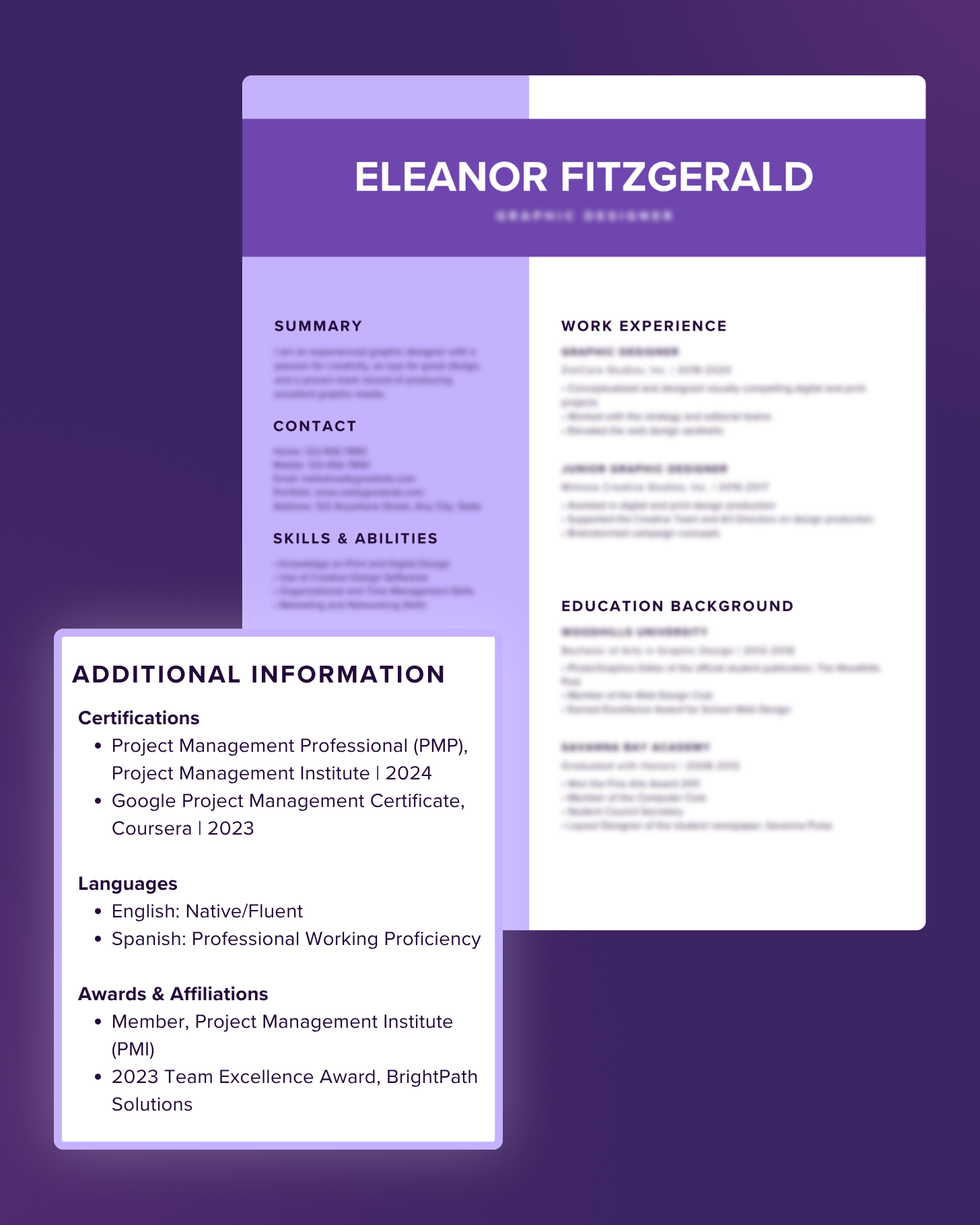
Here’s an example and a graphic showing how it might look on a resume:
Certifications
- Project Management Professional (PMP), Project Management Institute | 2024
- Google Project Management Certificate, Coursera | 2023
Languages
- English: Native/Fluent
- Spanish: Professional Working Proficiency
Awards & Affiliations
- Member, Project Management Institute (PMI)
- 2023 Team Excellence Award, BrightPath Solutions
How to Include Additional Information on Your Resume: Examples by Type
To include additional information on your resume, add relevant certifications, awards, projects, volunteer work, languages, or other supporting details in dedicated sections or within existing resume sections where they fit naturally.
Throughout this section, you’ll find tips for including different types of additional information on your resume, examples showing where they can be placed, and insights from Toni Frana, a career expert and Certified Professional Resume Writer (CPRW) at Monster.
Certifications & Licenses
“Including certifications and licenses on your resume, particularly when it’s a requirement for a role, is important because it allows for the hiring team to see with a glance that you meet the specific requirement for the position,” Frana shares.
Industry-mandated certifications, like CPR for healthcare workers or a CPA license for accountants, should almost always be included. Supplemental certifications, like online courses or specialized training, can help reinforce expertise and initiative.
Formatting tips:
- Include the certification name, issuing organization, and completion year.
- List required or industry-recognized certifications first.
- Use the same formatting style for every certification entry.
Example certifications and licenses section:
- Project Management Professional (PMP), Project Management Institute | 2024
- Google Project Management Certificate, Coursera | 2023
- Certified ScrumMaster (CSM), Scrum Alliance | 2022
Certifications can also be incorporated into skills or education sections when relevant, especially if you want to save space, you only have one certification to highlight, or your credentials aren’t required for the role, but you still want to highlight them.
Example of certifications in the skills section:
- Adobe Creative Suite (Photoshop, Illustrator, InDesign)
- Brand identity design
- Typography
- Social media graphics
- UI/UX fundamentals
- Adobe Certified Professional in Visual Design
- Cross-functional collaboration
- Feedback delivery and implementation
- Time management
Example of certifications in the education section:
Bachelor of Arts in Design and Psychology | Cleveland State University
Cleveland, OH | May 2026
- GPA: 3.8
- Relevant Coursework: Typography, UX Design, Digital Illustration, Consumer Psychology
- Certification: Adobe Certified Professional in Visual Design | 2025
Honors & Awards
“Adding honors and awards to your resume is a way to show proof of your leadership and performance successes,” said Frana. “Whether you include it in a separate section, or as part of your work experience, highlighting recognition for an achievement that’s relevant to the role you’re applying for gives employers more context about you and your abilities.”
Formatting tips:
- Include the award name, organization, and year received.
- Bold the name of major awards or honors if you want them to stand out.
- Keep award titles short and easy to scan.
Example honors and awards section:
- Top Sales Performer Award, Horizon Financial, Q3 2024
- Employee of the Year, BrightPath Solutions, 2023
- Dean’s List, University of Michigan, 2020–2022
In some cases, it might make more sense to include awards and honors under the educational institution or workplace wherein you received them.
Example of honors and awards in the education section:
Bachelor of Science in Marketing | University of Texas at Austin
Austin, TX | May 2026
- GPA: 3.8
- Honors: Dean’s List (2023–2025), Phi Beta Kappa Honor Society
Example of honors and awards in the work experience section:
Customer Service Representative
ClearPath Customer Support, Seattle, WA | June 2022–May 2026
- Resolved 50+ customer inquiries daily across phone and email channels.
- Maintained a 98% customer satisfaction rating for three consecutive quarters.
- Awarded Employee of the Year in 2025 for outstanding customer support performance.
Publications
“Employers are looking for candidates who embrace learning and have a growth mindset,” as Frana explained. “Having publications to share illustrates to them that you’re a thought leader and subject matter expert who possesses these skills.”
Formatting tips:
- Include the publication title, publication name, and date.
- Put publication titles in quotation marks and italicize the associated organization when appropriate.
- Use reverse-chronological order, starting with the most recent publication.
Example publications section:
- “5 Ways to Improve Agile Workflows,” ProjectLeader.com | January 2025
- “Improving Hybrid Team Communication,” HR Today magazine | March 2024
- “Data Visualization Trends in Healthcare,” Healthcare Analytics Journal | 2023
Depending on your career path and education, your publications may fit better under your work experience or education.
Example of publications in the work experience section:
Marketing Coordinator
Moose Media Association, Denver, CO | June 2022–Present
- Develop email and social campaigns that have increased audience engagement by 28%.
- Collaborate with cross-functional teams to support product launch strategies.
- Published “5 Ways to Improve Agile Workflows” on ProjectLeader.com in January 2025.
Example of publications in the education section:
Master of Public Health | University of North Carolina at Chapel Hill
Chapel Hill, NC | May 2025
- Research & Publications:
- “Data Visualization Trends in Healthcare,” Healthcare Analytics Journal, 2023
- “Improving Hybrid Team Communication,” HR Today magazine, March 2024
Speaking Engagements
Frana emphasizes the credibility that speaking engagements bring to your resume: “For management, training, consulting, or any other role that requires stakeholder communication, including speaking engagements on your resume can add value to your candidacy.”
Formatting tips:
- Include your role, event name, and year.
- Keep event names consistent in formatting and capitalization.
- List the most relevant or recognizable speaking engagements first.
Example speaking engagements section:
- Speaker, Women in Tech Leadership Summit, 2024
- Panelist, Remote Work Strategies Webinar Series, 2023
- Presenter, Annual Healthcare Operations Conference, 2022
Volunteer Work
Volunteer work can demonstrate leadership, initiative, teamwork, and transferable skills, especially for entry-level professionals or career changers.
“Volunteer work can be very valuable to include on your resume, either in a separate section or included with your work experience,” said Frana. “For example, if you’ve been on a career break and spent time volunteering, you can include a bullet or two in your work experience section to indicate relevant experience and skill-building through volunteer work.”
Formatting tips:
- Include your volunteer title, the organization name, and dates involved.
- Add bullet points if the experience included major responsibilities or achievements.
- Consider formatting volunteer entries similarly to work experience entries.
Example volunteer work section:
- Volunteer Coordinator, Pittsburgh Community Food Drive | 2022–Present
- Mentor, Big Brothers Big Sisters Program | 2021–Present
- Fundraising Volunteer, American Cancer Society | 2020–2022
Volunteer work can be included in your work experience section if it’s highly relevant to the role, fills employment gaps, or represents a significant time commitment. Likewise, if your volunteer experience is closely connected to your academic background, leadership activities, or field of study, it can fit naturally within your education section.
Example of volunteering in the work experience section:
Volunteer Coordinator
Pittsburgh Community Food Drive, Pittsburgh, PA | 2022–Present
- Coordinate schedules and assignments for 25+ volunteers during weekly food distribution events.
- Organize donation collection and inventory tracking to support efficient food distribution for local families.
- Assist with community fundraising and outreach efforts that have increased volunteer participation and donations.
Example of volunteering in the education section:
Bachelor of Science in Sociology | Slippery Rock University
Pittsburgh, PA | May 2024
- GPA: 3.6
- Volunteering:
- Peer Mentor, First-Year Student Success Program | 2022–2024
- Volunteer Coordinator, Pittsburgh Community Food Drive | 2022–Present
Professional Affiliations & Memberships
“Professional involvement and memberships show an employer a commitment to your industry and that you take initiative to grow and develop in your field,” noted Frana. “Including this information on your resume highlights this involvement in an easy-to-see way for an employer.”
It’s also important to note that professional affiliations on resumes can also reinforce important keywords for applicant tracking system (ATS) scans.
Formatting tips:
- Include the full organization name in addition to abbreviations.
- Use a simple list format and avoid adding excessive details unless you’re an active contributor with results to highlight.
- Prioritize memberships most relevant to your industry or career goals.
Example professional affiliations section:
- Member, Project Management Institute (PMI)
- Member, Society for Human Resource Management (SHRM)
- Member, American Marketing Association (AMA)
Languages With Proficiency Levels
Include language skills when they’re relevant to the role, especially for client-facing, regional, multilingual, or global positions. Be specific and honest about your proficiency level, as “putting language skills on your resume can be a differentiator, especially for roles that include client interaction and/or working with a globally distributed team,” Frana shares.
Common proficiency levels include:
- Native or Bilingual Proficiency
- Fluent or Full Professional Proficiency
- Professional Working Proficiency
- Limited Working Proficiency
- Elementary Proficiency
Formatting tips:
- Include both the language and your proficiency level.
- Use consistent proficiency labels throughout the section.
- List stronger language skills before beginner-level languages.
Example languages section:
- English: Native
- Spanish: Professional Working Proficiency
- French: Limited Working Proficiency
If you need to conserve space, languages aren’t as relevant for the role, or you only want to add one, languages can also go in your skills section.
Example of languages in the skills section:
- Customer service
- CRM software
- Phone, email, and chat support
- Conflict resolution
- Verbal communication
- Active listening
- Problem-solving
- Time management
- English and Hindi: Bilingual
Training & Continuing Education
Include relevant workshops, seminars, bootcamps, or online courses when they support your qualifications or demonstrate continued learning.
As Frana shared, “Showing training and coursework you’ve completed adds value to your candidacy, especially if there’s relevancy to the role you’re applying to. As some roles require continuing education credits, this section is a good way to highlight those classes as well.”
Formatting tips:
- Include the course name, provider, and completion year.
- Group similar training programs together when possible.
- Keep course entries concise and relevant to the role.
Example training and continuing education section:
- AI for Business Professionals, LinkedIn Learning | 2025
- Advanced Excel Workshop, General Assembly | 2024
- UX Design Fundamentals, Coursera | 2023
Training and continuing education can also be incorporated into an education or certifications section when relevant.
Example of training and continuing education in the education section:
Bachelor of Science in Business Administration | Arizona State University
Tempe, AZ | May 2024
- Relevant Training:
- AI for Business Professionals, LinkedIn Learning | 2025
- Advanced Excel Workshop, General Assembly | 2024
Example of training and continuing education in the certifications section:
- Google Data Analytics Certificate | Coursera | 2024
- UX Design Fundamentals | Coursera | 2023
- Project Management Essentials | LinkedIn Learning | 2025
Testimonials & Endorsements
“Testimonials and endorsements offer ‘social proof’ of your results,” said Frana. “For consulting, freelance, or project-based roles, including a testimonial or endorsement from a client can make an impact.”
Formatting tips:
- Keep testimonials short and focused on results or strengths.
- Include the name and title of the person giving the endorsement.
- Use quotation marks to separate testimonial text clearly.
Example testimonials and endorsements section:
- “Consistently delivered projects ahead of schedule while improving team communication.” —Sarah Nguyen, Senior Operations Manager, Keystone Operations Group
- “An exceptional problem-solver with strong leadership and organizational skills.” —Michael Torres, Director of Marketing, Good Work Co.
Testimonials may fit more naturally within work experience or education sections, depending on the context.
Example of testimonials and endorsements in the work experience section:
Freelance Graphic Designer
GlitzGlam Creative Studio, Seattle, WA | January 2021–Present
- Develop branding and digital marketing assets for startups and nonprofit organizations.
- Manage multiple client projects simultaneously while meeting tight turnaround deadlines.
- Client Feedback: “An exceptional designer who consistently delivered polished, creative work ahead of schedule.” —Rachel Kim, Founder, Brightline Creative Studio
Example of testimonials and endorsements in the education section:
Bachelor of Arts in Communications | Temple University
Philadelphia, PA | May 2024
- GPA: 3.8
- Faculty Endorsement:
- “Demonstrated outstanding leadership, collaboration, and presentation skills throughout multiple group research projects.” —Dr. Emily Carter, Communications Department
Hobbies & Interests
“Hobbies and interests can be valuable when they’re particularly relevant to the role you’re applying to, or if they’re related to the company’s mission, vision, or values,” Frana said. Only include them when they reinforce relevant skills, demonstrate leadership or discipline, or align with company culture.
Formatting tips:
- Keep hobbies professionally relevant.
- Use bullet points or a short list for readability.
- Prioritize interests that demonstrate transferable skills or leadership.
Example hobbies and interests section:
- Mentoring junior project coordinators through local PMI networking groups
- Organizing community fundraising and event planning initiatives
- Leading cross-functional volunteer teams for nonprofit events
Projects & Portfolio Work
Projects and portfolio work can be especially valuable for students, freelancers, creatives, and professionals in technical fields.
Frana added, “Early career professionals or career changers may consider including relevant projects on their resume. Linking a portfolio of your work can be a helpful tool to show an employer your ability to demonstrate the key skills required to do the job successfully.”
You can also include projects that demonstrate relevant skills, measurable impact, or hands-on experience.
Formatting tips:
- Include the project name, year, and a short description of the outcome or purpose.
- Start project descriptions with action verbs when possible.
- Include measurable results or tools used if they strengthen the example.
Example projects section:
- Personal Finance Budgeting App | 2024: Created a budgeting application using Python and SQL to track expenses, analyze spending patterns, and generate monthly financial reports.
- UX Portfolio Website | 2023: Built a personal portfolio website featuring UX case studies, branding projects, and responsive web design examples.
- Nonprofit Fundraising Initiative | 2022: Managed a cross-functional volunteer fundraising campaign that raised $15,000 for local nonprofit organizations.
Projects can also be incorporated into work experience or education sections when relevant. The examples below showcase how this might look.
Example of projects in the work experience section:
Website Designer
Beautiful Site Solutions, Austin, TX | June 2022–Present
- Design and update responsive websites for small business clients across retail and healthcare industries.
- Collaborate with clients to improve site navigation, branding consistency, and user experience.
- Led a website redesign project in 2024 that improved mobile conversion rates by 18%.
Example of projects in the education section:
Bachelor of Science in Computer Science | University of Colorado Boulder
Boulder, CO | May 2025
- GPA: 3.7
- Academic Projects:
- Personal Finance Budgeting App | 2024: Created a budgeting application using Python and SQL to track expenses and generate monthly financial reports.
- UX Portfolio Website | 2023: Built a responsive portfolio website featuring UX case studies and branding projects.
Multiple Types Under an Additional Information Section
If you have several types of relevant information to include, you can group them under a single “Additional Information” section instead of breaking each into its own standalone category. This approach works especially well when you only have a few entries per category or want to save space on your resume.
As Frana explains, “For relevant information that should be included on your resume but isn’t necessarily enough to warrant its own separate section, you can create an additional information section to highlight the most important and relevant ‘extras’ outside of your work experience.”
Strategically grouping information can help keep your resume concise while still showcasing certifications, languages, awards, affiliations, volunteer work, and other supporting qualifications.
Formatting tips:
- Use clear subheadings to separate different categories.
- Consider using a two-column resume format so the information doesn’t take up too much space.
- Maintain consistent spacing, formatting, and date styles throughout the section.
Example additional information section:
Certifications
- Certified Sales Leadership Professional (CSLP), National Association of Sales Professionals (NASP) | 2023
- HubSpot Inbound Sales Certification | 2024
Languages
- English: Native Proficiency
- Portuguese: Professional Working Proficiency
Professional Affiliations
- Member, National Association of Sales Professionals (NASP)
Volunteer Work
- Volunteer Mentor, Dress for Success Career Readiness Program | 2021–Present
Awards
- Top Regional Sales Manager Award, Summit Peak Sales | 2024
- President’s Club Recipient, Summit Peak Sales | 2022, 2023
Examples of Additional Information Sections by Career Stage
The best additional information on resume examples will vary depending on your experience level, career goals, and professional background. Here are examples tailored to different career stages and situations:
Entry-Level Professional or New Grad
For entry-level professionals and recent graduates with little to no experience, additional information sections can help compensate for limited work experience by highlighting transferable skills, leadership experience, coursework, volunteer work, and extracurricular involvement.
For example:
Volunteer Work
- Peer Mentor, First-Year Student Success Program | 2023–2024
- Volunteer Event Coordinator, Local Food Bank Fundraiser | 2022–Present
Languages
- English: Native/Fluent
- Spanish: Professional Working Proficiency
Relevant Coursework
- Data Analytics
- Digital Marketing Strategy
- Business Communication
Hobbies & Interests
- Managing a personal finance blog
- Organizing campus networking events
- Creating social media content for student organizations
Experienced Professional
Experienced professionals can use additional information sections to reinforce industry expertise, professional involvement, certifications, publications, and measurable accomplishments.
For example:
Certifications
- Project Management Professional (PMP), Project Management Institute | 2025
- Certified ScrumMaster (CSM), Scrum Alliance | 2024
Professional Affiliations
- Member, Project Management Institute (PMI)
- Member, Scrum Alliance
Publications
- “Improving Cross-Functional Collaboration,” ProjectLeader.com | 2024
- “Scaling Agile Teams Successfully,” Agile Business Review | 2023
Awards
- Leadership Excellence Award, Riverview Solutions | 2024
- Top Operations Manager Award, Northstar Consulting Group | 2022
Career Changer
Career changers should focus on certifications, training, projects, and transferable experience that demonstrate commitment to the new field and help bridge experience gaps.
For example:
Training & Certifications
- Google Data Analytics Certificate, Coursera | 2025
- SQL for Data Analysis, LinkedIn Learning | 2024
Volunteer Work
- Volunteer Data Coordinator, Community Health Alliance | 2023–Present
Projects
- Sales Dashboard Project | 2025: Built an interactive Tableau dashboard analyzing quarterly sales trends and customer retention metrics.
- Customer Insights Analysis | 2024: Used Excel and SQL to analyze purchasing behavior and identify revenue opportunities.
Professional Development
- Member, Women in Data Organization
Professional Returning to the Workforce
Professionals returning to the workforce can use additional information sections to showcase continued learning, volunteer leadership, recent training, and projects that demonstrate active skill development.
For example:
Volunteer Work
- PTA Fundraising Chair | 2021–2024
- Volunteer Coordinator, Community Holiday Drive | 2022–Present
Training & Continuing Education
- Digital Marketing Foundations, Coursera | 2025
- Advanced Excel Workshop, LinkedIn Learning | 2024
Professional Affiliations
- Member, American Marketing Association (AMA)
Projects
- Small Business Social Media Campaign | 2024: Developed a social media content strategy that increased engagement by 35% over three months.
Professional With Employment Gaps
For professionals with employment gaps, additional information sections can help highlight volunteer experience, certifications, projects, and continued education completed during periods away from traditional employment.
For example:
Volunteer Work
- Operations Volunteer, Habitat for Humanity | 2022–2024
- Career Mentor, Local Workforce Development Program | 2023–Present
Certifications
- Certified Associate in Project Management (CAPM), Project Management Institute | 2024
Training & Continuing Education
- Business Analytics Essentials, Coursera | 2023
- Excel for Business Professionals, Udemy | 2023
Projects
- Community Fundraising Initiative | 2024: Coordinated a volunteer fundraising campaign that raised $12,000 for local nonprofit organizations.
Key Formatting Tips for Including Additional Information on Resumes
Your additional information section should be easy to scan, concise, and visually consistent with the rest of your resume. If you’re including multiple types of information, such as certifications, languages, volunteer work, or awards, follow these formatting guidelines:
Use clear subheadings. Separate categories like certifications, volunteer work, languages, or awards with clear labels to make the section easier for recruiters and ATS to scan.
Keep entries concise. Use bullet points or short lines instead of long paragraphs so hiring managers can quickly identify relevant qualifications and supporting details.
Match the rest of your resume formatting. Keep font styles, spacing, bullet formatting, punctuation, and date conventions consistent so the section feels polished and integrated with the rest of your resume.
Quantify accomplishments when possible. Include measurable details, such as fundraising totals, audience size, volunteer hours, certifications earned, or project results, to better demonstrate impact and credibility.
Focus only on relevant details. Include information that strengthens your qualifications, supports your fit for the role, or adds meaningful context to your experience rather than filler content.
 Pro Tip
If you’re unsure how to format additional information cleanly, resume templates and Monster’s Resume Builder can help you organize certifications, projects, volunteer work, and other supporting details in a polished, ATS-friendly format.
Common Mistakes to Avoid When Adding Additional Information to Your Resume
Your additional information section should strengthen your resume, not distract from it. Here are some of the most common pitfalls to avoid:
Sharing personal details: Leave out personal demographic information, like age, marital status, religion, or photos.
Listing irrelevant hobbies: Only include hobbies and interests that reinforce relevant skills or fit the role or company culture.
Repeating information: Avoid listing skills, accomplishments, or qualifications already covered elsewhere on your resume.
Including outdated awards or certifications: Remove older or less relevant credentials that no longer strengthen your application.
Adding filler content: Don’t use the section just to fill space on your resume.
Inflating language skills: Be honest and specific about your language proficiency levels.
Using vague or unverified claims: Avoid generic statements or accomplishments that can’t be backed up with context or examples.
Use Additional Information to Strengthen Your Resume
Knowing what to add in additional information on resumes can help you strengthen your application beyond your core work history. No matter the information you include, your ultimate goal should be to reinforce your qualifications and provide context that helps your resume stand out and tells employers, “I’m the candidate you want to hire.”
If you choose to include additional information on resumes, always focus on relevant, high-value details that add something meaningful to your application, and place them where they fit most naturally within your resume structure. And once it’s complete, you can upload your resume to Monster and get matched with jobs that fit your wants and needs.
Frequently Asked Questions
What should I put for additional information on my resume?
The additional information section on a resume can include certifications, languages, volunteer work, awards, publications, professional memberships, relevant coursework, or hobbies and interests that support your qualifications. Focus on details that strengthen your application or add context to your experience, rather than unrelated personal information.
Do employers actually read the additional information section?
Yes, employers often read the additional information section when it adds value to your application. Hiring managers may look for certifications, languages, volunteer experience, technical proficiencies, or other details that help differentiate candidates and show alignment with the role.
Should I include hobbies in additional information?
You can include hobbies in additional information if they’re relevant, professional, or help showcase transferable skills. For example, leadership roles in community organizations, managing a blog, or participating in competitive activities can highlight communication, organization, or teamwork skills.
How long should the additional information section be?
The additional information section should usually be short and easy to scan, typically three to six bullet points or a few concise categories. Include only details that support your qualifications, strengthen your resume, or provide meaningful context for the role.
What’s the difference between additional information and a skills section?
A skills section focuses specifically on job-related abilities, such as software, technical skills, or workplace competencies. An additional information section is broader and can include certifications, volunteer work, languages, awards, publications, interests, or other supporting details that don’t fit elsewhere on your resume.
Can I use additional information to fill an employment gap?
Yes, you can use additional information to help explain employment gaps if you completed certifications, freelance work, volunteer work, coursework, caregiving responsibilities, or professional development during that time. Including relevant activities can show continued growth and engagement, even outside of traditional employment.

Kirsten Chorpenning is a career advice writer who empowers job seekers to take control of their career paths using Monster’s comprehensive job search and resume tools. She specializes in helping job seekers find rewarding jobs in today’s dynamic work environment.
See More From Kirsten ChorpenningExplore Related Career Advice

Overqualified Hiring Stats: 57% Would Cut Resume Experience to Get Hired

Updated:
Sep 28, 2026
|
9 min read

20 First Job Interview Questions & Sample Answers: Tips to Land Your First Job
Updated:
Sep 24, 2026
|
20 min read

“Do You Have Any Questions for Me?” How to Answer in an Interview (30 Examples)
Updated:
Sep 18, 2026
|
14 min read



20 Companies That Pay 100% Health Insurance & Other Top Benefits
Updated:
Sep 10, 2026
|
14 min read


How Long of a Commute Is Too Long? 49% Have Turned Down a Job Due to the Commute
Updated:
Sep 8, 2026
|
11 min read

Manage Your Career Like an Expert
Take control of your professional journey with Monster’s expert resources. Explore advice, research, and tips to make informed decisions and advance your career with confidence.

Job Search
Discover strategies to get noticed, network effectively, and streamline your job search process.

Resumes
Get practical tips to create a resume or CV that stands out to employers and wins interviews.

Cover Letters
Learn how to craft a compelling cover letter that highlights your experience and fit for the role.

Career Paths
Explore career paths, industry trends, and growth opportunities to plan your next move.

Interviewing
Prepare for interviews with tips on answering common questions and following up effectively.

Career Development
Develop key skills and knowledge to grow in your current role or pivot to new opportunities.

Leaving a Job
Navigate job changes and career transitions with practical advice and planning resources.