
How to Write Resume Bullet Points That Get Interviews

Learn how to write powerful resume bullet points that highlight your value, pass ATS software, and land more interviews.
Updated:
|

19 min read

Table of Contents


Hiring managers review hundreds of applications daily, rapidly deciding which candidates will move on. If your resume consists of dense paragraphs, you risk burying your best achievements.
To pass modern applicant tracking systems (ATS) and capture an employer’s attention, you need to learn how to write resume bullet points that highlight your value.
This guide explains how to properly use bullet points, how many to use, where to put them, and how to format them. We also provide helpful resume bullet point examples and answer some common questions about using bullet points.
Why Should You Use Bullet Points in a Resume?
Bullet points are the gold standard for resume formatting because they:
- Facilitate rapid scanning: Recruiters can quickly identify your key skills and wins. Organizing your experience into structured lists allows recruiters to instantly zero in on the exact qualifications they need.
- Improve readability: They break up text walls, making your document more inviting to read. Adding white space around concise statements creates a clean, professional look that naturally guides the reviewer’s eye down the page.
- Aid in ATS scanning: Bullet points are scannable by ATS software. Many organizations rely on this automated software to parse incoming resumes for relevant keywords before human review. Structuring your data cleanly boosts your chances of passing this initial digital screening.
- Isolate specific wins: Dedicating a separate line to a specific milestone emphasizes its importance and draws direct attention to your measurable impact. This highlights the unique value you bring beyond basic job requirements.
The Anatomy of a Strong Bullet Point: The APR Formula
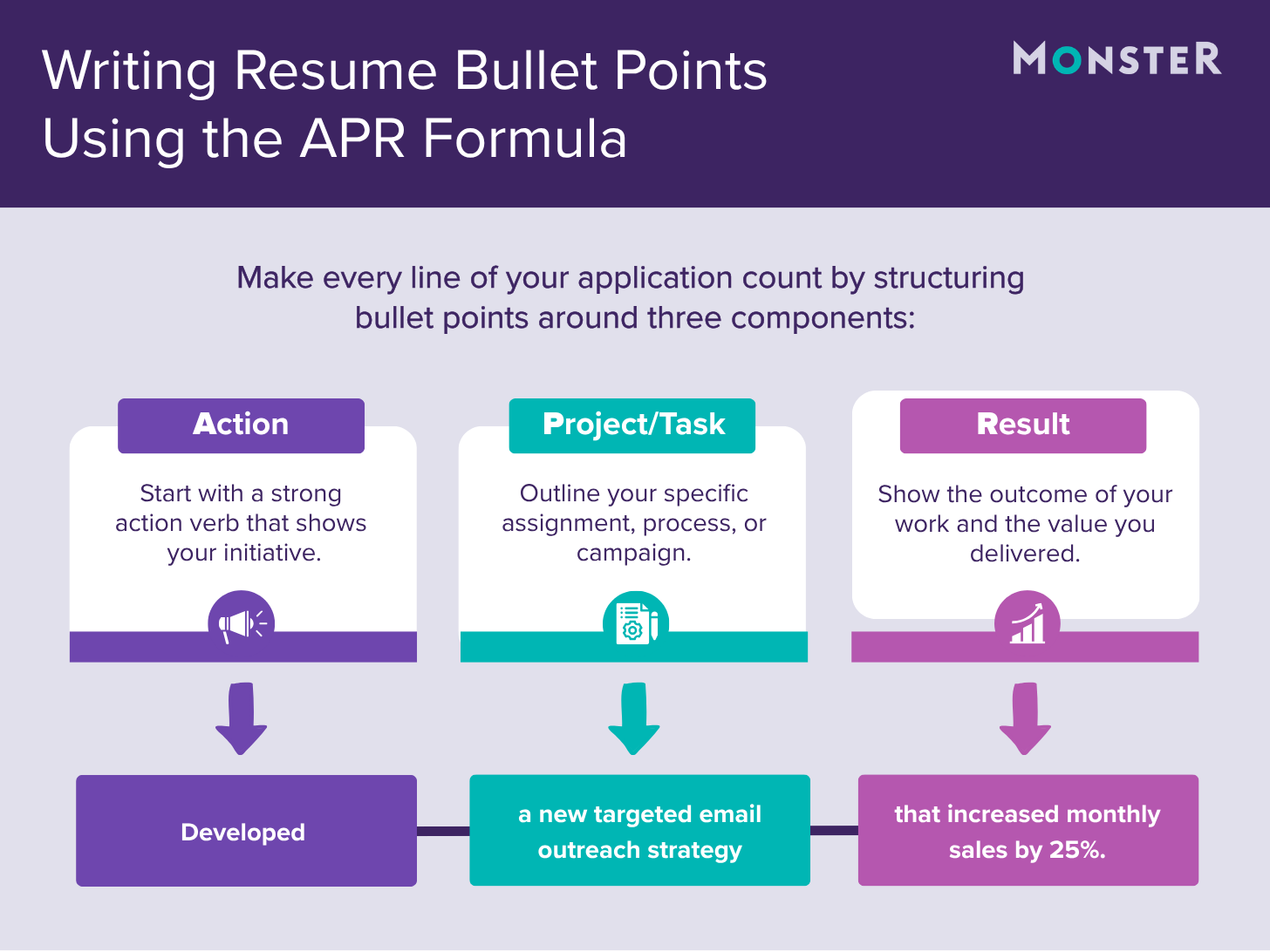
To ensure every line on your application works for you, use the APR formula. This formula breaks down the structure of a perfect bullet point into three distinct components: action, project/task, and result.
- 1.
Action: Start every bullet point with a dynamic action verb rather than passive phrases like “responsible for” or “duties included,” which merely reiterate a basic job description. Action verbs like “spearheaded,” “developed,” or “optimized” immediately demonstrate your initiative and frame you as an active achiever.
- 2.
Project/Task: This provides the necessary context by outlining the specific assignment, process, or campaign you handled.
- 3.
Result: The result showcases the outcome of your work, proving the tangible benefit, success, and value you delivered to the organization.
Action Verbs by Skill Category
Using the right action verbs tailors your resume’s language to reflect specific roles and helps you stand out to human recruiters while passing ATS. Many employers use ATS to filter out applications that lack resume keywords while highlighting resumes with terms they want to see.
Below are effective action verbs for different skill categories. Start each bullet with one to show impact:
- Achievement-focused: Accelerated, exceeded, generated, maximized, outperformed, propelled, secured, slashed, surpassed, tripled
- Communication: Advocated, articulated, authored, clarified, corresponded, facilitated, mediated, negotiated, persuaded, presented
- Creative: Brainstormed, composed, conceptualized, customized, designed, devised, illustrated, redesigned, storyboarded, visualized
- Leadership: Championed, cultivated, delegated, directed, executed, mentored, orchestrated, spearheaded, steered, supervised
- Research: Analyzed, assessed, audited, diagnosed, evaluated, forecasted, investigated, modeled, quantified, synthesized
- Technical: Architected, automated, configured, debugged, deployed, engineered, integrated, optimized, programmed, upgraded
How to Quantify Your Impact
To see how to put this into practice, the table below contrasts vague, responsibility-driven bullet points with strong, specific bullets that have been upgraded using the APR framework.
As you read through the rows, observe how the improved examples in the right column are carefully constructed around three core elements:
- Action: The specific steps you took to solve a problem or complete a task.
- Project: The scope, context, or scale of the work involved.
- Result: The hard numbers or measurable data that prove your effectiveness.
| Task | Vague Bullet | Specific Bullet |
| Improving sales | Responsible for improving sales. | Developed a new targeted email outreach strategy that increased monthly sales by 25%. |
| Customer service and support | Answered customer phone calls and solved their issues. | Resolved over 50 daily customer issues, achieving a 98% satisfaction rating. |
| Social media and marketing | Managed the company’s social media accounts and posted new content. | Spearheaded a cross-platform social media campaign that grew audience engagement by 40% over three months. |
| Administrative and process improvement | Responsible for organizing files and making things run better. | Streamlined digital filing protocols, saving the administrative team 10 hours of manual work per week. |
| Business development | Worked on selling software to new clients. | Negotiated and closed 15 new enterprise software contracts, generating $150K. |
How to Use Metrics to Elevate Your Resume
By quantifying your work, you transform a generic list of duties into a compelling, measurable track record of success. While some fields lend themselves to easy metric inclusions, like sales, almost all positions have some means of quantifying success.
When listing your achievements, consider incorporating one of the four core types of metrics:
- Money: Did you increase revenue, cut costs, or manage a budget? Highlighting financial impact always grabs attention (e.g., “generated $50K in new sales” or “reduced operating costs by 15%”).
- Time: Did you save time, speed up a process, or meet tight deadlines? Efficiency is highly valued by employers (e.g., “decreased onboarding time by two weeks” or “delivered the project three days ahead of schedule”).
- Volume: How many people, items, or accounts did you manage? Scale gives context to your responsibilities (e.g., “led a team of 10 developers” or “resolved 50+ customer tickets daily”).
- Percentages: Did you improve efficiency, grow an audience, or increase satisfaction rates? Percentages show relative impact and growth, proving your value even if you don’t have access to exact financial data or large volume numbers (e.g., “increased organic web traffic by 40%” or “boosted client retention by 25%”).
Determining the Right Number of Bullet Points for Resumes
The length of your work history will help you determine the right number of bullets for each role. Focus on highlighting specific, high-impact wins for your most recent positions, while scaling back details for older roles to maximize your resume’s impact.
Entry-Level (0–2 Years)
If you’re a new industry professional or have limited work experience, focus on 3–5 bullets per role. Emphasize transferable skills and academic achievements.
Here are some resume bullet point examples for recent graduates:
- Spearheaded a targeted social media campaign during a summer marketing internship, increasing engagement by 20%.
- Analyzed a dataset of 10,000+ customer records for a senior capstone project, identifying trends that modeled a 15% increase in potential revenue.
- Optimized digital filing system across 3 departments as an office assistant, reducing server storage usage by 34%.
Mid-Level (3–10 Years)
After you’ve progressed in your career, aim for 5–7 bullets for your most recent roles. Leverage your professional accomplishments, focusing on your core contributions and growth.
Mid-level career bullet points will look something like this:
- Directed a cross-functional team of 8 to launch a new software feature and generated $120K in Q1 revenue.
- Engineered an automated reporting dashboard, reducing reporting errors by 25%.
- Led a campaign that slashed annual software procurement costs by 18% and saved the company $45,000 overall.
- Completed a website redesign that boosted organic traffic by 40% and increased conversion rates by 12% over 6 months.
- Maximized supply chain efficiency by auditing 50+ vendor accounts, implementing a new tracking system that improved on-time delivery from 85%–98%.
Senior/Executive (10+ Years)
Senior or executive-level applications can include 7–10 bullets to demonstrate strategic impact, leadership, and long-term results. This amount of detail is needed to convey the high-level impact expected of executive personnel.
Bullet points for a senior-level application will resemble the following:
- Oversaw a global market expansion strategy, generating $15M in new annual recurring revenue.
- Orchestrated a company-wide digital transformation for 500+ employees, reducing operational costs by 22% within 18 months.
- Cultivated a high-performing department of 45 software engineers, reducing turnover by 30% over 2 years.
- Directed the post-merger integration of 2 regional competitor acquisitions, capturing $5M in synergistic savings.
- Presented quarterly financial forecasts to the board of directors, securing $10M in funding by articulating a clear growth strategy.
- Steered a comprehensive corporate restructuring initiative across 4 regional offices, saving the organization $2.5M annually.
- Championed a centralized enterprise data governance framework for a Fortune 500 client, achieving 100% regulatory compliance.
Monster’s resume templates are pre-formatted examples that show the ideal number of bullet points and offer professional formatting, so you can quickly fill out your work experience with high-impact achievements.
Optimizing Keywords for ATS: Before & After Examples
To rank higher in an ATS, naturally integrate the exact keywords found in the job description directly into your resume bullet points. When your language mirrors the employer’s requirements, you clearly signal relevance to both automated systems and human recruiters.
Start by reviewing the job posting and identifying keywords in:
- The required skills section
- The preferred or optional qualifications section
- The role description itself
Once you’ve identified the most important terms, look for places where they genuinely reflect your experience and incorporate them into your bullets without forcing them.
The examples below show how the same experience becomes more ATS-friendly and recruiter-readable when keywords are integrated naturally into high-impact bullet points.
| Role | Before: Vague Bullet (Missing Keywords) | After: Specific Bullet Point (Keywords Integrated) |
| Sales | Responsible for calling customers and making sales. | Generated $85K in revenue by executing a targeted B2B cold-calling strategy, consistently exceeding quarterly sales quotas by 15%. |
| Administrative | Handled scheduling and ordered materials. | Managed executive scheduling across three time zones and negotiated vendor contracts, reducing office supply costs by 12%. |
| Customer Service | Answered tickets and helped customers with problems. | Resolved 60+ daily support tickets using Salesforce Service Cloud, maintaining a 99% CSAT and reducing average response time by 20%. |
Industry-Specific Resume Bullet Point Examples
Use these concise resume bullet point examples from various industries to inspire high-impact statements on your own resume.
Administrative Resumes
Administrative roles are the backbone of well-running office environments. These bullets show how to highlight organizational skills, time-saving automation, and vendor management capabilities.
- Streamlined digital and physical filing systems for over 5,000 client records, reducing document retrieval time by 30%.
- Corresponded with 40+ external vendors and clients daily via email and phone, resolving billing inquiries and maintaining a 24-hour response rate.
- Automated data entry for weekly expense reports using Excel macros, saving the administrative team 5 hours of manual work per week.
- Managed the office supply inventory for a 50-person staff, sourcing a new supplier to cut quarterly supply costs by 15%.
- Coordinated the scheduling of 3 conference rooms, eliminating double-bookings and ensuring seamless meetings for the executive team.
Cashier Resumes
Cashiers are often the final touchpoint for a customer, making speed and accuracy paramount. These examples demonstrate how to highlight register precision, high-volume efficiency, and interpersonal and communication skills.
- Processed over 150 transactions daily with 100% drawer accuracy, consistently balancing the register within 3 minutes of shift close.
- Persuaded 40+ customers per week to sign up for the store loyalty program, ranking in the top 5% of cashiers regionally for new enrollments.
- Scanned and bagged up to 30 items per minute during peak holiday hours, reducing checkout line wait times by an estimated 15%.
- Clarified store return policies and promotional discounts for 50+ customers daily, minimizing checkout confusion and manager escalations.
- Trained 3 new cashiers on the updated sales system and counterfeit bill detection, getting them fully autonomous 2 days faster than average.
Finance Resumes
Finance professionals should let the numbers speak for themselves. These examples show how to highlight expertise in identifying cost savings, forecasting trends, and improving reporting accuracy.
- Forecasted quarterly revenue trends using advanced Excel modeling, identifying a $100K budget surplus that was reallocated for marketing.
- Reconciled 500+ monthly corporate accounts, identifying and resolving billing discrepancies to recover $15K in lost revenue.
- Analyzed client investment portfolios valued at $5M+, yielding an average annual return of 12% vs the market standard of 8%.
- Streamlined the month-end financial close process, cutting reporting time by 3 days and improving data accuracy by 15%.
- Audited annual expense reports for a 50-person department, discovering inefficiencies and reducing operational overhead by 10%.
General Laborer Resumes
For general labor positions, employers prioritize safety, reliability, and efficient physical work. These examples quantify role output, logistical efficiency, and commitment to workplace standards.
- Executed daily loading and unloading of 50+ pallets of inventory, adhering to strict safety standards with no workplace injuries.
- Operated heavy machinery, including forklifts and pallet jacks, to organize a 10,000 sq. ft warehouse, improving picking efficiency by 20%.
- Inspected inbound materials for defects, identifying and rejecting 15+ damaged shipments before they entered the production line.
- Collaborated with a crew of 12 to complete a commercial construction site clean-up, finishing the project 2 days ahead of schedule.
- Maintained and serviced essential power tools and equipment weekly, reducing unexpected mechanical downtime by 25% over 6 months.
Healthcare Resumes
Healthcare resumes need to balance compassionate patient care with operational precision. These examples showcase the ability to improve clinical workflows, maintain compliance, and enhance patient outcomes.
- Evaluated patient triage workflows in a high-volume ER, streamlining intake procedures and reducing average patient wait times by 20%.
- Administered daily care plans for 15+ acute care patients, achieving a 99% accuracy rate in medication charting and documentation.
- Mentored 5 incoming nursing residents on electronic health record (EHR) software, cutting their onboarding time by a full week.
- Audited medical supply inventory across 3 departments, negotiating with vendors to slash quarterly procurement costs by 12%.
- Facilitated weekly health education workshops for 30+ diabetic patients, improving overall medication adherence rates by 25%.
IT Resumes
In the tech world, employers want to see how you improve system efficiency, bolster security, and solve complex problems. These bullets demonstrate how to quantify your technical prowess and infrastructure improvements.
- Engineered a cloud migration strategy for legacy systems, eliminating server downtime and saving $20K in annual hosting costs.
- Automated daily data backup processes using Python scripts, reducing manual workload by 10 hours per week and ensuring 100% data compliance.
- Resolved an average of 45 Tier 2 technical support tickets daily, maintaining a 98% user satisfaction rate and decreasing resolution time by 15%.
- Upgraded cybersecurity protocols across 200+ company devices, thwarting 3 major phishing attempts with 0 data breaches.
- Configured and deployed new internal networking hardware across 2 regional offices, finishing the project 2 weeks ahead of schedule.
Marketing Resumes
Marketing roles are all about driving engagement and generating revenue. These examples highlight how to convey impact on campaigns, audience growth, and bottom-line metrics.
- Spearheaded a multichannel digital campaign, increasing inbound leads by 35% and generating $50K in new pipeline revenue within Q2.
- Conceptualized and executed a social media content strategy across Instagram and TikTok, growing audience engagement by 45% in 6 months.
- Analyzed weekly email marketing metrics to optimize testing, boosting average open rates from 18% to 28%.
- Orchestrated a product launch event for 300+ industry professionals, securing 15 media placements and trending on social channels.
- Authored 20+ blog posts per month, driving a 50% increase in organic website traffic over a year.
Restaurant Resumes
Restaurant roles require thriving in high-pressure environments while maximizing shift revenue. These bullets highlight the ability to handle heavy volume, upsell menu items, and control food costs.
- Directed front-of-house operations during dinner rushes of 200+ covers, optimizing table turnover rates by 15% without sacrificing service quality.
- Spearheaded a new daily specials menu by analyzing local dining trends, increasing appetizer sales by 25% over 3 months.
- Trained 5 new servers on sales systems and allergy protocols, achieving a 100% safety compliance rate and no order errors.
- Negotiated fresh produce deliveries with 3 local farm vendors, slashing weekly food costs by 12% while improving ingredient quality.
- Maximized beverage sales by upselling premium wine pairings, boosting individual shift revenue by an average of $150.
Retail Resumes
Retail managers and associates need to prove their ability to drive sales while keeping the floor running smoothly. Tailor these bullets to showcase success in exceeding revenue targets, managing inventory, and handling customers.
- Exceeded monthly sales targets by 20% consistently over 6 months, generating $15K in additional revenue for the apparel department.
- Redesigned store window displays and endcaps, increasing foot traffic by 15% and boosting promotional item sales by 30%.
- Supervised a team of 8 sales associates during peak holiday shifts, ensuring 100% floor coverage and no customer complaints.
- Audited weekly inventory deliveries of 1,000+ units, reducing stock discrepancies by 18% and preventing product shrinkage.
- Resolved complex customer returns and exchanges, maintaining a 95% customer retention rate and minimizing negative online reviews.
Service Industry Resumes
The service industry thrives on exceptional customer experiences and seamless operations. These examples illustrate how to quantify impact on guest satisfaction, team coordination, and upselling.
- Facilitated the onboarding of 10 new service staff members, developing a training manual that reduced training time by 20%.
- Managed front-desk operations for a 200-room hotel, checking in 50+ guests daily while maintaining a 4.8 out of 5-star guest satisfaction rating.
- Maximized upselling opportunities during routine service calls, increasing average transaction value by 15% over 3 months.
- Coordinated schedules for a team of 15 event staff members, ensuring seamless execution for weekend weddings of up to 300 guests.
- Resolved high-stress customer complaints swiftly and professionally, turning 90% of dissatisfied clients into repeat customers.
Bullet Point Formatting Best Practices
Follow these visual rules to keep your document professional:

Keep it brief. Limit to one to two lines.
Use standard symbols. Stick to simple circles or squares to ensure ATS compatibility.
Stay consistent. Use the same punctuation style throughout.
Front-load wins. Place your most impressive achievements at the top of each list.
Common Resume Bullet Point Mistakes
Avoid these common mistakes to keep your application competitive:

Listing daily tasks instead of achievements: Explain what you achieved instead of listing daily duties.
Using weak verbs: Bypass terms like “helped” or “assisted” and utilize “collaborated” or “supported” instead.
Being too generic: Tailor your details to the specific job you want.
Using inconsistent grammar: Use sentence fragments rather than full grammatical sentences, and apply them consistently.
Copying the same bullets: Focus on different aspects of the role for each entry. Even if your job titles were identical, your accomplishments likely weren’t.
Make Every Bullet Count
Stop listing duties and start highlighting achievements. Using the APR formula, strong action verbs, relevant resume keywords, and measurable results, your bullet points turn your experience into a clear story of impact. Well-crafted bullets grab recruiters’ attention, pass ATS scans, and show the value you bring, which will help you land interviews faster.
Frequently Asked Questions
What is a good bullet point for a resume?
A good bullet point for a resume combines strong action verbs, specific context, and a measurable result to clearly prove your value to a potential employer. By structuring your experience this way, you give hiring managers concrete evidence of your soft, hard, and technical skills. This format ensures your achievements stand out, making your application significantly more compelling and easier for automated systems to process.
How do you put bullet points on a resume?
You can add bullet points to your resume using the list tool in your word processor or a resume builder. Place them directly under your job title and company name in your “Experience” section, and keep your formatting consistent so recruiters can easily scan your achievements and any quantifiable results.
How many bullet points should you have per job on a resume?
The number of bullet points you should have per job on a resume depends on your experience level. The longer your career, the more bullet points you can include in your most recent position. A new career professional will have three to five, while executive applicants can include up to 10. Older positions will have fewer bullet points overall, with only enough to highlight essential functions of the position and major accomplishments.
Should I use full sentences or fragments in my resume bullets?
You should use fragments rather than full sentences in resume bullets. Omitting personal pronouns lets you begin each line with a dynamic action verb that immediately highlights your direct impact. Maintaining this specific grammatical structure across your entire document ensures your application remains scannable.
How do I write bullet points if I don’t have numbers?
To write bullet points if you don’t have numbers, focus on qualitative results and project outcomes. Describing how you solved a specific problem, improved an internal workflow, or successfully trained new team members effectively demonstrates your professional value. Highlighting specific situational achievements proves your overall competence to hiring managers even without relying on precise metrics or dollar amounts.

Megan Dawkins is a career industry editor who empowers job seekers to take control of their career paths using Monster’s comprehensive job search and resume tools. She specializes in helping job seekers navigate the flexible job market.
See More From Megan DawkinsExplore Related Career Advice

Cashier Career Paths: Monster Workforce Mobility Report (Volume 2)

Updated:
Oct 19, 2026
|
9 min read

Highest Paying Medical Jobs: 35 Top Healthcare Careers by Salary

Updated:
Oct 16, 2026
|
18 min read

How to Ask for a Raise at Work: Steps, Scripts, & Email Templates
Updated:
Oct 15, 2026
|
20 min read

Job Hugging Statistics: Nearly 9 in 10 Workers Have “Hugged” a Job
Updated:
Oct 13, 2026
|
9 min read

Nearly 3 in 10 LinkedIn Users Have Updated a Past Job After Leaving It
Updated:
Oct 7, 2026
|
7 min read

Employee Loyalty Statistics: 90% Say Companies Expect More Than They Give
Updated:
Oct 5, 2026
|
7 min read


Overqualified Hiring Stats: 57% Would Cut Resume Experience to Get Hired
Updated:
Sep 28, 2026
|
9 min read

20 First Job Interview Questions & Sample Answers: Tips to Land Your First Job
Updated:
Sep 24, 2026
|
20 min read
Manage Your Career Like an Expert
Take control of your professional journey with Monster’s expert resources. Explore advice, research, and tips to make informed decisions and advance your career with confidence.

Job Search
Discover strategies to get noticed, network effectively, and streamline your job search process.

Resumes
Get practical tips to create a resume or CV that stands out to employers and wins interviews.

Cover Letters
Learn how to craft a compelling cover letter that highlights your experience and fit for the role.

Career Paths
Explore career paths, industry trends, and growth opportunities to plan your next move.

Interviewing
Prepare for interviews with tips on answering common questions and following up effectively.

Career Development
Develop key skills and knowledge to grow in your current role or pivot to new opportunities.

Leaving a Job
Navigate job changes and career transitions with practical advice and planning resources.