
How to Use Resume Keywords to Beat an ATS

Will your resume pass a recruiter’s review or an ATS scan? This guide shows you how to use the right resume keywords to prove you’re the best candidate.
Updated:
|

17 min read

Table of Contents


Resume keywords are your secret weapon for standing out in a stack of applications. They help your resume pass applicant tracking systems (ATS) that screen candidates based on job requirements. When a recruiter reviews your resume, these keywords show whether you meet the must-have qualifications.
This guide explains how to choose and use resume keywords naturally to boost your chances of getting noticed and hired.
What Are Resume Keywords?
Resume keywords are specific words or phrases that signal your qualifications for a role. They should appear throughout your resume sections and be tailored to each application.
Types of keywords to include:
- Job titles: Exact or closely related roles you’ve held (e.g., Marketing Manager, Data Analyst, Customer Support Specialist).
- Hard skills: Technical, teachable abilities (e.g., Excel, Python, bookkeeping).
- Soft skills: Personal or interpersonal traits (e.g., communication, leadership, problem-solving, teamwork).
- Certifications and credentials: Proof of expertise (e.g., PMP, CPA, Google Analytics Certified, CPR).
- Industry terms: Field-specific language (e.g., HIPAA in healthcare, GAAP in accounting, Agile in tech).
- Action verbs: Strong verbs describing accomplishments (e.g., led, created, improved, analyzed, managed).
Think of keywords like SEO for your resume: Recruiters and ATS “rank” candidates based on how well the resume matches the job posting. According to Select Software Reviews (SSR), 99% of Fortune 500 companies use ATS that scan for keywords.
Why Resume Keywords Matter in the Job Search
Resume keywords aren’t “magic” words—they’re specific terms that describe your skills for a particular job. They work best when you update your resume for each application to reflect the role’s must-have skills.
A Harvard study found that 88% of qualified applicants get passed over because their resumes don’t include relevant keywords. Even when job titles are the same (like “software engineer”), candidates can be rejected if their resumes don’t use the same language and keywords as the job posting.
How Do Resume Keywords Work?
Picture this: You reuse the resume that got you hired years ago—same experience, same skills—but now it’s not landing interviews. Why? The language no longer matches what employers search for today. Your resume needs fresh, job-specific keywords.
For example, a job ad asks for someone who can “analyze data to drive strategy”, but your resume says you “worked with data.” Small wording gaps like these can hide your qualifications.
When you update your resume to mirror the employer’s keywords, your chances of landing an interview go up. You don’t need a full rewrite, just swap in relevant terms, tweak job titles, and cut experience that doesn’t match.
How to Find the Right Resume Keywords
There’s no one-size-fits-all ATS keywords list. Use these strategies to identify the resume keywords that will make your application stand out:
- 1.
Read Job Descriptions Thoroughly
Your target job posting is the best source of resume keywords. Focus on the company intro, role overview, and both required and preferred qualifications.
Each section is packed with keywords you can use, but you don’t need to match everything. Hitting at least 50% of the requirements is a strong start.
- 2.
Highlight Requirements & Repeated Skills
As you review the job ad, highlight or note keywords that match your skills and experience.
High-value keywords are often repeated and appear in job requirements, including skills, education, expertise, and certifications. Keep your notes handy when updating your resume to avoid missing key terms.
- 3.
Identify Required vs Preferred Qualifications
Job ads often list qualifications as “required” or “preferred,” and this matters for both job fit and resume keywords. Prioritize required keywords, since they show you meet the role’s basics, but don’t ignore preferred keywords.
Required keywords carry more weight in ATS scoring, but preferred ones still add points.
- 4.
Look for Tools, Software, or Certifications
Many job listings mention specific certifications, tools, or software necessary to perform the role. Use exact terms from the posting. For example, write “QuickBooks” instead of “accounting software,” or “PMP certification” instead of “project management certification.”
The more precise your wording, the higher your resume will rank in ATS scans and the more quickly a recruiter will see that you’re qualified.
- 5.
Use Employer-Preferred Job Titles
A simple way to make your resume more relevant is to match the employer’s job title. For example, a posting for “Human Resources Assistant” may not align with a resume that says “HR Professional,” even if the roles are similar.
Use the employer’s wording wherever possible without misrepresenting your role.
- 6.
Scan Similar Job Postings
After identifying the keywords for the job you’re applying for, review other job postings to spot common skills, tools, and certifications employers value most.
Identifying these patterns lets you tailor your resume to match the language employers use, improving your chances of getting noticed.
- 7.
Check Company Websites for Culture Keywords
Browse the company’s website to identify words and phrases used to describe its culture, including its values, work style, or team environment.
Words like “collaborative,” “innovative,” “customer-focused,” or “fast-paced” signal cultural fit. Include them naturally in your resume or cover letter.
Where to Include Resume Keywords
Include keywords throughout your resume, and focus on high-impact sections, like your summary, skills, work experience, and education. If you’re revising your resume, our guide on how to write a resume walks through each section step by step.
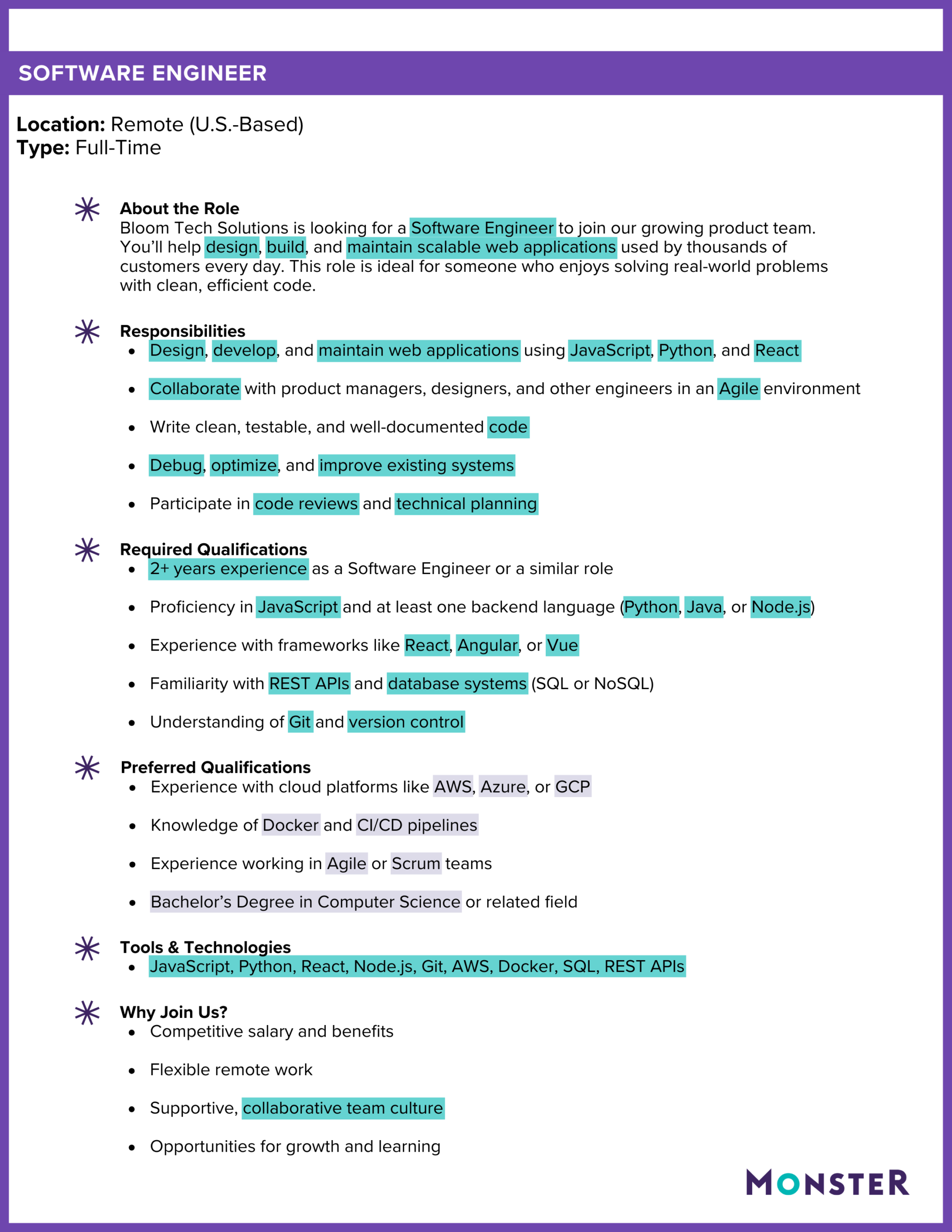
See keywords in action with this mock software engineer job ad, which highlights required qualifications in teal and preferred skills in lavender.
Resume Headline
A resume headline is a short, keyword-rich phrase that quickly shows what you offer and grabs recruiters’ attention.
Using high-relevance, required keywords from the mock job description, here’s an example of an attention-grabbing resume headline with keywords bolded:
Software Engineer Building Scalable Applications With JavaScript, Python, and React
Resume Summary or Objective
Whether you’re an experienced job seeker opting for a resume summary or an early-career applicant using a career objective, the same rules apply when it comes to incorporating keywords:
- Use the exact job title from the ad.
- Include two or three skills keywords from the job requirements.
- Add credentials, such as degrees, specializations, or certifications.
- Highlight key expertise when describing accomplishments.
Here’s an example resume summary optimized with keywords from the software engineer mock job ad:
Software Engineer with 4+ years of experience designing and maintaining high-traffic web applications. Holds a Bachelor’s degree in Computer Science with strong skills in REST APIs, SQL databases, and Git version control. Recently led a major feature rollout in an Agile environment, reducing page load time by 30% and improving performance for thousands of daily users.
And here’s an example of a career objective:
Aspiring Software Engineer with a Bachelor’s degree in Computer Science. Skilled in REST APIs, SQL databases, and Git version control, with hands-on experience building small web applications and collaborative projects. Eager to contribute to an Agile development team and apply technical skills to create scalable, user-focused solutions.
Work History
Integrate resume keywords naturally into your work history section bullet points by linking them to specific accomplishments, tools, or responsibilities. Describe what you did, how you did it, and the results you delivered while weaving in the terms from the job posting.
Check out these keyword-optimized work history bullets:
- Developed a customer-facing web application using JavaScript and React, improving page load speed by 25%.
- Integrated REST APIs to connect front-end and back-end systems, enhancing data accuracy.
- Collaborated in an Agile team, delivering new features on schedule while maintaining code quality through Git version control.
Avoid cramming every term from the job ad into your resume or “hiding” keywords in tiny or white text. Keyword stuffing is detectable and can disqualify you from the job.
Skills
Your skills section is a great place for including important ATS keywords because recruiters often scan it first. Focus on both technical and professional skills that match the job posting, using the employer’s exact terms whenever possible.
Here’s an example of a keyword-optimized skills section:
- Agile collaboration
- Code optimization
- Debugging
- Git
- JavaScript
- Problem-solving
- React
- REST APIs
- Teamwork
Avoid repeating resume skills keywords you’ve included elsewhere in your resume, which is another way to “keyword-stuff” and a common resume mistake.
Education
Education, certifications, and academic projects are prime sources of resume keywords, especially for early-career candidates or roles with specific credential requirements.
To spot relevant keywords:
- Pull degrees, certifications, or programs listed in the job posting.
- Highlight tools, languages, or methodologies from coursework or projects that match the role (e.g., “REST APIs,” “machine learning,” “SQL databases”).
- Turn projects where you applied skills into keyword-rich bullet points without exaggeration.
Here’s an example of an education section optimized with keywords from the mock software engineer job ad:
- Bachelor of Science in Computer Science, New York University
Certifications
- AWS Certified Developer – Associate
- Scrum Master Certification
Relevant Coursework & Projects
- Web Application Development: Built a full-stack web app using React, Node.js, and REST APIs.
- Database Management Systems: Designed and implemented an SQL database for a student project tracking system.
- Machine Learning Fundamentals: Developed predictive models in Python for a class project analyzing user behavior.
You don’t need to have a high skill level or years of experience to include relevant keywords in your resume. By strategically mentioning keywords in key resume sections, you can optimize without lying or exaggerating your qualifications.
Great Keywords for Resumes by Type & Industry
If you’re creating or updating a resume without a specific job in mind, these keyword lists by action verbs and industry can help. For a faster option, use Monster’s Resume Builder to craft a resume with the most relevant keywords for your target role.
Action Verb Keywords for All Jobs
Action verbs are simple yet powerful resume keywords that can be applied to many jobs and industries to add context to your skills.
- Achievement keywords: Accelerated, achieved, advanced, boosted, completed, delivered, enhanced, expanded, exceeded, generated, improved, increased, maximized, optimized, produced, realized, strengthened, surpassed
- Analysis keywords: Analyzed, assessed, audited, calculated, compared, diagnosed, evaluated, examined, explored, forecasted, interpreted, investigated, measured, monitored, researched, synthesized, tested, validated
- Communication keywords: Advised, advocated, articulated, briefed, collaborated, coached, consulted, explained, liaised, mediated, moderated, negotiated, partnered, presented, promoted, publicized, reported, trained
- Creativity keywords: Brainstormed, conceptualized, created, devised, designed, drafted, formulated, illustrated, implemented, imagined, initiated, innovated, invented, piloted, refined, revamped, streamlined, transformed
- Leadership keywords: Administered, chaired, coordinated, delegated, directed, empowered, executed, facilitated, guided, led, managed, mentored, mobilized, orchestrated, organized, oversaw, strategized, supervised
- Technical keywords: Automated, built, calibrated, configured, customized, debugged, deployed, engineered, implemented, installed, integrated, maintained, monitored, programmed, provisioned, refactored, secured, troubleshot, tuned, upgraded
Resume Keywords by Industry
We’ve organized industry-specific keywords to include in a resume to help you identify and naturally incorporate terms employers are looking for.
Business Administration Keywords
- Benchmarking
- Budgeting
- Business continuity
- Business development
- Business reporting
- Change management
- Contract management
- Cross-functional collaboration
- Customer relations
- Data analysis
- Decision-making
- Enterprise resourcing planning (ERP)
- Executive support
- Meeting coordination
- Office administration
- Operational efficiency
- Operations management
- Performance improvement
- Performance metrics
- Policy implementation
- Process documentation
- Process improvement
- Records management
- Resource allocation
- Scheduling
- Stakeholder communication
- Strategic planning
- Vendor management
- Workflow optimization
Construction & Engineering Keywords
- AutoCAD
- Blueprints
- Building codes
- Building information modeling (BIM)
- CAD software
- Carpentry
- Change orders
- Civil engineering
- Construction management
- Cost estimation
- Design implementation
- Electrical systems
- Engineering analysis
- Field inspections
- Fire safety
- Land grading
- Lean construction
- Material procurement
- Mechanical engineering
- Permitting
- Problem-solving
- Project management
- Project planning
- Quality assurance
- Risk assessment
- Site inspections
- Site supervision
- Structural analysis
- Structural design
- Surveying
- Sustainable design
- Team leadership
- Technical drawing
Creative & Design Keywords
- Adobe Creative Suite
- Animation
- Brand identity development
- Color theory
- Concept development
- Creative direction
- Design strategy
- Digital design
- Figma
- Graphic design
- Illustration
- Illustrator
- InDesign
- Information architecture (IA)
- Interactive design
- Layout design
- Logo design
- Motion graphics
- Photoshop
- Portfolio development
- Print design
- Prototyping
- Responsive design
- Sketch
- Typography
- User experience (UX)
- User interface (UI)
- Video production
- Visual storytelling
- Wireframing
Education Keywords
- Academic advising
- Behavior management
- Classroom instruction
- Classroom management
- Classroom observation
- Collaborative learning
- Curriculum development
- Differentiated instruction
- Educational policy
- Educational technology
- E-learning
- Instructional design
- Learning management systems (LMS)
- Lesson planning
- Mentoring
- Online learning platforms
- Parent communication
- Pedagogy
- Professional development
- Special education
- Student assessment
- Student engagement
- Student support
- Syllabus design
- Teaching certification
- Test preparation
- Tutoring
- Workshop facilitation
Finance Keywords
- Accounting
- Accounts payable
- Accounts receivable
- Annual and monthly budgeting
- Asset management
- Auditing
- Banking operations
- Bookkeeping
- Cash flow management
- Cost reduction
- Credit analysis
- Expense management
- Financial analysis
- Financial modeling
- Financial planning
- Financial reporting
- Forecasting
- Generally accepted accounting principles (GAAP)
- Investment analysis
- Liquidity management
- Loan processing
- Mergers & acquisitions
- Portfolio management
- QuickBooks
- Reconciliation
- Regulatory compliance
- Risk management
- SAP
- Tax preparation
- Treasury management
- Variance analysis
Food Service Keywords
- Back of house
- Beverage preparation
- Cash handling
- Catering
- Complaint resolution
- Cooking techniques
- Cost control
- Culinary operations
- Dining etiquette
- Food preparation
- Food presentation
- Food safety
- Front of house
- HACCP procedures
- Health regulations
- Kitchen management
- Meal planning
- Menu planning
- Ordering
- Point-of-sale (POS) systems
- Portion control
- Quality control
- Recipe development
- Sanitation
- ServSafe
- Station setup
- Supplier management
- Table service
- Teamwork
- Training staff
- Vendor coordination
Healthcare Keywords
- Advanced Cardiac Life Support (ACLS)
- Care planning
- Clinical documentation
- Clinical procedures
- Clinical research
- CPR
- Diagnostic equipment
- Discharge planning
- Electronic health records (EHR)
- Emergency response
- Health education
- Health Insurance Portability and Accountability Act (HIPAA)
- Infection control
- IV therapy
- Laboratory testing
- Medical coding
- Medication administration
- Nursing
- Patient advocacy
- Patient assessment
- Patient care
- Patient scheduling
- Public health policy
- Telehealth
- Treatment plans
- Vital signs
- Wound care
Legal Keywords
- Case management
- Client consultation
- Contract drafting
- Contract review
- Corporate law
- Court filings
- Courtroom procedures
- Dispute resolution
- Due diligence
- Intellectual property
- Legal advice
- Legal advocacy
- Legal analysis
- Legal briefs
- Legal compliance
- Legal counsel
- Legal documentation
- Legal drafting
- Legal ethics
- Legal investigations
- Legal research
- Legal strategy
- Legal writing
- LexisNexis software
- Litigation support
- Mediation
- Negotiation
- Policy interpretation
- Regulatory affairs
- Statutory interpretation
Manufacturing & Production Keywords
- Activity-based costing
- Assembly line
- Blueprint reading
- CNC machining
- Continuous improvement
- Equipment operation
- Industrial safety
- Inventory control
- Lean manufacturing
- Machine maintenance
- Manufacturing operations
- Manufacturing software
- Material planning
- Occupational Safety and Health Administration (OSHA) standards
- Packaging
- Preventative maintenance
- Process optimization
- Process validation
- Product assembly
- Production efficiency
- Production management
- Production planning
- Production reporting
- Production scheduling
- Product lifecycle management
- Root cause analysis
- Safety compliance
- Six sigma
- Statistical process control (SPC)
- Supply chain management
- Workflow management
Marketing Keywords
- A/B testing
- Advertising strategy
- Affiliate marketing
- Analytics
- Branding
- Brand management
- Campaign management
- Content creation
- Content strategy
- Conversion rate optimization
- Copywriting
- Customer segmentation
- Digital marketing
- Email campaigns
- Engagement metrics
- Event planning
- Google Analytics
- Influencer marketing
- Market analysis
- Marketing automation
- Marketing research
- Media buying
- Paid ads
- Pay-per-click (PPC) advertising
- Product marketing
- Public relations
- Search engine marketing (SEM)
- Search engine optimization (SEO)
- Social media advertising
- Social media management
- Video production
Retail & Ecommerce Keywords
- Average order value (AOV) tracking
- Cash handling
- Complaint resolution
- Cross-selling
- Customer engagement
- Customer onboarding
- Customer retention
- Customer service
- Display setup
- Ecommerce platform management
- Inventory management
- Key performance indicator (KPI) tracking
- Loss prevention
- Marketing promotions
- Merchandising
- Order fulfillment
- POS
- Pricing strategy
- Product knowledge
- Product promotion
- Retail analytics
- Retail management
- Retail software
- Returns processing
- Sales targets
- Stock replenishment
- Store layout
- Store operations
- Vendor relations
- Visual merchandising
Sales Keywords
- Account management
- Account penetration
- Business-to-business (B2B) sales
- Business-to-consumer (B2C) sales
- Business development
- Client acquisition
- Closing deals
- Cold calling
- Consultative selling
- Contract negotiation
- Customer relationship management (CRM)
- Key account management
- Lead generation
- Market research
- Networking
- Pipeline management
- Presentation skills
- Proposal development
- Prospect analysis
- Prospecting
- Quota attainment
- Relationship-building
- Revenue growth
- Sales enablement
- Sales forecasting
- Sales reporting
- Sales strategy
- Solution selling
- Strategic partnerships
- Territory management
- Upselling
Technology & IT Keywords
- Agile
- Angular
- Application programming interface (API) development
- Automation
- Amazon Web Services (AWS)
- Azure
- Big data
- C++
- Containerization
- Continuous integration (CI) and continuous deployment (CD)
- Cloud computing
- Cybersecurity
- DevOps
- Firewalls
- Google Cloud Platform (GCP)
- Git
- IT infrastructure
- Java
- JavaScript
- Linux
- Machine learning
- Mobile development
- Node.js
- NoSQL
- Python
- React
- REST APIs
- Scrum
- Software as a Service (SaaS)
- Software development
- Software engineering
- SQL
- System architecture
- Testing & quality assurance (QA)
- Troubleshooting
- Version control
Tools for Resume Keyword Optimization
Resume review tools and ATS checkers compare your resume to a job description and provide resume tips based on which keywords are present, missing, or need improvement.
Here are some tools you can use to ensure your resume is optimized with relevant keywords:
- ATS resume checkers: Submit your resume to ATS checkers for instant feedback on keywords, phrasing, and formatting.
- Job match scanners: Upload your resume and your target job description to see how well your resume matches the role.
- Resume builders: Create a resume with all key sections, optimized with relevant keywords, skills, and achievements.
While these tools help, don’t rely on them alone. Review each job description to catch nuances, such as company-specific phrasing, preferred qualifications, and culture-fit keywords. Human review combined with automated analysis ensures your resume is ATS-friendly and tailored for recruiters.
Use Resume Keywords Strategically
Think of resume keywords as a storytelling tool. Align your experience with the job description to show recruiters and ATS software that you’re the right fit. Use exact terms from the job ad when they accurately reflect your skills, and integrate keywords naturally into your headline, summary, work history, skills, and education sections.
When used strategically, keywords highlight your strengths, boost your ATS ranking, and increase your chances of landing the job. If you need more help, use our resume templates to create a winning resume and get hired faster.

Elizabeth Muenzen is a Certified Professional Resume Writer (CPRW) and member of the Professional Association of Resume Writers & Career Coaches who empowers job seekers to take control of their career paths using Monster’s comprehensive job search and resume tools.
See More From Elizabeth MuenzenExplore Related Career Advice



20 Companies That Pay 100% Health Insurance & Other Top Benefits

Updated:
Sep 10, 2026
|
14 min read


How Long of a Commute Is Too Long? 49% Have Turned Down a Job Due to the Commute

Updated:
Sep 8, 2026
|
11 min read


Beauty Bias at Work Statistics: 88% Say Attractive People Have an Advantage
Updated:
Aug 31, 2026
|
8 min read


How to Put Transferable Skills on Your Resume: 120 Skills, Examples, & Tips
Updated:
Aug 27, 2026
|
16 min read
Manage Your Career Like an Expert
Take control of your professional journey with Monster’s expert resources. Explore advice, research, and tips to make informed decisions and advance your career with confidence.

Job Search
Discover strategies to get noticed, network effectively, and streamline your job search process.

Resumes
Get practical tips to create a resume or CV that stands out to employers and wins interviews.

Cover Letters
Learn how to craft a compelling cover letter that highlights your experience and fit for the role.

Career Paths
Explore career paths, industry trends, and growth opportunities to plan your next move.

Interviewing
Prepare for interviews with tips on answering common questions and following up effectively.

Career Development
Develop key skills and knowledge to grow in your current role or pivot to new opportunities.

Leaving a Job
Navigate job changes and career transitions with practical advice and planning resources.