
What to Do In Between Jobs: Managing Money, Your Career, & What Comes Next

When one job ends before the next begins, knowing what to prioritize can help you protect your finances, career momentum, and well-being.
Updated:
|

20 min read

Table of Contents


What You’ll Learn
- When you’re in between jobs, prioritize immediate financial needs before turning your attention to your job search and longer-term career goals.
- Review unemployment benefits, health insurance, retirement accounts, and your budget as soon as possible.
- Structure your days around a targeted job search, networking, skill-building, earning income when needed, and time away from your search.
- Update your resume and professional profiles, target the right jobs, reconnect with your network, and keep your skills current.
- Address employment gaps honestly and briefly on your resume, in your cover letter, and during interviews.
Being in between jobs can feel like having a dozen new jobs at once. Managing your finances, searching for work, keeping your career on track, and figuring out what comes next is a lot to juggle, especially if you need to earn money in the meantime.
You don’t need to tackle everything at once. This guide breaks down what to prioritize when you’re between jobs, from handling immediate financial needs and structuring your job search to earning income, explaining an employment gap, and taking care of yourself.
What Does “In Between Jobs” Mean?
“In between jobs” means you’re temporarily unemployed after leaving or losing one job and before starting another. The phrase generally implies that you’re actively looking for work or expect to return to employment, rather than being out of the workforce indefinitely.
People often use “in between jobs” as a softer alternative to “unemployed.” Either can be appropriate when simply describing your current employment status, and which one you use is largely a matter of personal preference.
When talking with a recruiter or potential employer, however, the reason you’re not currently working may be more relevant than the label itself. Be prepared to briefly explain why you left your last job, what you’ve been doing since, and the type of job you’re seeking.
What to Do First When You’re In Between Jobs
When you’re in between jobs, protect your finances and handle any time-sensitive benefits or paperwork as soon as possible. Check your state’s unemployment or workforce agency for eligibility requirements and application instructions, and apply promptly if you’re eligible. Then, review your budget and reduce expenses where possible.
Handle Unemployment, Health Insurance, & Other Logistics
First, make sure you understand what happens to the benefits and accounts connected to your previous employer. Prioritize anything with an enrollment, filing, or decision deadline so you don’t unintentionally lose access to benefits or options.
Depending on your situation, that may include:
- Unemployment benefits: Check your state’s eligibility requirements and apply promptly if you qualify. Eligibility, benefit amounts, and duration vary by state and the circumstances of your separation, so use your state’s unemployment or workforce agency for guidance.
- Health insurance: Confirm when your employer-sponsored coverage ends, and review your options to avoid a coverage gap.
- Retirement accounts: If you have a 401(k) from your previous employer, review your options for leaving the money in your existing plan, rolling it into a new employer’s plan or an IRA, or taking a distribution.
- Final pay and other benefits: Check for outstanding pay, unused paid time off, flexible spending accounts, or other benefits that may require action after your employment ends.
Review Your Budget & Reduce Expenses
Once you’ve handled the immediate logistics, compare your current finances with your regular spending. Start with recurring expenses, such as:
- Housing
- Utilities
- Insurance
- Transportation
- Subscriptions
- Debt payments
Add up your essential monthly expenses, then compare that amount with the income and resources you currently have available, such as savings, unemployment benefits, severance, or other household income. This can help you determine how much you need to cover each month and where you may need to make adjustments.
Separate essential expenses from costs you can temporarily reduce or pause. Start with discretionary spending and recurring charges you can easily cut, then look for ways to lower larger expenses if needed.
If you’re concerned about keeping up with bills or debt payments, contact lenders, creditors, utility providers, or other companies before you miss a payment. Ask about available payment plans, hardship programs, due date changes, or other options that could give you more flexibility while you’re between jobs.
How to Structure Your Days When In Between Jobs
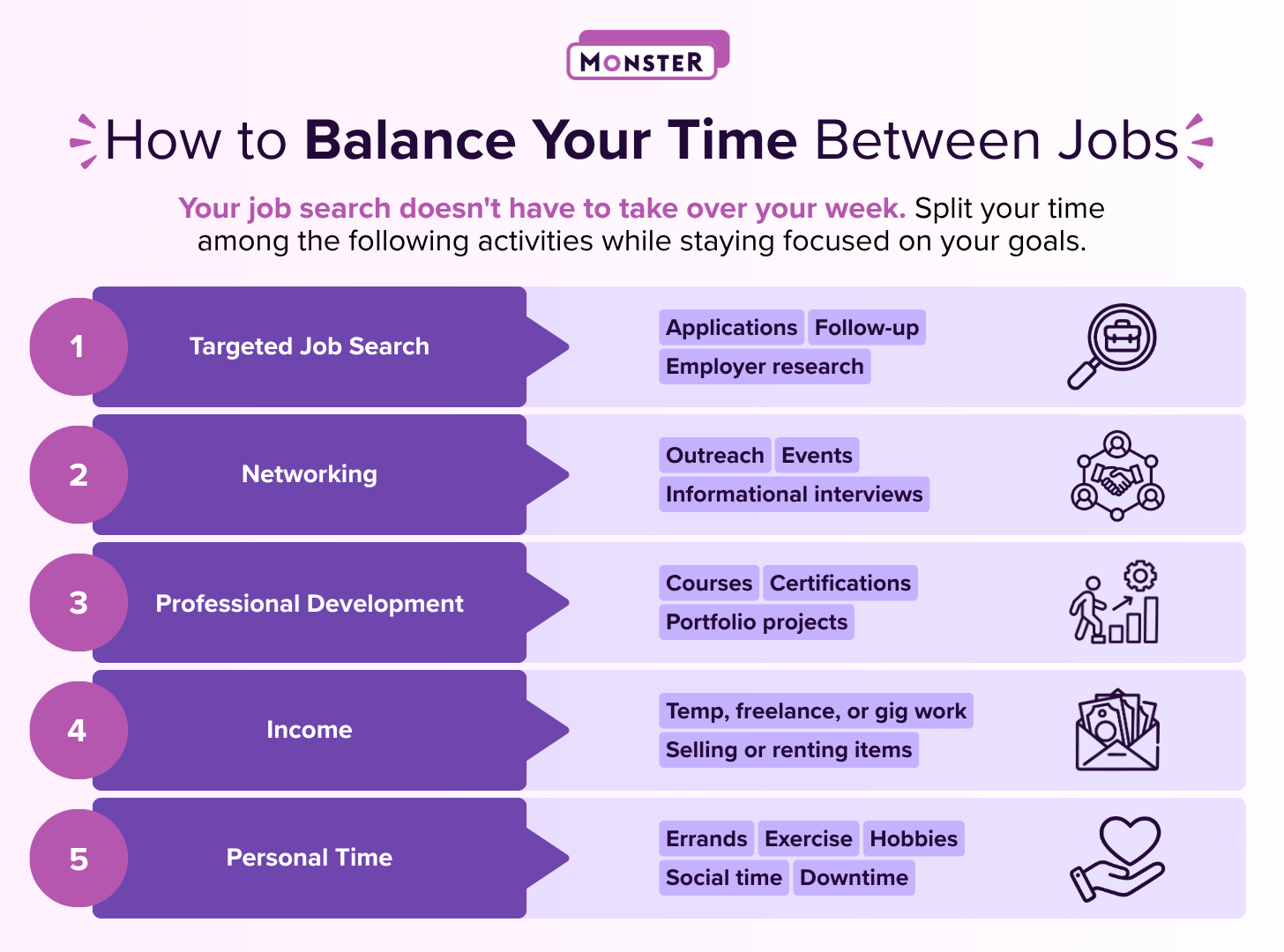
Give your weekdays some structure, but don’t feel like you need to spend eight hours a day searching for work. Instead, set aside focused blocks of time for different priorities, such as:
- Spending three to four focused hours a day on your job search, including searching for openings, submitting targeted applications, following up, and responding to recruiters
- Networking and reaching out to professional contacts
- Completing courses, certifications, or other skill-building activities
- Working a temporary, freelance, or gig job if you’re earning income between roles
- Setting a reasonable stopping point for job search activities so you aren’t checking job boards or your inbox throughout the day
Here’s a quick guide to balancing your time while in between jobs:
4 Professional Steps to Take When You’re In Between Jobs
Use your time between jobs to update your resume and LinkedIn profile, identify the roles and employers you want to target, tailor your applications, reconnect with your network, and build your skills and qualifications.
- Step 1:
Update Your Resume & Professional Profiles
Review and improve your resume to reflect your current experience and the types of jobs you’re targeting. Add recent accomplishments, skills, certifications, and projects, and remove outdated information that’s no longer relevant.
As you update your resume:
- Compare job descriptions. Review several postings for the roles you’re targeting and note recurring skills, tools, and qualifications.
- Emphasize accomplishments. Rewrite bullets to highlight results rather than listing responsibilities alone.
- Quantify your impact. Add measurable results where possible, such as revenue generated, projects completed, time saved, customers supported, or performance improvements.
- Update your skills. Make sure your skills section reflects the tools and abilities employers are currently requesting.
- Build a master resume and tailor it to each role. Keep a comprehensive version of your experience, skills, and accomplishments, then select and adjust the most relevant information for each application.
Update your LinkedIn and other professional profiles at the same time. Make sure your job titles, dates, skills, and recent experience align, but don’t simply copy everything over. Because LinkedIn isn’t tailored to a single job posting, you can include a broader range of relevant skills, accomplishments, projects, and experience.
- Step 2:
Create a Focused Job Search Strategy
Before you start applying, get specific about the opportunities you’re looking for. Clear criteria can help you spend less time sorting through irrelevant postings and more time pursuing roles that fit.
Define your search by identifying:
- Two or three job titles that align with your experience and career goals, including common variations employers may use
- Industries, companies, or types of organizations you’d like to work for
- What you need from your next role, such as a minimum salary, location, schedule, benefits, or remote work options
- Qualifications you already meet, along with recurring skills or credentials that could expand your options
Then, use those criteria to guide and organize your search:
- Set up job alerts with your target titles and filters to find relevant openings as they’re posted.
- Track the roles you pursue, including the company, job title, application date, posting, contacts, interview stages, and follow-up dates.
- Set weekly goals for applications, follow-ups, networking, and other job search activities to add structure and keep yourself on track.
As Toni Frana, a career expert at Monster, advises, “Test and evaluate.” If your job search isn’t getting the response you expected, review what’s working across your applications, follow-ups, and networking, then adjust your approach.
Start with your applications. Make sure you’re tailoring your resume to each role, and consider adding a cover letter if you haven’t already. Then, review your follow-up strategy. Research the company and hiring process to identify the hiring manager or another appropriate contact to reach out to.
- Step 3:
Reconnect With & Grow Your Network
Professional networking can help you get referrals, gain insight into roles and companies, and uncover opportunities that aren’t listed publicly.
To start, reconnect with former coworkers, managers, classmates, clients, and other professional contacts. Briefly explain what you’re looking for and ask them to keep you in mind if something relevant comes up.
You can also grow your network by:
- Joining professional or industry groups
- Attending virtual or in-person events
- Participating in LinkedIn or industry communities
- Engaging with companies you’re interested in
- Requesting informational interviews with people in relevant roles or industries
- Step 4:
Keep Your Skills Current
Use your time between jobs to strengthen qualifications that repeatedly appear in your target job postings. Identify any skills or credentials you’re missing, then prioritize activities that can help close those gaps.
Depending on your field, that might include:
- Completing a relevant professional certification or online course
- Learning or refreshing a software program or technical skill
- Volunteering your skills for a nonprofit or community organization
- Creating a portfolio project that demonstrates a skill employers want
- Attending webinars, conferences, or industry training
- Reading current industry publications and staying familiar with changes in your field
How to Make Money While You’re In Between Jobs
If you need to make money in between jobs, look for work that’s flexible enough to accommodate applications, interviews, and a potential start date for your next full-time role.
Depending on your skills, schedule, and resources, options can include:
- Temporary, contract, and seasonal work: Look for short-term opportunities through staffing agencies, job boards, or local employers that need temporary or seasonal help.
- Freelance work: Consider offering skills you already have, such as writing, design, marketing, bookkeeping, administrative support, or web development.
- Gig and delivery work: Look into rideshare driving, food or grocery delivery, pet care, and other task-based services.
- Selling or renting what you own: Consider selling unused belongings or renting out eligible space, equipment, or other assets.
If you’re wondering how to make money in between jobs, these can all be practical options. That said, earnings vary widely by the type of work.
For context, data from the U.S. Bureau of Labor Statistics (BLS) shows that full-time temporary help agency workers had median weekly earnings of $818 in July 2023, compared with $949 for independent contractors including consultants and freelance workers, and $1,014 for contract firm workers.
In comparison, BLS reports a median wage of $21.13 per hour for delivery drivers. This isn’t specific to app-based gig work, but it can provide a general benchmark for delivery work.
Keep in mind that the weekly BLS figures above are for full-time workers, so they don’t reflect what you might earn from part-time, occasional, or short-term work.
Your earnings will depend on how many hours you work, your experience, local demand and pay rates, and the type of work you take on. Some options also come with expenses, such as gas, supplies, equipment, platform fees, and taxes, which can reduce how much of that income you actually keep.
How to Explain an Employment Gap in Resumes, Cover Letters & Interviews
Explain an employment gap honestly and briefly, then shift the focus to your qualifications and readiness for the role. On your resume or cover letter, provide context when useful and highlight relevant activities during the gap. In an interview, briefly explain the circumstances and transition to what you can bring to the position.
 Pro Tip
Keep your explanation brief and relevant, without unnecessary personal details. Give employers enough context to understand the gap, then shift the conversation to your qualifications and readiness for the role.
Review the guides and examples below to explain employment gaps when you’re in between jobs.

How to Represent an Employment Gap on Your Resume
You can often leave a short employment gap unexplained on your resume and address it if an employer asks. For longer gaps, consider including relevant work, education, volunteering, or other experience from that time.
Here are a few ways to approach an employment gap on your resume:
- Include relevant activities from the gap. Freelance or contract work, volunteer experience, certifications, coursework, and substantial independent projects can potentially earn a place on your resume.
- Give the activity a clear label. Instead of trying to disguise a gap, identify what you actually did, such as “Freelance Graphic Designer,” “Professional Development,” or “Career Break.”
- Emphasize accomplishments and skills. Treat relevant gap experience like the rest of your resume by focusing on what you completed, contributed, or developed.
- Keep personal explanations brief. You generally don’t need to provide detailed information about why you weren’t working. A simple label like “Career Break” may be enough if context is necessary.
- Don’t manipulate employment dates to hide the gap. Keep your work history accurate and be prepared to discuss the timeline if an employer asks.
- Use a combination resume format in most cases. A combination resume emphasizes relevant skills and qualifications while maintaining a chronological work history, helping you showcase your strengths without hiding gaps.
- Consider a functional resume format in special cases. A functional resume emphasizes skills over work history, which may help with unusually long or complex gaps. Use it selectively, as it can make your employment timeline less clear at first glance.
For example, someone who spent several months completing coursework while looking for a new marketing role might include:
Professional Development
January 2026–Present- Completed Google Analytics and advanced Excel training focused on data analysis, reporting, and performance measurement.
- Built a sample marketing dashboard to track campaign metrics and translate performance data into actionable insights.
- Practiced advanced Excel functions, including pivot tables, lookups, and data visualization, using sample business datasets.
- Applied new analytics skills to evaluate campaign performance and identify trends across traffic, engagement, and conversion data.
Pro Tip
Only include activities from an employment gap if they strengthen your candidacy, demonstrate relevant skills, or provide useful context for the gap.

How to Address an Employment Gap in Cover Letters
If your employment gap is recent, significant, or likely to raise questions, a brief explanation in your cover letter can provide useful context.
Keep your explanation to one or two sentences. State the reason for the gap as specifically as you’re comfortable with, mention any relevant experience or development during that time, and quickly shift the focus back to your qualifications and interest in the role. Avoid apologizing for the gap or sharing unnecessary personal details.
For example, someone returning to work after taking time away for a family responsibility might write:
After taking a career break to care for a family member, I’m ready to return to work and excited to bring my five years of account management experience to the account manager position at Care Customs. During my time away, I stayed current with industry developments and maintained my professional network.

How to Explain an Employment Gap in an Interview
If an interviewer asks about your employment gap, answer directly, don’t apologize for it, and don’t try to avoid the question.
“Explaining a career gap to a hiring manager doesn’t require much detail. In fact, keeping it simple and straightforward is most effective,” Frana explains. “Saying you took an intentional pause to take care of family, or were one of multiple people laid off during a company restructuring, is enough.”
From there, focus on where you’re headed next rather than dwelling on the circumstances that led to the gap. Show enthusiasm for the role, highlight any relevant skills or certifications you gained during your break, and make it clear that you’re ready and excited to return to work.
Keep the explanation positive as well. “Explaining a career gap in a positive, forward-thinking way is going to show the employer that you’re adaptable and have the right mindset and motivation to reach company goals and objectives,” Frana advises.
In particular, avoid criticizing a previous employer or dwelling on negative circumstances surrounding your departure.
Here are some examples of how that approach might sound in different circumstances:
If you were laid off:
My position was eliminated during a company restructuring in March. Since then, I’ve been focused on finding a role that aligns with my content and SEO experience, and I’ve also completed additional analytics training. I’m excited about this position because it would let me apply both areas.
If you left a job without another lined up:
I decided to leave my previous position and take some time to be intentional about my next move. I’ve been focusing my search on project management roles where I can build on my operations experience, which is what interested me about this opportunity.
If you took time away for personal reasons:
I took a career break to handle a personal responsibility that required my attention. That’s now resolved, and I’m ready to return to work. I’m particularly interested in this role because it aligns closely with my previous experience in customer service and account management.
If the gap has lasted longer than expected:
I’ve been actively searching for my next role while being selective about finding the right fit. During that time, I’ve kept my skills current through freelance projects and coursework, and I’m ready to bring that experience back into a full-time position.
How to Take Care of Yourself While You’re In Between Jobs
While you’re in between jobs, make time for your relationships, health, and activities you enjoy throughout your job search.
Maintain Your Social Connections
Being between jobs can mean losing some of the everyday interaction that comes with a workplace. Stay connected with friends, family, former coworkers, and others in your personal and professional circles.
Make plans, participate in community activities, and spend time with your people without making every conversation about your job search.
Consider Your Health & Well-Being
Job searching can bring uncertainty, rejection, and financial stress, particularly when the process lasts longer than expected. Try to maintain the basic habits that support your mental health, including:
- Consistent sleep
- Regular meals
- Physical activity
- Time outside
- Genuine downtime
Not everything you do between jobs needs to strengthen your resume, expand your network, or become a side hustle. This time is still part of your life, not simply a waiting period for the next job.
Watch for Signs of Job Search Burnout
Watch for signs that your job search is taking an unhealthy toll. Frana notes that when job seekers continually apply without hearing back from employers, “it’s easy to feel frustrated and discouraged.” She says that “stress, feelings of despair, spending all your time searching for jobs and not allowing breaks for other activities are indicators that burnout is setting in.”
If you’re struggling to step away from applications or feeling increasingly overwhelmed, make time to do activities that help you recharge. Take a walk, exercise, meet a friend for coffee, spend time on a hobby, or do something else that gives you a break from your job search—little pockets of self-care can help you return with more energy and motivation.
Keep Moving Toward Your Next Job
Being in between jobs can bring you face-to-face with your career expectations and lead to financial uncertainty. But the decisions you make during this time can prepare you for what comes next.
Address immediate financial needs, approach your job search with a clear strategy, and use the time to support both your career and your life outside of work. With a plan in place, you can make this transition more manageable as you work toward a role that fits what you want next.
Frequently Asked Questions
What does it mean to be in between jobs?
Being in between jobs means you’re temporarily unemployed after leaving or losing one job and before starting another. The phrase typically suggests that you plan to return to work and may already be searching for your next opportunity.
What is it called when you’re in between jobs?
Being in between jobs is another way of saying you’re temporarily unemployed or experiencing an employment gap. Depending on the circumstances, you might also describe this period as a career break, a job transition, or a job search.
What should you do first after losing your job?
After losing your job, first address any time-sensitive financial and benefits-related tasks. Check your eligibility for unemployment benefits, confirm when your health insurance coverage ends, review your final pay and other employer benefits, and assess your current budget. Once you handle immediate needs, you can focus on your job search strategy..
How do you make money while looking for a job?
You can make money while looking for a job through temporary, contract, seasonal, freelance, or gig work. You might also sell unused belongings or rent eligible assets. Look for options that fit your skills and financial needs without making it difficult to apply, interview, or start a new job.
Does an employment gap hurt your resume?
An employment gap doesn’t have to dominate your resume. Keep your work history accurate, provide brief context when useful, and emphasize the qualifications and experience relevant to the job.

Kirsten Chorpenning is a career advice writer who empowers job seekers to take control of their career paths using Monster’s comprehensive job search and resume tools. She specializes in helping job seekers find rewarding jobs in today’s dynamic work environment.
See More From Kirsten ChorpenningExplore Related Career Advice
Cashier Career Paths: Monster Workforce Mobility Report (Volume 2)

Updated:
Oct 19, 2026
|
9 min read

Highest Paying Medical Jobs: 35 Top Healthcare Careers by Salary
Updated:
Oct 16, 2026
|
18 min read

How to Ask for a Raise at Work: Steps, Scripts, & Email Templates
Updated:
Oct 15, 2026
|
20 min read

Job Hugging Statistics: Nearly 9 in 10 Workers Have “Hugged” a Job
Updated:
Oct 13, 2026
|
9 min read

Nearly 3 in 10 LinkedIn Users Have Updated a Past Job After Leaving It
Updated:
Oct 7, 2026
|
7 min read

Employee Loyalty Statistics: 90% Say Companies Expect More Than They Give
Updated:
Oct 5, 2026
|
7 min read


Overqualified Hiring Stats: 57% Would Cut Resume Experience to Get Hired
Updated:
Sep 28, 2026
|
9 min read

20 First Job Interview Questions & Sample Answers: Tips to Land Your First Job
Updated:
Sep 24, 2026
|
20 min read
Manage Your Career Like an Expert
Take control of your professional journey with Monster’s expert resources. Explore advice, research, and tips to make informed decisions and advance your career with confidence.

Job Search
Discover strategies to get noticed, network effectively, and streamline your job search process.

Resumes
Get practical tips to create a resume or CV that stands out to employers and wins interviews.

Cover Letters
Learn how to craft a compelling cover letter that highlights your experience and fit for the role.

Career Paths
Explore career paths, industry trends, and growth opportunities to plan your next move.

Interviewing
Prepare for interviews with tips on answering common questions and following up effectively.

Career Development
Develop key skills and knowledge to grow in your current role or pivot to new opportunities.

Leaving a Job
Navigate job changes and career transitions with practical advice and planning resources.