
The Application Black Box: 60% Say Silence Is Their Biggest Job Search Frustration

Uncertainty, automation, and repetition are driving candidate drop-off in today’s hiring process.
Updated:
|

7 min read

Table of Contents


According to Monster’s Application Black Box Report, 60% of U.S. job seekers say not knowing whether a human ever viewed their resume is the most frustrating part of the application process. This lack of visibility is what turns many interested applicants into frustrated job seekers, especially when there’s no clear indication that their effort was ever seen.
Our national survey of more than 1,000 U.S. workers highlights how silence, automation, and repetitive steps are shaping modern hiring and influencing how long candidates are willing to stay engaged.
The findings show that the issue isn’t effort. Job seekers are tailoring resumes, adapting to applicant tracking systems (ATS), and investing time. But when the process feels unclear or overly automated, many are reaching a breaking point.
Key Findings
- 60% say not knowing whether a human viewed their resume is their biggest frustration.
- 43% would abandon an application within 15 minutes, and 6 in 10 would drop off by 20 minutes.
- 61% have experienced resume upload errors or technical problems on career sites.
- 54% support either heavy regulation or banning applicant tracking systems entirely.
- Nearly half (48%) say tailoring their resume for each job is the most difficult part of resume writing.
When asked about the most frustrating parts of applying for jobs, job seekers consistently point to silence and lack of visibility:
- Not knowing if a human ever viewed their resume: 60%
- Reentering resume information already listed: 58%
- No updates or feedback after applying: 55%
- Automated rejection emails with no explanation: 52%
- Unclear resume requirements or instructions: 20%
- Formatting issues in ATS: 15%
The data shows that uncertainty outweighs rejection. Candidates can accept a “no.” What’s harder to accept is not knowing whether their application was ever meaningfully reviewed, leaving many to wonder, “Why do employers not respond to applications in the first place?”
The 20-Minute Breaking Point
The report reveals a clear time threshold for candidate patience, shown here:
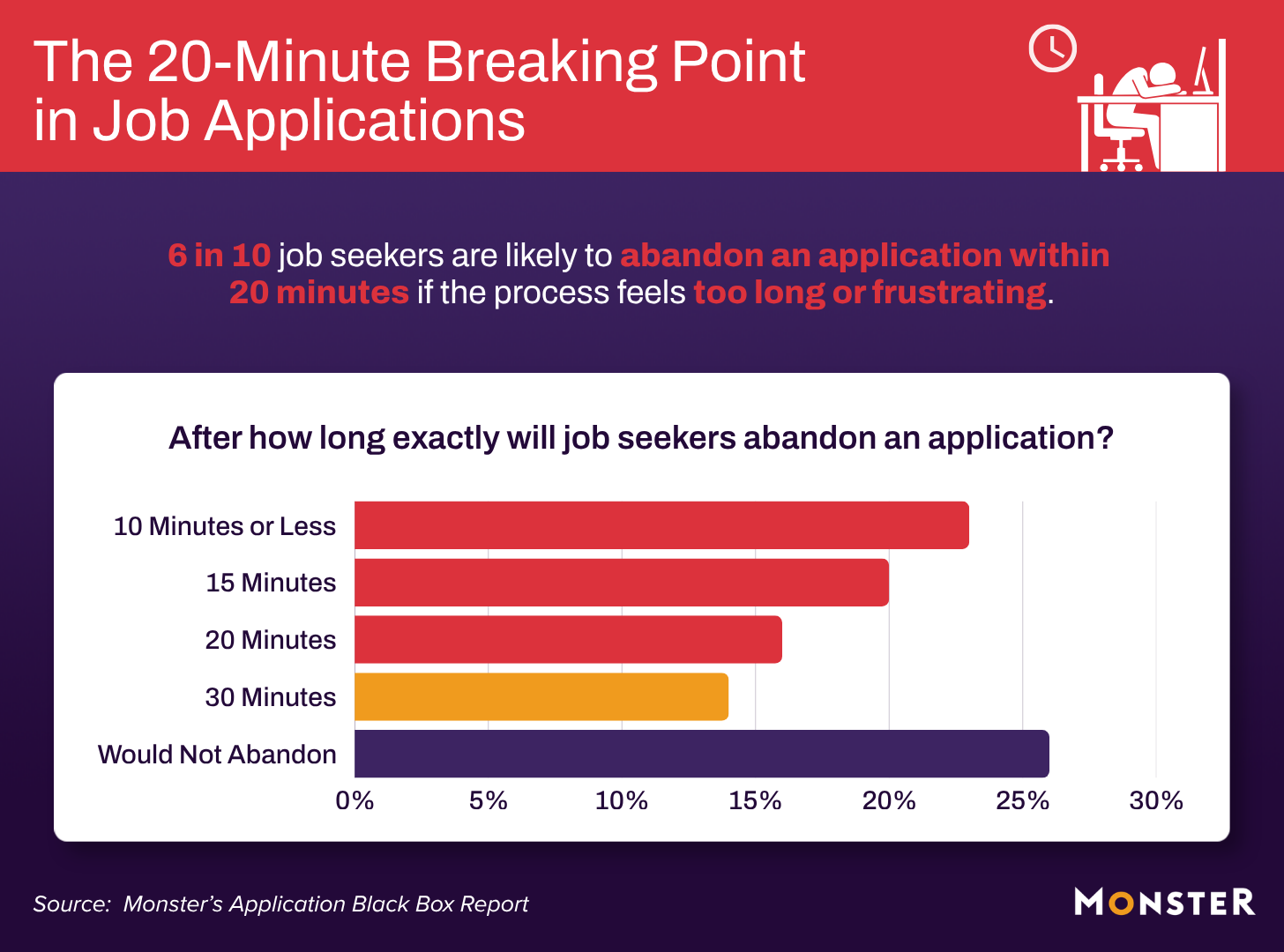
- 23% would abandon an application after 10 minutes or less.
- 20% would abandon it after 15 minutes.
- 16% would abandon it after 20 minutes.
- 14% would abandon it after 30 minutes.
- 26% say they wouldn’t abandon it due to time.
That means nearly 6 in 10 job seekers are likely to abandon an application within 20 minutes if the process feels too long or frustrating.
Technical issues only add to the drop-off, as 61% percent of respondents say they’ve experienced a resume upload error or other technical issue during the application process.
ATS Anxiety Is Reshaping Resume Behavior
Applicant tracking systems are now a central part of the hiring process, and job seekers are adapting:
- 40% say most of the time, they modify their resume to include keywords from job descriptions.
- 36% say they do so sometimes.
- 24% say they rarely or never do.
At the same time, many job seekers remain skeptical of ATS technology:
- 40% say ATS should be improved, not restricted.
- 35% say they should be heavily regulated.
- 19% support banning them entirely.
- Just 6% believe ATS works well as they are.
This tension reflects a system where candidates feel they must optimize for automation, even when they’re unsure how that automation works. As a result, common job seeker frustrations are no longer just about competition or qualifications—they’re about navigating a process that often feels opaque and impersonal.
Resume Writing Remains a Major Hurdle
When asked about the hardest parts of resume writing, job seekers pointed to customization and compression:
- Tailoring a resume for each job: 48%
- Keeping it concise or under two pages: 32%
- Writing strong bullet points: 29%
- Choosing the right format or layout: 27%
- Avoiding employment gaps or layoffs: 24%
- Using metrics and data effectively: 20%
- Making it ATS-friendly: 7%
Bottom Line
Monster’s research shows that today’s job search is defined less by rejection and more by friction. Job seekers are investing time, tailoring resumes, and adapting to automated systems. But silence, redundancy, and technical barriers are eroding trust and driving measurable drop-off.
In an environment where clarity and efficiency matter more than ever, having a strong, optimized resume is one of the few variables job seekers can control. To help candidates create polished, ATS-ready resumes quickly and confidently, Monster offers a Free Resume Builder that guides users through formatting, keyword alignment, and concise storytelling in minutes.
When the application process feels like a black box, preparation and clarity can help you stay competitive.
For press inquiries, please contact Lauren Adams at lauren.adams@monster.com.
Methodology
This survey was conducted by Pollfish on February 7, 2026, among 1,002 currently employed U.S. workers. Respondents answered multiple-choice questions exploring resume writing challenges, job application friction, applicant tracking system confidence, and abandonment behavior. The sample included 17% Gen Z, 27% millennials, 27% Gen X, and 29% baby boomers. Respondents identified as 46% male and 54% female.
About Monster
Monster is a global leader in online job searching, resume building, and employment solutions. For over 30 years, the company has been a trusted authority for both job seekers and companies. Beyond the job search, Monster provides an intuitive Resume Builder and hundreds of resume templates to help candidates stand out against the competition while offering employers a comprehensive resume database to source top talent. As a G2 category leader, Monster has been featured in Forbes, CNBC, CNN, and USA Today, sharing the career advice needed to bridge the gap between job seekers and hiring managers. Follow Monster on LinkedIn, Facebook, and Instagram for the latest employment trends.

Vicki Salemi is a nationally recognized career expert who helps professionals navigate the hiring landscape and find the right fit on Monster. With over 15 years of experience in corporate recruiting and HR, she offers expert guidance on job search strategies, interview preparation, and career development to help candidates land their next role.
See More From Vicki SalemiExplore Related Career Advice

40 Hands On Jobs That Don’t Involve Sitting at a Desk: Skilled Trades, Healthcare, & More

Updated:
May 15, 2026
|
17 min read

Ideas for a Career Change at 50: A Step by Step Guide to Making the Switch
Updated:
May 15, 2026
|
17 min read

Job Search Statistics Reveal Growing Strain: 1 in 4 Job Seekers Spend Over a Year Searching
Updated:
May 15, 2026
|
7 min read

What Makes a Good Manager? 25+ Skills, Qualities, & Behaviors of Strong Leaders
Updated:
May 13, 2026
|
15 min read

Job Search Deal-Breakers Report: 60% of Job Seekers Won’t Apply Without Salary Range
Updated:
May 8, 2026
|
9 min read

89% of Grads Fear AI Replacing Entry Level Jobs, Monster Report Finds
Updated:
May 8, 2026
|
7 min read


Manage Your Career Like an Expert
Take control of your professional journey with Monster’s expert resources. Explore advice, research, and tips to make informed decisions and advance your career with confidence.

Job Search
Discover strategies to get noticed, network effectively, and streamline your job search process.

Resumes
Get practical tips to create a resume or CV that stands out to employers and wins interviews.

Cover Letters
Learn how to craft a compelling cover letter that highlights your experience and fit for the role.

Career Paths
Explore career paths, industry trends, and growth opportunities to plan your next move.

Interviewing
Prepare for interviews with tips on answering common questions and following up effectively.

Career Development
Develop key skills and knowledge to grow in your current role or pivot to new opportunities.

Leaving a Job
Navigate job changes and career transitions with practical advice and planning resources.