
What Are Core Competencies on a Resume? Examples & How to List Them

Learn when to add core competencies, which to include, and how to format them with examples that keep your resume polished and competitive.
Updated:
|

18 min read

Table of Contents


Core competencies on a resume are the primary skills and strengths that show how you can do the specific job you’re applying for and why you’re a strong fit. They give hiring managers and applicant tracking systems (ATS) a quick, scannable snapshot of what you bring to the table, helping your resume stand out before your experience is reviewed in detail.
As Toni Frana, career expert at Monster, explains:
Skills on a resume tend to be task-specific, and qualifications are more about experience and credentials. Core competencies, on the other hand, are a way for you to highlight your key strengths, like leadership, strategic planning, or relationship management, for example.
Hiring teams see core competencies on your resume as a quick positioning statement and help them understand where you excel and how you could contribute to the company on a higher level.
In this guide, you’ll learn when to add a core competencies section, how to identify the right ones for your target roles, and how to format them with templates and examples.
Core Competencies vs Skills vs Qualifications on Resumes
Understanding the meaning of core competencies for resumes helps you choose the right mix of strengths to highlight. While the terms “core competencies,” “skills,” and “qualifications” are often used interchangeably, especially core competencies vs skills, they serve slightly different purposes. That said, they should all be tailored based on the job description.
Here’s how core competencies, skills, and qualifications compare so you can choose the right mix to highlight on your resume:
| Type of Resume Section | What It Means | What It Includes | When & How It’s Used |
| Core Competencies | A curated set of your most relevant, high-impact strengths | Broad abilities tied to how you perform | A dedicated resume section typically placed near the top (below the summary or contact info) to highlight your most relevant strengths for quick ATS and recruiter scanning |
| Skills Section | A list of specific abilities you’ve learned or developed | Your hard, technical, and soft skills | A standard section on most resumes; often interchangeable with core competencies, but typically more detailed and tool-specific |
| Qualifications | Your overall background and credentials | Education, certifications, years of experience, and key achievements | Reflected throughout your resume; can also appear in a “Summary of Qualifications” at the top for a broader overview of your experience |
Should You Add a Core Competencies Section on Resumes?
Yes, in most cases, adding a core competencies section can strengthen your resume and make it easier to scan for both hiring managers and ATS.
A core competencies section adds value because it:

Helps with ATS keyword matching by grouping relevant terms from the job description in one place.
Creates a visual snapshot for recruiters and hiring managers, allowing them to see your top strengths without digging through your experience.
Differentiates you from candidates with similar backgrounds by emphasizing how you work and what you can do.
Makes it easier to tailor your resume for each application without rewriting your entire document.
As Frana explains:
Recruiters and hiring managers spend seconds skimming candidate resumes to determine whom to invite for an interview. Core competencies on your resume allow a way for the hiring team to quickly see your top, impactful strengths, so they can easily assess your fit for a role.
Also, the ATS scans for relevant keywords tied to core competencies and other requirements, so having strong keyword matches helps ensure your application is advanced to the next stage of the hiring process.
How to Identify Your Core Competencies in 5 Steps
To identify your core competencies, list your strengths, align them with job descriptions and industry standards, and narrow them down to the abilities most relevant for each role.
The steps below offer a complete guide on how to build a targeted, relevant list of core competencies.
- Step 1:
Take Inventory of Your Skills, Strengths, & Feedback
Start by listing everything you bring to the table. This includes:
Pull from past roles, performance reviews, peer feedback, and results you’ve delivered. Look for patterns in what you do well and where you’ve made the biggest impact.
- Step 2:
Research Job Descriptions & Industry Norms
Review job descriptions for your target roles and note recurring keywords, responsibilities, and required skills. These often point directly to the competencies employers care about most.
You can also review LinkedIn profiles of professionals in similar roles to see how they describe their strengths and what competencies show up consistently.
- Step 3:
Use Established Competency Frameworks (When Available)
If your field has recognized competency frameworks, use them as a reference point.
Organizations like the Federal Bureau of Investigation (FBI) or the Association of American Medical Colleges (AAMC) publish structured competency models that can help you validate and refine your list.
- Step 4:
Compare Your Inventory Against Employer Language
Match your list of strengths to the exact wording used in job descriptions.
If employers consistently use terms like “cross-functional collaboration” or “data-driven decision-making,” reflect that language in your competencies (when it accurately applies to you) to improve ATS matching and clarity for recruiters.
- Step 5:
Narrow Down the 5–10 Most Relevant Competencies for Each Application
Once you’ve identified a broad list, prioritize the most relevant competencies for each job. Focus on quality over quantity.
Use this quick decision framework to finalize your list:
- Relevance: Does this appear in the job description or align closely with the role?
- Proof: Can you support it with a measurable result in your experience?
- Specificity: Is it clear and concrete (e.g., “stakeholder communication” vs “good communicator”)?
- Impact: Does this competency reflect meaningful value (efficiency, revenue, performance, or outcomes)?
If a competency doesn’t meet all four criteria, remove it. This keeps your section focused, credible, and impactful.
How to Validate Your Core Competencies Before Adding Them
Before adding a competency to your resume, make sure you can clearly prove it. Strong core competencies should be defensible with real examples and results.
Use the checks below to validate each one:
- Use a quick STAR check. Ask yourself: Can I describe a situation, task, action, and result where I demonstrated this competency? If not, it may be too vague or not strong enough to include.
- Tie each competency to a measurable outcome. For example, “process improvement” should connect to a result like reducing costs, saving time, or increasing efficiency. If you can’t attach a result, consider replacing it with a stronger, more specific competency.
- Look for repeat evidence. The strongest competencies show up across multiple roles or projects, not just once.
- Use a simple decision filter. If a competency doesn’t appear in the job description or can’t be backed up in your experience section, it doesn’t belong on your resume.
Quick test: If you removed this competency from your resume, would your strongest experience bullet still clearly prove it?
Validating your competencies ensures your resume stays credible, targeted, and aligned with what employers are actually looking for.
How to List Core Competencies on Resumes
To list core competencies on a resume, place a concise, well-formatted section near the top, tailor it to the job, and support each competency with clear examples in the experience section of your resume. The tips below will help you do this effectively.

Create a Dedicated Core Competencies Section
For those wondering where to put core competencies on resumes, the answer is (almost always) near the top, directly below your contact information or professional summary. This placement ensures hiring managers and ATS see your most relevant strengths right away.
An alternative option is placing your core competencies section after your experience, which can work if you want your work history to lead. That said, top placement is more effective for quick scanning and keyword visibility.

Format Core Competencies Correctly
Keep your core competencies clear, concise, and easy to scan:
- Use one to two words per competency, such as “prioritization,” “project management,” or “data analysis.” Short, noun-based phrases are easier for recruiters to scan and help ATS match keywords more accurately than longer descriptions.
- Choose one format and stay consistent, whether you’re using a simple comma-separated list, vertical bars, bullet points, or columns. Consistent formatting improves readability and ensures your competencies are easy to scan in seconds.
- Group competencies by category if your list is long or varied, with groups like design, tools, technical, interpersonal, or career certifications.
- Aim for 8–12 competencies total, and avoid long, uninterrupted lists that are harder to read quickly.
If you’re unsure how to structure your section, using resume templates, an ATS-friendly format, or tools like Monster’s Resume Builder can help you keep everything clean, consistent, and polished.

Prove Your Core Competencies in Your Experience Section
Your core competencies section should introduce your strengths, but your experience section should prove them.
For example, if you list “process improvement” as a competency, support it with a quantified bullet that starts with an action verb, like:
- Improved workflow efficiency by 25% by redesigning internal processes.
Use noun-based phrases in your competencies section and verb-driven bullets in your experience section. This helps reinforce your strengths while improving keyword coverage for ATS.
You can further strengthen your core competencies by tying them to quantifiable results, projects, initiatives, or measurable business impact. For instance, a competency like relationship management becomes more compelling when connected to outcomes, such as increased retention or revenue growth.
As Frana explains, “Employers love data and are looking for performance impact.” Whenever possible, back up your capabilities with concrete metrics to help your resume stand out.

Optimize Core Competencies for ATS
To make your core competencies ATS-friendly:
- Match job description language. Mirror exact phrasing from the job description when it accurately reflects your experience.
- Use consistent keyword variations. For example, include “data analysis” in your competencies and reinforce it with action-based phrasing like “analyzed data” in your experience bullets.
- Stay accurate and selective. Avoid keyword stuffing and only include competencies you can support with real examples.
- Include relevant variations. Use closely related terms like “cross-functional collaboration” and “collaboration” throughout your entire resume to improve keyword coverage.

Avoid Common Mistakes When Listing Core Competencies
Watch for these common mistakes that can make your core competencies and skills harder to scan, less credible, or less impactful:

Using vague generalities like “good communicator” instead of specific strengths like “executive briefings”
Listing competencies you can’t back up with experience
Reusing the same section for every job without tailoring it
Including too many competencies, which can dilute impact
Mixing inconsistent formatting styles
Placing competencies in the wrong section, such as your summary or awards, instead of a dedicated section
Core Competencies Section Templates & Resume Format Examples
Choosing the right format can make your core competencies easier to read and more impactful. The examples below include resume templates, in-text examples, and visual layouts so you can see how each format works and decide which one fits your experience and resume style.
Single-Line Format
This is a single-line keyword section listing your core skills in a comma-separated format. It’s designed to be ATS-friendly, easy to scan, and flexible in placement depending on your resume strategy.
Template:
In-Text Example:
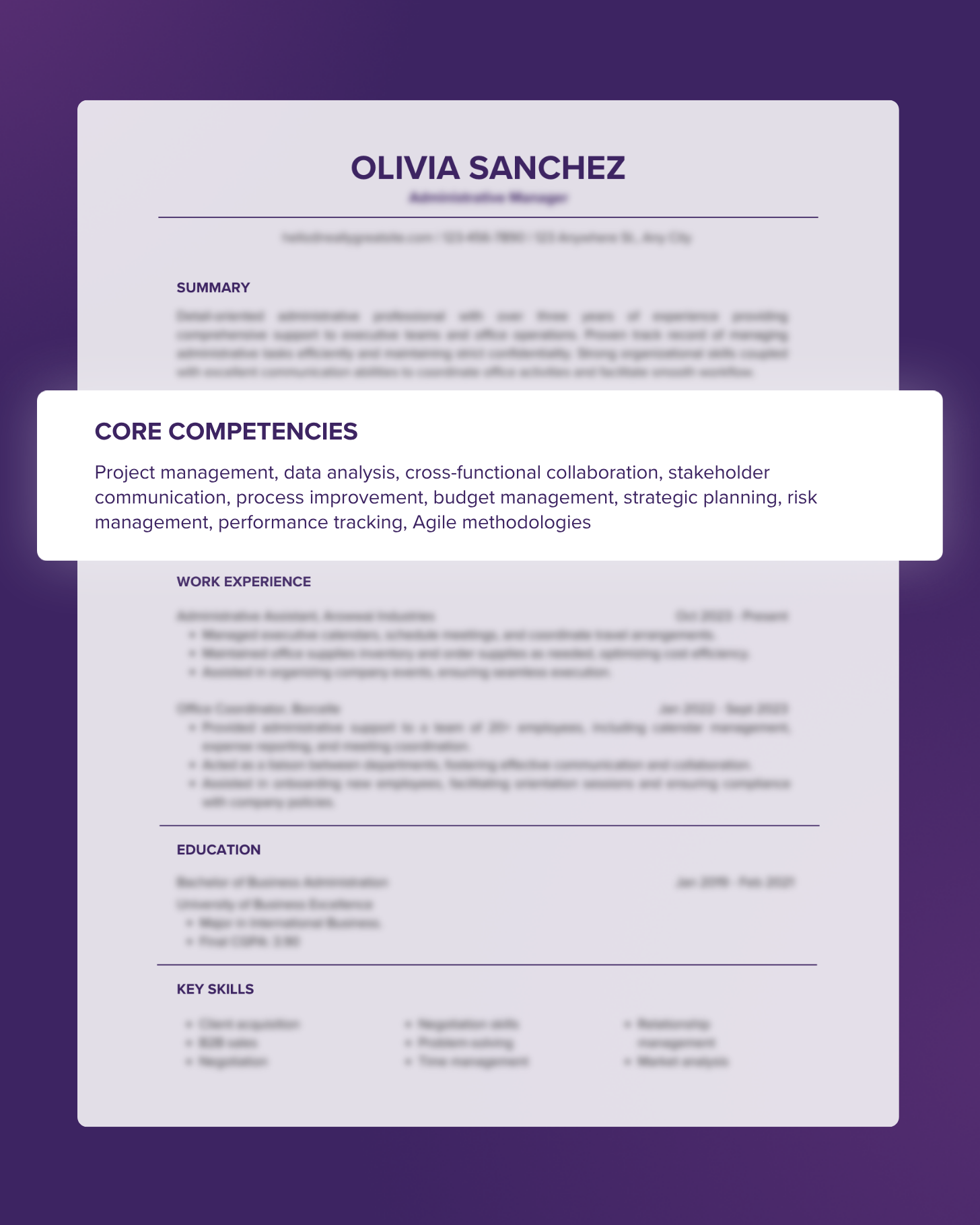
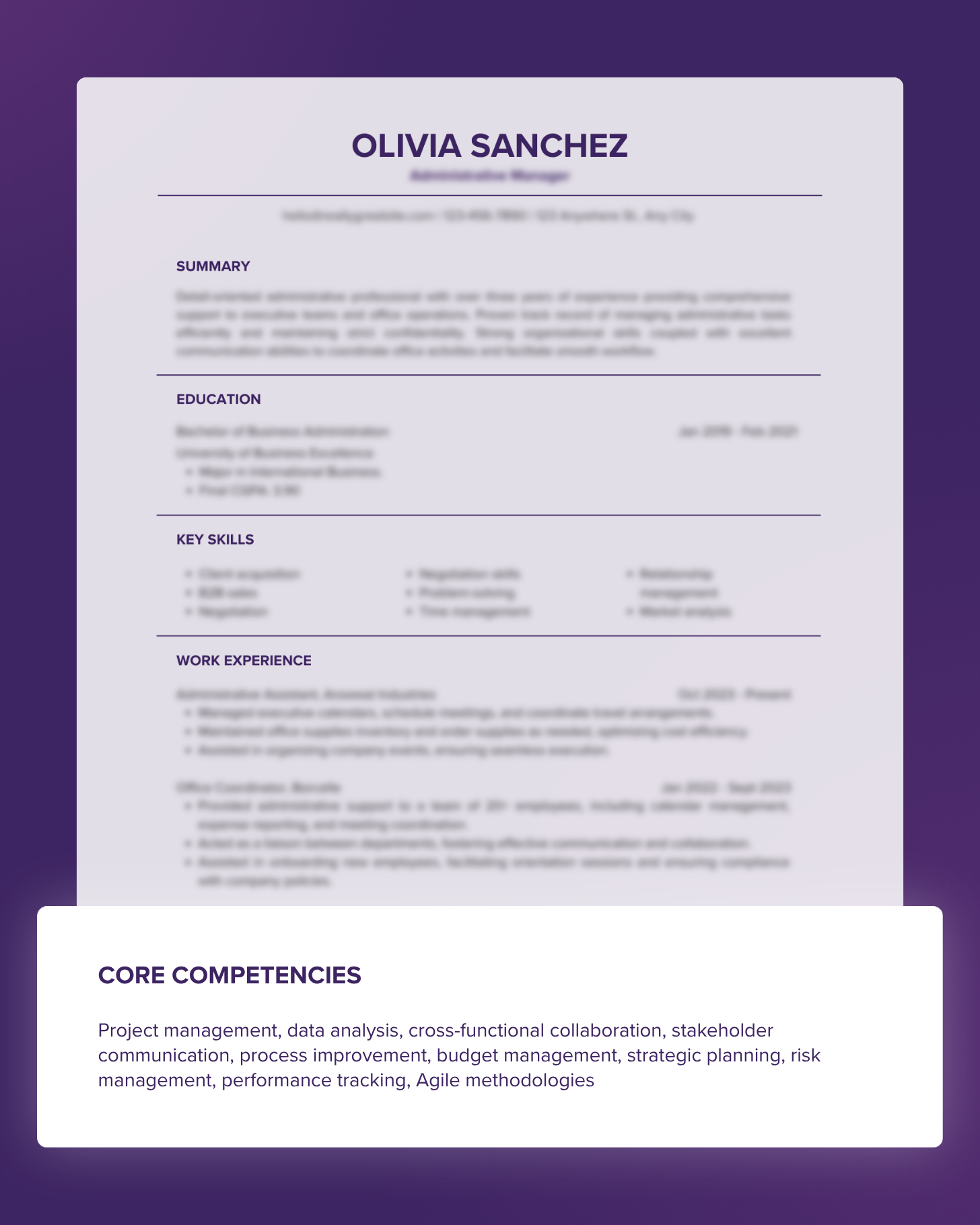
Project management, data analysis, cross-functional collaboration, stakeholder communication, process improvement, budget management, strategic planning, risk management, performance tracking, Agile methodologies
Placement Option 1: Below a Professional Summary
Best for most professionals with established experience. This placement immediately connects your high-level value (summary) with your key skills, helping recruiters quickly understand your strengths.
Visual Example:
Placement Option 2: After Work Experience Section
Best if you want your experience to lead the resume narrative first. This keeps your job history as the primary focus, while still adding keyword optimization at the end.
Visual Example:
Two-Column Format
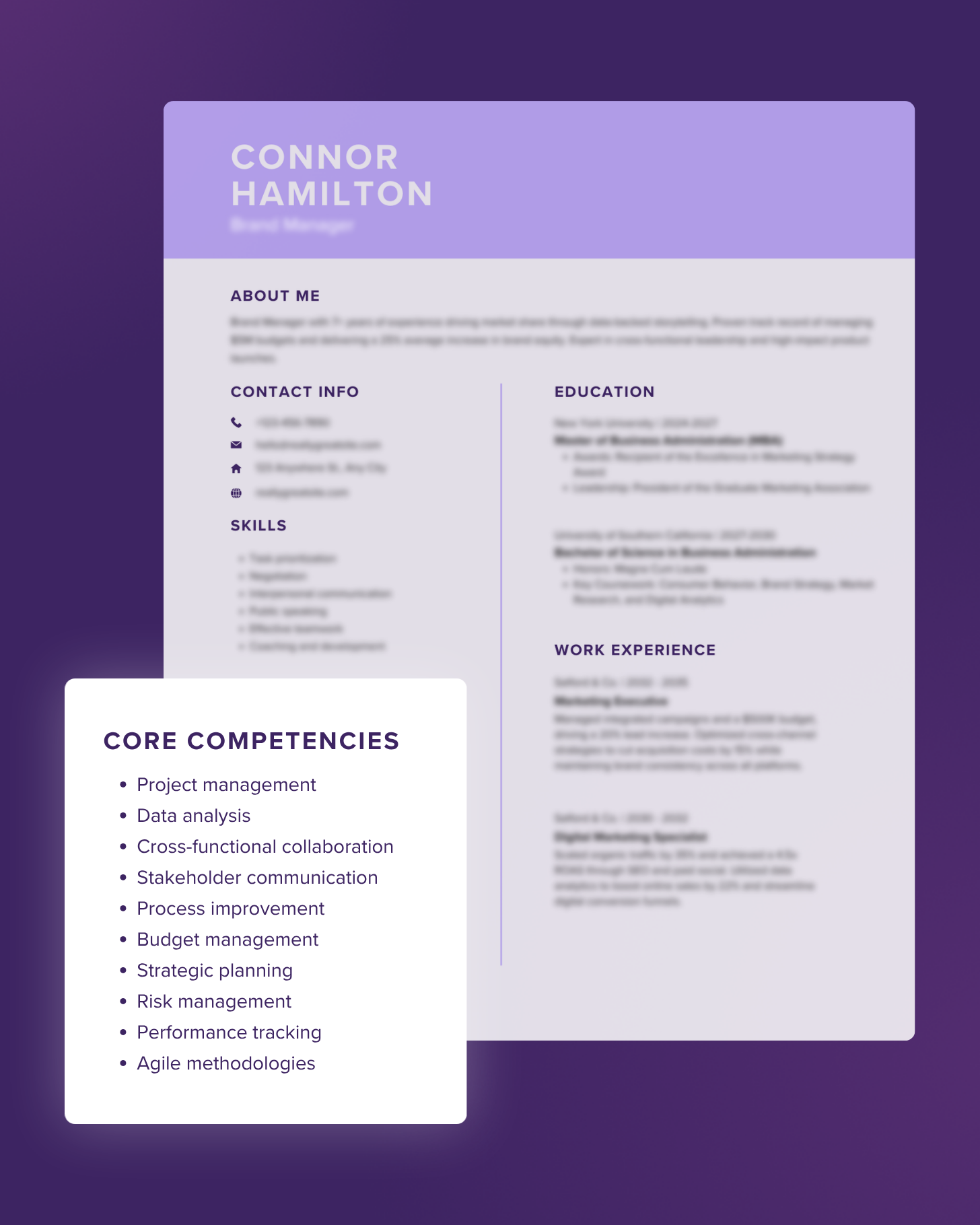
This format lists each competency as a bulleted item within one column of a two-column resume layout. It’s ideal for candidates with a longer list of competencies or those who want a cleaner, more structured format that’s easy to scan.
Template:
In-Text Example:
- Project management
- Data analysis
- Cross-functional collaboration
- Stakeholder communication
- Process improvement
- Budget management
- Strategic planning
- Risk management
- Performance tracking
- Agile methodologies
Visual Example:
Categorized Format
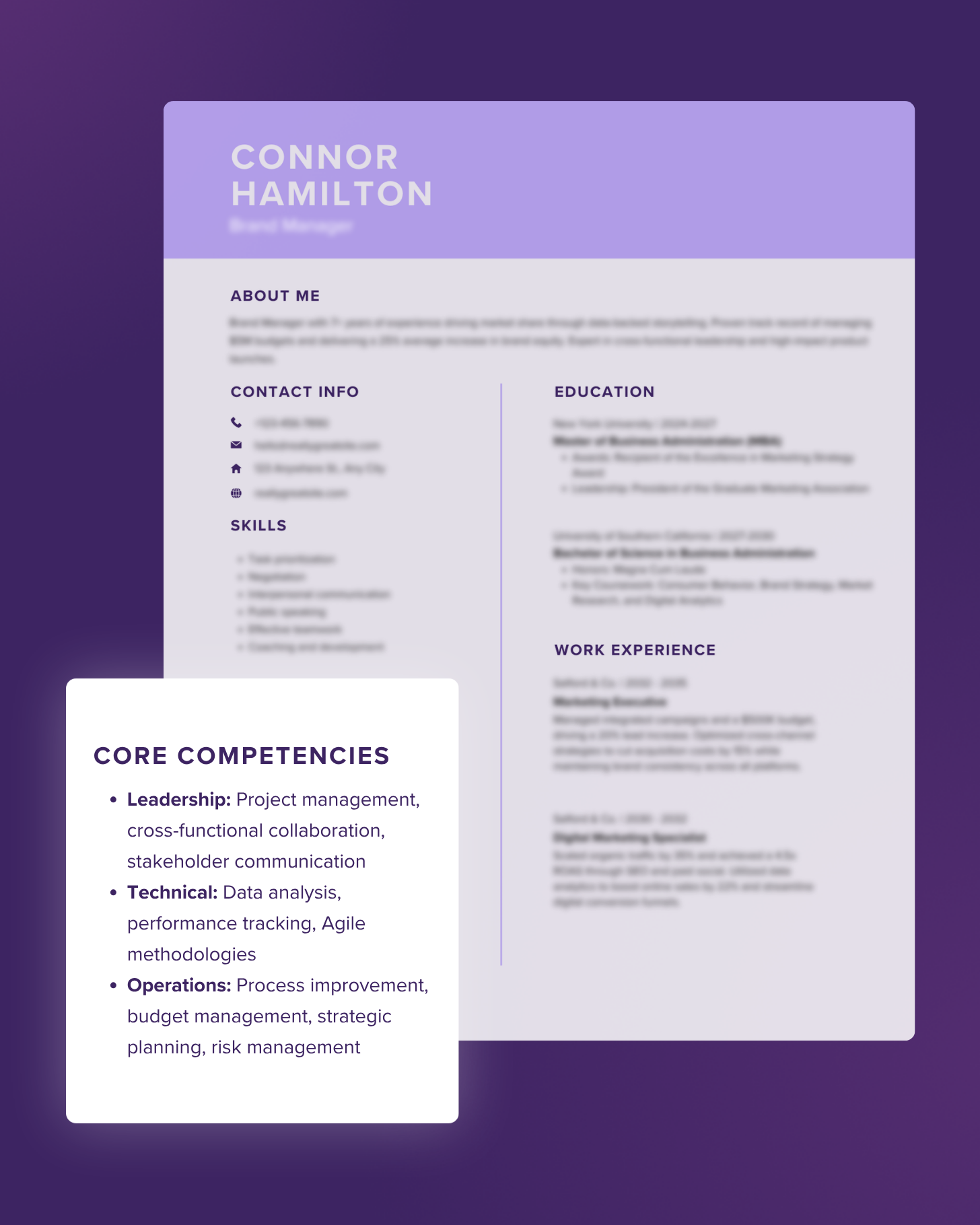
This format groups competencies by type, which is helpful if your strengths span multiple areas like leadership, technical skills, and operations. It works well for mid- to senior-level professionals or more complex roles.
Template:
In-Text Example:
- Leadership: Project management, cross-functional collaboration, stakeholder communication
- Technical: Data analysis, performance tracking, Agile methodologies
- Operations: Process improvement, budget management, strategic planning, risk management
Visual Example:
50 Core Competencies for Resumes: Examples by Category
This list isn’t exhaustive, but you can use these examples to identify patterns and refine your own core competencies. Focus on selecting strengths that match your target role, not copying a generic list.
Analytical & Problem-Solving Competencies
- Critical thinking
- Data analysis
- Decision-making
- Forecasting
- Performance analysis
- Problem-solving
- Process evaluation
- Research
- Risk assessment
- Root cause analysis
Communication & Interpersonal Competencies
- Active listening
- Conflict resolution
- Cross-functional collaboration
- Customer engagement
- Negotiation
- Presentation skills
- Relationship-building
- Stakeholder communication
- Verbal communication
- Written communication
Leadership & Management Competencies
- Change management
- Coaching and mentoring
- Decision-making
- Delegation
- Organizational leadership
- People management
- Performance management
- Strategic planning
- Talent development
- Team leadership
Operational & Project Competencies
- Agile methodologies
- Budget management
- Process improvement
- Project management
- Quality assurance
- Resource allocation
- Risk management
- Scheduling
- Vendor management
- Workflow optimization
Technical & Industry-Specific Competencies
- Cloud computing
- Compliance
- Customer relationship management (CRM) systems
- Data visualization
- Database management
- Digital marketing
- Financial reporting
- Regulatory knowledge
- Software development
- UX design
Core Competencies Resume Examples by Job Title
Not sure what core competencies to include for your role? Below are sample sections by job title to help you see what strong, tailored competencies look like in practice.
Administrative Assistant
Calendar management, document preparation, data entry, office coordination, stakeholder communication, scheduling, records management, customer support, time management, Microsoft Office
Bookkeeper or Accountant
Financial reporting, accounts payable, accounts receivable, general ledger, reconciliation, tax preparation, budgeting, data analysis, compliance, QuickBooks
Construction Manager
Project planning, site management, budget oversight, safety compliance, contractor coordination, scheduling, risk management, quality control, cost estimation, blueprint reading
Customer Service Representative
Customer support, conflict resolution, communication, problem-solving, CRM systems, call handling, relationship-building, issue escalation, product knowledge, time management
Graphic Designer
Visual design, Adobe Creative Suite, branding, typography, layout design, UX design, creative direction, concept development, digital media, attention to detail
HR Manager
Talent acquisition, employee relations, performance management, HR compliance, onboarding, benefits administration, conflict resolution, policy development, leadership, workforce planning
Intelligence Analyst (FBI)
Data analysis, intelligence gathering, critical thinking, risk assessment, report writing, surveillance analysis, information synthesis, pattern recognition, communication, decision-making
IT Solutions Specialist
Technical support, system implementation, troubleshooting, network administration, cloud solutions, cybersecurity, software integration, documentation, problem-solving, customer support
Marketing Manager
Campaign management, digital marketing, content strategy, SEO, data analysis, brand management, stakeholder communication, performance tracking, market research, lead generation
Project Manager
Project planning, stakeholder communication, risk management, Agile methodologies, budgeting, scheduling, team leadership, process improvement, performance tracking, resource allocation
Public Health Program Specialist
Program development, community outreach, data analysis, public health education, grant management, research, stakeholder engagement, compliance, reporting, policy implementation
Registered Nurse
Patient care, clinical assessment, medication administration, care coordination, documentation, infection control, patient education, critical thinking, communication, teamwork
Sales Representative
Sales strategy, lead generation, negotiation, relationship-building, CRM systems, product knowledge, closing techniques, customer engagement, communication, performance tracking
Software Engineer
Software development, programming, debugging, system design, version control, problem-solving, code review, testing, Agile methodologies, technical documentation
Teacher
Lesson planning, classroom management, student assessment, curriculum development, communication, differentiated instruction, technology integration, collaboration, time management, student engagement
Wrapping Up
A strong core competencies section can make your resume easier to scan, more relevant to the role, and more effective for ATS and hiring managers. By choosing the right competencies, tailoring them to each job, and backing them up with real results, you end up with a strong picture of what you bring to the table.
Once your resume is ready, you can upload it to Monster to get matched with jobs that fit your skills and experience.
Frequently Asked Questions
What’s the difference between core competencies vs skills on resumes?
The difference between core competencies vs skills on resumes is that core competencies highlight your most relevant strengths at a high level, while skills are more specific abilities. Core competencies are often grouped in a short, targeted section, while skills can appear throughout your resume and in a dedicated skills section.
How many core competencies should I list on my resume?
You should list eight to 12 core competencies on your resume. This keeps your section focused and easy to scan while still covering your most important strengths. Listing too many can dilute impact and make your resume harder to read.
Where should the core competencies section go on a resume?
The core competencies section should go near the top of your resume, typically below your contact information or professional summary. This placement makes it easy for hiring managers and ATS to quickly identify your key strengths.
Should I tailor my core competencies for every job application?
Yes, you should tailor your core competencies for every job application. Align them with the job description by using relevant keywords and prioritizing the strengths that best match the role.
What are core competencies for entry-level resumes?
Core competencies for entry-level resumes are foundational strengths like communication, teamwork, organization, and problem-solving, along with any relevant technical skills. These help demonstrate your potential even if you have limited work experience.
Can soft skills count as core competencies?
Yes, soft skills can count as core competencies if they’re specific and relevant to the role. For example, “stakeholder communication” or “conflict resolution” are stronger and more effective than vague terms like “good communicator.”

Kirsten Chorpenning is a career advice writer who empowers job seekers to take control of their career paths using Monster’s comprehensive job search and resume tools. She specializes in helping job seekers find rewarding jobs in today’s dynamic work environment.
See More From Kirsten ChorpenningExplore Related Career Advice

Nearly 3 in 10 LinkedIn Users Have Updated a Past Job After Leaving It

Updated:
Oct 7, 2026
|
7 min read

Employee Loyalty Statistics: 90% Say Companies Expect More Than They Give
Updated:
Oct 5, 2026
|
7 min read


Overqualified Hiring Stats: 57% Would Cut Resume Experience to Get Hired
Updated:
Sep 28, 2026
|
9 min read

20 First Job Interview Questions & Sample Answers: Tips to Land Your First Job
Updated:
Sep 24, 2026
|
20 min read

“Do You Have Any Questions for Me?” How to Answer in an Interview (30 Examples)
Updated:
Sep 18, 2026
|
14 min read



20 Companies That Pay 100% Health Insurance & Other Top Benefits
Updated:
Sep 10, 2026
|
14 min read
Manage Your Career Like an Expert
Take control of your professional journey with Monster’s expert resources. Explore advice, research, and tips to make informed decisions and advance your career with confidence.

Job Search
Discover strategies to get noticed, network effectively, and streamline your job search process.

Resumes
Get practical tips to create a resume or CV that stands out to employers and wins interviews.

Cover Letters
Learn how to craft a compelling cover letter that highlights your experience and fit for the role.

Career Paths
Explore career paths, industry trends, and growth opportunities to plan your next move.

Interviewing
Prepare for interviews with tips on answering common questions and following up effectively.

Career Development
Develop key skills and knowledge to grow in your current role or pivot to new opportunities.

Leaving a Job
Navigate job changes and career transitions with practical advice and planning resources.