
How to Put an Expected Graduation Date on Resumes (With Examples)

Degree in progress? Learn how to write expected graduation dates on resumes and format them clearly so employers know when you’ll be ready.
Updated:
|

15 min read

Table of Contents


If you’re still in school, include your expected graduation date in your education section (e.g., “Expected May 2026”) directly under your degree and school name.
This helps employers quickly understand your timeline, confirm your availability for internships or entry-level roles, and see that you’re actively progressing toward your degree. It also shows initiative and reinforces your qualifications as a current, committed candidate.
When & Why Should You Include an Expected Graduation Date on Your Resume
Include an expected graduation date on your resume when you’re still working toward your degree and haven’t officially graduated yet. It gives employers a clear sense of your timeline and helps them understand how your availability aligns with internships, entry-level roles, or structured hiring cycles.
Listing it also shows you’re actively progressing toward your degree, clarifies when you’ll be available for full-time work, and reinforces that you’re building relevant skills as you complete your program.
Why Do Employers Ask for Your Date of Graduation?
Employers use your graduation date to verify your education, understand your experience level, and align you with the right roles.
It helps them determine whether you’re a current student, recent graduate, or more experienced candidate, and whether you’re a fit for internships, entry-level programs, or roles with specific credential requirements.
Where to Put Expected Graduation Date on Resumes
Place your expected graduation date in your education section, directly below your degree and school name, as shown in the example and graphic below. Include your GPA only if it’s strong (typically 3.5 or higher) and relevant to the roles you’re applying for.
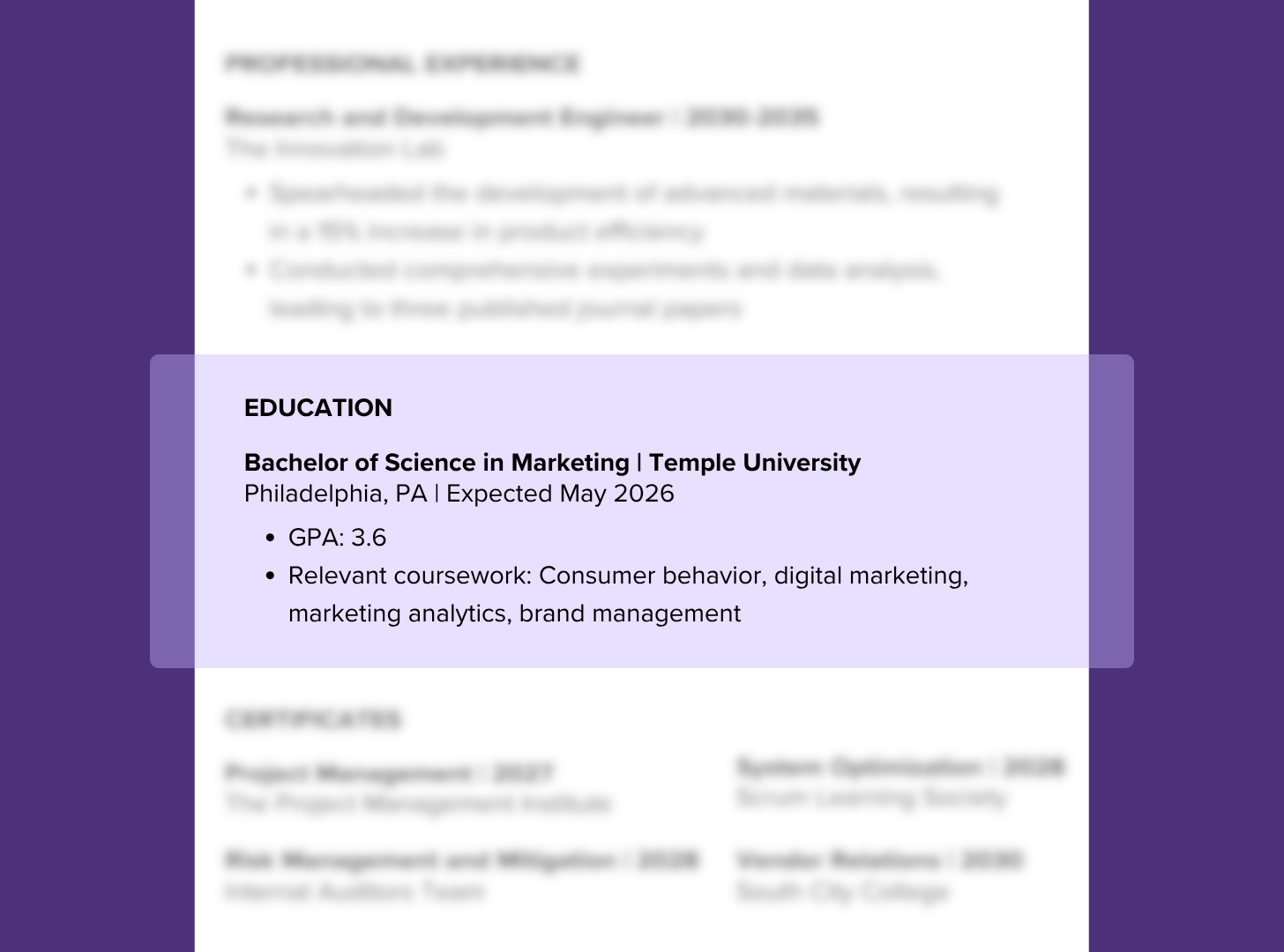
Bachelor of Science in Marketing | Temple University
Philadelphia, PA | Expected May 2026
- GPA: 3.6
- Relevant coursework: Consumer Behavior, Digital Marketing, Marketing Analytics, Brand Management
 Pro Tip
If you’re still in school or recently graduated, position your education section above your work experience section so employers see your academic status right away.
How to Calculate Your Expected Graduation Date
To estimate your expected graduation date, look at how far along you are in your program and what’s left to complete:
- Check completed vs required credits. Compare how many credits you’ve finished with your program’s total requirements.
- Review your course load per term. Factor in how many classes you typically take each semester.
- Account for requirements. Include internships, capstone projects, clinicals, or study abroad programs that may affect your timeline.
- Use your degree auditor or advisor. Your school’s degree-audit tool or an academic advisor can help confirm your projected graduation term.
Expected Graduation Date vs Date Conferred
When adding your expected graduation date on resumes, it’s important to understand how it differs from a graduation date and a date conferred:
| Term | Definition |
| Expected graduation date | The month and year you anticipate completing your degree (used while you’re still in school). |
| Graduation date | The date you complete your degree requirements and typically participate in a ceremony. |
| Date conferred | The official date your school awards your degree, which may be weeks or months after the ceremony. |
On your resume, list an expected graduation date until your degree is complete. Once you’ve graduated, switch to your graduation date. If an employer specifically requests your date conferred, you may need to confirm it with your school (especially for background checks or HR systems).
How to Format an Expected Graduation Date (With Examples)
Your expected graduation date should be clear, consistent, and easy to scan. Most formats are acceptable as long as they follow standard resume conventions and match the rest of your document.
Follow these formatting rules:
- Match the format used elsewhere on your resume. If your experience section uses “January 2024–March 2025,” keep the same style in your education section.
- Use month and year when possible. “Expected May 2026” is clearer than listing only the year.
- Avoid exact dates. There’s no need to include the day.
- Don’t present it as completed. Never list your graduation date as if you’ve already graduated if you haven’t yet.
Here are some examples of common and acceptable ways to write it:
- Expected May 2026
- Anticipated May 2026
- May 2026 (Expected)
- Anticipated 05/2026
- Expected Graduation 2026
- Graduating May 2026
Pro Tip
Using tools like Monster’s Resume Builder and ready-to-use resume templates can help keep your formatting consistent, ATS-friendly, and easy to update as your graduation date approaches.
What to Do if You Don’t Know Your Expected Graduation Date
If you’re not exactly sure when you’ll graduate, include the simplest, most honest estimate you can.
As a rule, aim to be as specific as your situation allows. A rough estimate is better than leaving it off, since it helps employers understand your availability and plan accordingly, and you can update it as you get a better idea of your timeline.
Start with the most precise option, and use a broader format only if needed, as shown below.
- 1.
Use Month & Year When Possible
This is the clearest and most preferred format because it gives a specific timeline.
Example:
Bachelor of Science in Psychology | Boston University
Boston, MA | Expected May 2027 - 2.
Use Year Only if Needed
If you’re unsure of the exact month, the year alone still provides helpful context.
Example:
Bachelor of Science in Psychology | Boston University
Boston, MA | Expected 2027 - 3.
Use a Range if Your Timeline May Vary
If your graduation depends on factors like course load or requirements, a range shows flexibility.
Example:
Bachelor of Science in Psychology | Boston University
Boston, MA | Expected Spring 2027 to Fall 2027 - 4.
Use “TBD” as a Last Resort
Only use this if you truly can’t estimate yet, since it gives the least clarity.
Example:
Bachelor of Science in Psychology | Boston University
Boston, MA | Expected TBD
Special Situations Regarding Graduation Dates
If your education path looks a little different, here’s how to put expected graduation dates on resumes based on your situation:
If You Have an Unfinished Degree You Don’t Plan to Finish
You can still include the degree if it’s relevant, but don’t list an expected graduation date and make it clear that the degree is unfinished. Simply list the school, your field of study, and optionally the years attended, and do one or both of the following:
- Include “Coursework toward [Degree]” in the heading.
- Place “Completed [X] credits toward degree” in the text below the degree information.
Example:
Coursework toward Bachelor of Science in Marketing | Temple University
Philadelphia, PA | 2020–2022
- Completed 50 credits toward degree
- GPA: 3.5
- Relevant coursework: Consumer Behavior, Digital Marketing, Marketing Analytics
If You’re on Hiatus From School
If you’ve paused your studies, include your education but avoid listing an expected graduation date unless you have a confirmed return timeline. To prevent confusion, use a brief note like the ones above to show your progress without implying completion.
Example:
Bachelor of Science in Finance (Coursework toward degree) | Penn State University
University Park, PA
- Completed 60 credits
- Relevant coursework: Financial Accounting, Corporate Finance, Investments
If You’re Pursuing a Master’s or MBA
Include your expected graduation date just like you would for an undergraduate degree. Place it in your education section and format it clearly, such as “Expected May 2026.” List it above your bachelor’s degree so employers see your most recent and relevant education first.
Example:
Master of Business Administration (MBA) in progress | University of North Carolina
Chapel Hill, NC | Expected May 2026
Bachelor of Science in Business Administration | University of Florida
Gainesville, FL | May 2022
If You’re Enrolled in an Online or Part-Time Program
List your expected graduation date the same way as a traditional program. There’s no need to specify “online” or “part-time.”
Example:
Bachelor of Arts in Communications | Arizona State University
Tempe, AZ | Expected 2027
- Relevant coursework: Organizational Communication, Media Ethics, Public Speaking
If You’re Still in High School
Include your high school and expected graduation date, especially if you’re applying for part-time jobs, internships, or early roles. Once you complete a college degree, you should remove your high school from your resume, since it’s no longer relevant.
Example:
High School Diploma | Stuyvesant High School
New York, NY | Expected June 2026
- GPA: 3.6
- Relevant coursework: English Composition, Algebra II, U.S. History
If You’re Changing Careers or Going Back to School
If you’ve returned to school for a new field, include your expected graduation date as you would for any other degree in progress to show your transition timeline. It’s also a good idea to include relevant coursework to highlight the new skills you’re building and how they connect to the roles you’re targeting.
Example:
Bachelor of Science in Computer Science | University of Maryland Global Campus
Adelphi, MD | Expected 2027
- Relevant coursework: Data Structures, Python Programming, Systems Design
When Not to Include a Graduation Date
In most cases, you should include your expected graduation date if your degree is in progress. This section mainly applies to completed degrees, where leaving the date off can help keep the focus on your experience and current qualifications.
- You have over a decade of experience. Remove the graduation date if it’s from 10+ years ago to keep the focus on your recent roles, achievements, and career progression.
- You’re concerned about ageism. Omit the date so employers evaluate your qualifications based on skills and experience rather than timeline cues.
- You’ve changed careers, or your degree isn’t relevant to the roles you’re targeting. Leave off the date to keep the focus on your current field and applicable experience.
- You work in a rapidly evolving industry. Skip older graduation dates so your resume emphasizes up-to-date skills, tools, and knowledge reflected in your experience.
- Your education is outdated or not central to your current career. Exclude the date when the degree itself provides enough context, and the timing doesn’t add value.
- You have multiple degrees with varying timelines. Remove dates if they create clutter or draw attention to gaps that don’t impact your qualifications.
- You need to simplify your resume. Cut graduation dates when space is limited to prioritize more relevant information.
Mistakes to Avoid When Listing Graduation Dates on Your Resume
Even small mistakes with graduation dates can create confusion or raise red flags. Here are the most common issues to avoid:

Listing a graduation date as if you’ve already graduated: Always label it clearly as “Expected” or “Anticipated” until your degree is complete.
Inflating your GPA or fudging your graduation date: Employers can verify this information, and inconsistencies can cost you the offer.
Using inconsistent date formats: Keep formatting aligned across your resume, such as “May 2026” in both your education and experience resume sections.
Including the start date of your degree: This is usually unnecessary and can draw attention away from your expected completion date.
Leaving an outdated expected date after you’ve graduated: Update your resume promptly to reflect your actual graduation date once your degree is complete.
Expected Graduation Date on Resume Examples
Here are examples of how to list expected graduation date on resumes across different education levels and scenarios. Use these as a guide to format your education section clearly and consistently.
Undergraduate (Simple)
Use this format when you want a standard entry that highlights your degree and expected graduation date.
Bachelor of Science in Nursing (BSN) | Temple University
Philadelphia, PA | Expected May 2026
Undergraduate (With Details)
Add your GPA and relevant coursework when they strengthen your application or match the roles you’re targeting.
Bachelor of Science in Marketing | New York University
New York, NY | Expected May 2026
- GPA: 3.6
- Relevant coursework: Consumer Behavior, Digital Marketing, Marketing Analytics
Double Major
List both majors on one line to keep your education section concise and display your areas of study.
Bachelor of Science in Finance and Economics | Penn State University
University Park, PA | Expected May 2026
- GPA: 3.5
Master’s Degree or MBA
Format your expected graduation date on resumes the same way as an undergraduate degree, and list this entry above your bachelor’s to show your most recent education first.
Master of Education (MEd) in Elementary Education | Columbia University
New York, NY | Expected May 2026
- GPA: 3.8
Bachelor of Arts in English | University of Michigan
Ann Arbor, MI | May 2022
- GPA: 3.6
Associate Degree
Use a straightforward format that clearly shows your degree and expected completion date, especially for entry-level roles.
Associate of Science in Business Administration | Bucks County Community College
Newtown, PA | Expected 2026
High School Student
Include your expected graduation date, and add GPA or coursework if they support your application for part-time jobs or internships.
High School Diploma | Southwest High School
Minneapolis, MN | Expected June 2026
- GPA: 3.6
- Relevant coursework: Statistics, World Cultures, Psychology
Show Off Your Education
Adding your expected graduation date the right way helps employers quickly understand where you are in your academic journey and when you’ll be ready to start. Keep it simple, place it in your education section, and format it clearly so it’s easy to scan.
Once your resume is polished, don’t let it sit idle. Upload your resume to Monster to get matched with jobs that fit your skills, experience, and timeline, so you can move from “expected graduation” to your next opportunity faster.
Frequently Asked Questions
How do you write your expected graduation date on a resume?
To write your expected graduation date on a resume, list it in your education section below your degree and school name as “Expected May 2026.” You can also use similar formats, like “Anticipated May 2026” or “May 2026 (Expected),” as long as it’s clear and consistent with the rest of your resume.
Should I put my expected graduation date on resumes?
Yes, you should put your expected graduation date on your resume if you haven’t graduated yet. Including it helps employers understand your timeline, assess your eligibility for internships or entry-level roles, and see how far along you are in your degree program.
What’s the abbreviation for expected graduation date?
The abbreviation for expected graduation date is often written as “Expected” or “Anticipated,” though some people use “EGD.” On a resume, it’s best to spell it out for clarity, such as “Expected May 2026,” since abbreviations can be unclear or look less professional.
Should I include my GPA with my expected graduation date?
You should include your GPA with your expected graduation date if it’s 3.5 or higher, or if it’s required by the employer. If your GPA is lower than 3.5, you can leave it off and focus on relevant coursework, projects, or skills instead.
Do I list my expected graduation date if I’m changing my major?
Yes, you should list your expected graduation date if you’re changing your major, as long as you’re still enrolled. Including it helps show your updated timeline and signals that you’re actively progressing toward completing your new degree.

Kirsten Chorpenning is a career advice writer who empowers job seekers to take control of their career paths using Monster’s comprehensive job search and resume tools. She specializes in helping job seekers find rewarding jobs in today’s dynamic work environment.
See More From Kirsten ChorpenningExplore Related Career Advice

Nearly 3 in 10 LinkedIn Users Have Updated a Past Job After Leaving It

Updated:
Oct 7, 2026
|
7 min read

Employee Loyalty Statistics: 90% Say Companies Expect More Than They Give
Updated:
Oct 5, 2026
|
7 min read


Overqualified Hiring Stats: 57% Would Cut Resume Experience to Get Hired
Updated:
Sep 28, 2026
|
9 min read

20 First Job Interview Questions & Sample Answers: Tips to Land Your First Job
Updated:
Sep 24, 2026
|
20 min read

“Do You Have Any Questions for Me?” How to Answer in an Interview (30 Examples)
Updated:
Sep 18, 2026
|
14 min read



20 Companies That Pay 100% Health Insurance & Other Top Benefits
Updated:
Sep 10, 2026
|
14 min read
Manage Your Career Like an Expert
Take control of your professional journey with Monster’s expert resources. Explore advice, research, and tips to make informed decisions and advance your career with confidence.

Job Search
Discover strategies to get noticed, network effectively, and streamline your job search process.

Resumes
Get practical tips to create a resume or CV that stands out to employers and wins interviews.

Cover Letters
Learn how to craft a compelling cover letter that highlights your experience and fit for the role.

Career Paths
Explore career paths, industry trends, and growth opportunities to plan your next move.

Interviewing
Prepare for interviews with tips on answering common questions and following up effectively.

Career Development
Develop key skills and knowledge to grow in your current role or pivot to new opportunities.

Leaving a Job
Navigate job changes and career transitions with practical advice and planning resources.