
CV vs Cover Letter: Differences, Examples, & When to Use Each

Discover the difference between a CV and a cover letter and learn how to use both documents to present your skills and experience.
Updated:
|

20 min read

Table of Contents


A CV (curriculum vitae) is a detailed record of your experience and qualifications, while a cover letter is a short, tailored message explaining why you’re a strong fit for a specific job.
If you’re applying for jobs, chances are you’ve asked yourself if you need a CV, a cover letter, or both. The confusion is common, especially since employers often expect different application materials depending on the role, industry, or country.
Understanding the difference between a CV vs cover letter is key to presenting your qualifications and securing interviews. In this guide, you’ll learn when to use each document, how they work together, and what to include to impress employers and get hired faster.
What Is a CV?
A CV is a comprehensive document that details your education, work experience, skills, and achievements. It provides a complete picture of your academic and professional background, often including certifications, publications, awards, and other accomplishments that demonstrate your qualifications in depth. This helps employers quickly assess whether your background meets the role’s requirements, especially in fields where detailed credentials matter.
In the U.S., the terms CV and resume are sometimes used interchangeably, but they’re distinct documents. A resume is a shorter, more tailored document focused on specific job applications, usually one page in length. A CV, on the other hand, is more detailed and extensive, often spanning multiple pages and used primarily for academic, research, or medical roles.
In many other countries, such as those in Europe, Asia, and Africa, the term CV commonly refers to what Americans call a resume. In those regions, a CV is typically a shorter document tailored to job applications, rather than an extended academic record.
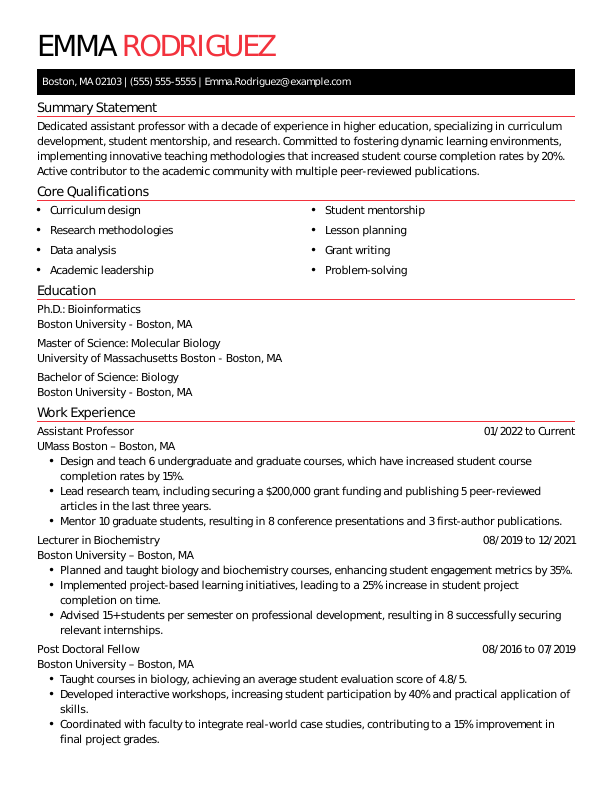
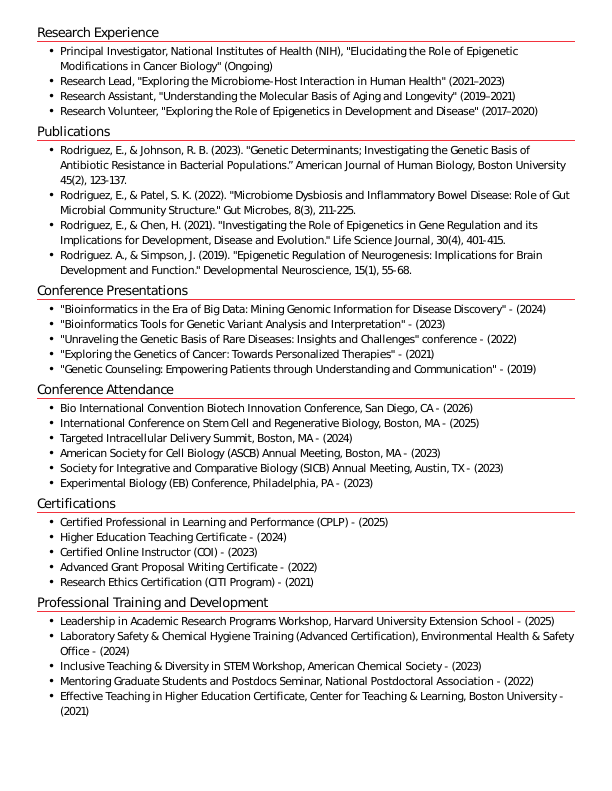
Here’s an example of a U.S. CV for an assistant professor role:
Page 1
Page 2
 Pro Tip
You can use one of Monster’s resume templates to create a polished resume or CV designed to impress recruiters and hiring managers in your field.
What Is a Cover Letter?
A cover letter is a personalized, persuasive document that accompanies your CV or resume when applying for a job. It explains your interest in a specific role and highlights how your background, skills, and experience make you a strong fit for the position.
Unlike a CV, which provides a structured outline of your credentials and qualifications over several pages, a cover letter is one page long and focuses more on context and motivation.
Cover letters allow you to address the employer directly, show enthusiasm for the role, and connect your experience to the job requirements in a more tailored and narrative way.
Here’s an example of strong cover letter content for the assistant professor from above:
EMMA RODRIGUEZ
Boston, MA 02103 | (555) 555-5555 | Emma.Rodriguez@example.com
April 8, 2026
Dylan Kim, Hiring Manager
Northeastern University
Boston, MA 02115
(555) 555-5555
example@example.com
Dear Hiring Manager,
I am writing to express my interest in the assistant professor position in the Department of Biology at Northeastern University. With a decade of experience in higher education, I have developed and taught courses in biology, molecular biology, and bioinformatics, creating data-driven and hands-on learning environments that empower students to excel.
In my current role, I have designed and delivered over ten undergraduate and graduate courses, integrating laboratory exercises and computational analyses that increased student engagement scores by 35% and boosted course completion rates by 20%. I have mentored more than 150 students in research projects and career development, guiding eight students per year to secure internships in leading biotechnology and bioinformatics organizations.
My research on molecular signaling pathways and genomic data analysis has produced ten peer-reviewed publications and over a dozen presentations at national conferences, including the American Society for Cell Biology. I hold certifications in Next-Generation Sequencing Data Analysis and Bioinformatics Programming, which I integrate into curricula and collaborative research projects, enhancing student research output by 30%.
I have also secured internal research grants totaling $250,000, supporting student-led initiatives and interdisciplinary collaborations. These experiences have honed my ability to combine rigorous scientific inquiry with mentorship, fostering both academic excellence and professional growth among students.
I would welcome the opportunity to bring my teaching, research, and mentorship experience to Northeastern University and contribute to your department’s success. Thank you for your time and consideration.
Sincerely,
Emma Rodriguez
Cover Letter vs CV: Key Differences
CVs provide a structured, detailed breakdown of your qualifications, while cover letters offer a tailored explanation of your interest in the role and how your background fits.
Here’s a breakdown of key CV vs cover letter differences:
| Category | CV | Cover Letter |
| Purpose | Complete overview of qualifications | Personalized explanation of fit and interest |
| Format | Structured sections with bullet points | Business letter with paragraphs |
| Length | Multiple pages (as needed) | One page maximum |
| Content Focus | Factual career and academic history | Narrative, persuasive pitch |
| Customization | Tailored sections depending on role | Fully customized for each application |
| Necessity | Required for most applications | Optional, but strongly recommended |
When to Use a CV or Cover Letter
In most job applications, a CV (or resume) is required because it provides the essential information employers need to evaluate your qualifications. A cover letter is usually optional, but it can strengthen your application by highlighting what makes you a great fit for the job and help hiring managers quickly see why you’re a strong candidate.
When to Submit a CV
Always submit a CV when applying for roles that expect a full record of your academic and professional background. CVs are used for academic, research, education, and medical roles, where a comprehensive history of your achievements and credentials is important.
If you’re applying for industry roles in the U.S., submit a resume instead of a CV. If you’re applying to jobs internationally, such as in the UK, Europe, or Australia, “CV” is the standard term for the essential job application document that you’ll submit.
When to Submit a Cover Letter
Use a cover letter when you want to add context to your CV and explain your interest in a specific role. It’s especially valuable when you need to highlight key achievements, career transitions, or personal fit that may not be fully captured in your CV.
Cover letters aren’t always required, but they play a key role in hiring decisions. A ResumeGenius survey of employers across the U.S. found that 94% of hiring managers say cover letters influence their interview decisions, highlighting the benefit of submitting a cover letter alongside your CV, even when it’s not required. In competitive roles, this extra context can be the difference between getting overlooked and getting shortlisted.
When to Submit Both
You should submit both a CV and a cover letter when:
- The job application asks for them.
- A cover letter is optional, but the role is competitive.
- You’re particularly interested in the opportunity or company.
Submitting both documents gives you the strongest chance of standing out, as it combines a full overview of your qualifications with a tailored explanation of your alignment with the position.
What to Include in a CV
At a minimum, a CV should include your contact information, a professional summary, education history, and work experience listed in reverse-chronological order. Depending on your field, you may also include sections for research experience, projects, or technical competencies.
Header With Your Contact Details
Your CV header should include your full name, phone number, professional email address, and location (city and state or country). This section should be clear, accurate, and placed at the top of your CV so employers can easily identify and reach you.
A CV header is formatted the same as a resume header. Keep it simple and professional, avoiding unnecessary details like full mailing addresses or personal information.
Here’s an example CV header:
Jane Smith
Seattle, WA | (555) 123-4567 | jane.smith@email.com | linkedin.com/in/janesmith
Professional Summary
A professional summary is a brief statement at the top of your CV that highlights your key qualifications, experience, and career focus. It gives employers a quick snapshot of who you are as a candidate and what you bring to the role.
Typically three to five sentences long, your summary should emphasize your most relevant experience, core skills, and notable achievements. It should be tailored to the role you’re applying for, using language that aligns with the job description. This helps recruiters understand your value within seconds and decide whether to keep reading.
Here’s an example of a professional summary for a digital marketing role:
Results-driven digital marketing specialist with 5+ years of experience in content strategy and campaign management. Proven ability to increase brand awareness and drive lead generation through SEO, paid media, and data-driven insights. Strong background in cross-channel marketing, analytics, and optimizing campaigns to improve performance and ROI. Experienced in collaborating with cross-functional teams to execute integrated marketing initiatives that support business growth.
Work Experience
Your work experience section outlines your employment history and shows employers how your past roles have prepared you for the position.
Highlight your responsibilities, achievements, and impact in each role, focusing on the experience most relevant to the job you’re applying for. List your roles in reverse-chronological order, including your job title, company name, location, and dates of employment.
Under each position, use bullet points to describe your key accomplishments, ideally with measurable results (e.g., increased revenue, improved efficiency, or higher engagement).
Here’s an example for a software engineering role:
Senior Software Engineer
TechSolutions Inc., San Francisco, CA | July 2020–Present
- Developed scalable web applications using JavaScript, Python, and React, improving system performance by 30% and reducing load times by 25%.
- Collaborated with cross-functional teams to design and implement new features, increasing user engagement by 20% and customer retention by 15%.
- Wrote clean, efficient, and well-documented code, reducing production bugs by 40% and improving overall code quality metrics.
Pro Tip
Start your work history bullet points with strong action verbs like “led” and “implemented” to clearly communicate your impact and make your experience more compelling to employers.
Education
Your education section outlines your academic background and is a key part of a CV, especially for roles where formal qualifications are essential.
It should be listed in reverse-chronological order, starting with your most recent degree, and include the institution, degree earned, and field of study.
To strengthen this section, you can also add relevant academic details, such as honors, GPA (if strong and applicable), key coursework, research projects, dissertations, or academic awards.
Here’s an example education section for a medical CV:
Master of Public Health (MPH), Epidemiology
Harvard University, Boston, MA
- Focus: Epidemiological methods, biostatistics, and population health analysis
- Capstone: Evaluated public health interventions for reducing cardiovascular disease risk in urban populations
- Relevant Coursework: Advanced Epidemiology, Biostatistics, Global Health, Health Policy Analysis
Doctor of Medicine (MD)
University of California, Los Angeles (UCLA), Los Angeles, CA
- Honors: High Pass in Internal Medicine and Pediatrics clerkships
- Clinical Rotations: Internal Medicine, Pediatrics, Surgery, Psychiatry, Emergency Medicine
- USMLE Step 1 & Step 2: Passed
- Research: Contributed to a clinical study on cardiac outcomes in patients with heart failure
Bachelor of Science (BS), Biology, Minor in Chemistry
University of Michigan, Ann Arbor, MI
- Honors: Dean’s List all semesters
- Undergraduate Research: Assisted in laboratory research on cellular biology and disease mechanisms
- Relevant Coursework: Organic Chemistry, Genetics, Microbiology, Biochemistry
Relevant Skills
Include a skills section on your CV to highlight the key abilities that make you a strong candidate for the role. This gives employers a quick, scannable overview of your core strengths and helps demonstrate how well you match the position.
Include a mix of technical skills, industry-specific expertise, and transferable skills, such as communication, teamwork, and problem-solving. The goal is to focus on abilities that are directly relevant to the role, rather than listing every skill you have.
Grouping similar skills into categories can also make this section easier to read and more impactful for hiring managers.
Here’s an example:
- Teaching skills: Curriculum development, lecture delivery, seminar facilitation, student assessment
- Research skills: Academic publishing, qualitative and quantitative research, grant writing, literature reviews
- Subject expertise: Educational theory, pedagogical methods, discipline-specific knowledge
- Academic skills: Thesis supervision, peer review, conference presentations, syllabus design
- Professional skills: Academic advising, collaboration, leadership, time management
Optional Sections
When you write your CV, you can include additional sections to highlight qualifications that don’t fit into standard categories like education or work experience.
Common sections include:
- Awards and honors
- Relevant certifications
- Publications
- Conferences and presentations
- Academic projects
- Volunteer experience
- Professional memberships
- Languages
- Technical proficiencies
For academic, research, or specialist roles, these can be especially valuable as they demonstrate expertise, engagement in your field, and ongoing professional development.
What to Include in a Cover Letter
Your cover letter should include a professional introduction, a short explanation of your interest in the role, and a summary of your most relevant skills and achievements. When you write your cover letter, connect your background to the employer’s needs rather than repeating your CV.
Header & the Employer’s Information
Your cover letter header should match the details and formatting of your CV to ensure a consistent, professional presentation across your application materials. Include your contact information at the top, followed by the date and the employer’s contact details.
Here’s an example of how to format your header:
Michael Turner | Seattle, WA | (555) 987-6543 | michael.turner@email.com
March 15, 2026
Hiring Manager
Telkin Marketing Group
1234 Pine Street
Seattle, WA 98101
Salutation
The salutation is the greeting at the start of your cover letter, and it should address the recipient as directly and professionally as possible. Whenever possible, use the hiring manager’s name to make your application more personal and targeted.
If you know their name, write “Dear [First Name Last Name]” or “Dear Ms./Mr. [Last Name].”
If the name isn’t available, use a respectful alternative that still feels professional and specific to the company. Avoid overly generic openings like “To whom it may concern,” as they can feel impersonal and outdated.
Examples of appropriate salutation options include:
- Dear Ms. Johnson,
- Dear Mr. Smith,
- Dear Dr. Patel,
- Dear Hiring Manager,
- Dear Marketing Team,
- Dear ABC Company Team,
- Dear Human Resources Team,
Attention-Grabbing Introduction
Follow your salutation with a compelling introduction that immediately states who you are, what role you’re applying for, and why you’re a strong candidate.
Hiring managers are busy, so it’s important to start your cover letter with a strong hook that encourages them to continue reading.
Here’s an example:
I am a public health researcher with a Master’s in Public Health and over three years of experience in epidemiological analysis and clinical research, and I am excited to apply for the Research Analyst position at the University of Washington School of Public Health. In my previous role, I supported multisite studies on chronic disease trends, applying advanced statistical modeling in R and Python to improve data accuracy and identify key risk factors that informed evidence-based public health recommendations.
Tailored Body Paragraphs
Tailored body paragraphs are the main section of your cover letter, where you connect your skills and experience directly to the job requirements. Their purpose is to show employers why you’re an excellent fit by providing specific, relevant examples.
In these paragraphs, focus on two to three key qualifications from the job description and match them with your own experience. Show your understanding of the company and explain how your background aligns with their goals, values, or needs. This is what turns your application from a generic submission into a compelling case for why you should be interviewed.
Here’s an example body paragraph for an engineering cover letter:
In my previous role as a software engineer, I designed and implemented scalable backend systems using Python and Java, improving API response times by 35% and supporting increased user traffic across core platform services. I collaborated closely with product and engineering teams to develop and deploy new features in an Agile environment, ensuring timely delivery and alignment with user needs. Additionally, I optimized database queries and system architecture, reducing server load and improving overall application performance and reliability.
Pro Tip
The ideal cover letter length is between half a page and one full page (around three to four paragraphs and 250 to 400 words). Keep the body of your letter focused and targeted to maintain the hiring manager’s attention and quickly demonstrate your strengths.
Closing Paragraph & Sign-Off
Add a closing paragraph reinforcing your interest in the position and prompting the next step in the hiring process, followed by a professional sign-off and your typed name or digital signature.
Maintain a confident, polite tone in your conclusion, and leave a strong final impression without introducing new information. Reaffirm your enthusiasm for the position and indicate your availability for an interview or further discussion. End with a professional sign-off, such as “Sincerely” or “Best regards,” followed by your name.
Here’s an example:
I am excited about the opportunity to contribute to Greenfield Consulting as a financial analyst, and I’m confident my experience in financial modeling, data analysis, and forecasting would allow me to add immediate value to your team. I would welcome the opportunity to discuss further how my skills and experience align with your needs. Thank you for your time and consideration.
Best regards,
Emily Carter
How a CV & Cover Letter Complement Each Other
CVs provide a structured, detailed breakdown of your qualifications, while cover letters offer a tailored explanation of your interest in the role and how your background fits. Both documents work together to form a complete job application, with each playing a distinct but complementary role in presenting your experience effectively.
You can think of your cover letter as the “story behind the highlights,” and the CV as the “full record.” A cover letter draws the employer in and shows your fit, while a CV provides the depth and detail needed to evaluate your qualifications.
Here’s a close look at how CVs and cover letters support one another:
- CVs provide a structured overview of your education, experience, and skills, while cover letters add context and personality to that information.
- CVs highlight your full career history, while cover letters focus on the most relevant achievements for the job.
- CVs present facts in a clear format, while cover letters build a narrative around your enthusiasm and alignment with the job.
- CVs help employers quickly assess qualifications, while cover letters help them understand your motivation and intent.
Putting Your CV & Cover Letter Into Action
A CV or cover letter is not an either-or decision in most job applications—together, these documents create a stronger and more complete presentation of your qualifications.
Understanding the difference between CVs and cover letters helps you choose the right document for the situation, present your experience more effectively, and meet employer expectations with confidence. With this clarity, you’ll know when to rely on your CV, when to add a cover letter, and how each one strengthens your overall application.
When you’re ready, you can use Monster’s Resume Builder to create a polished, professional CV that clearly showcases your experience and works seamlessly alongside your cover letter.
Frequently Asked Questions
Do you need a cover letter if you have a CV?
You don’t always need a cover letter if you have a CV. In most job applications, a CV or resume is the primary document required, while a cover letter is often optional.
We strongly recommend including a cover letter, as it adds important context to your CV and demonstrates your suitability for the role in a more tailored, personal way, helping to strengthen your overall application and improve your chances with hiring managers.
Is a CV basically a cover letter?
No, a CV is not a cover letter—they’re two distinct documents that are often submitted together when you apply for jobs.
So, what is a CV vs a cover letter? A CV is a document that outlines your education, work experience, skills, and achievements in detail, and a cover letter is a business letter-type document that explains how your background fits the specific role.
Do employers prefer a CV or a resume?
Employers don’t universally prefer a CV or a resume, as it depends on the country, industry, and role.
- In the U.S., a resume is the standard document used across industries. CVs are mainly expected for academic, research, medical, or scientific positions.
- Outside the U.S., especially in the UK and Europe, the term “CV” is more commonly used for standard job applications across industries and fields.
Which one comes first, a cover letter or a CV?
In most job applications, the cover letter is submitted before or alongside the CV, but there is no fixed reading order. Employers may open either document first, depending on the application system or format. The important point is that the cover letter introduces your application, while the CV provides the detailed evidence of your experience and qualifications.

Elizabeth Muenzen is a Certified Professional Resume Writer (CPRW) and member of the Professional Association of Resume Writers & Career Coaches who empowers job seekers to take control of their career paths using Monster’s comprehensive job search and resume tools.
See More From Elizabeth MuenzenExplore Related Career Advice

“Do You Have Any Questions for Me?” How to Answer in an Interview (30 Examples)

Updated:
Sep 18, 2026
|
14 min read



20 Companies That Pay 100% Health Insurance & Other Top Benefits
Updated:
Sep 10, 2026
|
14 min read


How Long of a Commute Is Too Long? 49% Have Turned Down a Job Due to the Commute

Updated:
Sep 8, 2026
|
11 min read


Beauty Bias at Work Statistics: 88% Say Attractive People Have an Advantage
Updated:
Aug 31, 2026
|
8 min read

Manage Your Career Like an Expert
Take control of your professional journey with Monster’s expert resources. Explore advice, research, and tips to make informed decisions and advance your career with confidence.

Job Search
Discover strategies to get noticed, network effectively, and streamline your job search process.

Resumes
Get practical tips to create a resume or CV that stands out to employers and wins interviews.

Cover Letters
Learn how to craft a compelling cover letter that highlights your experience and fit for the role.

Career Paths
Explore career paths, industry trends, and growth opportunities to plan your next move.

Interviewing
Prepare for interviews with tips on answering common questions and following up effectively.

Career Development
Develop key skills and knowledge to grow in your current role or pivot to new opportunities.

Leaving a Job
Navigate job changes and career transitions with practical advice and planning resources.