
70+ Resume Buzzwords to Avoid & 100+ Power Words to Use Instead

Learn which resume buzzwords and clichés hurt your application and which power words can help you stand out and get interviews.
Updated:
|

17 min read

Table of Contents


Resume buzzwords are vague, overused words and phrases that describe skills or traits without showing results. Because they’re used so often, they fail to differentiate candidates and rarely impress hiring managers.
Most buzzwords for resumes fall into four main categories:
- Empty personality descriptions
- Weak or vague action verbs
- Outdated resume phrases
- Corporate jargon that adds little real meaning
The problem shows up the moment a recruiter starts scanning resumes. When everything sounds the same, individual accomplishments disappear. Generic language blends together, and hiring managers skim past resumes that don’t clearly show value or results. If your resume sounds like everyone else’s, even top qualifications won’t make it stand out.
In this guide, you’ll find 70+ resume buzzwords to avoid, 100+ power words to use instead, and rewrite examples to help you update your resume.
Buzzwords vs Keywords vs Clichés
Not all commonly used resume language is bad. The real issue is figuring out which resume clichés and buzzwords hurt your chances and which ones actually help.
This is where power words come in.
Power words are specific, action-oriented verbs that clearly show what you did and what changed as a result. They work because they communicate ownership, impact, and outcomes instead of vague traits or participation.
Unlike resume buzzwords, power words don’t rely on hype. They earn attention by showing real work, clear scope, and measurable results.
Keywords (Good & Necessary)
Keywords are exact terms pulled directly from the job description. They’re specific, role-relevant, and align closely with the resume keywords employers and applicant tracking systems (ATS) scan for.
Examples of resume keywords include:
- Financial modeling
- Paid media strategy
- Python, SQL, Tableau
- Salesforce CRM
Use these terms intentionally and accurately, especially in your work experience and skills sections.
Example of a keyword-driven bullet:
- Before: Worked with customer data
- After: Analyzed customer data in Salesforce CRM to identify churn trends and improve retention by 15%.
Buzzwords (Depends on How You Use Them)
Buzzwords fall into a gray area. Some are useful action verbs when they’re tied to clear results. Others turn into filler when they’re vague or overused.
For example, “led” works when you explain what or whom you led and why it mattered. “Leveraged” doesn’t add much value unless it’s followed by specific context.
Clichés (Always a Red Flag)
Clichés are overused phrases that should almost always be removed or rewritten.
Common examples of clichés to avoid include:
- hard worker
- team player
- think outside the box
During a quick resume scan, these phrases blur together, which makes it harder for recruiters to see what actually sets you apart.
Resume Buzzwords to Avoid (70+ Examples)
As you review the lists below, scan your own resume for these terms and focus on rewriting the entire bullet point for impact, not just swapping in a synonym.
30 Overused Personality Traits
These terms sound positive, but they describe traits instead of actions, which makes them hard to back up.
- Adaptable
- Capable
- Committed
- Dedicated
- Dependable
- Detail-oriented
- Driven
- Dynamic
- Energetic
- Enthusiastic
- Experienced
- Fast learner
- Flexible
- Forward-thinking
- Go-getter
- Hard worker
- Highly motivated
- Organized
- Passionate
- People person
- Positive attitude
- Proactive
- Professional
- Reliable
- Responsible
- Results-driven
- Self-starter
- Strong work ethic
- Team player
- Trustworthy
20 Weak Action Verbs
These verbs obscure your contribution by focusing on participation rather than ownership, impact, or results.
- Aided
- Assisted
- Completed duties
- Contributed to
- Dealt with
- Did
- Handled
- Helped
- Helped with
- Involved in
- Managed tasks
- Oversaw (without context)
- Participated in
- Provided support
- Responsible for
- Supported
- Tasked with
- Took part in
- Was involved
- Worked on
13 Outdated Resume Terms
These phrases signal an outdated resume and often take up space without adding meaningful information.
- Career summary (generic)
- Curriculum vitae (when a resume is requested)
- Duties included
- Entry-level professional
- Fax number
- GPA listed after 10+ years of experience
- Hard copy resume
- Microsoft Office proficient
- Objective statement
- Personal interests (when irrelevant)
- References available upon request
- Salary requirements
- Typing speed
15 Unnecessarily Complex Terms
Corporate jargon may sound sophisticated, but it often replaces clarity, making your experience harder to understand.
- Bandwidth
- Best-in-class
- Circle back
- Core competency
- Ecosystem
- Holistic approach
- Leverage
- Low-hanging fruit
- Move the needle
- Paradigm shift
- Stakeholder alignment
- Synergy
- Thought leader
- Value-add
- Wheelhouse
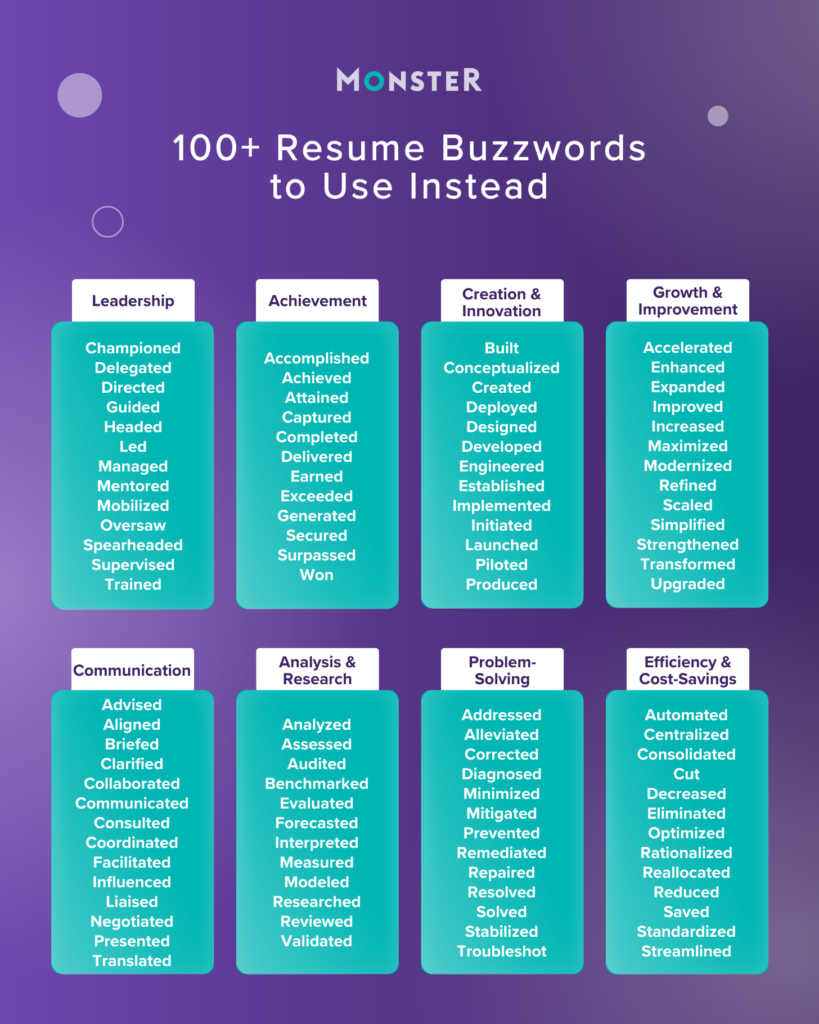
100+ Resume Buzzwords to Use Instead (With Examples)
The words below aren’t meant to be dropped in randomly; they should be action-oriented power words backed by real results. Use them to replace vague language and strengthen resume bullets by combining verbs with context to demonstrate your impact.
Each list applies the following formula: Resume buzzword + example context with results.
Leadership Buzzwords
These words are most effective when you’re describing people management, project ownership, or decision-making authority.
- Championed a new onboarding program that reduced employee ramp-up time by 25%
- Delegated responsibilities to team members, increasing overall project efficiency
- Directed a cross-functional team of 8 to complete a product launch ahead of schedule
- Guided junior analysts to improve reporting accuracy by 15%
- Headed a quarterly marketing campaign that increased leads by 30%
- Led vendor negotiations that cut supply costs by 12%
- Managed daily operations, improving turnaround time by 20%
- Mentored 3 interns, two of whom were promoted within 6 months
- Mobilized resources across departments to implement process improvements
- Oversaw budget tracking, reducing overruns by 8%
- Spearheaded a cross-team initiative that launched a new product line
- Supervised a team of 5, ensuring 100% project completion on schedule
- Trained staff on new software, increasing adoption rate by 95%
Achievement Buzzwords
These words help highlight outcomes and wins, especially when you can tie them to measurable results.
- Accomplished a 20% reduction in operational costs within six months
- Achieved a 15% increase in quarterly sales targets
- Attained a client retention rate of 98% through relationship management
- Captured key market share by launching a targeted ad campaign
- Completed a high-priority project two weeks ahead of deadline
- Delivered a new reporting dashboard that improved executive decision-making
- Earned employee recognition awards for exceeding performance goals
- Exceeded monthly KPIs by 25%
- Generated over $500K in new business revenue
- Secured a strategic partnership that expanded product distribution
- Surpassed annual customer satisfaction targets by 12%
- Won an industry award for innovation in product design
Creation & Innovation Buzzwords
Use these when you’ve built, launched, or introduced something new, from idea to execution.
- Built a new client portal that increased engagement by 40%
- Conceptualized a marketing strategy that boosted lead generation
- Created a content calendar that improved social media reach by 35%
- Deployed automated reporting tools to reduce manual work by 50%
- Designed a new website layout that increased traffic by 20%
- Developed an internal training program adopted company-wide
- Engineered a scalable backend system that improved platform reliability
- Established new procedures that cut error rates by 18%
- Implemented a CRM system that streamlined customer tracking
- Initiated a cross-department collaboration that increased efficiency
- Launched a product line that generated $1M in first-year sales
- Piloted a workflow improvement that shortened project timelines
- Produced high-impact marketing collateral that improved conversions
Growth & Improvement Buzzwords
Use these verbs when you’ve changed a process, improved performance, or helped a team or organization move forward.
- Accelerated project delivery timelines by 20%
- Enhanced customer experience, improving NPS scores by 10 points
- Expanded service offerings to attract new client segments
- Improved operational efficiency, reducing processing time by 25%
- Increased social media engagement by 35% through targeted campaigns
- Maximized team productivity by introducing new project management tools
- Modernized reporting processes, improving accuracy and speed
- Refined internal workflows to reduce duplication of work
- Scaled marketing campaigns to reach a broader audience
- Simplified complex data reporting, saving 10 hours per week
- Strengthened client relationships, resulting in repeat business growth
- Transformed customer support process, cutting response time by 50%
- Upgraded software infrastructure, reducing downtime by 40%
Communication Buzzwords
These verbs are useful when your role requires collaboration, persuasion, or clear communication across teams.
- Advised senior leadership on strategic decisions, influencing outcomes
- Aligned departmental goals with overall company objectives
- Briefed executives on project status, enabling timely decisions
- Clarified complex processes for cross-functional teams
- Collaborated with stakeholders to launch a new product line
- Communicated key metrics in weekly performance reports
- Consulted with clients to improve campaign performance
- Coordinated logistics for multiple events, ensuring smooth execution
- Facilitated workshops that improved team engagement
- Influenced decision-making by presenting data-driven recommendations
- Liaised between departments to resolve workflow bottlenecks
- Negotiated vendor contracts, saving the company 15% in costs
- Presented project outcomes to executive leadership
- Translated technical concepts for non-technical audiences
Analysis & Research Buzzwords
Choose these verbs when your work involves analysis, research, or data that directly informs decisions.
- Analyzed customer behavior data to guide marketing strategy
- Assessed operational efficiency, identifying areas for cost savings
- Audited financial records to ensure compliance and accuracy
- Benchmarked industry trends to inform product development
- Evaluated campaign performance, increasing ROI by 18%
- Forecasted sales trends to guide inventory planning
- Interpreted complex datasets to inform leadership decisions
- Measured performance metrics, enabling process improvements
- Modeled financial scenarios to optimize budgeting
- Researched competitor offerings to identify growth opportunities
- Reviewed internal reports to improve operational efficiency
- Validated data to ensure accuracy in reporting
Problem-Solving Buzzwords
This language works best when you can clearly show how you identified a problem and took steps to resolve it.
- Addressed client complaints, improving satisfaction by 20%
- Alleviated workflow bottlenecks, speeding up project delivery
- Corrected process errors, reducing rework by 15%
- Diagnosed system issues, minimizing downtime
- Minimized operational risks through proactive monitoring
- Mitigated project delays with contingency planning
- Prevented recurring errors by implementing standardized procedures
- Remediated compliance gaps, avoiding potential penalties
- Repaired critical system failures, restoring operations quickly
- Resolved interdepartmental conflicts, improving collaboration
- Solved complex technical problems that improved client outcomes
- Stabilized underperforming teams, increasing productivity
- Troubleshot software issues, reducing customer complaints by 25%
Efficiency & Cost-Saving Buzzwords
Choose these verbs when you can clearly point to cost savings, efficiency gains, or reduced waste.
- Automated reporting processes, saving 10 hours per week
- Centralized data management to reduce redundancies
- Consolidated vendor contracts, cutting costs by 12%
- Cut unnecessary expenses, improving budget efficiency
- Decreased project turnaround time by 20%
- Eliminated bottlenecks in workflows
- Optimized resource allocation, reducing waste by 15%
- Rationalized processes for greater efficiency
- Reallocated team resources to high-priority initiatives
- Reduced operational costs by $50K annually
- Saved company time and money by streamlining reporting
- Standardized procedures to improve consistency
- Streamlined client onboarding, reducing setup time by 30%
10 Common Resume Clichés & Better Alternatives
Generic phrases feel safe, but they don’t differentiate you. The problem isn’t the idea behind these clichés; it’s that they don’t show proof. Below, each cliché is broken down into why it falls flat, what to use instead, and how to rewrite it in a stronger, more concrete way.
- 1.
“Natural Leader”
Why it falls flat: This phrase is subjective and unverifiable. Hiring managers want to see how you led and what changed as a result.
Use instead: Directed, mentored, trained, guided, mobilized
Before After Natural leader who motivates teams Directed a cross-functional team of 8 to deliver a product launch 2 weeks ahead of schedule - 2.
“Great Communicator”
Why it falls flat: It’s vague and overused, and it doesn’t explain who you communicated with or why it mattered.
Use instead: Presented, negotiated, facilitated, clarified, influenced
Before After Great communicator with strong interpersonal skills Presented weekly performance updates to senior leadership, aligning teams on priorities and next steps - 3.
“Seasoned Professional”
Why it falls flat: This signals experience without defining scope, specialization, or impact.
Use instead: Accomplished, specialized, adept, qualified
Before After Seasoned professional in operations Accomplished operations manager with 10+ years of experience optimizing supply chain workflows - 4.
“Highly Motivated”
Why it falls flat: Motivation is assumed; results are what prove it.
Use instead: Driven, committed, proactive, tenacious
Before After Highly motivated self-starter Proactively identified process gaps and implemented improvements that reduced turnaround time by 18% - 5.
“Creative”
Why it falls flat: Creativity means different things in different roles. Without context, it’s meaningless.
Use instead: Designed, developed, conceptualized, launched
Before After Creative marketing professional Designed and launched a multichannel campaign that increased lead generation by 35% - 6.
“Passionate”
Why it falls flat: Passion doesn’t show contribution or outcomes. It tells how you feel, not what you did.
Use instead: Championed, spearheaded, advanced, invested in
Before After Passionate about customer experience Championed customer experience initiatives that improved NPS scores by 12 points - 7.
“Strategic Thinker”
Why it falls flat: It’s abstract and hard to measure unless tied to decisions or results.
Use instead: Analyzed, planned, evaluated, forecasted
Before After Strategic thinker with strong planning skills Analyzed market trends and developed a quarterly roadmap that supported a 20% revenue increase - 8.
“Multitasker”
Why it falls flat: Multitasking doesn’t indicate effectiveness or prioritization.
Use instead: Coordinated, prioritized, balanced, managed
Before After Strong multitasker in fast-paced environments Coordinated multiple client projects simultaneously while meeting 100% of delivery deadlines - 9.
“Innovative”
Why it falls flat: Innovation without evidence sounds like fluff.
Use instead: Implemented, piloted, engineered, transformed
Before After Innovative problem-solver Piloted a new reporting workflow that cut manual processing time in half - 10.
“Skilled”
Why it falls flat: This says nothing about what you’re skilled at or how that skill was applied.
Use instead: Developed, implemented, managed, achieved
Before After Skilled project manager Managed end-to-end project delivery for 5 client initiatives, all completed under budget
 Pro Tip
Strong word choices matter, but they only work when paired with context, scope, and outcomes. If you can’t rewrite a cliché into a concrete example, it’s a sign that the bullet needs more substance.
How to Use Resume Buzzwords Effectively
Buzzwords only work when earned—simply listing traits won’t convince hiring managers. Once you know what to avoid and what to use, the next step is applying those words correctly.

Provide context and examples instead of claiming skills outright.
Back up your statements with quantifiable achievements whenever possible.
Numbers, scope, and outcomes make your experience credible.
Lead bullet points with strong action verbs and active voice throughout your resume.
Tailor your wording to the job description and review postings carefully for industry-specific terminology.
Vary your language so you don’t repeat the same verb in every bullet.
For example, instead of writing “Responsible for reporting,” a stronger version would be, “Prepared weekly performance reports that informed leadership decisions and reduced forecasting errors by 20%.”
Where to Use Resume Buzzwords
Even strong resume buzzwords can fall flat if they’re used in the wrong place, so where you use them matters just as much as which ones you choose.
Resume Summary
Your summary should highlight a few standout buzzwords that align closely with the role. Avoid stuffing this section with personality traits or buzzwords without context. A short, focused summary that shows impact is stronger than a list of descriptors to show your value upfront.
Example:
Marketing specialist with 5+ years of experience leading cross-functional campaigns and increasing conversion rates through data-driven strategy.
If you’re not sure how to structure this section, reviewing strong examples of resume summaries can help you understand what hiring managers look for.
Experience Section
Each bullet outlining your work experience should start with an action verb and clearly show impact. Include results, scope, or outcomes to make your contributions clear. This is where buzzwords work best because they’re tied to results.
Example:
Implemented a new onboarding process that reduced employee ramp-up time by 30%.
Skills Section
Focus on industry-relevant keywords and technical skills rather than personality traits. Soft skills like communication or leadership are stronger when demonstrated in your experience section.
Example:
Data analysis, SQL, Salesforce CRM, campaign reporting, stakeholder communication.
Before & After Resume Examples
If you’re struggling to revise your resume as you job search, these examples highlight common mistakes, making it easier to spot weak language in your own resume.
All of the weak examples below have one thing in common: They rely on vague language, passive phrasing, or unmeasured claims that don’t show real impact. In every strong example, vague claims are replaced with clear action, context, and measurable outcomes.
Example 1: Operations Job
| Weak Resume Summary | Strong Resume Summary |
| Highly motivated team player with strong communication skills. | Operations coordinator with 4 years of experience managing vendor relationships and streamlining internal workflows to reduce processing time by 25%. |
Example 2: Tech Job
| Weak Resume Bullet | Strong Resume Bullet |
| Worked on software development projects. | Developed and deployed backend features in Python, improving system performance and reducing load times by 40%. |
Example 3: Healthcare Job
| Weak Resume Bullet | Strong Resume Bullet |
| Responsible for patient care and documentation. | Delivered direct patient care to an average of 20 patients per shift while maintaining accurate electronic health records in compliance with HIPAA standards. |
Example 4: Marketing Job
| Weak Resume Bullet | Strong Resume Bullet |
| Helped with marketing campaigns. | Executed multichannel marketing campaigns that increased lead generation by 35% over 6 months. |
7 Quick Steps to Review Your Resume for Buzzwords
If your resume hasn’t been updated in a while, use the checklist below to identify weak language, remove unnecessary buzzwords, and strengthen how your experience comes across.
- 1.
Take a break before reviewing to spot vague or overused language more easily.
- 2.
Read your resume out loud since clichés become obvious fast.
- 3.
Use CTRL + F to search for and quickly identify common weak phrases.
- 4.
Try to prove every claim and rewrite anything you can’t support.
- 5.
Ask someone else to review it for any jargon.
- 6.
Revisit the job description for industry-specific keywords.
- 7.
Use AI tools to flag vague or generic language.
It’s easy to get caught up in polished resume language, and you may find you’ve embellished details. This review is a good time to make sure your resume is honest and accurate.
Exaggeration and vague language can raise red flags, so make sure you’re clear on where the line is when it comes to sharing the best of your experience without lying on your resume.
Make Your Resume Speak for You
When you replace vague phrases with clear action and measurable impact, your experience does the talking. You’ll feel more confident in your resume, stand out more easily, and have a clearer way to talk about your work.
To take the next step, check out Monster’s Resume Builder and resume templates, which you can use to turn strong language into real interview results.

Elizabeth Muenzen is a Certified Professional Resume Writer (CPRW) and member of the Professional Association of Resume Writers & Career Coaches who empowers job seekers to take control of their career paths using Monster’s comprehensive job search and resume tools.
See More From Elizabeth MuenzenExplore Related Career Advice

Overqualified Hiring Stats: 57% Would Cut Resume Experience to Get Hired

Updated:
Sep 28, 2026
|
9 min read

20 First Job Interview Questions & Sample Answers: Tips to Land Your First Job

Updated:
Sep 24, 2026
|
20 min read

“Do You Have Any Questions for Me?” How to Answer in an Interview (30 Examples)
Updated:
Sep 18, 2026
|
14 min read



20 Companies That Pay 100% Health Insurance & Other Top Benefits
Updated:
Sep 10, 2026
|
14 min read


How Long of a Commute Is Too Long? 49% Have Turned Down a Job Due to the Commute
Updated:
Sep 8, 2026
|
11 min read

Manage Your Career Like an Expert
Take control of your professional journey with Monster’s expert resources. Explore advice, research, and tips to make informed decisions and advance your career with confidence.

Job Search
Discover strategies to get noticed, network effectively, and streamline your job search process.

Resumes
Get practical tips to create a resume or CV that stands out to employers and wins interviews.

Cover Letters
Learn how to craft a compelling cover letter that highlights your experience and fit for the role.

Career Paths
Explore career paths, industry trends, and growth opportunities to plan your next move.

Interviewing
Prepare for interviews with tips on answering common questions and following up effectively.

Career Development
Develop key skills and knowledge to grow in your current role or pivot to new opportunities.

Leaving a Job
Navigate job changes and career transitions with practical advice and planning resources.