
U.S. Resume Format: Best Practices, Template, & Examples

Learn how to format your resume for the U.S. job market with expert guidance, examples, and tips for standing out from the competition.
Updated:
|

20 min read

Table of Contents


In the United States, resumes follow specific conventions for structure, length, and content. If your formatting doesn’t align with these standards, your qualifications might be overlooked.
Many international job seekers—and Americans applying for jobs for the first time—struggle with U.S. resumes after experiencing repeated rejections, low response rates, or applicant tracking systems (ATS) that filter them out. In most cases, the issue isn’t experience, but formatting, structure, or cultural expectations that differ from those used outside the U.S.
This guide breaks down the U.S. resume format, showing you how to organize your experience, what information to prioritize, and which common mistakes to avoid.
What Is a U.S. Resume?
A U.S. resume is a concise, one- to two-page document that highlights your skills, work experience, education, and key achievements relevant to a specific job. Its purpose is to show employers how your background aligns with the role and why you’re a strong candidate.
In the U.S., a resume is a marketing document that presents your value in terms of the employer’s needs. Unlike CVs used in many other countries, an American resume is:
- Brief and targeted: Typically one page for early-career candidates and no more than two pages for those with extensive experience
- Achievement-focused: Emphasizes measurable results rather than listing job duties
- Professional and simple in design: Clean formatting with clear section headings, bullet points, and easy-to-read fonts
- Customized: Tailored to each position using keywords from the job description
How Do U.S. Resumes Differ From International CVs?
Whereas a U.S. resume is a short, focused document designed to demonstrate your qualifications for a specific job, a curriculum vitae (CV) is a longer, more detailed document with broader career information and, in some regions, personal data.
Some key differences between CVs and resumes include length, level of detail, and content. Here’s a closer look at how these two documents compare:
U.S. Resumes
- Length: One to two pages
- Focus: Skills and measurable achievements
- Work History: Relevant experience only, listed in reverse-chronological order
- Customization: Tailored to each job description
- Personal Details: No photo, age, marital status, or nationality
- Tone: Concise, results-driven, keyword-optimized
International CVs
- Length: Often two or more pages
- Focus: Comprehensive career and academic history
- Work History: Full employment record
- Customization: May be more static across multiple job applications
- Personal Details: Photo, birth date, or nationality may be included
- Tone: Detailed and credential-focused
Why International Resumes Get Rejected in the U.S.
Many international resumes are rejected in the U.S. because they don’t follow conventions that align with American hiring standards.
Common reasons for rejections include:
- Including personal information, such as your age, nationality, or photos
- Using a lengthy CV instead of a concise, one- to two-page resume
- Listing job duties instead of measurable achievements
- Failing to customize your resume to the job description
U.S. employers expect brief, results-driven, and role-specific resumes. Aligning your resume with these expectations improves your chances of getting interviews.
What Is the Format for a Resume in the U.S.?
There are three primary resume formats used in the U.S.: chronological, functional, and combination. Each format serves a different purpose depending on your career stage, work history, and goals.
Chronological Format
The most widely used American resume format is the chronological format, which lists your work experience prominently, starting with your most recent position and working backward.
In the U.S., “chronological” almost always refers to a reverse-chronological format, meaning your most recent experience appears first.
The chronological resume format is best for:
- Candidates with steady work history
- Those advancing within the same field
- Job seekers with progressive career growth
Functional Format
The functional resume format focuses on skills rather than chronological work history. Instead of emphasizing experience, it highlights grouped skill categories with supporting accomplishments. If you choose this format, include clear dates, employers, and accomplishments to avoid raising concerns about missing or unclear work history.
The functional resume format is best for:
- Career changers
- Candidates with employment gaps
- Those reentering the workforce
- Entry-level job seekers with limited experience
Combination Format
The combination resume format blends elements of both chronological and functional formats. It includes a strong skills section and a detailed work history in reverse-chronological order.
The combination resume format is best for:
- Experienced candidates with diverse skills
- Professionals changing industries but with relevant expertise
- Those with strong technical or leadership skills
What to Include in a U.S. Resume
A U.S. resume should include only the information that highlights your qualifications for the job, including key resume sections like contact information, work history, skills, and education.
Contact Information
In your resume header, include your full name, professional email address, phone number, and location (city and state only). Optional links to your LinkedIn profile or portfolio can be added. Avoid personal details like photos, birth date, or marital status.
Here’s an example resume header for a U.S.-based candidate:
New York, NY | (555) 987-6543 | john.smith@email.com | linkedin.com/in/johnsmith
If you’re applying to a U.S.-based role from abroad, list your city and country instead of your full street address, or write “Relocating to [City, Country]” if you plan to move.
Professional Summary
Include a two- to four-sentence professional summary at the top of your resume to highlight your key qualifications, experience, and career goals. Tailor it to each job by emphasizing relevant skills and measurable achievements that show why you’re a strong candidate.
Here’s an example of a strong professional summary for a U.S. resume:
Results-driven marketing specialist with 5+ years of experience leading digital campaigns and shaping brand strategy for consumer and B2B markets. Proven track record of increasing social media engagement by 35%, boosting lead generation, and improving ROI through targeted content and data-driven campaigns. Skilled in SEO and content creation, consistently delivering measurable results that drive business growth.
Entry-level job seekers or those changing careers can use a resume objective instead, which briefly explains your goals and what you hope to contribute. Keep it to two to three sentences, tailored to the position, and focus on relevant skills or education rather than vague ambitions.
Work Experience
The work experience section is the core of a U.S. resume and should showcase your relevant jobs in reverse-chronological order, like the American resume example above.
Focus on achievements rather than just duties, using bullet points to highlight measurable results. Include your job title, company name, location, and dates of employment, emphasizing accomplishments that demonstrate the value you bring to potential employers.
Here’s an example work experience section for a U.S. resume:
Digital Marketing Specialist
BrightWave Agency, New York, NY | June 2019–Present
- Lead digital campaigns across social media, email, and display advertising, which has increased engagement by 35% and driven a 20% lift in qualified leads.
- Develop and execute SEO strategies that have improved organic search traffic by 40% over 12 months.
- Manage a $250K annual marketing budget, optimizing spend to maximize ROI.
Marketing Coordinator
Spark Media, New York, NY | Jan 2017–May 2019
- Supported cross-functional teams in project management, analytics reporting, and social media strategy.
- Assisted in the creation and implementation of content marketing plans, contributing to a 25% increase in website traffic.
- Coordinated email marketing campaigns with an average open rate of 28% and click-through rate of 12%.
Start each bullet in your work experience section with a powerful action verb to make your accomplishments stand out. Words like “led,” “developed,” “increased,” “optimized,” and “managed” immediately convey impact and initiative.
Skills
A key component of the U.S. resume format is a dedicated skills section that highlights the abilities most relevant to the job and helps your resume pass ATS screening.
Include a mix of hard skills (e.g., technical abilities, software, certifications) and soft skills (e.g., communication, leadership, problem-solving). Keep your list concise and focused on the role, and prioritize skills that match the job description.
Here’s an example of a strong skills section for a U.S. resume:
- SEO
- Email marketing
- Social media strategy
- Content creation
- Data analysis
- Project management
- Communication
- Marketing automation
- Campaign reporting
Education
In a U.S. resume, the education section should be clear, concise, and focused on qualifications relevant to the job. List your degree, school name, location, and graduation date if you’re a recent graduate or applying for an internship.
You can also include honors, relevant coursework, or professional certifications that demonstrate skills valued by U.S. employers.
Here’s an example of a well-formatted education section:
Bachelor of Science in Marketing
University of California, Los Angeles, CA
- Relevant Coursework: Digital Marketing, Consumer Behavior
- Honors: Dean’s List
- Certifications: Google Analytics Certified, HubSpot Content Marketing Certified
If you’re writing a resume without experience, place the education section near the top, just below your contact information and professional summary or objective. This immediately highlights your academic credentials to potential employers.
Optional Sections
U.S. resumes can include optional sections to highlight additional strengths or qualifications that don’t fit in the core sections. These might include relevant certifications, professional affiliations, volunteer work, publications, awards, or languages.
Use optional sections strategically to demonstrate relevant skills, experiences, or accomplishments that give you an edge for the specific job.
Here’s a certifications section from an American resume sample:
- Google Analytics Individual Qualification, Google, 2022
- HubSpot Content Marketing Certification, HubSpot, 2021
- Facebook Blueprint Certification, Meta, 2022
- Certified Digital Marketing Professional, Digital Marketing Institute, 2021
 Pro Tip
When writing your U.S. resume, use American English conventions in your skills, job titles, and descriptions. For instance, write “color” instead of “colour” or “center” instead of “centre.” Consistency with U.S. spelling helps your resume look polished and professional.
Formatting Best Practices for a U.S. Resume
A well-formatted U.S. resume is clean, consistent, and easy to read, helping employers quickly assess your qualifications.
Here’s a close look at key resume tips for clean formatting:

Length: Keep your resume to one to two pages, with one page preferred for entry-level candidates and two pages for those with extensive experience.
Paper size: Use U.S. letter size (8.5″ x 11″), which is standard for American job applications and ensures proper printing and formatting.
Line spacing: Use single or 1.15 spacing to ensure your resume is easy to read while still using your limited space efficiently and effectively.
Margins: Use 0.5″–1″ margins on all sides to create a balanced layout that looks professional without crowding content.
Font: Stick to professional fonts like Arial, Helvetica, or Times New Roman. Use a 10–12 point font size for body text and 14–16 points for section headers.
Section structure: Organize your resume with clear headings, such as “Work Experience,” “Skills,” and “Education,” to guide the reader through your qualifications.
ATS compatibility: Avoid complex tables, images, or decorative fonts. Use standard headings, simple bullet points, and simple formatting so ATS can parse your information.
Consistency: Ensure formatting is uniform across sections, including bullet style, punctuation, font size, and spacing, giving your resume a polished appearance.
“Your complete resume, whether one or two pages, should strike a good balance between text and white space, making it easy to read for a hiring team. If your resume only needs a few lines on the second page, consider making some edits to fit everything on one page, as a few lines on the second page leave a bit too much white space.”
—Toni Frana, Career Expert
U.S. Resume Template & Example
Below, you’ll find a U.S. resume template and an example designed to help you showcase your experience, skills, and accomplishments in a way that stands out to American employers.
Resume Template
The following American resume template is structured to meet standard U.S. hiring expectations. Fill in your information to customize it for any job application:
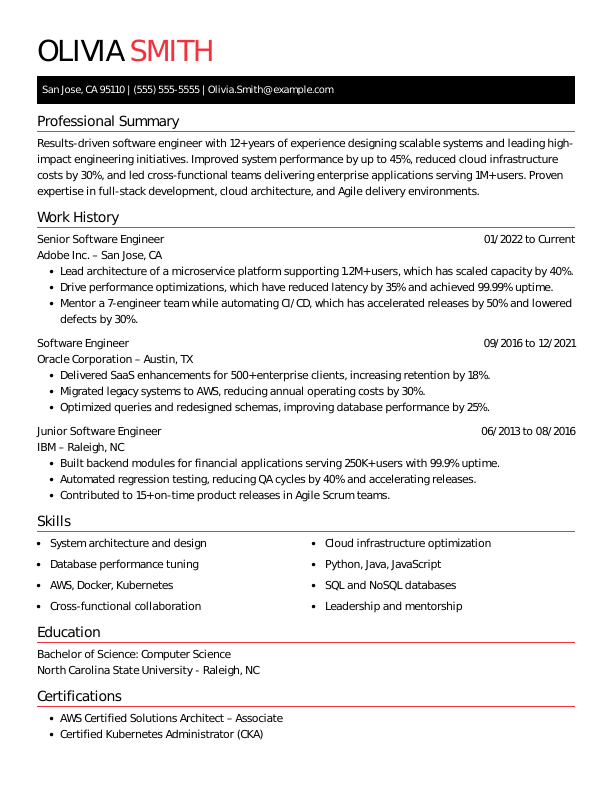
Resume Example
The U.S. resume example below shows how to implement the template above with proper formatting, consistent spacing, and a professional, chronological layout that aligns with employer expectations:
 Pro Tip
You can use Monster’s resume templates to create a professional resume that follows standard formatting conventions and catches the attention of recruiters and hiring managers.
What to Leave Off of an American Resume
An American resume should include only job-related information that demonstrates your qualifications. Personal details, sensitive data, and unnecessary content should be excluded.
U.S. hiring practices are shaped by federal and state antidiscrimination laws that prohibit employment decisions based on protected characteristics. To align with these standards and avoid bias, do not include the following information on your U.S. resume:
- Headshot or photo: Photos are not standard on U.S. resumes. Employers are expected to evaluate candidates based on qualifications, not appearance.
- Age or date of birth: This information is unrelated to job performance and could raise age discrimination concerns under U.S. employment laws.
- Marital status: Details about being single, married, or having children are considered personal and irrelevant to hiring decisions.
- Religion: Religious affiliation is protected information and should not appear on a resume unless directly relevant to the role (such as certain faith-based organizations).
- Ethnicity or race: Employers are prohibited from making hiring decisions based on race or ethnicity, so this information should never be included.
- Social Security number (SSN): This is highly sensitive personal data and should only be shared after hiring through official onboarding paperwork.
- Immigration status or visa details: Do not include specific visa types. Employers will ask about work authorization separately during the application process.
- Full street address: Listing your city and state is sufficient; a full address is unnecessary and may raise privacy concerns.
- References: Do not write “References available upon request.” Employers assume you can provide references if asked.
- Salary history or expectations: This information should only be provided if explicitly requested, as including it upfront can limit negotiation flexibility.
Common U.S. Resume Mistakes to Avoid
Common U.S. resume mistakes often involve including too much information, using the wrong format, or failing to tailor the content to the job.
Because employers typically spend only seconds reviewing each resume, relevance and professionalism are critical to making a strong first impression.
Avoid these common mistakes on your U.S. resume:

Including personal information: Adding a photo, age, marital status, or other protected details does not meet U.S. standards and may raise legal concerns.
Using an international CV format: Submitting a long, detailed CV instead of a concise one- to two-page resume can overwhelm hiring managers.
Listing job duties instead of achievements: Employers want to see measurable results, not just a description of duties and responsibilities.
Failing to tailor the resume: Sending the same resume to every employer without adjusting keywords and skills can reduce your chances of passing ATS.
Using weak action verbs: Phrases like “responsible for” or “helped with” reduce impact. Strong action verbs make accomplishments clearer and more compelling.
Poor formatting: Inconsistent fonts, crowded text, large blocks of paragraphs, or excessive design elements can make your resume difficult to read.
Spelling and grammar errors: Even small mistakes can suggest a lack of attention to detail. After writing your resume, proofread carefully for errors.
Craft a U.S. Resume That Gets Noticed
Creating a U.S. resume that meets American hiring standards is a key step in advancing your career. By focusing on clear formatting, relevant skills, measurable achievements, and avoiding unnecessary personal details, you increase your chances of catching recruiters’ attention.
For additional support, you can use Monster’s Resume Builder to create a tailored resume that showcases your qualifications and positions you for success in the U.S. job market.
Frequently Asked Questions
How long should a U.S. resume be?
A U.S. resume should be one to two pages, depending on your experience level. Entry-level candidates and recent graduates should keep their resume length to one page, while experienced candidates with extensive relevant experience may use two full pages.
Resumes longer than two pages are uncommon in the U.S. and can reduce clarity and impact. Hiring managers scan resumes, so concise, relevant content is essential.
Is a CV a resume in the U.S.?
No, a CV is not the same as a resume in the U.S. An American-style resume is a concise, one- to two-page document used for most private-sector jobs, whereas a CV is a longer, detailed document primarily used for academic, research, or medical positions. Submitting the correct document type is essential for standing out.
What is the 7-second rule for resumes?
The 7-second rule refers to the average amount of time a U.S. hiring manager spends reviewing a resume during an initial scan. In those few seconds, they look for key information like job titles, skills, and achievements. This is why clear formatting, concise language, and strong action verbs are essential to make a quick, positive impression.
What do recruiters want to see on a U.S. resume?
On a U.S. resume, recruiters want to see clear, relevant information that demonstrates your ability to succeed in the role. This includes a concise professional summary, measurable achievements in work experience, relevant skills, and education.
They also look for well-organized formatting, use of strong action verbs, and keywords from the job description to quickly assess your qualifications and fit.
Should I put U.S. citizenship on my resume?
No, you should not include U.S. citizenship on your resume. Employers in the U.S. are prohibited from making hiring decisions based on nationality or immigration status.
Only provide work authorization or visa information if specifically requested during the application or interview process. Including citizenship can be seen as unnecessary personal information and is not standard practice.
What are the 5 P’s of a resume?
The 5 P’s of a U.S. resume are often cited as purpose, personalization, professionalism, presentation, and proof. Each helps ensure your resume is effective:
- Purpose: Clearly show why you’re a strong candidate for the job.
- Personalization: Tailor your resume to each position.
- Professionalism: Use appropriate language, tone, and formatting.
- Presentation: Keep your layout clean, readable, and well-organized.
- Proof: Highlight measurable achievements and verified skills to demonstrate results.
Should a U.S. resume include a headshot?
No, a U.S. resume should not include a headshot. American employers focus on qualifications, experience, and skills rather than appearance, and including a photo can create potential bias or legal concerns. Only consider including a headshot for specific roles where images are explicitly required, such as modeling, acting, or certain creative portfolios.
The standard United States resume format should be professional and content-focused, with clear formatting and measurable achievements to align with hiring standards.
Should I include a cover letter with my U.S. resume?
Yes, in most cases, you should include a cover letter with your U.S. resume. A cover letter allows you to introduce yourself, expand on key achievements in your resume, and demonstrate how your skills align with the job.
Even when optional, submitting a tailored cover letter demonstrates professionalism, attention to detail, and genuine interest in the position, helping you stand out from other candidates. For guidance on how cover letters differ from resumes, see our cover letters vs resumes guide.

Elizabeth Muenzen is a Certified Professional Resume Writer (CPRW) and member of the Professional Association of Resume Writers & Career Coaches who empowers job seekers to take control of their career paths using Monster’s comprehensive job search and resume tools.
See More From Elizabeth MuenzenExplore Related Career Advice
Cashier Career Paths: Monster Workforce Mobility Report (Volume 2)

Updated:
Oct 19, 2026
|
9 min read

Highest Paying Medical Jobs: 35 Top Healthcare Careers by Salary

Updated:
Oct 16, 2026
|
18 min read

How to Ask for a Raise at Work: Steps, Scripts, & Email Templates
Updated:
Oct 15, 2026
|
20 min read
Job Hugging Statistics: Nearly 9 in 10 Workers Have “Hugged” a Job
Updated:
Oct 13, 2026
|
9 min read

Nearly 3 in 10 LinkedIn Users Have Updated a Past Job After Leaving It
Updated:
Oct 7, 2026
|
7 min read

Employee Loyalty Statistics: 90% Say Companies Expect More Than They Give
Updated:
Oct 5, 2026
|
7 min read


Overqualified Hiring Stats: 57% Would Cut Resume Experience to Get Hired
Updated:
Sep 28, 2026
|
9 min read

20 First Job Interview Questions & Sample Answers: Tips to Land Your First Job
Updated:
Sep 24, 2026
|
20 min read
Manage Your Career Like an Expert
Take control of your professional journey with Monster’s expert resources. Explore advice, research, and tips to make informed decisions and advance your career with confidence.

Job Search
Discover strategies to get noticed, network effectively, and streamline your job search process.

Resumes
Get practical tips to create a resume or CV that stands out to employers and wins interviews.

Cover Letters
Learn how to craft a compelling cover letter that highlights your experience and fit for the role.

Career Paths
Explore career paths, industry trends, and growth opportunities to plan your next move.

Interviewing
Prepare for interviews with tips on answering common questions and following up effectively.

Career Development
Develop key skills and knowledge to grow in your current role or pivot to new opportunities.

Leaving a Job
Navigate job changes and career transitions with practical advice and planning resources.