
85% of Workers Say Honest Job Descriptions Make Them More Likely to Apply

Honest job descriptions matter: Only 10% say listings accurately reflect the role, while 78% may stop applying due to vague ones. Read Monster’s report.
Updated:
|

8 min read

Table of Contents


Job descriptions are often a candidate’s first interaction with an employer. But according to new research from Monster, many workers don’t believe what they read.
The Monster Job Description Report finds that today’s candidates value honesty over polished recruiting language. Rather than being discouraged by realistic descriptions of workload or challenges, workers say transparency and honest job descriptions increase trust and make them more likely to apply.
Key Findings
- Trust in job descriptions is low. Only 10% of workers say job descriptions always accurately reflect the reality of the role.
- Vague language changes candidate behavior. 85% say unclear or misleading job descriptions affect how they approach a job opportunity.
- Candidates may abandon the application process. 78% say they’re at least somewhat likely to stop applying after reading a vague or unclear job description.
- Workers ask more questions when information is missing. 87% say vague language makes them more likely to ask follow-up questions during interviews.
- Realistic job descriptions earn greater trust. 76% trust a job description that honestly highlights challenges over one that’s overly positive but vague.
- Transparency attracts applicants. 85% say they’re more likely to apply when employers clearly describe workload, expectations, and other realities of the role.
Only 1 in 10 Workers Fully Trust Job Descriptions
Many workers believe job descriptions paint an incomplete picture of what a position is actually like. When asked “Are job descriptions accurate?”, survey respondents said:
- Always: 10%
- Often: 28%
- Sometimes: 45%
- Rarely: 14%
- Never: 3%
The findings also show that vague or overly positive language has become commonplace. More than 8 in 10 workers (81%) say they always, often, or sometimes encounter job descriptions that feel vague or overly polished.
Vague Job Descriptions Influence Candidate Decisions
Candidates don’t simply ignore unclear job descriptions—they adjust their approach to the hiring process. When workers encounter vague or misleading language:
- 42% still apply but proceed more cautiously.
- 30% become less likely to apply.
- 5% decide not to apply immediately.
- 15% say it doesn’t change their decision.
- 8% become more likely to apply.
Overall, 85% say vague language changes their behavior in some way during the hiring process.
For many candidates, the uncertainty is enough to stop them before they even finish an application. When asked how likely they’d be to abandon a job application after reading a vague or unclear job description:
- Very likely: 26%
- Somewhat likely: 52%
- Not very likely: 19%
- Not at all likely: 3%
Altogether, 78% say they’re at least somewhat likely to abandon an application because the job description doesn’t provide enough clarity.
Candidates Fill in the Gaps
When employers don’t provide enough information upfront, candidates actively look for answers elsewhere. After reading a vague job description:
- 49% are very likely to ask follow-up questions during interviews.
- 38% are somewhat likely.
- 11% aren’t very likely.
- 2% aren’t at all likely.
In total, 87% say unclear language makes them more likely to ask additional questions throughout the hiring process. Rather than building excitement, incomplete job descriptions often create uncertainty that employers have to overcome later in the recruiting process.
Transparency Builds Trust & Encourages More Applications
Workers overwhelmingly favor honesty over highly polished recruiting messages. When asked which type of job description they trust more:
- 76% trust one that’s realistic, even if it highlights challenges.
- 24% trust one that’s highly positive but vague.
Transparency also directly impacts application intent. When employers clearly outline challenges such as workload and expectations:
- 45% say they’re much more likely to apply.
- 40% say they’re somewhat more likely.
- 12% say it makes no difference.
- 3% say they’d be less likely to apply.
Ultimately, 85% say honest job descriptions make them more likely to submit an application.
What Makes Candidates Trust a Job Posting?
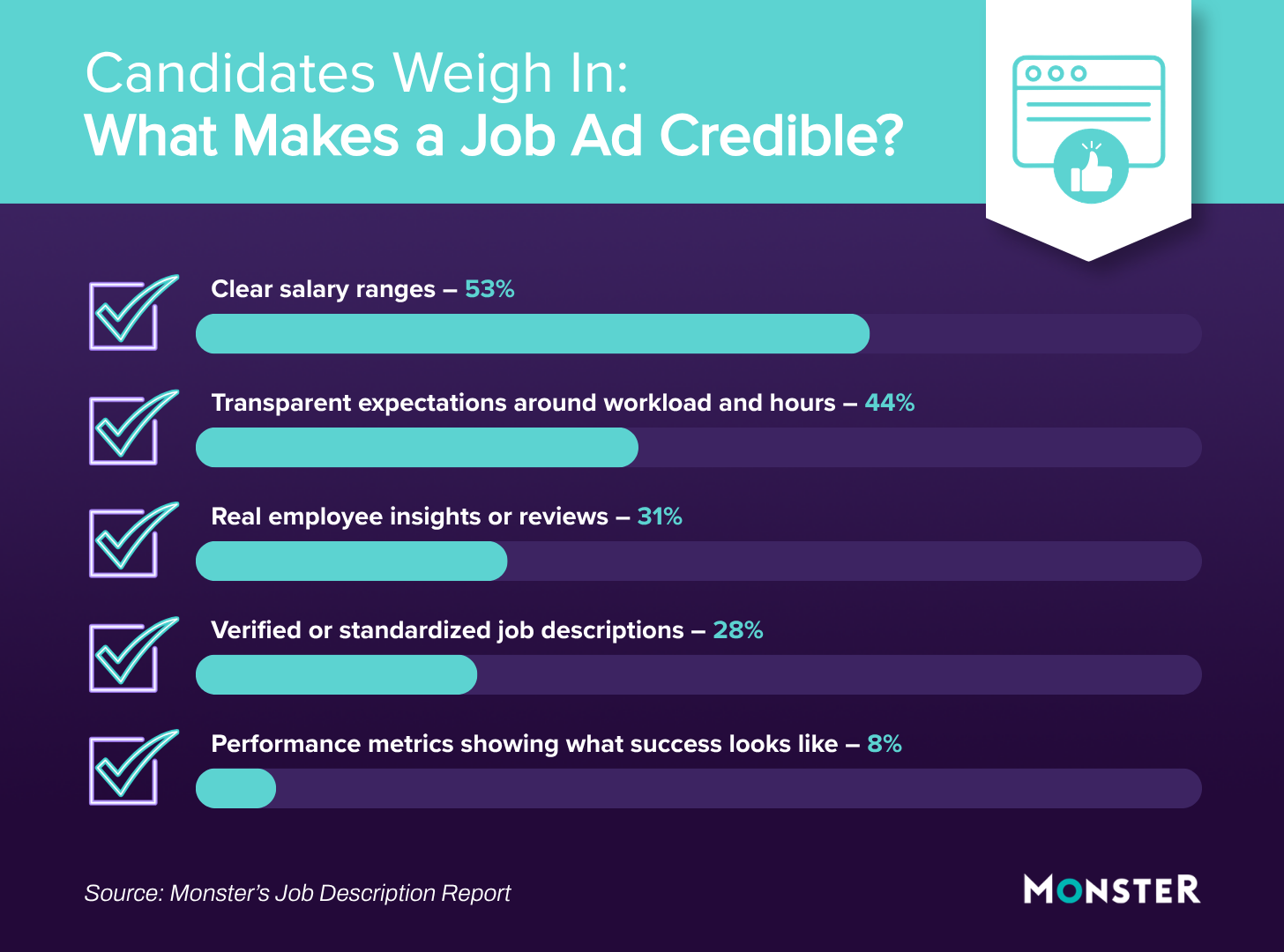
Workers say credibility comes from practical, useful information—not marketing language. The features most likely to increase trust in a job posting include:
- Clear salary ranges: 53%
- Transparent expectations around workload and hours: 44%
- Real employee insights or reviews: 31%
- Verified or standardized job descriptions: 28%
- Performance metrics showing what success looks like: 8%
The findings reinforce that candidates want concrete details they can use to evaluate whether a role aligns with their goals and expectations.
How Employers Can Write Better Job Descriptions
Creating an effective job description isn’t about making every opportunity sound perfect. It’s about giving candidates enough information to make an informed decision.
- 1.
Be Honest About the Role
Clearly explain day-to-day responsibilities, workload expectations, and any challenges candidates should expect. Transparency builds trust and helps attract applicants who are genuinely aligned with the role.
- 2.
Replace Buzzwords With Specifics
Instead of relying on vague phrases like “fast-paced environment” or “wear many hats,” describe what those expectations actually mean in practice.
- 3.
Include Salary Whenever Possible
Salary transparency remains one of the strongest trust signals for candidates. Providing a compensation range helps workers determine whether a role meets their expectations before they apply.
- 4.
Set Clear Expectations for Success
Help candidates understand how performance is measured by outlining key responsibilities, priorities, and what success looks like during the first several months on the job.
- 5.
Think Beyond Recruitment
Job descriptions are often a candidate’s first impression of your company. A realistic, detailed posting can strengthen the employer brand, improve hiring quality, and create better alignment throughout the hiring process.
Honesty Is the Golden Rule of Job Descriptions
Today’s candidates don’t expect every job to be perfect—they expect employers to be honest. Monster’s research suggests that organizations willing to communicate realistic expectations upfront can earn greater trust, encourage more qualified applications, and create stronger alignment between candidates and roles before the interview process even begins.
By focusing on transparency instead of perfection, employers can improve both the candidate experience and long-term hiring outcomes.
For press inquiries, please contact Shanna Briggs at shanna.briggs@bold.com.
Methodology
The findings presented in the Monster Job Description Report are based on a Pollfish survey conducted July 14–15, 2026, among 1,060 currently employed U.S. workers. Respondents answered multiple-choice questions about job descriptions, transparency, candidate trust, and application behavior.
Demographic Breakdown
The sample represented workers across a range of industries, age groups, and career stages. Respondents identified their gender as 52% female and 48% male and represented multiple generations, including 11% ages 18–24, 18% ages 25–34, 19% ages 35–44, 17% ages 45–54, 15% ages 55–64, and 20% ages 65 and older.
About Monster
Monster is a global leader in online job searching, resume building, and employment solutions. For over 30 years, the company has been a trusted authority for both job seekers and companies. Beyond the job search, Monster provides an intuitive Resume Builder and hundreds of resume templates to help candidates stand out against the competition, while offering employers a comprehensive resume database to source top talent. As a G2 category leader, Monster has been featured in Forbes, CNBC, CNN, and USA Today, sharing the career advice needed to bridge the gap between job seekers and hiring managers.

Vicki Salemi is a nationally recognized career expert who helps professionals navigate the hiring landscape and find the right fit on Monster. With over 15 years of experience in corporate recruiting and HR, she offers expert guidance on job search strategies, interview preparation, and career development to help candidates land their next role.
See More From Vicki SalemiExplore Related Career Advice

Overqualified Hiring Stats: 57% Would Cut Resume Experience to Get Hired
Updated:
Sep 28, 2026
|
9 min read

20 First Job Interview Questions & Sample Answers: Tips to Land Your First Job

Updated:
Sep 24, 2026
|
20 min read

“Do You Have Any Questions for Me?” How to Answer in an Interview (30 Examples)
Updated:
Sep 18, 2026
|
14 min read



20 Companies That Pay 100% Health Insurance & Other Top Benefits
Updated:
Sep 10, 2026
|
14 min read


How Long of a Commute Is Too Long? 49% Have Turned Down a Job Due to the Commute
Updated:
Sep 8, 2026
|
11 min read

Manage Your Career Like an Expert
Take control of your professional journey with Monster’s expert resources. Explore advice, research, and tips to make informed decisions and advance your career with confidence.

Job Search
Discover strategies to get noticed, network effectively, and streamline your job search process.

Resumes
Get practical tips to create a resume or CV that stands out to employers and wins interviews.

Cover Letters
Learn how to craft a compelling cover letter that highlights your experience and fit for the role.

Career Paths
Explore career paths, industry trends, and growth opportunities to plan your next move.

Interviewing
Prepare for interviews with tips on answering common questions and following up effectively.

Career Development
Develop key skills and knowledge to grow in your current role or pivot to new opportunities.

Leaving a Job
Navigate job changes and career transitions with practical advice and planning resources.