
Overqualified Hiring Stats: 57% Would Cut Resume Experience to Get Hired

Experience should be an advantage in a job search, but many workers worry that being overqualified could hurt their chances of getting hired.
Updated:
|

9 min read

Table of Contents


Experience is usually something job seekers work to build, not hide. But when candidates worry they’ll be seen as overqualified, their experience and accomplishments can start to feel like liabilities. Some workers even remove or downplay parts of their backgrounds, or consider doing so, to improve their chances of getting hired.
Monster’s 2026 Overqualification Report explores how workers experience overqualification during the hiring process, how they adjust their resumes in response, and why they believe employers hesitate to hire experienced candidates.
Key Findings
- More than half would remove experience to improve their chances of getting hired. 57% say they’d remove experience from their resume if it doubled their chances of landing a job.
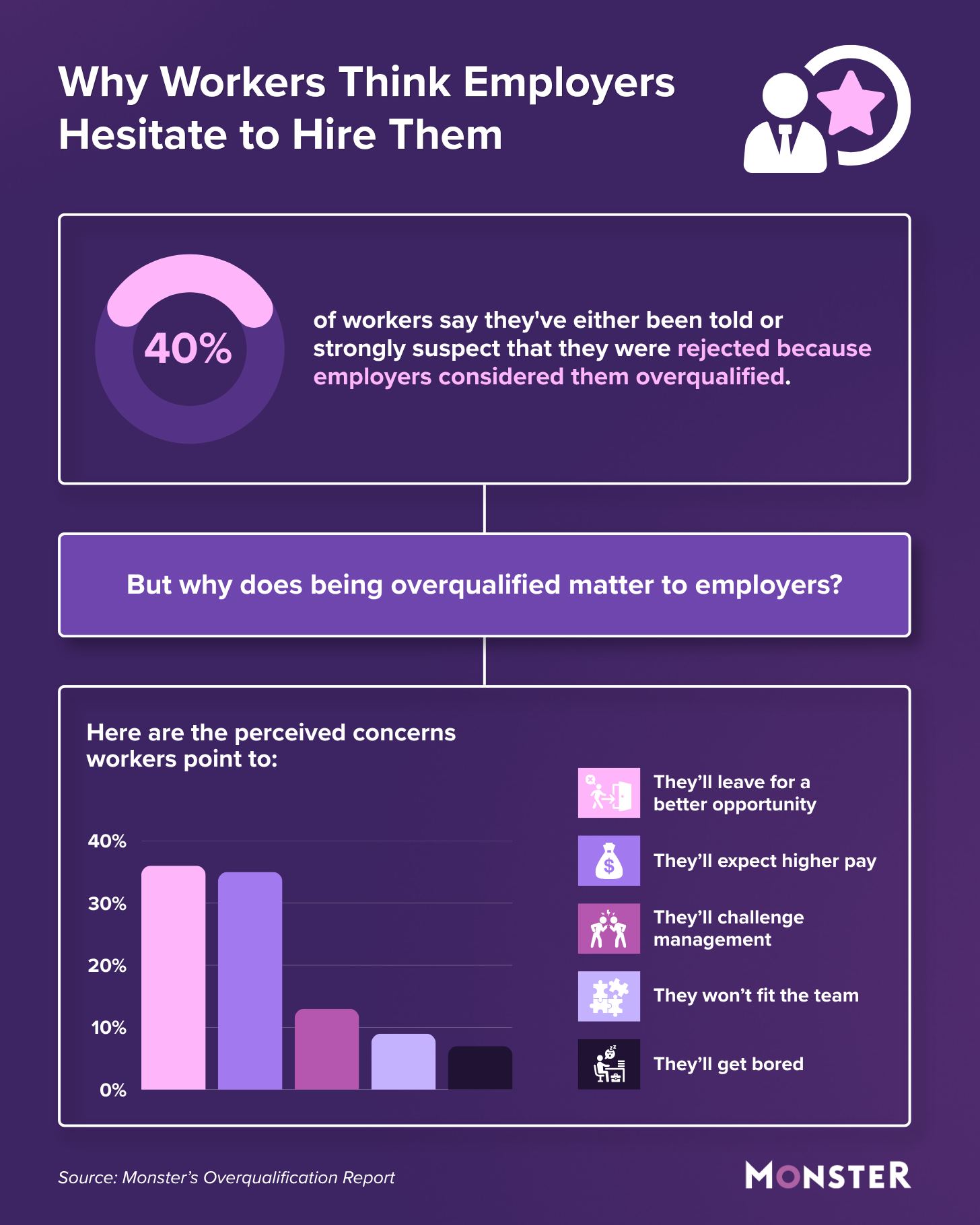
- 2 in 5 believe overqualification has cost them a job. 40% say they’ve either been told (21%) or strongly suspected (19%) that they were rejected because employers considered them overqualified.
- Nearly half worry their experience can work against them. 45% have been excited about a job but worried their qualifications would actually hurt their chances of getting hired.
- Workers are already changing how they present their backgrounds. 43% say they’ve removed or downplayed at least one aspect of their resume, including older work experience, graduation dates, years of experience, accomplishments, degrees, leadership experience, or senior job titles.
- Retention and salary expectations are the biggest perceived concerns. 36% believe employers worry overqualified candidates will leave for a better opportunity, while 35% believe employers assume they’ll expect higher pay.
- Better work-life balance is the top reason workers would pursue a lower-level role. Among those who would knowingly apply for a job they were overqualified for, 25% say better work-life balance would be their biggest motivation.
Experience Doesn’t Always Feel Like an Advantage
Candidates are often encouraged to build their experience, strengthen their credentials, and demonstrate a long track record of success. But Monster’s findings suggest that some workers believe those same qualifications can become an obstacle when applying for certain roles.
Overall, 40% of workers believe they’ve already been rejected because employers viewed them as overqualified. That includes 21% who say they were directly told they were overqualified and another 19% who strongly suspect that was the reason they were rejected.
The concern extends beyond workers who believe they’ve already lost out on a job. Nearly half (45%) say they’ve been excited about a role but worried their experience would actually hurt their chances of getting hired. The remaining 55% say they’ve never had that concern.
The findings suggest that for many job seekers, the challenge isn’t simply demonstrating they can do the job—it may also involve convincing employers that they genuinely want it.
Over Half Would Remove Experience From Their Resume to Get a Job
For some workers, concerns about appearing overqualified are significant enough that they’d reconsider what they include on their resume.
More than half of workers (57%) say they’d remove experience from their resume if doing so doubled their chances of getting hired.
And many workers are already making similar changes. More than 2 in 5 (43%) say they’ve removed or downplayed at least one part of their background.
The most commonly reported changes include:
- Older work experience: 18%
- Graduation year: 6%
- Years of experience: 6%
- Major accomplishments: 4%
- Advanced degree: 4%
- Leadership experience: 4%
- Senior job title: 2%
Rather than removing their qualifications entirely, workers most commonly report reducing visible signs of seniority or longevity.
Why Do Workers Believe Employers Hesitate to Hire Overqualified Candidates?
Monster’s findings suggest workers believe employer concerns about overqualification have less to do with whether a candidate can perform the job and more to do with assumptions about what may happen after they are hired.
When asked why employers hesitate to hire candidates they consider overqualified, workers pointed to several perceived concerns:
- They’ll leave for a better opportunity: 36%
- They’ll expect higher pay: 35%
- They’ll challenge management: 13%
- They won’t fit the team: 9%
- They’ll get bored: 7%
Retention and compensation stand out as the most common perceived concerns, suggesting workers believe employers may see greater experience as a flight risk or a sign of higher salary expectations.
When candidates feel pressure to downplay experience just to get an interview, employers risk overlooking qualified workers who genuinely want the role. Focusing on fit and motivation can help avoid assumptions based on experience alone.
Why Workers Would Apply for a Job They’re Overqualified For
Being overqualified for a position does not necessarily mean a worker lacks interest in it. Monster’s findings show that workers may intentionally pursue lower-level roles for reasons beyond career advancement.
Among workers who would knowingly apply for a job they were overqualified for:
- Better work-life balance: 25%
- Opportunity to work for a company they really want to join: 19%
- Less stress or responsibility: 18%
- Greater job stability: 14%
- Remote or flexible work: 13%
- Career change: 11%
Better work-life balance is the most common motivation, followed by interest in a particular employer and a desire for less stress or responsibility.
The findings suggest that a candidate’s decision to pursue a lower-level role can reflect a deliberate career choice rather than a lack of other options.
How Can Employers Respond to Concerns About Overqualification?
Monster’s Overqualification Report suggests employers may miss out on qualified candidates when they rely on assumptions about why someone with extensive experience would want a particular role.
Workers believe employers are especially concerned that overqualified candidates will leave for another opportunity or expect higher pay. At the same time, the report shows that workers may pursue these roles for reasons including better work-life balance, less stress, greater stability, more flexibility, a career change, or interest in a particular company.
Focusing on a candidate’s motivation, interest, and fit for the role can help employers better understand why an experienced applicant is pursuing the opportunity rather than assuming their background automatically makes them a poor fit.
How Job Seekers Are Rethinking Their Experience
Monster’s findings show that some workers are already changing how they present their backgrounds in response to concerns about overqualification.
Older work experience is the most commonly removed information, with 18% saying they’ve left it off. Smaller shares say they’ve removed their graduation year, reduced the number of years of experience shown, downplayed accomplishments or leadership experience, omitted an advanced degree, or removed a senior job title.
What to Take Away From These Overqualified Hiring Stats
Monster’s Overqualification Report shows that experience can create hiring barriers, even as workers intentionally pursue lower-level roles for flexibility, stability, less stress, career changes, and other priorities.
- For employers, ask experienced candidates about their motivations to understand why they want the role, rather than making assumptions based on their background. This can help you avoid overlooking strong candidates.
- For job seekers, make your “why” clear. Use your resume summary to explain why you want the role and why you’re a strong fit, backed by specific results or metrics. Reinforce your motivation in your cover letter, follow up after applying, and be ready to address overqualification concerns in an interview.
Ultimately, experience is only one part of the hiring equation, and an open conversation can help both sides determine whether the opportunity is the right fit.
For press inquiries, please contact Shanna Briggs at shanna.briggs@bold.com.
Methodology
The findings in the Monster Overqualification Report are based on a survey conducted by Pollfish on July 21–24, 2026, among 1,001 U.S. adults. Respondents answered a series of multiple-choice questions examining overqualification, resume editing, hiring perceptions, and job application behavior.
Demographic Breakdown
The sample included adults across industries, age groups, and career stages. Respondents identified their gender as 50% female and 50% male and represented multiple generations, including 13% ages 18–24, 20% ages 25–34, 17% ages 35–44, 17% ages 45–54, 16% ages 55–64, and 17% ages 65 and older.

Vicki Salemi is a nationally recognized career expert who helps professionals navigate the hiring landscape and find the right fit on Monster. With over 15 years of experience in corporate recruiting and HR, she offers expert guidance on job search strategies, interview preparation, and career development to help candidates land their next role.
See More From Vicki SalemiExplore Related Career Advice

20 First Job Interview Questions & Sample Answers: Tips to Land Your First Job

Updated:
Sep 24, 2026
|
20 min read

“Do You Have Any Questions for Me?” How to Answer in an Interview (30 Examples)
Updated:
Sep 18, 2026
|
14 min read



20 Companies That Pay 100% Health Insurance & Other Top Benefits
Updated:
Sep 10, 2026
|
14 min read


How Long of a Commute Is Too Long? 49% Have Turned Down a Job Due to the Commute
Updated:
Sep 8, 2026
|
11 min read


Beauty Bias at Work Statistics: 88% Say Attractive People Have an Advantage
Updated:
Aug 31, 2026
|
8 min read
Manage Your Career Like an Expert
Take control of your professional journey with Monster’s expert resources. Explore advice, research, and tips to make informed decisions and advance your career with confidence.

Job Search
Discover strategies to get noticed, network effectively, and streamline your job search process.

Resumes
Get practical tips to create a resume or CV that stands out to employers and wins interviews.

Cover Letters
Learn how to craft a compelling cover letter that highlights your experience and fit for the role.

Career Paths
Explore career paths, industry trends, and growth opportunities to plan your next move.

Interviewing
Prepare for interviews with tips on answering common questions and following up effectively.

Career Development
Develop key skills and knowledge to grow in your current role or pivot to new opportunities.

Leaving a Job
Navigate job changes and career transitions with practical advice and planning resources.