
How Long of a Commute Is Too Long? 49% Have Turned Down a Job Due to the Commute

A job offer may come with the right salary and responsibilities, but for many workers, the commute can be enough to make them walk away.
Updated:
|

11 min read

Table of Contents


Nearly half of U.S. workers say commuting costs or commute length have influenced them to turn down a job opportunity, according to Monster’s Commute Report. Workers are also putting a significant price on additional travel time: 32% would require at least 20% more pay to accept a job with a commute 20 minutes longer than they prefer.
The findings show how transportation costs, time away from home, and flexibility are factoring into how workers evaluate how long of a commute is too long.
Key Findings
- Nearly half have turned down an opportunity because of the commute. 49% say commuting costs or length have influenced them to reject a job opportunity.
- Workers put a high price on additional travel time. 32% would require at least 20% more pay to accept a job with a commute 20 minutes longer than they prefer.
- For 3 in 10, a longer commute is nonnegotiable. 30% say none of the incentives presented would persuade them to accept a significantly longer commute.
- Flexibility is becoming more important. 75% say rising living costs have made work-life balance or commute flexibility more important in their job search.
- Gas prices are adding financial pressure. 76% say current gas prices have increased their financial stress.
- Workers want employers to help with commuting costs. 68% believe employers should help offset commuting expenses for at least some employees required to work on-site.
- Gas prices are changing job search priorities. Among current job seekers, 65% say rising gas prices have changed what they look for in an opportunity.
Almost Half of Workers Say a Bad Commute Can Kill a Job Offer
For many workers, the commute has become part of the job offer itself. Nearly half (49%) say commuting costs or commute length have influenced them to turn down an opportunity.
That calculation is becoming even more important as workers manage rising living expenses. Three-quarters (75%) say rising living costs have made work-life balance or commute flexibility more important when looking for a job, including 37% who say it has become significantly more important.
The findings suggest workers aren’t evaluating an opportunity based on salary alone. The time and money required to get to work can play a significant role in determining whether a job ultimately feels worthwhile.
A Longer Commute Comes With a Higher Price Tag
Workers expect substantial compensation when a job requires significantly more time on the road. When asked what would persuade them to accept a job with a commute at least 20 minutes longer than they prefer, respondents answered as follows:
- 32% would require a pay increase of at least 20%.
- 10% would accept at least 10% more pay.
- 11% would accept a hybrid schedule with remote workdays.
- 9% would want gas reimbursement or commuter benefits.
- 4% would accept stronger long-term career growth opportunities.
- 4% would accept better healthcare or overall benefits.
For 30% of workers, none of these incentives would be enough to make a significantly longer commute worthwhile.
The results highlight the value workers place on their time outside of work. While higher pay is the strongest incentive for those willing to make the trade, flexibility and direct help with commuting expenses can also factor into the decision.
Rising Gas Prices Are Reshaping Job Searches
Not only are transportation costs affecting whether workers accept an offer, but they’re also changing the types of opportunities current job seekers pursue.
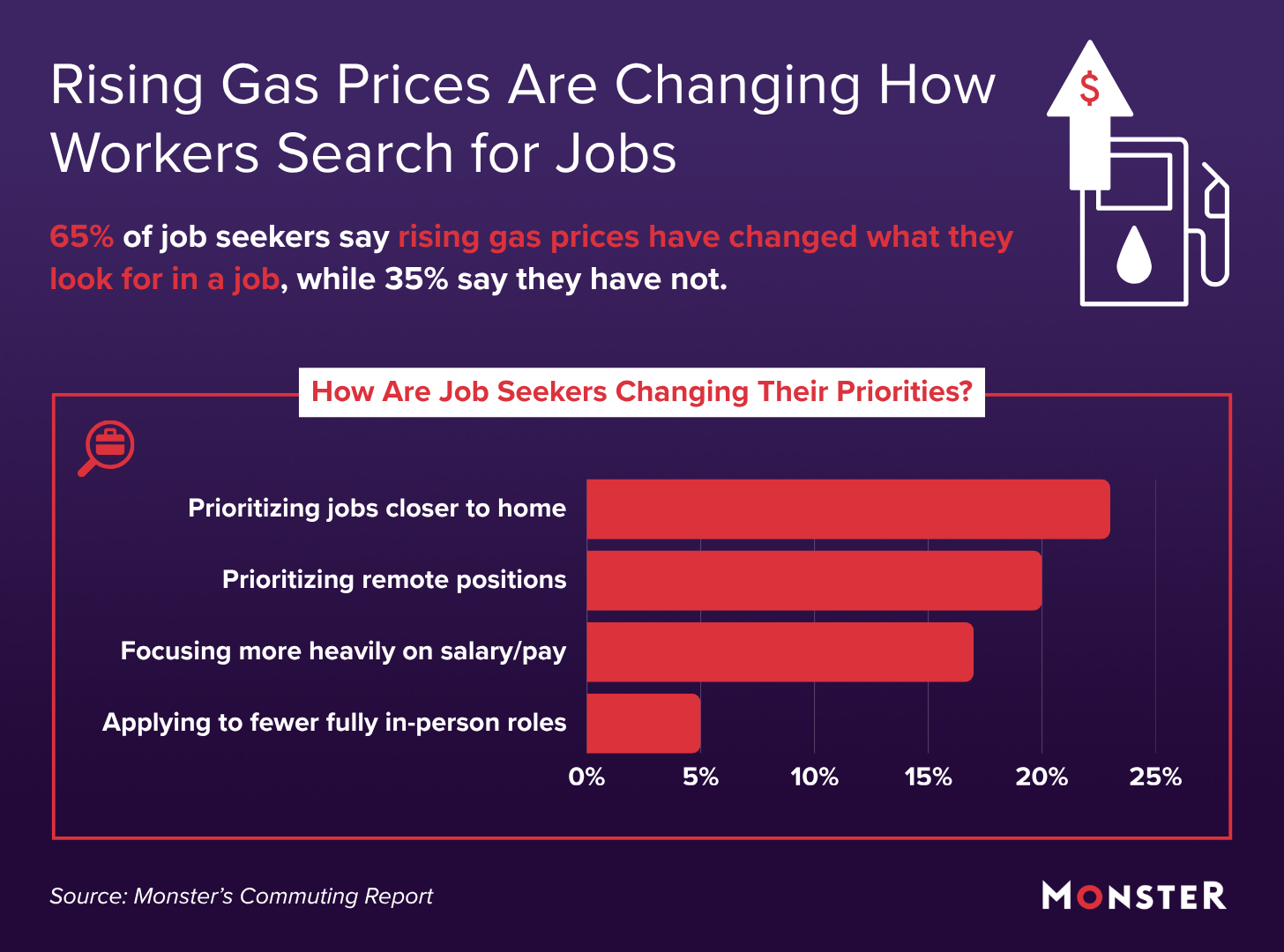
Among workers currently searching for a job, 65% say rising gas prices have changed what they look for:
- 23% are prioritizing jobs closer to home.
- 20% are prioritizing remote positions.
- 17% are focusing more heavily on salary or pay.
- 5% are applying to fewer fully in-person roles.
- 35% say rising gas prices have not changed what they look for.
These shifts show how location and work arrangement can carry financial value of their own, particularly when workers are responsible for absorbing the cost of getting to and from work.
Most Workers Want Employers to Help With Commuting Costs
With transportation expenses affecting workers’ finances and career decisions, many believe employers should share at least some of the cost.
More than two-thirds (68%) believe employers should help offset commuting expenses for at least some employees required to work on-site.
Workers differ on who should receive that assistance:
- 36% believe commuter assistance should be available to all on-site employees.
- 19% say it should specifically go to employees with long commutes.
- 13% say employers should provide assistance during periods of high gas prices.
At the same time, 32% believe commuting costs should remain the employee’s responsibility.
Gas Prices Are Increasing Financial Stress for 76% of Workers
The impact of commuting extends beyond workers’ job decisions. More than three-quarters (76%) say current gas prices have increased their financial stress, including 42% who report a significant increase.
To absorb higher costs, workers say they are cutting back in other areas:
- Dining out or entertainment: 30%
- Groceries or household essentials: 17%
- Savings or paying down debt: 16%
- Personal travel or non-work transportation: 13%
- Career-related expenses: 2%
Another 22% say gas prices have not changed their spending habits.
Workers are also changing their behavior on the road, with 31% saying they’ve reduced how much they drive because of rising living costs.
Average Cost of Commute & Average Daily Commute Time
Average daily commute time statistics show U.S. workers spend about 54 minutes on a round-trip commute. The average cost of a commute varies by distance and transportation expenses, but fuel alone can add several dollars per day:
- Average commute time: The latest U.S. Census Bureau data shows the average one-way commute is 27.2 minutes, or about 54 minutes round trip. For someone commuting five days a week, that adds up to roughly 4.5 hours per week traveling to and from work.
- Average commute distance: According to Federal Highway Administration data, the average trip to or from work is 13.5 miles, or about 27 miles round trip.
- Average gas and commuting costs: AAA estimates that fuel costs about 13 cents per mile for a new vehicle driven 15,000 miles annually. At that rate, a 27-mile round-trip commute would cost about $3.50 in fuel per day, before parking, tolls, maintenance, insurance, depreciation, and other costs.
For a full-time worker commuting five days a week year-round, that adds up to a rough average of $910 per year in fuel alone—before parking, tolls, maintenance, insurance, depreciation, and other costs.
How to Evaluate a Commute During Your Job Search: 5 Steps
A job’s salary is only one part of what an opportunity may ultimately cost you. Before accepting an offer, factoring in transportation expenses, travel time, flexibility, and other commuting considerations can help you better understand how long of a commute is too long for your situation and priorities.
- Step 1:
Calculate Your Full Commuting Costs
Look beyond gas alone. Consider transportation, parking, tolls, vehicle maintenance, and other recurring expenses associated with getting to work. Comparing those costs with your potential salary can give you a clearer picture of the offer’s financial value.
- Step 2:
Consider the Time Commitment
Think about how much time you’ll spend commuting each day and week. A longer commute can mean less time available for family, personal responsibilities, hobbies, and other priorities outside of work.
- Step 3:
Ask About Workplace Flexibility
Before accepting an offer, understand exactly how often you’ll be expected on-site. Ask whether the employer offers remote or hybrid workdays or other schedule flexibility that could reduce your commuting time.
- Step 4:
Review Commuter Benefits
Find out whether the employer provides gas reimbursement, commuter benefits, parking assistance, or other support for employees who work on-site. These benefits can help offset some of the expenses associated with a commute.
- Step 5:
Evaluate the Entire Offer
Consider salary alongside commute time and costs, benefits, flexibility, career growth, and work-life balance. If commuting expenses significantly reduce the value of the offer, you may have room to negotiate your salary or ask for other compensation, such as a commuting stipend or additional remote days.
Looking at the complete package can help you determine whether the opportunity is worth the financial and personal trade-offs.
How Long Is Too Long of a Commute for You?
A job offer’s salary doesn’t necessarily represent its full value once the cost and time of getting to work are factored in. The findings in Monster’s Commute Report show that commuting considerations can influence everything from where workers apply to whether they ultimately accept an opportunity.
As you evaluate your next role, considering transportation expenses, commute length, workplace flexibility, and employer support alongside compensation can help you better understand what an opportunity is really worth.
For press inquiries, please contact Shanna Briggs at shanna.briggs@bold.com.
Methodology
This survey was conducted by Pollfish in July 2026 among 1,005 employed U.S. adults. Respondents answered a series of multiple-choice questions examining the effects of rising living and commuting costs on financial pressure, work decisions, job search priorities, and attitudes toward commute flexibility and employer support.
Demographic Breakdown
The sample included 12% of respondents ages 18–24, 17% ages 25–34, 19% ages 35–44, 15% ages 45–54, 17% ages 55–64, and 20% ages 65 and older. Respondents identified their gender as 52% female, 47% male, 1% nonbinary, and less than 1% preferred not to say.
About Monster
Monster is a global leader in online job searching, resume building, and employment solutions. For over 30 years, the company has been a trusted authority for both job seekers and companies. Beyond the job search, Monster provides an intuitive Resume Builder and hundreds of resume templates to help candidates stand out against the competition, while offering employers a comprehensive resume database to source top talent. As a G2 category leader, Monster has been featured in Forbes, CNBC, CNN, and USA Today, sharing the career advice needed to bridge the gap between job seekers and hiring managers.

Vicki Salemi is a nationally recognized career expert who helps professionals navigate the hiring landscape and find the right fit on Monster. With over 15 years of experience in corporate recruiting and HR, she offers expert guidance on job search strategies, interview preparation, and career development to help candidates land their next role.
See More From Vicki SalemiExplore Related Career Advice
Cashier Career Paths: Monster Workforce Mobility Report (Volume 2)
Updated:
Oct 19, 2026
|
9 min read

Highest Paying Medical Jobs: 35 Top Healthcare Careers by Salary

Updated:
Oct 16, 2026
|
18 min read

How to Ask for a Raise at Work: Steps, Scripts, & Email Templates
Updated:
Oct 15, 2026
|
20 min read

Job Hugging Statistics: Nearly 9 in 10 Workers Have “Hugged” a Job
Updated:
Oct 13, 2026
|
9 min read

Nearly 3 in 10 LinkedIn Users Have Updated a Past Job After Leaving It
Updated:
Oct 7, 2026
|
7 min read

Employee Loyalty Statistics: 90% Say Companies Expect More Than They Give
Updated:
Oct 5, 2026
|
7 min read


Overqualified Hiring Stats: 57% Would Cut Resume Experience to Get Hired
Updated:
Sep 28, 2026
|
9 min read

20 First Job Interview Questions & Sample Answers: Tips to Land Your First Job
Updated:
Sep 24, 2026
|
20 min read
Manage Your Career Like an Expert
Take control of your professional journey with Monster’s expert resources. Explore advice, research, and tips to make informed decisions and advance your career with confidence.

Job Search
Discover strategies to get noticed, network effectively, and streamline your job search process.

Resumes
Get practical tips to create a resume or CV that stands out to employers and wins interviews.

Cover Letters
Learn how to craft a compelling cover letter that highlights your experience and fit for the role.

Career Paths
Explore career paths, industry trends, and growth opportunities to plan your next move.

Interviewing
Prepare for interviews with tips on answering common questions and following up effectively.

Career Development
Develop key skills and knowledge to grow in your current role or pivot to new opportunities.

Leaving a Job
Navigate job changes and career transitions with practical advice and planning resources.