
Should You Put a Job You Were Fired From on Your Resume?

There’s a fine balance between being honest and oversharing about getting fired during your job search. Your resume isn’t the place to explain it.
Updated:
|

15 min read

Table of Contents


What You’ll Learn
- Your resume usually isn’t the place to explain a firing, and your cover letter generally shouldn’t either. Save that explanation for the interview if it comes up.
- Include a job you were fired from if it’s relevant, adds valuable experience, or prevents a significant employment gap.
- To list a role you were fired from without stating it directly, list it normally and highlight your skills and accomplishments.
- You can sometimes omit short-term and probationary roles from your resume if they’re irrelevant and won’t create a noticeable employment gap.
- If asked why you were fired in an interview, be honest and concise, take accountability when appropriate, and focus on what you’ve learned.
Getting fired can leave you with a lot of questions about what comes next, and your resume is often one of the first places you get stuck. If you’re asking, “Should I put a job I was fired from on my resume?” you may be weighing honesty against the risk of drawing unnecessary attention to a difficult career moment.
Your resume still needs to make a strong case for where you’re headed next. That means making thoughtful decisions about what belongs on the page and accurately presenting your experience in a way that’s relevant and useful to employers.
Below, we’ll cover how to approach those decisions throughout your job search with examples and expert tips.
When Should You Include a Job You Were Fired From on Your Resume?
In most cases, you should put a job you were fired from on your resume if the experience is relevant to the position you’re pursuing. As Toni Frana, a career expert at Monster, explains, “If you had meaningful results and accomplishments, and the job is relevant to the position you hope to land, it makes sense to include it.”
That doesn’t mean you should disclose the termination. You shouldn’t state anywhere on your resume that you were fired or explain why the job ended. As Frana notes, “Resumes are more a reflection of your skills, impact, and results, not details about why you left a role.”
“Often, it’s during the interview that the conversation about why you left a job takes place,” Frana explains. That’s the time to describe what happened honestly and professionally.
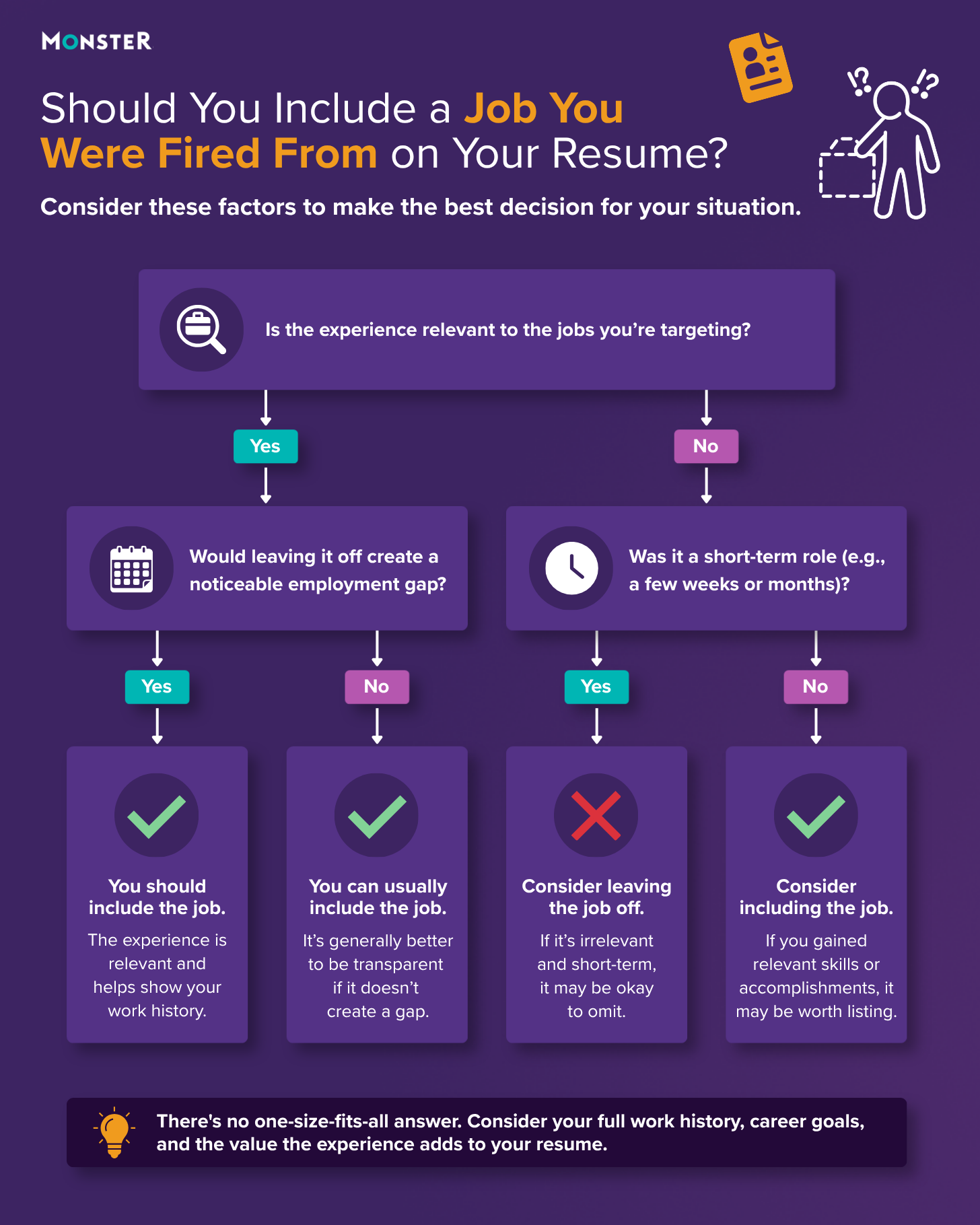
When Should You Leave a Job You Were Fired From off Your Resume?
Consider leaving a job you were fired from off your resume if the role was brief, irrelevant, or adds little value to your work history. Before you leave it off, consider whether doing so would create a significant employment gap.
As a general rule, a job you held for more than a few months is more likely to be worth including, especially if it’s relevant or leaving it off would create a noticeable gap.
Consider keeping it on your resume when:

Your experience is relevant. If the role gave you skills, knowledge, or experience that strengthens your qualifications for your target job, it’s generally worth including.
You have meaningful accomplishments from the role. Being fired doesn’t negate positive results you achieved while employed there.
You worked there for a significant period. Leaving a longer-term position off your resume could remove an important part of your professional history.
Removing it would create a substantial employment gap. Including the position can provide a more complete picture of your work history.
Consider leaving it off when:

You were only there briefly. A position that lasted a few weeks or months may not add much to your resume, particularly if you gained little relevant experience.
The experience isn’t relevant anymore. If the position doesn’t support your current career direction, there may be little reason to include it.
You have stronger experience to highlight. Resume space is limited, so more recent or relevant positions may deserve priority.
Leaving it off won’t create a significant gap. If removing the position doesn’t make your work history confusing, omitting it may be the simpler option.
How to Put a Job You Were Fired From on Your Resume: 3 Tips
If you’ve been fired, you can still put the job on your resume without indicating that you were terminated. Instead, list the role normally and keep the focus on your experience and qualifications.
Here’s what to put on a resume after being fired and how to do it well:
- 1.
Treat It Like Any Other Role
List the job the same way you would any other position on your resume. Include it in your work history section with the job title, employer, location, and accurate dates of employment. There’s no need to write “fired,” “terminated,” or include a reason for leaving.
Avoid changing your job title or adjusting employment dates to make the experience look different. Keep the basic details factual and consistent with your employment history.
- 2.
Highlight Your Achievements, Skills, & Contributions
Focus your bullet points on what you accomplished while you were in the role, not how it ended. Highlight relevant skills, responsibilities, projects, and measurable results that show what you can offer your next employer.
Whenever possible, quantify your accomplishments with numbers, percentages, or other specific results. A strong work experience entry keeps the reader’s attention on your professional value rather than the circumstances of your departure.
Here’s an example:
Customer Service Manager
PA Retail Group | Easton, PA | March 2022–June 2025- Managed a team of 12 customer service representatives and maintained a 94% customer satisfaction rating.
- Reduced average response times by 18% by improving scheduling and support workflows.
- Trained and onboarded 15 new employees on customer service procedures, company policies, and point-of-sale systems.
- 3.
Choose a Resume Format That Highlights Your Strengths
The resume format you use can help you emphasize your strongest qualifications without hiding your work history.
Here are your options:
Resume Format When to Use It Chronological resume A steady work history where experience and career progression are your strongest selling points Combination resume Relevant skills and accomplishments need more emphasis while maintaining a clear chronological work history; generally the better skills-focused option after being fired Functional resume Skills matter more than your career timeline, such as during certain career changes or portfolio careers; use cautiously because recruiters may have a harder time understanding your work history For most job seekers who want to emphasize relevant qualifications while keeping their work history clear, a combination resume offers a good balance between highlighting strengths and giving employers the timeline they expect.
Whichever format you choose, remember that a strong resume highlights your qualifications while presenting your work history clearly and accurately, rather than using formatting to conceal that you were fired.
When & How Should You Explain Being Fired During Your Job Search?
If you were fired, you generally don’t need to explain it until an employer asks about it during an interview. Leave the termination off your resume and, in most cases, your cover letter.
When it comes up in an interview, be honest about what happened without sharing unnecessary details, and focus on what you learned and what you can offer moving forward.
Should You Mention Being Fired in a Cover Letter?
Generally, you shouldn’t explain a firing in your cover letter. Instead, use your cover letter to explain why you’re interested in the position and highlight the qualifications that make you a strong candidate.
If the circumstances surrounding your departure need clarification, such as when the job ending resulted in a lengthy employment gap, address the situation briefly without going into the details of the termination.
Here’s an example of how this might appear in a strong cover letter:
After my previous position ended, I took time to reassess my career goals and strengthen my project management skills. I’m now excited to bring that experience to the project coordinator position at Philadelphia Consulting.
This briefly explains the transition without drawing attention to the termination and redirects the focus to your qualifications and next opportunity.
How to Explain Being Fired in a Job Interview
If an interviewer asks why you were fired, answer honestly, keep your explanation brief, and then move the conversation forward. You don’t need to share every detail, but you should accurately describe why the job ended rather than using vague language to avoid the question.
A strong answer generally follows four steps:
- Step 1:
Use neutral, blame-free language that accurately describes what happened. For example, if you were fired because the role wasn’t a good fit, explain that briefly without assigning blame.
- Step 2:
Take accountability when appropriate. If performance, attendance, or another issue contributed to the termination, acknowledge your part without making excuses or criticizing your former employer.
- Step 3:
Explain what changed. Share what you learned and, when possible, give specific examples of what you’ve done differently since.
- Step 4:
Redirect the conversation to the new role. Connect what you’ve learned to the position you’re interviewing for and why you’re prepared to succeed in it.
For example, if you were fired for repeatedly missing deadlines, you might say:
I was let go because I wasn’t consistently meeting the position’s project deadlines. I take responsibility, and the experience showed me I needed a better system for managing competing priorities.
Since then, I’ve completed a project management course and developed a new system with weekly project plans, earlier internal deadlines, and checkpoints to identify potential delays. I’d be happy to share more about my current process and examples of the planning templates I’ve developed.
I’m looking forward to putting those changes into practice in my next role, and I’m especially interested in this position because its project-based structure aligns with how I’ve learned to organize and manage my work.
Keep your answer focused on the essential facts. The interviewer needs enough context to understand what happened and, more importantly, evidence that you’ve learned from the experience and are prepared to move forward.
 Pro Tip
Choose references who can speak positively and credibly about your work rather than someone who was directly involved in your termination. Always ask permission before listing someone as a reference.
Other Resume Considerations After Being Fired: Short-Term Roles, Probation, & Employment Gaps
Short-term or probationary employment doesn’t automatically need to be removed from your resume. When deciding whether to include it, consider how long you held the job, where you were in the employment period, and what your work history looks like without it.
- 1.
Short-Term Roles
If you were fired after only two or three months, consider what the position adds to your resume before deciding to include it. A short-term job may be worth keeping if it’s relevant to your target position, gave you valuable experience, or fills what would otherwise be a noticeable employment gap.
If the role lasted only a short time, isn’t relevant, and you can remove it without creating a significant gap, leaving it off may make more sense.
- 2.
Termination During a Probationary Period
You don’t need to identify a probationary termination on your resume. If you include the job, list it like any other position and consider whether the experience strengthens your resume or adds little value.
- 3.
Employment Gaps
Before removing a job you were fired from, consider the employment gap it would leave. Omitting a three-month position, for example, may be relatively inconsequential within an otherwise consistent work history. Removing a longer position could leave a more noticeable gap that you’ll need to explain later.
When you’re choosing between showing a short stint and creating an unexplained gap, consider which option gives employers a clearer and more accurate picture of your relevant experience. If you do have a gap, you can address it separately without including the details of your termination on your resume.
Quick Tips & Mistakes to Avoid on Your Resume After Being Fired
When updating your resume after being fired, keep the focus on your experience and qualifications rather than the circumstances of your departure.
Use these quick dos and don’ts to keep your resume accurate, professional, and forward-looking:
Do
List relevant experience, even if the job ended in termination.
Keep your job title and employment dates accurate.
Highlight accomplishments, skills, and measurable results.
Choose a format that highlights your strengths while keeping your work history clear.
Keep descriptions positive and professional.
Don't
Write “fired” or “terminated” or include a reason for leaving.
Change titles or dates to hide a short tenure or employment gap.
Use valuable resume space explaining what went wrong or why the job ended.
Use formatting to conceal your work history or make the timeline difficult to follow.
Criticize your former employer, manager, or coworkers anywhere on your resume.
Move Forward With a Resume That Focuses on What You Offer
Knowing how to write a resume after being fired comes down to presenting an accurate picture of the experience and value you bring to your next employer. One job ending doesn’t define the rest of your career, but how you position yourself for what comes next can make a difference. Build your resume around the skills, accomplishments, and qualifications that show employers where you can go from here.
Frequently Asked Questions
Should I put a job I was fired from on my resume?
Yes, you should generally include a job you were fired from if the experience is relevant, demonstrates valuable skills, or leaving it off would create a significant employment gap. List the position normally without stating that you were fired. If the role was very brief or irrelevant, you may decide to leave it off.
Does getting fired look bad on a resume?
Getting fired doesn’t inherently look bad on a resume because your resume doesn’t typically state why a job ended. Employers will see your position, employment dates, and accomplishments. A short tenure or employment gap may prompt questions, but you can address those honestly during an interview.
Can employers find out if I was fired?
Yes, a prospective employer may find out that you were fired, although what a former employer discloses can vary by company policy and applicable laws. Don’t lie about how your employment ended if you’re asked. Instead, give a brief, honest explanation and focus on what you learned from the experience.
How do I professionally say I was terminated on a resume?
You generally don’t need to say that you were terminated on your resume. List the position with your job title, employer, dates, and relevant accomplishments, just as you would any other job. Don’t include “fired,” “terminated,” or a reason for leaving. If an employer asks about the termination during an interview, explain it honestly and professionally.
Can I leave a job off my resume?
Yes, you can leave a job off your resume. A resume doesn’t need to include every position you’ve held. You might omit a job if it was brief, irrelevant to your target position, or doesn’t strengthen your candidacy. Before removing it, consider whether doing so would create a significant employment gap or remove experience that’s valuable for the job you’re pursuing.

Kirsten Chorpenning is a career advice writer who empowers job seekers to take control of their career paths using Monster’s comprehensive job search and resume tools. She specializes in helping job seekers find rewarding jobs in today’s dynamic work environment.
See More From Kirsten ChorpenningExplore Related Career Advice

Overqualified Hiring Stats: 57% Would Cut Resume Experience to Get Hired

Updated:
Sep 28, 2026
|
9 min read

20 First Job Interview Questions & Sample Answers: Tips to Land Your First Job
Updated:
Sep 24, 2026
|
20 min read

“Do You Have Any Questions for Me?” How to Answer in an Interview (30 Examples)
Updated:
Sep 18, 2026
|
14 min read



20 Companies That Pay 100% Health Insurance & Other Top Benefits
Updated:
Sep 10, 2026
|
14 min read

How Long of a Commute Is Too Long? 49% Have Turned Down a Job Due to the Commute
Updated:
Sep 8, 2026
|
11 min read


Beauty Bias at Work Statistics: 88% Say Attractive People Have an Advantage
Updated:
Aug 31, 2026
|
8 min read
Manage Your Career Like an Expert
Take control of your professional journey with Monster’s expert resources. Explore advice, research, and tips to make informed decisions and advance your career with confidence.

Job Search
Discover strategies to get noticed, network effectively, and streamline your job search process.

Resumes
Get practical tips to create a resume or CV that stands out to employers and wins interviews.

Cover Letters
Learn how to craft a compelling cover letter that highlights your experience and fit for the role.

Career Paths
Explore career paths, industry trends, and growth opportunities to plan your next move.

Interviewing
Prepare for interviews with tips on answering common questions and following up effectively.

Career Development
Develop key skills and knowledge to grow in your current role or pivot to new opportunities.

Leaving a Job
Navigate job changes and career transitions with practical advice and planning resources.