

Monster Livelihood Index Q3 2026: Only 39% Could Maintain Living Standards for 3 Months After Income Loss

Financial pressures and limited job opportunities are shaping how U.S. workers assess their financial stability and career options.
Updated:
|

7 min read
Table of Contents


The Q3 2026 Monster Livelihood Index (MLI) reveals gaps in workers’ financial resilience, with many lacking confidence in their ability to withstand an extended loss of income. These financial pressures, combined with limited job opportunities, can make career changes riskier for workers who can’t afford disruptions to their pay or benefits.
Developed by the Monster Research Institute, this quarterly index measures worker readiness and resilience across four dimensions: Economic Security, Skill Portability, Market Agency, and Future Readiness.
The overall Q3 MLI score was 3.28 out of 5, placing workers in the Holding category amid ongoing financial pressures and career constraints.
Key Findings
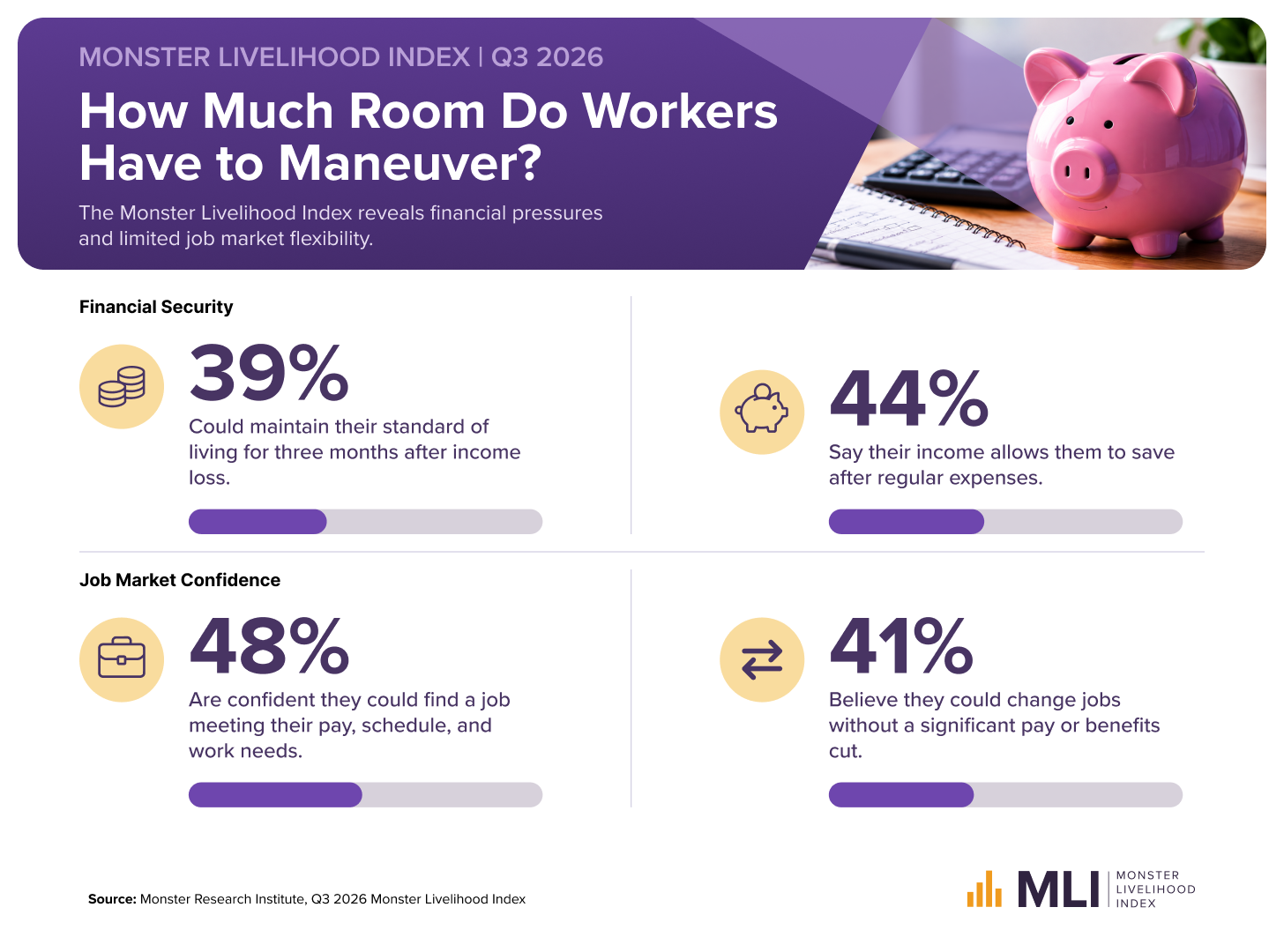
- Financial resilience is limited. Only 39% say they could maintain their current standard of living for at least three months if they lost their primary source of income.
- Building a financial cushion is difficult for many. 44% say their income allows them to save after covering regular expenses, while 42% worry about maintaining their current standard of living over the next three months.
- Income pressure has increased for some workers. Compared with three months ago, 32% say their income’s ability to keep up with expenses has worsened, while 22% say it’s improved.
- Suitable job options appear limited. 48% feel confident they could find a job meeting their pay, schedule, and work requirements.
- Changing jobs may require trade-offs. Only 41% believe they could change jobs without a significant cut in pay or benefits, while 46% feel they have to accept whatever work situation they can get because of the job market.
Financial Resilience Is Limited
Economic Security scored 3.04, placing it in the MLI’s Stretched range.
Workers Face Challenges Building Financial Security
The latest emergency savings statistics reveal a gap between workers’ ability to cover immediate expenses and their financial preparedness for an extended income disruption.
- 55% say they could cover an unexpected $400 expense without borrowing or carrying a credit card balance.
- 49% say their income comfortably covers regular household expenses.
- 44% say they can save after covering regular expenses.
Looking ahead, 42% worry about maintaining their standard of living over the next three months, highlighting continued financial uncertainty.
Financial security was also a concern in Monster’s Q2 2026 Livelihood Index, which found that workers felt increasingly prepared for career changes but less financially equipped to pursue them.
More Workers Report Worsening Income Pressures
Compared with three months ago, workers report the following changes in their income’s ability to keep up with expenses:
- 32% say it’s worsened.
- 22% say it’s improved.
- 46% say it’s stayed about the same.
These findings suggest that covering everyday expenses or handling an emergency doesn’t necessarily mean workers have enough savings to withstand an extended loss of income.
Workers See Limits on Their Job Options
Beyond financial security, the MLI measures Market Agency, or workers’ perceived choices and leverage in the job market. This dimension scored 3.13 in Q3.
Workers report limited confidence in finding suitable opportunities:
- 48% feel confident they could find a job meeting their pay, schedule, and work requirements.
- 41% believe they could change jobs without taking a significant cut in pay or benefits.
- 46% feel they have to accept whatever work situation they can get because of the job market.
Combined with limited financial resilience, these findings suggest that changing jobs may feel especially risky for workers who lack the savings to absorb a temporary income disruption or a reduction in pay or benefits.
Worker Conditions Were Broadly Unchanged Over the Past 3 Months
The MLI also tracks Momentum, a separate measure of how workers perceive changes in their financial and career circumstances over the past three months. The Q3 Momentum score was +0.04 on a scale of −2 to +2, indicating broadly unchanged conditions overall.
Across all Momentum measures, “about the same” was the most common response to perceived changes, although individual experiences varied. For example, 32% say their income’s ability to keep up with expenses worsened, compared with 22% who report improvement.
As future MLI results are released, Momentum will help identify whether workers report improvements or declines in their financial and career circumstances.
MLI Highlights Financial Pressures & Career Constraints
The Q3 2026 Monster Livelihood Index highlights how limited financial resilience and constrained job opportunities can affect workers’ career decisions. Without a sufficient financial cushion, unexpected expenses, income disruptions, and career changes carry greater risks, especially when new opportunities require trade-offs in pay, benefits, or working conditions.
Although overall conditions appear relatively stable, the findings suggest that financial pressures continue to limit workers’ flexibility and confidence in pursuing new opportunities.
For press inquiries, please contact Shanna Briggs at shanna.briggs@bold.com.
About the Monster Livelihood Index
The Monster Livelihood Index (MLI) is Monster’s quarterly measure of worker readiness and resilience. Based on a survey of approximately 1,000 employed U.S. workers each quarter, the index measures four dimensions of worker livelihood:
- Economic Security: Can workers withstand financial disruption?
- Skill Portability: Can workers apply their value across roles and industries?
- Market Agency: Can workers successfully navigate job opportunities?
- Future Readiness: Are workers prepared for technological change?
Together, these dimensions provide an ongoing benchmark of how prepared workers feel to navigate today’s labor market. Scores range from 1 to 5, with higher scores indicating stronger financial resilience, career adaptability, and readiness for change.
Explore the full Monster Livelihood Index→
Methodology
The Q3 2026 Monster Livelihood Index is based on a Pollfish online survey of 1,033 currently employed U.S. adults ages 18–74, conducted from September 28, 2026, through October 3, 2026. The Level index uses 20 statements across four equally weighted dimensions, measured on a five-point agreement scale. Momentum is calculated separately from eight questions measuring perceived change over the past three months.
The updated Q3 questionnaire establishes a new baseline; Q3 scores are not directly compared with earlier editions. Findings reflect respondents’ perceptions and reported experiences rather than objective measures of financial circumstances or labor-market conditions.

Vicki Salemi is a nationally recognized career expert who helps professionals navigate the hiring landscape and find the right fit on Monster. With over 15 years of experience in corporate recruiting and HR, she offers expert guidance on job search strategies, interview preparation, and career development to help candidates land their next role.
See More From Vicki SalemiExplore Related Career Advice

Cashier Career Paths: Monster Workforce Mobility Report (Volume 2)
Updated:
Oct 19, 2026
|
9 min read

Highest Paying Medical Jobs: 35 Top Healthcare Careers by Salary

Updated:
Oct 16, 2026
|
18 min read

How to Ask for a Raise at Work: Steps, Scripts, & Email Templates
Updated:
Oct 15, 2026
|
20 min read

Job Hugging Statistics: Nearly 9 in 10 Workers Have “Hugged” a Job
Updated:
Oct 13, 2026
|
9 min read

Nearly 3 in 10 LinkedIn Users Have Updated a Past Job After Leaving It
Updated:
Oct 7, 2026
|
7 min read

Employee Loyalty Statistics: 90% Say Companies Expect More Than They Give
Updated:
Oct 5, 2026
|
7 min read


Overqualified Hiring Stats: 57% Would Cut Resume Experience to Get Hired
Updated:
Sep 28, 2026
|
9 min read
Manage Your Career Like an Expert
Take control of your professional journey with Monster’s expert resources. Explore advice, research, and tips to make informed decisions and advance your career with confidence.

Job Search
Discover strategies to get noticed, network effectively, and streamline your job search process.

Resumes
Get practical tips to create a resume or CV that stands out to employers and wins interviews.

Cover Letters
Learn how to craft a compelling cover letter that highlights your experience and fit for the role.

Career Paths
Explore career paths, industry trends, and growth opportunities to plan your next move.

Interviewing
Prepare for interviews with tips on answering common questions and following up effectively.

Career Development
Develop key skills and knowledge to grow in your current role or pivot to new opportunities.

Leaving a Job
Navigate job changes and career transitions with practical advice and planning resources.