

Ghost Job Laws: 92% of Job Seekers Want the Right to Know If a Job Is Actually Open

Workers want clarity on whether an advertised role is real, and they’re willing to walk away from employers who aren’t upfront about it.
Updated:
|

9 min read

Table of Contents


Before applying for a job, workers want to know one thing: Is there actually a job to apply for?
As concerns about ghost jobs and misleading listings grow, job seekers are calling for greater transparency from employers and job platforms. They want to know which positions are actively being filled, how current listings are, and what protections should exist when employers aren’t upfront about hiring opportunities.
Monster’s Job Seeker Bill of Rights Report 2026 examines these expectations, including growing support for ghost job laws, requirements for verifying active openings, and the consequences employers could face when misleading job postings undermine candidate trust.
Key Findings
- 92% want disclosure required by law. More than 9 in 10 say employers and job platforms should be legally required to disclose whether a publicly advertised posting represents a current, approved vacancy.
- Repeated misleading listings drive candidates away. 58% would avoid applying for an employer’s jobs if they learned the company repeatedly advertised positions it wasn’t actively trying to fill.
- Pipeline recruiting is acceptable when employers are transparent. 60% say employers should be allowed to advertise positions that aren’t currently open if the posting clearly states that it’s for future opportunities or candidate-pipeline purposes.
- Job seekers expect outdated listings to come down quickly. 76% say postings should be removed or updated within 48 hours after a position is filled, canceled, or paused indefinitely.
- Greater disclosure could rebuild trust. 74% say legal requirements identifying whether advertised positions are actively being filled would increase their confidence in online job listings.
- Verified openings could drive more applications. 81% would be more likely to apply if a job platform verified that a position represented a current vacancy.
What Is a Ghost Job & What Are Ghost Job Laws?
A ghost job is a job posting for a position an employer isn’t actively trying to fill. These listings may remain online after a position closes or be used to collect resumes for potential future openings, even when no immediate vacancy exists.
Ghost job laws are regulations designed to improve hiring transparency by requiring employers to disclose information about advertised positions, such as whether a vacancy is current, approved, and actively being filled.
Are Ghost Jobs Illegal?
No, ghost job postings aren’t automatically illegal, but misleading listings may violate applicable laws.
Monster’s 2026 Job Seeker Bill of Rights Report suggests strong public support for ghost job law requirements that would make hiring more transparent and protect applicants from misleading listings.
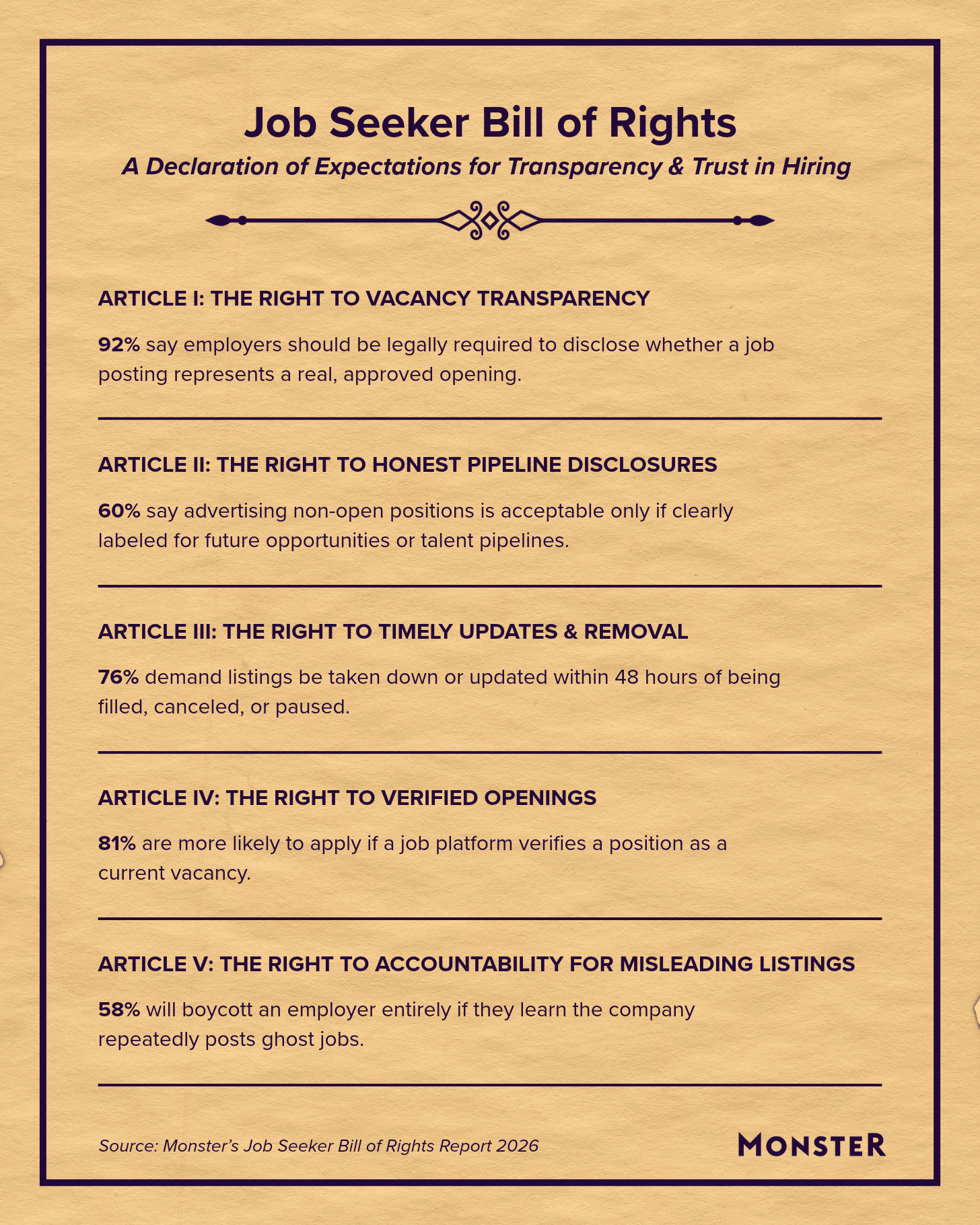
Job Seekers Want to Know If a Job Is Actually Open
For many workers, simply seeing a job advertised is no longer enough—they want basic information about its status before deciding whether to apply.
Monster’s ghost jobs statistics reveal how strongly workers feel about hiring transparency. More than 9 in 10 (92%) say employers and job platforms should “probably or definitely” be required by law to disclose whether a publicly advertised posting represents a current, approved vacancy.
When asked what specific information should be required on every posting, job seekers prioritized the status of the hiring process:
- 60% want to know whether the employer is actively accepting applications.
- 44% want to know whether the employer is actively interviewing candidates.
- 39% want to know whether the position is currently approved and funded.
- 34% want the expected time frame for filling the role.
- 28% want disclosure if a posting is only collecting resumes for future openings.
- 27% want an anticipated start date.
Other requested information includes when a position was originally posted, whether the process is paused, whether AI will be used to evaluate applicants, and whether an internal candidate is already under consideration.
Pipeline Recruiting Is Acceptable, As Long As Employers Say So
Job seekers appear willing to accept that not every advertised opportunity needs to represent an immediate hire, as long as employers are upfront about it.
Overall, 60% say employers should be allowed to advertise positions that aren’t currently open if the posting clearly states it’s for future opportunities or candidate-pipeline purposes.
The distinction is important. Transparency lets employers keep building talent pipelines while giving candidates what they need to decide whether an opportunity fits their immediate job-search goals.
Stale Listings Undermine Trust
Outdated ghost job postings can undermine trust when positions remain advertised after hiring has ended, and job seekers expect advertised opportunities to reflect hiring-status changes quickly.
More than three-quarters (76%) say a listing should be removed or updated within 48 hours after a position has been filled, canceled, or paused indefinitely, including:
- 37% who say it should happen immediately
- 39% who say within 48 hours
- 15% who say within one week
- 4% who say within two weeks
- 2% who say within 30 days
- 3% say no deadline should be required
For job seekers, posting accuracy isn’t only about whether a job was legitimate when first advertised. It’s also about whether job listings stay accurate as the hiring process changes.
Verification Could Change How Job Seekers Behave
Job seekers say verification could make them more willing to pursue an opportunity:
- 81% say they’d be more likely to apply for a position if a job platform verified that it represented a current vacancy.
- 51% say verification would make them much more likely to apply.
Verification could also help address concerns about suspicious or misleading job listings. Nearly three-quarters (74%) say that requiring employers and job platforms to disclose whether advertised positions are actively being filled would increase their confidence in online job listings, including 41% who say their confidence would increase significantly.
Job Seekers Want Accountability
Job seekers also expect consequences when misleading listings are repeatedly published. When asked what should happen when an employer, recruiter, or job platform repeatedly publishes misleading job listings:
- 60% say the listings should be removed.
- 37% support a formal warning.
- 33% say the listings should carry a public warning label.
- 32% say employers or recruiters should be temporarily prohibited from posting jobs.
- 28% say affected applicants should be notified.
Job seekers may also hold employers accountable themselves. If respondents learned that an employer repeatedly advertised positions it wasn’t actively trying to fill, many would consider that a job search deal-breaker: 58% would avoid applying for that employer’s jobs, 28% would withdraw an application already in progress, and 27% would warn other job seekers.
What to Do If You Suspect a Job Posting Isn’t Real
If transparency is one of your top priorities in a job search, there are steps you can take before investing your time in an application.
- Step 1:
Look for signs of hiring status. Check whether the posting indicates the employer is actively accepting applications or interviewing, rather than simply describing the role.
- Step 2:
Ask directly during the process. If you do apply or hear back, ask about the time frame for filling the position and whether it’s currently approved and funded.
- Step 3:
Watch for pipeline language. A posting that clearly states it’s for future opportunities or candidate-pipeline purposes isn’t necessarily a red flag; it’s a signal to set your expectations accordingly.
- Step 4:
Notice how current a listing is. A posting that hasn’t been updated in a long time, or that reappears repeatedly for the same role, may be worth extra scrutiny.
- Step 5:
Prioritize platforms and employers that verify openings. Verified vacancies can offer more confidence that the time you spend applying is well spent.
What’s Your Next Move?
Job seekers want a clearer contract with the hiring process: Tell me whether the job is open, tell me what stage the search is in, keep the listing current, and be transparent when the opportunity is for the future rather than today.
Monster’s Job Seeker Bill of Rights reflects those expectations, and for employers and job platforms, meeting them can build trust before a candidate ever reaches an interview.
For press inquiries, please contact Shanna Briggs at shanna.briggs@bold.com.
Methodology
The Monster Job Seeker Bill of Rights Report 2026 is based on a survey conducted from August 27, 2026, through September 3, 2026, among 1,011 U.S. adults who had searched for a job within the past 24 months. Respondents answered questions about their expectations for transparency in online job postings, including disclosure of whether positions represent current vacancies, verification of active openings, pipeline recruiting, listing accuracy, accountability for misleading postings, and responsibility across employers and job platforms.
Demographic Information
The sample included 33% millennials, 29% Gen X, 20% Gen Z, and 18% baby boomers. Respondents identified their gender as 51% female, 48% male, less than 1% nonbinary, and less than 1% preferred not to answer.

Vicki Salemi is a nationally recognized career expert who helps professionals navigate the hiring landscape and find the right fit on Monster. With over 15 years of experience in corporate recruiting and HR, she offers expert guidance on job search strategies, interview preparation, and career development to help candidates land their next role.
See More From Vicki SalemiExplore Related Career Advice


Monster Livelihood Index Q3 2026: Only 39% Could Maintain Living Standards for 3 Months After Income Loss
Updated:
Oct 28, 2026
|
7 min read

Cashier Career Paths: Monster Workforce Mobility Report (Volume 2)
Updated:
Oct 19, 2026
|
9 min read

Highest Paying Medical Jobs: 35 Top Healthcare Careers by Salary

Updated:
Oct 16, 2026
|
18 min read

How to Ask for a Raise at Work: Steps, Scripts, & Email Templates
Updated:
Oct 15, 2026
|
20 min read

Job Hugging Statistics: Nearly 9 in 10 Workers Have “Hugged” a Job
Updated:
Oct 13, 2026
|
9 min read

Nearly 3 in 10 LinkedIn Users Have Updated a Past Job After Leaving It
Updated:
Oct 7, 2026
|
7 min read

Employee Loyalty Statistics: 90% Say Companies Expect More Than They Give
Updated:
Oct 5, 2026
|
7 min read
Manage Your Career Like an Expert
Take control of your professional journey with Monster’s expert resources. Explore advice, research, and tips to make informed decisions and advance your career with confidence.

Job Search
Discover strategies to get noticed, network effectively, and streamline your job search process.

Resumes
Get practical tips to create a resume or CV that stands out to employers and wins interviews.

Cover Letters
Learn how to craft a compelling cover letter that highlights your experience and fit for the role.

Career Paths
Explore career paths, industry trends, and growth opportunities to plan your next move.

Interviewing
Prepare for interviews with tips on answering common questions and following up effectively.

Career Development
Develop key skills and knowledge to grow in your current role or pivot to new opportunities.

Leaving a Job
Navigate job changes and career transitions with practical advice and planning resources.