
Cashier Career Paths: Monster Workforce Mobility Report (Volume 2)

Monster’s data reveals how cashier experience connects to jobs across industries and the different career paths frontline workers can pursue.
Updated:
|

9 min read
Table of Contents


Cashier experience may open the door to a much wider range of jobs than the title suggests. Volume 2 of Monster’s Workforce Mobility Report explores those connections across sales, food service, management, customer service, and other frontline roles.
The analysis examined 370,509 resume-observed position changes into 20 high-volume roles from differently recorded job titles. The findings show that career movement isn’t always linear, with workers moving into and out of cashier positions across a variety of fields.
Cashier career paths involve much more than operating a register. From communication and problem-solving to sales and multitasking, workers often develop transferable skills that can support their next career move. Recognizing and communicating those skills can help job seekers demonstrate their qualifications and explore opportunities beyond their current title.
Key Takeaways
- Cashier appeared in 11 top-ranked pathways. It was the prior title in seven and the destination title in four.
- Cashier to sales was the largest cross-title pathway. Monster observed 2,268 transitions from cashier to sales and 1,638 in the opposite direction.
- Cashier and crew member movement was nearly balanced. There were 1,715 cashier-to-crew-member transitions and 1,799 from crew member to cashier.
- Cashier connected with jobs beyond retail. Prominent pathways linked it with sales, food service, management, customer service, and care work.
- Movement occurred in both directions. Workers entered cashier roles from many of the same titles that former cashiers had as destinations.
- A title change didn’t necessarily reveal career direction. The data doesn’t show whether these moves were promotions, lateral moves, or steps backward.
Where Do Cashiers Go Next?
Experience in cashier jobs can lead to opportunities across a variety of roles. In Monster’s analysis, Cashier appeared throughout the largest title-changing pathways:
| Rank | Prior Recorded Title | Destination Title | Observed Transitions |
| 1 | Cashier | Sales Representative | 2,268 |
| 3 | Crew Member | Cashier | 1,799 |
| 4 | Cashier | Crew Member | 1,715 |
| 5 | Sales Representative | Cashier | 1,638 |
| 9 | Cashier | Server | 1,415 |
| 11 | Cashier | Manager | 1,329 |
| 13 | Cashier | Caregiver | 1,183 |
| 14 | Cashier | Team Member | 1,139 |
| 16 | Cashier | Customer Service Representative | 985 |
| 18 (tie) | Server | Cashier | 942 |
| 18 (tie) | Team Member | Cashier | 942 |
Pathways are ranked by observed transition count. Two pathways tied for the 18th position, and both are included. Job titles are presented as recorded in the source data.
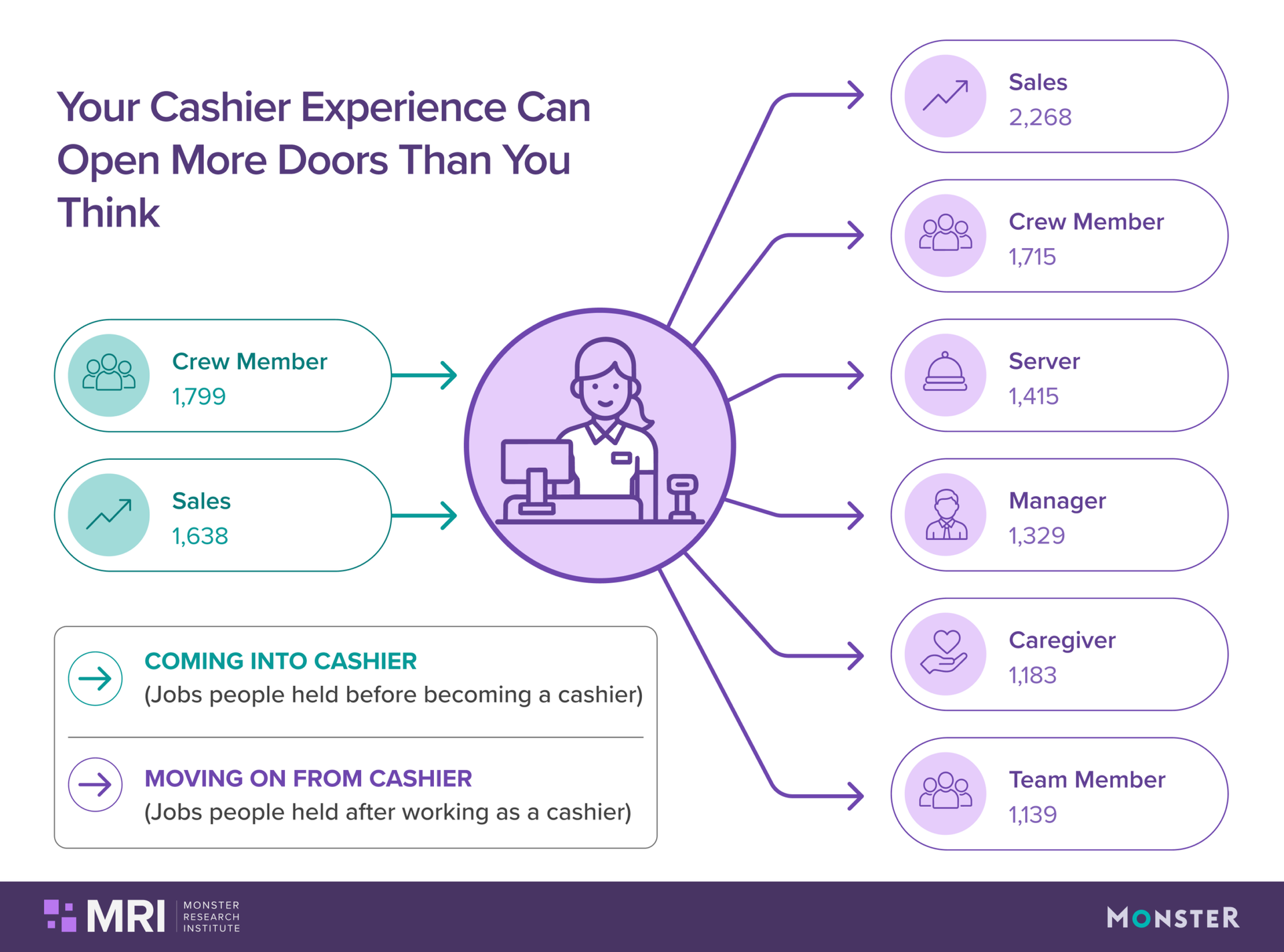
Cashier was the prior title in seven of these pathways and the destination title in four. No other recorded title appeared as frequently among the largest cross-title routes.
Cashier is a common title, so the data doesn’t prove that working as a cashier makes someone more likely to move into any particular role. The data does show that cashier repeatedly appears in the largest observed connections among the high-volume roles studied.
Cashier Isn’t Just a Starting Point
Cashier is often viewed as an entry-level job that workers eventually move beyond. Monster’s data shows a more complicated pattern, with workers moving both from cashier positions into other roles and from those roles into cashier positions.
Here’s how the transitions compared:
| Connected Title | Cashier to Role | Role to Cashier |
| Sales Representative | 2,268 | 1,638 |
| Crew Member | 1,715 | 1,799 |
| Server | 1,415 | 942 |
| Manager | 1,329 | 890 |
| Team Member | 1,139 | 942 |
| Customer Service Representative | 985 | 786 |
| Caregiver | 1,183 | 466 |
| Delivery Driver | 774 | 504 |
| Barista | 750 | 452 |
| Cook | 624 | 500 |
These figures don’t mean the same people repeatedly moved back and forth. They show that, across all resumes analyzed, transitions occurred in both directions between the titles.
They also don’t indicate which direction represented career progress. A person moving from cashier to sales might gain access to commissions or advancement. Someone moving from sales to cashier might receive more predictable hours, better benefits, or a shorter commute.
Those possibilities weren’t measured, but they illustrate why a job title alone can’t tell you whether someone moved up, down, or sideways.
What Skills Can Cashiers Take to Other Jobs?
Cashier experience can involve a range of responsibilities that may transfer to other settings. Depending on the position, those responsibilities may include:
- Helping customers make purchasing decisions
- Resolving complaints and service problems
- Recommending products or services
- Processing transactions accurately
- Handling cash and sensitive payment information
- Meeting sales or performance goals
- Managing inventory
- Training new employees
- Opening or closing a location
- Following safety and security procedures
- Working efficiently during high-volume periods
- Coordinating with coworkers across different functions
Not every cashier develops every skill on this list. Job seekers should identify the responsibilities they actually performed and connect them with the requirements of the position they want.
How to Make Cashier Experience Stand Out on a Resume
A job title alone doesn’t tell employers everything you did. Strong resume bullets highlight your responsibilities, accomplishments, and the results of your work.
Instead of:

Operated a cash register and helped customers.
Consider a more specific description, such as:

Processed high-volume customer transactions while maintaining accurate cash balances and resolving payment issues.
Or:
Recommended products based on customer needs and supported the team in meeting daily sales goals.
Whenever possible, include measurable details such as:
- Average transaction volume
- Sales or upselling results
- Accuracy rates
- Customer satisfaction results
- Number of employees trained
- Inventory responsibilities
- Recognition or performance awards
The goal is to show employers what your job title doesn’t capture without overstating your experience.
What Jobs Can You Get With Cashier Experience?
The pathways in Monster’s data connected cashier with roles including:
These jobs aren’t interchangeable, and some require training, credentials, or specialized experience. Still, they may share certain underlying transferable skills with cashier work.
Before applying, compare your actual experience with the job description. Look for overlap in customer service, communication, transactions, sales, inventory, teamwork, problem-solving, or fast-paced operations.
How to Tell Whether a New Job Is a Step Forward
If you’re wondering what to do after working as a cashier, remember that a new title doesn’t automatically mean a better job. Keeping or returning to a familiar title doesn’t necessarily mean moving backward.
The most important question is whether the position improves your circumstances or creates opportunities that matter to you. When evaluating an opportunity, compare:
- Base pay and total compensation
- Guaranteed and expected hours
- Schedule predictability
- Benefits eligibility
- Paid time off
- Commute and location
- Workload and staffing
- Physical and emotional demands
- Management support
- Training opportunities
- Promotion criteria
- Job stability
Cashier Experience May Be Broader Than It Looks
Monster’s findings show that cashier experience connects to a variety of career paths, both within and beyond retail jobs. That doesn’t mean every cashier needs to pursue a different role or that cashier work is simply a stepping stone.
If you’re considering a career move, focus on the skills you’ve developed, how they apply to other positions, and what you want from your next opportunity. Your job title is only one part of your experience.
For press inquiries, please contact Shanna Briggs at shanna.briggs@bold.com.
About the Monster Workforce Mobility Report
The Monster Workforce Mobility Report is a two-volume analysis of how workers move among employers and job titles. Volume 1: The Stickiest Job Titles examines moves that retained the same recorded title, while Volume 2 explores movement between different titles, focusing on cashier’s prominence among the largest cross-title pathways.
Methodology
Monster analyzed resume data covering 990,922 position changes recorded from January through July 2026. This report focuses on the 370,509 transitions ending in one of the 20 highest-volume destination roles where the recorded prior and destination titles differed.
Resumes were tracked over time, producing “from” and “to” values for job title, employer, and location. A change in job title, employer, or both counted as a position change. Because a single resume or individual could contribute multiple transitions, the unit of analysis was position changes, not unique workers.
Cross-title transitions required a difference between the recorded prior and destination job titles. Similar or equivalent occupations with differently recorded titles were counted as different.
Pathways were ranked by observed transition count. Because the analysis didn’t adjust for the overall prevalence of each prior title, the findings don’t establish whether cashier experience increases the likelihood of moving into another role. The data also doesn’t indicate whether transitions represented promotions, lateral moves, or steps backward.
The 370,509 cross-title transitions represent moves ending in the 20 roles analyzed, not all cross-title position changes captured in the dataset. Because additional destination-title data was unavailable, the results shouldn’t be generalized to all job titles, position changes, or the broader U.S. workforce.

Vicki Salemi is a nationally recognized career expert who helps professionals navigate the hiring landscape and find the right fit on Monster. With over 15 years of experience in corporate recruiting and HR, she offers expert guidance on job search strategies, interview preparation, and career development to help candidates land their next role.
See More From Vicki SalemiExplore Related Career Advice

Highest Paying Medical Jobs: 35 Top Healthcare Careers by Salary

Updated:
Oct 16, 2026
|
18 min read

How to Ask for a Raise at Work: Steps, Scripts, & Email Templates
Updated:
Oct 15, 2026
|
20 min read

Job Hugging Statistics: Nearly 9 in 10 Workers Have “Hugged” a Job
Updated:
Oct 13, 2026
|
9 min read

Nearly 3 in 10 LinkedIn Users Have Updated a Past Job After Leaving It
Updated:
Oct 7, 2026
|
7 min read

Employee Loyalty Statistics: 90% Say Companies Expect More Than They Give
Updated:
Oct 5, 2026
|
7 min read


Overqualified Hiring Stats: 57% Would Cut Resume Experience to Get Hired
Updated:
Sep 28, 2026
|
9 min read

20 First Job Interview Questions & Sample Answers: Tips to Land Your First Job
Updated:
Sep 24, 2026
|
20 min read

“Do You Have Any Questions for Me?” How to Answer in an Interview (30 Examples)
Updated:
Sep 18, 2026
|
14 min read
Manage Your Career Like an Expert
Take control of your professional journey with Monster’s expert resources. Explore advice, research, and tips to make informed decisions and advance your career with confidence.

Job Search
Discover strategies to get noticed, network effectively, and streamline your job search process.

Resumes
Get practical tips to create a resume or CV that stands out to employers and wins interviews.

Cover Letters
Learn how to craft a compelling cover letter that highlights your experience and fit for the role.

Career Paths
Explore career paths, industry trends, and growth opportunities to plan your next move.

Interviewing
Prepare for interviews with tips on answering common questions and following up effectively.

Career Development
Develop key skills and knowledge to grow in your current role or pivot to new opportunities.

Leaving a Job
Navigate job changes and career transitions with practical advice and planning resources.