

What Trades Are in Demand? 6 Skilled Trades With Strong Job Prospects

New national research highlights growing opportunities in skilled trades, but demand, pay, and workforce pathways vary significantly by occupation.
Updated:
|

12 min read
Table of Contents


Investments in infrastructure, manufacturing, energy, and data centers are driving demand for skilled trades workers. But what trades are in demand, and which offer the strongest career opportunities?
Monster’s Skilled Trades Career Guide 2026 explores six careers featured in The State of America’s Skilled Trades, a September 2026 report from Jobs for the Future (JFF). We compare projected employment growth, wages, and training requirements to help job seekers understand their options through 2035.
Key Findings
- Skilled trades are projected to have 1.7 million job openings annually through 2035. Demand reflects both employment growth and the need to replace workers who retire or leave their occupations.
- Nearly 1 in 4 skilled trades workers (24%) is 55 or older, while just 11% are under 25. An aging workforce is contributing to replacement needs across the trades.
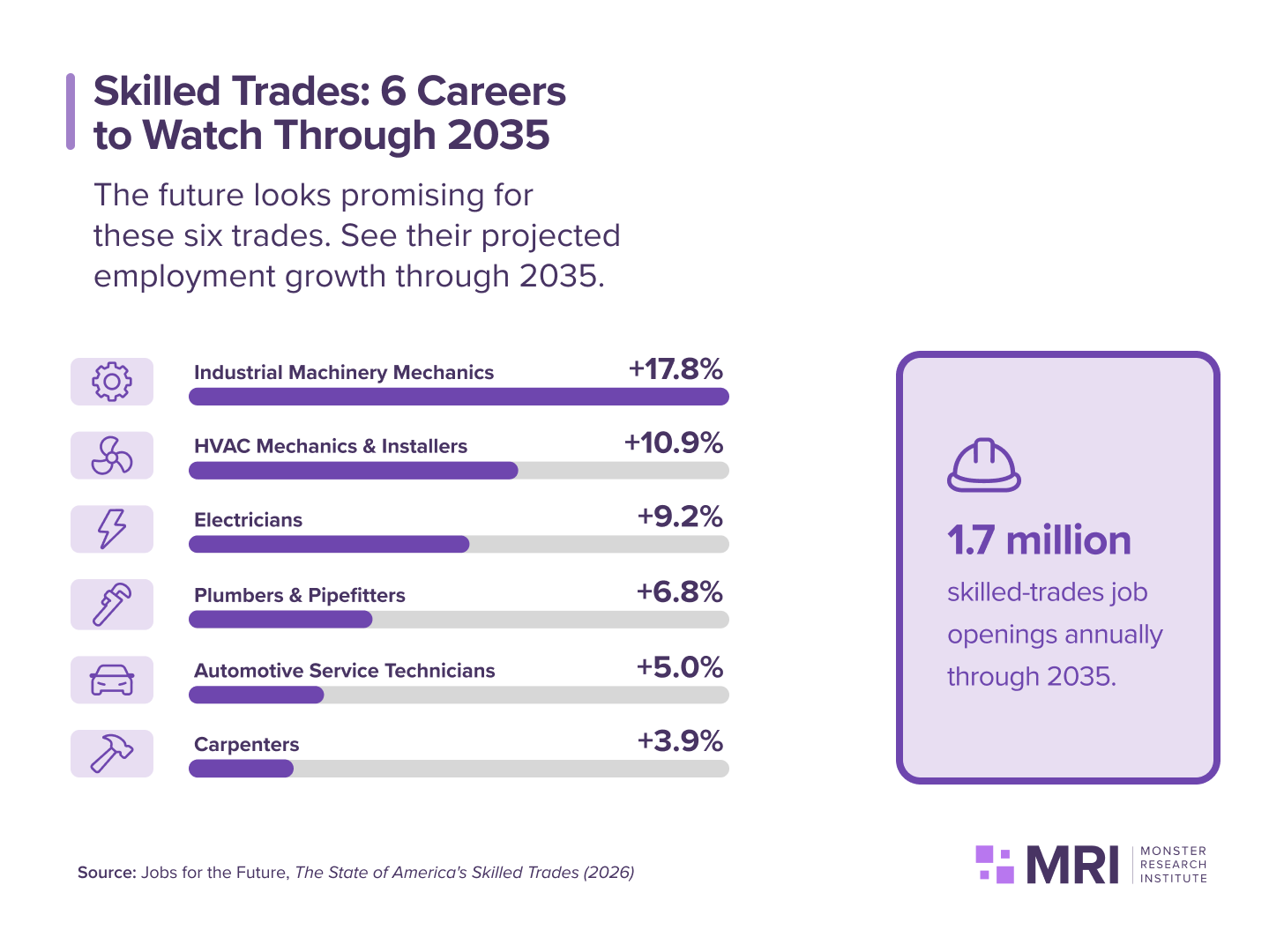
- Industrial machinery mechanics lead the six featured careers in projected growth. Employment is expected to increase 17.8% through 2035, followed by HVAC mechanics and installers (10.9%) and electricians (9.2%).
- More job openings don’t necessarily mean greater worker shortages. Automotive technicians generate approximately 66,000 openings annually, compared with 52,000 for the broader industrial machinery group, yet rank much lower on JFF’s Labor Shortage Index (54th versus 98th percentile).
- Most featured skilled trades careers (5 of 6) pay above the national median. Median annual wages range from $50,620 for automotive service technicians to $64,520 for industrial machinery mechanics, compared with $50,980 across all U.S. occupations.
6 Skilled Trades Careers at a Glance
The six featured skilled trades careers have projected employment growth ranging from 3.9% to 17.8% through 2035, with median annual salaries between $50,620 and $64,520. Five pay more than the $50,980 national median across all U.S. occupations.
JFF selected these occupations to illustrate different career opportunities, not to rank the most in-demand trades overall. The table below compares them by projected employment growth, pay, and typical training requirements.
| Career | Median Annual Pay | Projected Growth Through 2035 | Typical Training Pathway |
| Industrial Machinery Mechanics | $64,520 | 17.8% | 1+ year of on-the-job training |
| HVAC Mechanics & Installers | $61,010 | 10.9% | Technical program or apprenticeship |
| Electricians | $63,190 | 9.2% | 4–5-year apprenticeship |
| Plumbers, Pipefitters, & Steamfitters | $63,800 | 6.8% | 4–5-year apprenticeship |
| Automotive Service Technicians | $50,620 | 5% | Technical program or on-the-job training |
| Carpenters | $60,580 | 3.9% | Apprenticeship or on-the-job training |
Sources:
- Pay: U.S. Bureau of Labor Statistics (BLS), Occupational Employment and Wage Statistics (OEWS), May 2025
- Growth: BLS Employment Projections 2025–2035, as reported by JFF
- Employment counts in the profiles below: JFF analysis of BLS OEWS data, which excludes the self-employed
6 Trades in Demand: Pay, Growth, & Entry Requirements
The six in-demand skilled trades jobs featured in Monster’s report are industrial machinery mechanics, HVAC mechanics and installers, electricians, plumbers and pipefitters, automotive service technicians, and carpenters. Each offers different opportunities for employment growth, earning potential, and career training.
Below, we break down their job outlooks, median salaries, and typical paths into the field.
- 1.
Industrial Machinery Mechanics
Industrial machinery mechanics keep manufacturing and production equipment operating. Their work includes diagnosing breakdowns, repairing mechanical systems, and maintaining increasingly sophisticated industrial machinery.
This is one of the more compelling areas of skilled-trades growth. BLS projections cited by JFF show employment growing approximately 17.8% through 2035, as automation and plant modernization increase the need for diagnostic and repair skills.
Growth is uneven within the broader occupational group: Machinery maintenance workers are projected to decline about 2%, and millwrights to see little change. Together, the three occupations are projected to grow about 14.4% and generate approximately 52,000 job openings annually.
- Median annual pay: $64,520
- Projected employment growth through 2035: 17.8%
- Entry requirements: Industrial machinery mechanics typically receive at least 1 year of on-the-job training, although technical-college programs in industrial maintenance offer another entry point. Skills in hydraulics, pneumatics, programmable controls, and automated equipment can be particularly valuable.
- 2.
HVAC Mechanics & Installers
HVAC and refrigeration technicians install, service, and repair the systems that control temperature and air quality in homes, commercial buildings, healthcare facilities, and food-processing plants. Data centers and other technically complex facilities are adding demand for advanced cooling and controls expertise.
HVAC depends less on new construction than many building trades, because every installed system eventually needs maintenance, repair, and replacement. Employment grew about 19.8% between 2019 and 2025, from roughly 342,000 to 410,000 workers.
- Median annual pay: $61,010
- Projected employment growth through 2035: 10.9%
- Entry requirements: Many HVAC technicians complete a 6-month to 2-year technical program before gaining on-the-job experience, while others enter through apprenticeships. Section 608 certification from the Environmental Protection Agency (EPA) is required for regulated refrigerant work, and North American Technician Excellence (NATE) certification and ongoing training in heat pumps, newer refrigerants, and digital controls can support specialization.
- 3.
Electricians
Electricians install, maintain, and repair the electrical systems that power homes, businesses, factories, and infrastructure. Residential, commercial, industrial, and utility work share a technical foundation but call for different specialized experience.
Much of the new demand is tied to large projects, such as data centers, advanced manufacturing plants, and energy infrastructure. Employment grew about 10% between 2019 and 2025. That demand tends to be concentrated in particular places and time periods.
Despite strong demand, completing the required training can be challenging. The overall completion rate for electrician apprenticeships is approximately 44%, and training providers interviewed for JFF’s report identified the first year as a significant point of attrition.
- Median annual pay: $63,190
- Projected employment growth through 2035: 9.2%
- Entry requirements: Most electricians complete a 4–5-year union or nonunion registered apprenticeship combining paid work and classroom instruction. Pre-apprenticeships can provide early exposure to the work, and licensing requirements vary by state and locality.
- 4.
Plumbers, Pipefitters, & Steamfitters
These occupations all involve installing and maintaining piping systems, but each has a distinct specialty. Plumbers typically work on water, waste, and gas systems in buildings. Pipefitters install industrial piping that carries chemicals, gases, and other fluids. Steamfitters specialize in high-pressure steam systems.
Demand comes from construction, building maintenance, water-infrastructure renewal, energy projects, and advanced manufacturing facilities, such as semiconductor plants. Employment grew about 5.2% between 2019 and 2025, and conditions vary widely by state.
- Median annual pay: $63,800
- Projected employment growth through 2035: 6.8%
- Entry requirements: Most workers complete a 4–5-year registered apprenticeship, with training requirements varying by specialty. Most states license plumbers, and some cities and counties have additional requirements, so check the credentials and experience needed for your chosen trade.
- 5.
Automotive Service Technicians & Mechanics
Automotive service technicians inspect, maintain, diagnose, and repair cars and light trucks at dealerships, independent shops, service chains, and fleet operations.
Automotive service technicians offer an interesting contrast with industrial machinery mechanics and related occupations. Automotive technicians generate more annual openings—approximately 66,000 compared with 52,000—but face considerably less workforce shortage pressure.
JFF places automotive technicians in the 54th percentile nationally on its Labor Shortage Index, compared with the 98th percentile for the combined industrial machinery group. About 15.5% of automotive technicians are under 25, compared with 11% across the skilled trades.
Getting hired isn’t necessarily the main hurdle in this trade. As cameras, sensors, driver-assistance systems, and hybrid and electric drivetrains make repairs more complex, technicians must continually update their diagnostic skills.
- Median annual pay: $50,620
- Projected employment growth through 2035: 5%
- Entry requirements: Automotive technology programs are available in all 50 states, with registered apprenticeships and employer-sponsored training offering additional entry points. Certifications from the National Institute for Automotive Service Excellence (ASE) support advancement into specialties such as hybrid and electric vehicles, while manufacturer programs provide brand-specific training.
- 6.
Carpenters
Carpenters construct, install, and repair building frameworks and related structures, from framing and concrete forms to cabinetry and interior finishing. Many specialize in either structural or finish work.
Carpentry follows the construction cycle more closely than most trades. Employment stood at about 670,000 in 2025—roughly 64,000 below its 2019 level—even as modest growth is projected.
Shifts between single-family and multifamily construction change which skills are in demand, while disaster recovery can create sharp, concentrated demand in affected areas.
- Median annual pay: $60,580
- Projected employment growth through 2035: 3.9%
- Entry requirements: Carpenters typically enter through registered apprenticeships or employer-based training, with many union apprenticeships lasting 4 years and only a few states requiring licenses.
 Pro Tip
Because weather and project delays can interrupt the hours apprentices need, ask sponsors how they keep apprentices working steadily across a range of tasks.
How to Choose a Training Path for Skilled Trades Jobs
To choose a skilled trades training program, compare local job demand, entry requirements, costs, completion rates, and job placement outcomes. Apprenticeships, technical schools, and employer-sponsored training all offer potential pathways, but the best option depends on your chosen trade and location.
JFF’s report emphasizes that completing training and securing employment in the field matter just as much as enrolling, making program outcomes an important consideration.
Here are six steps to help you choose the right training path:
- Step 1:
Pick the work, not just the trade name. Think about whether you’d rather work on construction sites, in factories, in customers’ homes, or in a shop. Consider physical demands, schedules, and travel.
- Step 2:
Check the job market in your state. Opportunities vary considerably by state. JFF’s free America’s Skilled Trades Dashboard lets you look up national and state-level conditions.
- Step 3:
Read real job postings before you enroll. Search the trade in Monster’s job listings to see what employers near you require, what experience they expect, and what they pay.
- Step 4:
Ask programs about results, not just enrollment. What share of participants complete? How many are working in the trade a year later? Is training paid? What does it cost, and how long does it take?
- Step 5:
Look for support in the first year. Mentorship and help with practical barriers like transportation, tools, and childcare can make it easier to stay on track.
- Step 6:
Confirm licensing rules early. Requirements differ by state, and sometimes by county or city. Check with your state licensing agency before choosing a program.
Choosing an In-Demand Trade Career
The trades need workers, and many of these blue-collar careers pay well without a four-year degree. For job seekers, choosing a trade that fits their interests, understanding local opportunities, and evaluating training-program outcomes can lead to a more informed career decision.
One of the biggest mistakes job seekers can make when considering skilled trades or hands-on jobs is choosing a training program before researching the actual job opportunities.
Look at job postings in your area, find out which certifications employers require, and ask training providers about their completion and job placement rates. A career may look promising nationally, but what matters most is whether there’s a realistic path to getting hired where you want to work.
For press inquiries, please contact Shanna Briggs at shanna.briggs@bold.com.
About the Research
This article draws on The State of America’s Skilled Trades: A National Report, published September 30, 2026, by Jobs for the Future (JFF) with support from the Alliance for America’s Skilled Trades. The Burning Glass Institute led the labor-market research, with contributions from the Harvard Project on Workforce and survey research from the Ad Council Research Institute.
The report covers 124 skilled-trades occupations. Pay figures come from the U.S. Bureau of Labor Statistics (BLS) Occupational Employment and Wage Statistics, May 2025, and aren’t part of JFF’s report.
The Monster Research Institute did not conduct the underlying study. This article includes career-navigation guidance, some of which is drawn from JFF’s recommendations, to help readers act on the findings.
Sources
- JFF, The State of America’s Skilled Trades
- JFF, Full Report
- America’s Skilled Trades Dashboard
- BLS, Occupational Employment and Wages

Vicki Salemi is a nationally recognized career expert who helps professionals navigate the hiring landscape and find the right fit on Monster. With over 15 years of experience in corporate recruiting and HR, she offers expert guidance on job search strategies, interview preparation, and career development to help candidates land their next role.
See More From Vicki SalemiExplore Related Career Advice

12 Best Career Tests: Free Aptitude Tests & Quizzes to Choose Your Path

Updated:
Nov 6, 2026
|
19 min read

100+ Common Interview Questions & Answers (With Job Interview Tips)
Updated:
Nov 5, 2026
|
68 min read

Ghost Job Laws: 92% of Job Seekers Want the Right to Know If a Job Is Actually Open
Updated:
Nov 2, 2026
|
9 min read


Monster Livelihood Index Q3 2026: Only 39% Could Maintain Living Standards for 3 Months After Income Loss
Updated:
Oct 28, 2026
|
7 min read


Cashier Career Paths: Monster Workforce Mobility Report (Volume 2)
Updated:
Oct 19, 2026
|
9 min read

Highest Paying Medical Jobs: 35 Top Healthcare Careers by Salary
Updated:
Oct 16, 2026
|
18 min read

How to Ask for a Raise at Work: Steps, Scripts, & Email Templates
Updated:
Oct 15, 2026
|
20 min read
Manage Your Career Like an Expert
Take control of your professional journey with Monster’s expert resources. Explore advice, research, and tips to make informed decisions and advance your career with confidence.

Job Search
Discover strategies to get noticed, network effectively, and streamline your job search process.

Resumes
Get practical tips to create a resume or CV that stands out to employers and wins interviews.

Cover Letters
Learn how to craft a compelling cover letter that highlights your experience and fit for the role.

Career Paths
Explore career paths, industry trends, and growth opportunities to plan your next move.

Interviewing
Prepare for interviews with tips on answering common questions and following up effectively.

Career Development
Develop key skills and knowledge to grow in your current role or pivot to new opportunities.

Leaving a Job
Navigate job changes and career transitions with practical advice and planning resources.