
Beauty Bias at Work Statistics: 88% Say Attractive People Have an Advantage

Appearance may play a bigger role in workers’ careers than many would like to believe.
Updated:
|

8 min read
Table of Contents


Monster’s Beauty Bias at Work Report reveals 88% of U.S. workers believe conventionally attractive people have an advantage in hiring and promotions. Nearly half (43%) consider that advantage to be “major,” while another 45% say attractive workers have a slight advantage.
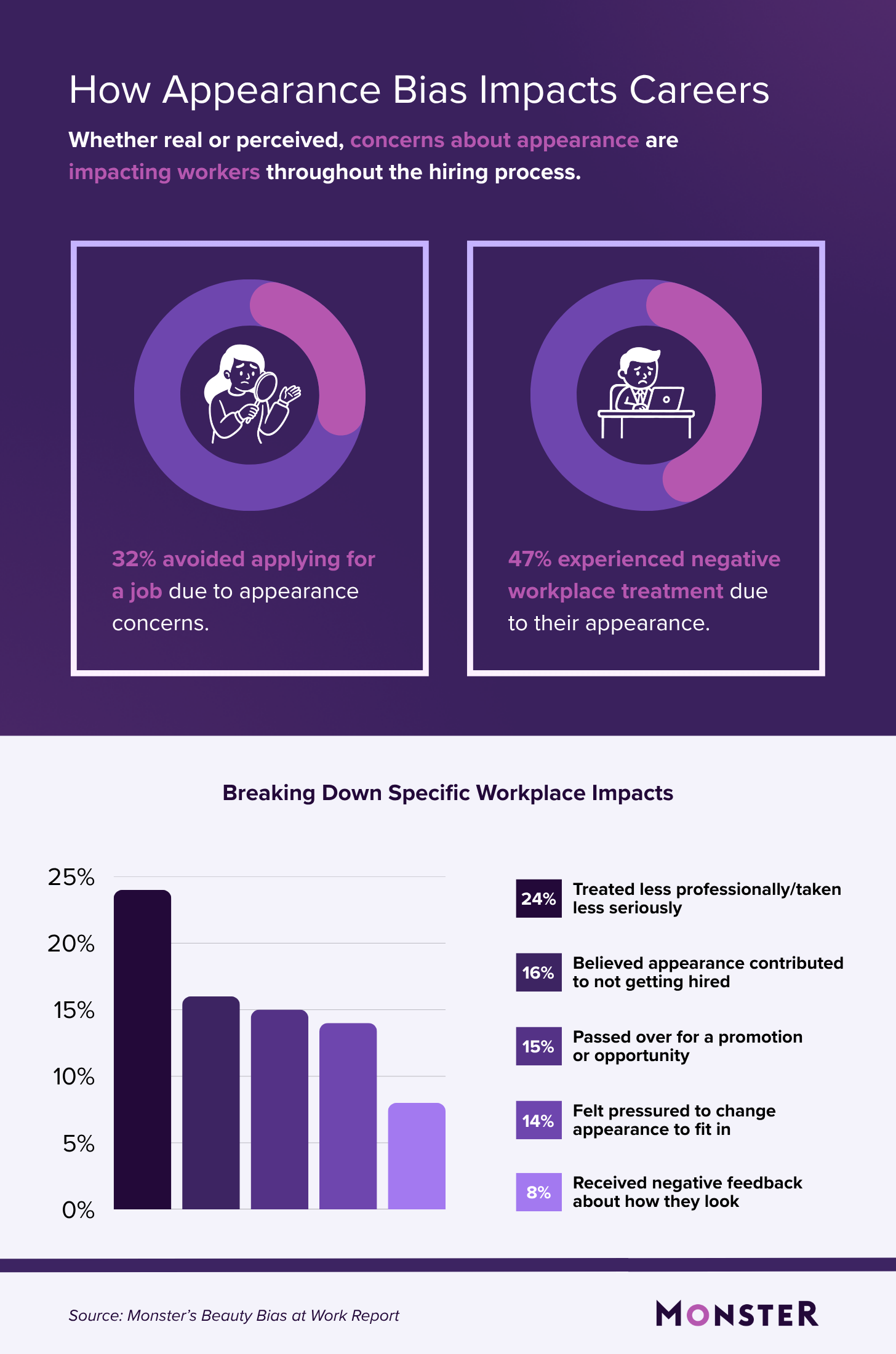
Appearance concerns may also influence whether workers pursue opportunities at all. Nearly one-third (32%) say they’ve avoided applying for a job because of concerns about their appearance.
The findings show that appearance bias, or “lookism,” can affect workers throughout their careers, from deciding whether to apply for a job to how seriously they’re treated at work and whether they believe they receive opportunities for advancement.
Workers want to believe career opportunities are based on their skills, experience, and ability to do the job. But these findings show appearance can feel like another factor they have to navigate. When workers feel they may be judged by how they look before they even have the chance to show what they can do, appearance quickly becomes a workplace issue.
Key Findings
- Most workers believe attractive people have a career advantage. 88% believe conventionally attractive people have an advantage in hiring and promotions, including 43% who say they have a major advantage and 45% who say they have a slight advantage.
- Appearance concerns can discourage workers from applying. 32% have avoided applying for a job because of concerns about their appearance.
- Nearly half report a negative appearance-related workplace experience. 47% have experienced at least one negative career or workplace experience related to their appearance.
- Most workers feel pressure to meet appearance standards. 62% have felt pressure to conform to a particular workplace appearance standard.
- Workers believe women face greater appearance pressure. 70% say women face significantly more or somewhat more appearance-related pressure at work than men.
What Is Lookism in the Workplace?
Lookism in the workplace is bias or unequal treatment based on physical appearance. The term overlaps with “beauty bias” and “pretty privilege,” which describe how being perceived as conventionally attractive can influence how someone is viewed or treated in the workplace.
Monster’s report provides lookism at work statistics that show how these dynamics can affect hiring, promotions, professional treatment, and workplace appearance expectations.
Appearance Bias May Affect Career Opportunities
For many workers, concerns about appearance discrimination in the workplace begin before the hiring process even starts. Nearly one-third (32%) say they’ve avoided applying for a job because of concerns about their appearance.
So, do attractive people get hired more? While these findings don’t measure actual hiring outcomes based on attractiveness, they show that many workers perceive appearance-based hiring bias. Nearly half (47%) reported experiencing at least one negative career or workplace experience related to their appearance.
Monster’s survey found:
- 24% said they were treated less professionally or taken less seriously.
- 16% believe their appearance contributed to them not being hired.
- 15% said their appearance led to being passed over for a promotion or another opportunity.
- 14% felt pressured to change their appearance to fit workplace expectations.
- 8% received negative feedback directly related to their appearance.
These findings suggest that workers see appearance bias as more than a hiring concern. It can shape their experiences throughout the workplace, affecting everything from professional treatment to opportunities for advancement.
Nearly Two-Thirds Feel Pressure to Conform to Workplace Appearance Standards
Appearance expectations are a routine part of the workplace experience for many employees. Nearly two-thirds (62%) of workers say they’ve felt pressured to conform to a particular workplace appearance standard, including expectations related to body type, hairstyle, grooming, clothing, age, or style.
Among workers surveyed:
- 37% have felt mild pressure to conform.
- 25% have felt strong pressure to conform.
- 38% haven’t felt pressure to conform.
Workplace feedback can reinforce those expectations. One-third (33%) say they frequently or occasionally receive feedback that makes them feel they should change their appearance. That includes 9% who say it happens frequently and 24% who say it happens occasionally.
Another 27% say they’ve rarely received this type of feedback, while 40% say they’ve never experienced it.
Majority Say Women Face More Appearance Pressure at Work
Workers also believe appearance expectations are not experienced equally, as 7 in 10 workers (70%) say women face greater appearance-related pressure in the workplace than men.
When asked how appearance-related pressure compares between women and men:
- 41% say women face significantly more pressure.
- 29% say women face somewhat more pressure.
- 23% say women and men face about the same level of pressure.
- 7% say men face greater pressure.
The results highlight how workplace appearance expectations can be perceived differently by gender, with a substantial majority of workers believing women face more pressure about how they look on the job.
For Many Workers, Appearance Is a Career Factor
Workers want their skills, experience, and ability to determine their career opportunities, but Monster’s findings show that many believe appearance can influence the workplace as well.
With 88% saying conventionally attractive people have an advantage in hiring and promotions, appearance bias is widely perceived among workers. For some, those concerns are significant enough to influence whether they apply for jobs in the first place. For others, appearance-related pressures show up through workplace treatment, feedback, or perceived missed opportunities.
The findings also show how common pressure around professional appearance remains: 62% have felt pressure to conform to workplace appearance standards, while 70% believe women experience greater appearance-related pressure than men.
Taken together, these beauty bias at work statistics show that appearance isn’t simply a matter of personal presentation for many workers. It can shape how they approach opportunities and how they experience the workplace.
For press inquiries, please contact Shanna Briggs at shanna.briggs@bold.com.
Methodology
This survey included 1,003 respondents and explored workers’ perceptions and experiences related to physical appearance, workplace appearance standards, hiring and career opportunities, professional self-presentation, video and social media pressure, and appearance-related spending.
Demographic Breakdown
Respondents identified their gender as 53% female and 47% male, with fewer than 1% identifying as nonbinary or preferring not to say. Age distribution included 12% ages 18–24, 17% ages 25–34, 19% ages 35–44, 16% ages 45–54, 16% ages 55–64, and 20% age 65 or older.
About Monster
Monster is a global leader in online job searching, resume building, and employment solutions. For over 30 years, the company has been a trusted authority for both job seekers and companies. Beyond the job search, Monster provides an intuitive Resume Builder and hundreds of resume templates to help candidates stand out against the competition, while offering employers a comprehensive resume database to source top talent. As a G2 category leader, Monster has been featured in Forbes, CNBC, CNN, and USA Today, sharing the career advice needed to bridge the gap between job seekers and hiring managers.

Vicki Salemi is a nationally recognized career expert who helps professionals navigate the hiring landscape and find the right fit on Monster. With over 15 years of experience in corporate recruiting and HR, she offers expert guidance on job search strategies, interview preparation, and career development to help candidates land their next role.
See More From Vicki SalemiExplore Related Career Advice
Job Hugging Statistics: Nearly 9 in 10 Workers Have “Hugged” a Job
Updated:
Oct 13, 2026
|
9 min read

Nearly 3 in 10 LinkedIn Users Have Updated a Past Job After Leaving It
Updated:
Oct 7, 2026
|
7 min read

Employee Loyalty Statistics: 90% Say Companies Expect More Than They Give
Updated:
Oct 5, 2026
|
7 min read


Overqualified Hiring Stats: 57% Would Cut Resume Experience to Get Hired
Updated:
Sep 28, 2026
|
9 min read

20 First Job Interview Questions & Sample Answers: Tips to Land Your First Job

Updated:
Sep 24, 2026
|
20 min read

“Do You Have Any Questions for Me?” How to Answer in an Interview (30 Examples)
Updated:
Sep 18, 2026
|
14 min read

Manage Your Career Like an Expert
Take control of your professional journey with Monster’s expert resources. Explore advice, research, and tips to make informed decisions and advance your career with confidence.

Job Search
Discover strategies to get noticed, network effectively, and streamline your job search process.

Resumes
Get practical tips to create a resume or CV that stands out to employers and wins interviews.

Cover Letters
Learn how to craft a compelling cover letter that highlights your experience and fit for the role.

Career Paths
Explore career paths, industry trends, and growth opportunities to plan your next move.

Interviewing
Prepare for interviews with tips on answering common questions and following up effectively.

Career Development
Develop key skills and knowledge to grow in your current role or pivot to new opportunities.

Leaving a Job
Navigate job changes and career transitions with practical advice and planning resources.