
Employee Loyalty Statistics: 90% Say Companies Expect More Than They Give

Workplace loyalty may still matter to employees, but most workers no longer believe that commitment goes both ways.
Updated:
|

7 min read

Table of Contents


Monster’s Workplace Loyalty Report examines employee loyalty statistics and how workers view commitment in the employer-employee relationship—and the findings reveal a clear disconnect. Employees still value loyalty, but many believe companies expect a level of commitment they aren’t willing to give in return.
For many workers, workplace loyalty has become a one-way street. Employees still value commitment, but they increasingly believe employers expect loyalty without demonstrating the same commitment in return.
Key Findings
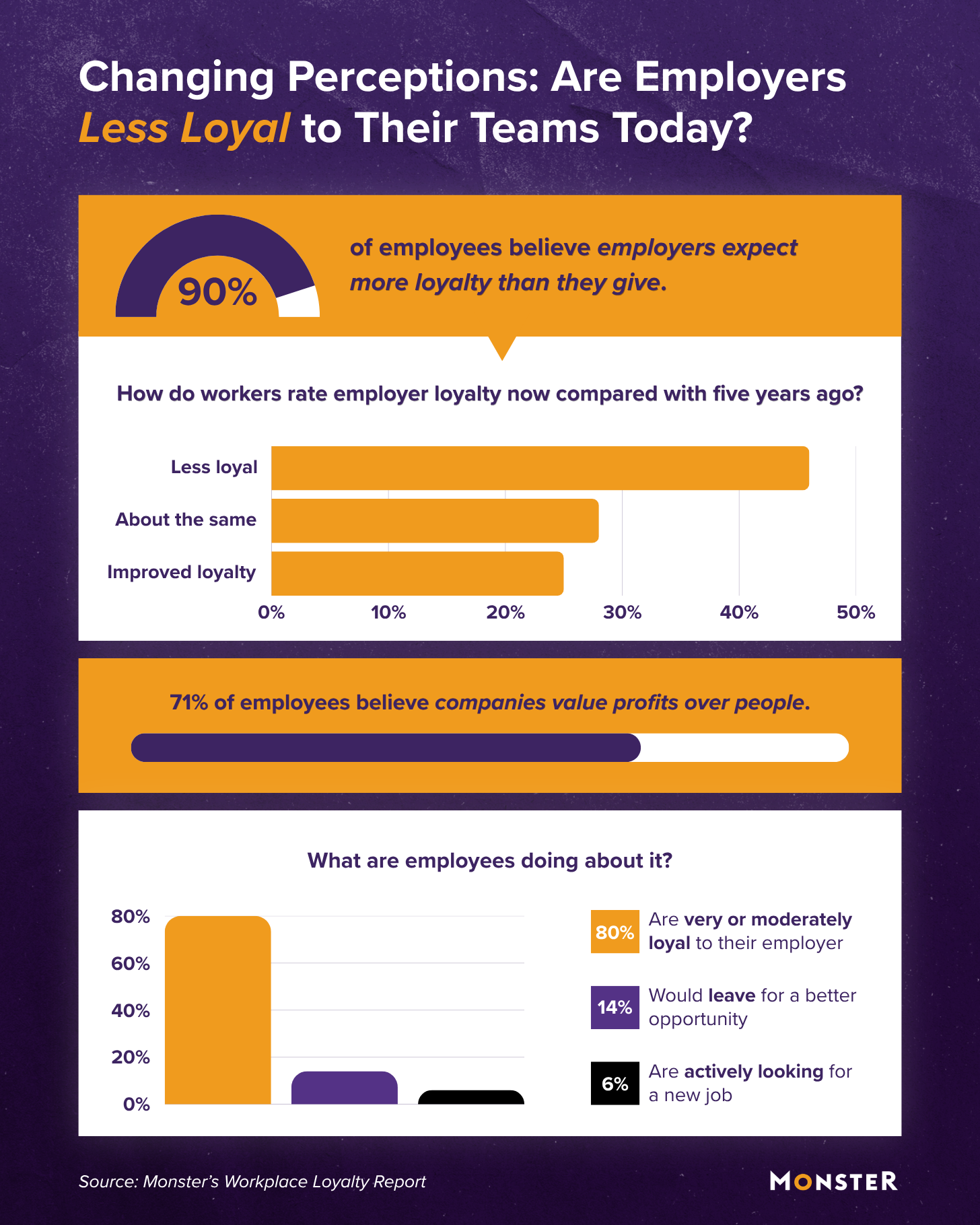
- Most workers believe workplace loyalty is one-sided. 90% say companies expect more loyalty from employees than they are willing to give in return.
- Workers believe corporate priorities have shifted. 71% say companies focus more on profits than on employees compared to five years ago.
- Nearly half say employer loyalty has declined. 46% believe companies are less loyal to employees than they were five years ago.
- Most employees still consider themselves loyal. 80% describe themselves as either very loyal (31%) or moderately loyal (49%) to their current employer.
- Exactly 1 in 5 workers describe themselves as disloyal. 14% say they would leave for a better opportunity, while 6% actively look for opportunities regardless of their current role.
Employees Say Companies Aren’t Matching Their Loyalty
For many, the question isn’t whether employers value loyalty. It’s whether companies are willing to demonstrate the same commitment they expect from employees. Most workers—9 in 10—believe companies expect more loyalty from employees than they are willing to give in return.
That perception is reflected in how workers believe the employer-employee relationship has changed. Nearly half (46%) say companies are either somewhat or much less loyal to employees than they were five years ago.
By comparison:
- 46% believe companies are less loyal to employees.
- 28% say employer loyalty has remained about the same.
- 25% believe employer loyalty has improved.
The results suggest that many workers see a widening imbalance between the commitment companies expect from their workforce and the commitment employees believe they receive in return.
When loyalty feels expected rather than mutual, employees may feel taken for granted or even taken advantage of, particularly if their commitment isn’t reflected in how they’re treated, supported, or rewarded.
71% Say Companies Are More Focused on Profits Than Employees
Workers also see a shift in what companies prioritize.
More than 7 in 10 workers (71%) believe companies are more focused on profits than employees compared to five years ago. Only 4% believe businesses have become less focused on profits relative to employees.
Together with workers’ perceptions of declining employer loyalty, the findings point to a workplace where many employees believe organizational priorities have moved further away from the workforce.
For employees, that perception may influence what workplace loyalty means. Rather than viewing commitment as an automatic part of the employer-employee relationship, workers may increasingly evaluate whether their employer demonstrates commitment in return.
Is Employer Loyalty Declining? Most Employees Still Consider Themselves Loyal
Despite concerns about employer loyalty, most workers still consider themselves loyal to their current employer: 4 in 5 workers (80%) describe themselves as either very or moderately loyal, while 20% say they’re slightly or not loyal.
Here’s how workers describe their loyalty:
- 31% are very loyal. They feel strongly committed to staying with their company long-term.
- 49% are moderately loyal. They prefer to stay but would leave under certain circumstances.
- 14% are slightly disloyal. They would leave if a better opportunity became available.
- 6% aren’t loyal. They actively look for new opportunities regardless of their current role.
The results show that employee loyalty remains strong, but for many workers, that commitment isn’t unconditional.
Loyalty today is less about tenure for its own sake and more about trust. Employees are more likely to stay committed when they believe their employer is equally committed to their growth, stability, and well-being.
What Should Employers Take From These Workplace Loyalty Statistics?
Monster’s findings show that employee loyalty remains strong, even as workers question how much commitment they receive in return.
For employers, earning loyalty requires demonstrating it. Growth opportunities, stability, fair treatment, recognition, and support for employee well-being can show workers that their contributions are valued. Rather than treating retention as an expectation, employers should give employees meaningful reasons to stay.
What to Do When Companies Expect More Loyalty Than They Give
If loyalty feels one-sided at your workplace, evaluate the job based on what it provides for your career and well-being. Consider your compensation, growth opportunities, job security, flexibility, working conditions, and overall treatment.
You can be committed to doing your job well without committing to an employer indefinitely. If another opportunity better supports your career, financial security, or priorities, it’s probably worth pursuing.
At the end of the day, workplace loyalty still matters, but it doesn’t have to be unconditional.
For press inquiries, please contact Shanna Briggs at shanna.briggs@bold.com.
Methodology
This survey was conducted by Pollfish on July 17, 2026, among 1,020 currently employed U.S. workers. Respondents answered a series of multiple-choice questions about workplace loyalty, employer trust, organizational commitment, and perceptions of how employer-employee relationships have changed over time.
Demographic Breakdown
The sample included employed adults across industries, company sizes, and work arrangements throughout the United States. Respondents identified their gender as 52% female and 48% male. Age distribution included 10% ages 18–24, 20% ages 25–34, 19% ages 35–44, 18% ages 45–54, 20% ages 55–64, and 13% age 65 or older.
Of the respondents, 26% worked at companies with 1–49 employees, 18% at companies with 50–249 employees, 20% at companies with 250–999 employees, 17% at companies with 1,000–4,999 employees, 6% at companies with 5,000–9,999 employees, and 13% at companies with 10,000 or more employees. Respondents reported working fully remote (18%), hybrid (22%), or fully in-office (60%).

Vicki Salemi is a nationally recognized career expert who helps professionals navigate the hiring landscape and find the right fit on Monster. With over 15 years of experience in corporate recruiting and HR, she offers expert guidance on job search strategies, interview preparation, and career development to help candidates land their next role.
See More From Vicki SalemiExplore Related Career Advice


Overqualified Hiring Stats: 57% Would Cut Resume Experience to Get Hired
Updated:
Sep 28, 2026
|
9 min read

20 First Job Interview Questions & Sample Answers: Tips to Land Your First Job

Updated:
Sep 24, 2026
|
20 min read

“Do You Have Any Questions for Me?” How to Answer in an Interview (30 Examples)
Updated:
Sep 18, 2026
|
14 min read



20 Companies That Pay 100% Health Insurance & Other Top Benefits
Updated:
Sep 10, 2026
|
14 min read


How Long of a Commute Is Too Long? 49% Have Turned Down a Job Due to the Commute
Updated:
Sep 8, 2026
|
11 min read
Manage Your Career Like an Expert
Take control of your professional journey with Monster’s expert resources. Explore advice, research, and tips to make informed decisions and advance your career with confidence.

Job Search
Discover strategies to get noticed, network effectively, and streamline your job search process.

Resumes
Get practical tips to create a resume or CV that stands out to employers and wins interviews.

Cover Letters
Learn how to craft a compelling cover letter that highlights your experience and fit for the role.

Career Paths
Explore career paths, industry trends, and growth opportunities to plan your next move.

Interviewing
Prepare for interviews with tips on answering common questions and following up effectively.

Career Development
Develop key skills and knowledge to grow in your current role or pivot to new opportunities.

Leaving a Job
Navigate job changes and career transitions with practical advice and planning resources.