
Nearly 3 in 10 LinkedIn Users Have Updated a Past Job After Leaving It

Your LinkedIn profile documents your professional history, but how you describe that history can evolve with your career and the job market.
Updated:
|

7 min read

Table of Contents


After analyzing millions of LinkedIn profiles, recent research found that workers revise past job entries long after leaving those roles. As the labor market changes, the way people describe their previous experience can evolve with it.
Monster surveyed LinkedIn users to understand what workers are changing when they revisit past roles, from updating outdated language to adding in-demand skills, reframing responsibilities, and altering details such as job titles and employment dates.
The resulting LinkedIn statistics for job seekers show how workers are adapting their professional histories for today’s job market, and where updating an old role can begin to blur the line between reframing experience and rewriting it.
Key Findings
- Nearly 3 in 10 LinkedIn users (29%) have edited a past job after leaving it, including 17% who’ve done so multiple times.
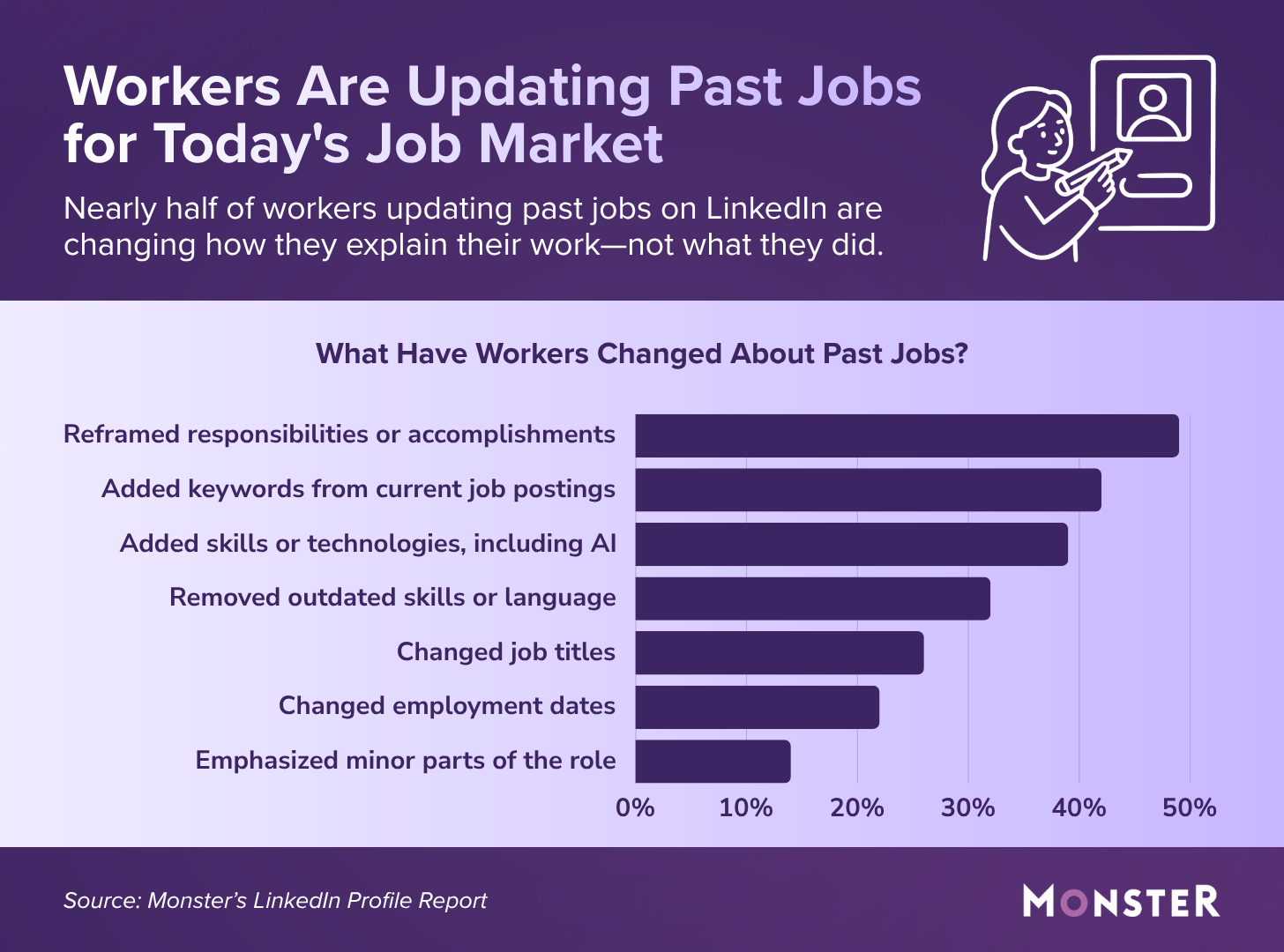
- Nearly half (49%) of those who’ve edited a past job reframed their responsibilities or accomplishments, making it the most common update.
- More than 2 in 5 (42%) added keywords from current job postings, while 39% added skills or technologies, including AI.
- About 1 in 4 (26%) changed a past job title, while 22% changed employment dates.
- Nearly 4 in 5 (79%) who reported activity within six months of an update applied for a new job, and 45% interviewed for one.
What Workers Are Changing in Past LinkedIn Jobs
Monster’s LinkedIn profile statistics show what users change when they revisit a past job after leaving it. Among respondents who had made an update:
- 49% reframed their responsibilities or accomplishments.
- 42% added keywords used in current job postings.
- 39% added skills or technologies, including AI.
- 32% removed skills or language that seemed outdated.
- 26% changed their job title.
- 22% changed their employment dates.
- 14% emphasized work that had originally been only a small part of their role.
Why Would Workers Update Jobs on LinkedIn Years After Leaving?
Workers may update old LinkedIn jobs to reflect current industry language, highlight newly relevant experience, or simply present their work more effectively.
The way work is described changes over time as technologies, job titles, and employer priorities change. Workers may also simply get better at presenting their experience as their careers progress, such as highlighting an accomplishment they previously overlooked or describing a skill more clearly.
Updating an old entry can make past experience easier for recruiters and hiring managers to understand today without changing the underlying facts.
When Does Updating Past Experience Become Misrepresentation?
Some changes to work history on LinkedIn may involve more than updating terminology.
Among respondents who edited a past job, 26% changed a job title, 22% changed employment dates, and 14% emphasized responsibilities that had been a small part of the role.
So, can you change your job title on LinkedIn? Yes, as long as it accurately reflects the position you held. You can clarify an unusual title, correct a date, or highlight a relevant responsibility without changing the facts of your work history.
LinkedIn Updates Often Coincide With Job Search Activity
Monster also asked what respondents did within six months of updating a past LinkedIn job. Among those who reported subsequent activity:
- 79% applied for a new job.
- 45% interviewed for a new job.
- 21% changed employers.
- 19% started freelancing or a business.
- 17% changed careers or industries.
- 11% pursued a promotion or another internal role.
These findings don’t establish that updating a LinkedIn entry caused those outcomes, but they do show us that many respondents updated past experience during periods of job search or career activity.
How to Update Past LinkedIn Experience Without Misrepresenting It
To update past LinkedIn experience without misrepresenting it, assess your work history for relevance to today’s job market while keeping the underlying facts accurate.
Start with the roles you’re targeting now. Review current job postings to understand how employers describe similar work, then use that context to identify where your past experience could be clearer or more relevant.
You can:
- 1.
Reframe vague responsibilities around specific accomplishments. Show what you contributed or achieved rather than relying on a generic list of duties.
- 2.
Update outdated terminology. Use current industry language when it accurately describes the same work, skill, or technology.
- 3.
Surface relevant experience. Give greater visibility to responsibilities or projects that are particularly relevant to the roles you’re pursuing.
- 4.
Add accurate, relevant keywords and skills. Incorporate terms employers use when they genuinely reflect your experience.
- 5.
Clarify unfamiliar job titles. If an internal title doesn’t communicate the nature of your role, provide context without implying you held a different position.
- 6.
Check titles and dates for accuracy. Correct genuine errors, but don’t alter factual details to make your experience appear longer, more senior, or more relevant than it was.
Keeping Past Experience Relevant
The value of past experience isn’t limited to how you described it at the time. As the job market changes, updating your resume and your LinkedIn profile can help show how that experience applies today without changing the facts.
Your resume and LinkedIn don’t need to match word for word, but key details like job titles, employers, and dates should be consistent. Tailor each to its purpose, and add your resume to LinkedIn to keep your professional profile current.
For press inquiries, please contact Shanna Briggs at shanna.briggs@bold.com.
Methodology
Monster and FlexJobs surveyed users of their platforms as part of the 15th Annual Super Survey. The LinkedIn questions were answered by 1,946 respondents between August 21, 2026, and August 30, 2026. For findings about LinkedIn users overall, respondents who reported not having a LinkedIn profile were excluded. Questions about specific profile changes and subsequent activity use the applicable respondent base for each question. Results reflect the experiences of participating Monster and FlexJobs users and are not nationally representative.

Vicki Salemi is a nationally recognized career expert who helps professionals navigate the hiring landscape and find the right fit on Monster. With over 15 years of experience in corporate recruiting and HR, she offers expert guidance on job search strategies, interview preparation, and career development to help candidates land their next role.
See More From Vicki SalemiExplore Related Career Advice

Employee Loyalty Statistics: 90% Say Companies Expect More Than They Give
Updated:
Oct 5, 2026
|
7 min read


Overqualified Hiring Stats: 57% Would Cut Resume Experience to Get Hired
Updated:
Sep 28, 2026
|
9 min read

20 First Job Interview Questions & Sample Answers: Tips to Land Your First Job

Updated:
Sep 24, 2026
|
20 min read

“Do You Have Any Questions for Me?” How to Answer in an Interview (30 Examples)
Updated:
Sep 18, 2026
|
14 min read



20 Companies That Pay 100% Health Insurance & Other Top Benefits
Updated:
Sep 10, 2026
|
14 min read

Manage Your Career Like an Expert
Take control of your professional journey with Monster’s expert resources. Explore advice, research, and tips to make informed decisions and advance your career with confidence.

Job Search
Discover strategies to get noticed, network effectively, and streamline your job search process.

Resumes
Get practical tips to create a resume or CV that stands out to employers and wins interviews.

Cover Letters
Learn how to craft a compelling cover letter that highlights your experience and fit for the role.

Career Paths
Explore career paths, industry trends, and growth opportunities to plan your next move.

Interviewing
Prepare for interviews with tips on answering common questions and following up effectively.

Career Development
Develop key skills and knowledge to grow in your current role or pivot to new opportunities.

Leaving a Job
Navigate job changes and career transitions with practical advice and planning resources.