
How to Make a Resume Stand Out: Tips to Get Interviews

Learn how to make a resume stand out with tips on tailoring content, showcasing results, optimizing for ATS, and getting noticed.
Updated:
|

13 min read

Table of Contents


A resume stands out when it quickly shows employers why you’re a strong match and what results you can deliver. In competitive hiring markets, recruiters often spend just six to seven seconds scanning a resume before deciding whether to keep reading, so clarity, relevance, and impact matter immediately.
This guide breaks down practical, actionable ways to make your resume stand out right away, including how to:
- Tailor your resume to each job.
- Highlight measurable achievements and results.
- Use stronger language and clearer formatting.
- Optimize for applicant tracking systems (ATS).
- Capture attention quickly and improve your chances of getting interviews.
Watch the quick walkthrough below to see these and other resume-building strategies in action.
How to Make Your Resume Stand Out to Employers
You can make your resume stand out by clearly showing how your skills and experience match the role and by highlighting the results you can deliver. Employers and ATS look for resumes that match the job description, are easy to scan, and are focused on measurable results.
The strategies below will help you strengthen your resume, communicate your value more clearly, and avoid resume mistakes that could cost you interviews.
- 1.
Tailor Your Resume to Every Job Application
When you use the same language and priorities as the job description, employers and ATS can quickly see you fit the role. That’s why tailoring your resume to each application is one of the most effective ways to stand out.
To start, review the job posting and identify:
- Required skills and qualifications
- Tools or platforms mentioned
- Keywords repeated throughout the posting
- Core responsibilities and outcomes
Then, adjust your resume accordingly. This may include updating your summary, reordering bullet points, or highlighting different skills.
Example:
If a job description emphasizes project coordination and scheduling, move those experiences higher on your resume and use similar language.
- Coordinated cross-functional project timelines across 3 departments.
- Managed schedules and deadlines using Asana and Google Workspace.
- 2.
Lead With Quantifiable Achievements
Replace task-based descriptions with measurable achievements so hiring managers understand the impact you’ve made, and use numbers when possible.
Example:
- Increased sales by 18%
- Reduced response time by 25%
- Supported 100+ weekly customer inquiries
- Managed a budget of $50,000
A simple way to structure accomplishments is the PAR method: problem, action, result.
Before Quantifying Achievements After Quantifying Achievements Responsible for managing company social media accounts. Revamped social media strategy, increasing engagement by 40% and growing followers by 2,000 over 6 months. Created and scheduled social media posts. Planned and scheduled content across 4 platforms, improving posting consistency and increasing reach by 65%. Monitored comments and messages across platforms. Managed 60+ daily comments and messages, improving response time by 40% and boosting audience engagement by 25%. Helped with monthly performance reports. Tracked performance metrics and compiled monthly reports to guide future content strategy. - 3.
Use Strong Action Verbs to Strengthen Impact
Strong action verbs create clearer, more engaging bullet points that make your experience easier to scan and help employers understand what you’ve done and the level of responsibility you held.
There are hundreds of action verbs you can use to strengthen your resume. Choose ones that match the type of work you do and the results you’ve delivered.
Replace phrases like “responsible for,” “helped with,” or “duties included” with stronger, more direct verbs, such as:
- Led
- Implemented
- Developed
- Analyzed
- Improved
- Launched
- Coordinated
Here are some more examples of action verbs, organized by category:
- Communication: Addressed, presented, negotiated, collaborated, trained, explained, persuaded, documented, consulted, clarified, reported
- Creative: Branded, designed, created, produced, developed, conceptualized, drafted, edited, wrote, illustrated, styled, reimagined
- Customer service: Assisted, resolved, responded, supported, guided, advised, retained, de-escalated, followed up
- Leadership: Coached, managed, directed, supervised, mentored, delegated, oversaw, facilitated, executed
- Operations: Coordinated, processed, monitored, maintained, improved, fulfilled, handled, verified
- Project management: Administered, planned, organized, scheduled, prioritized, tracked, delivered, streamlined, aligned
- Research and analysis: Assessed, researched, evaluated, measured, compiled, reviewed, interpreted, forecasted, summarized, validated
- Sales and marketing: Captured, generated, promoted, pitched, converted, expanded, increased, launched, positioned, negotiated
- Technical: Analyzed, built, programmed, optimized, automated, configured, tested, troubleshot, integrated
- 4.
Optimize Your Resume for ATS to Get Noticed
Many employers use ATS software to organize and screen applications before a recruiter reviews them. These systems scan resumes for relevant resume keywords, skills, and experience to determine whether a candidate is a strong match. Optimizing your resume for ATS helps ensure it gets through this initial screening and reaches a hiring manager.
ATS-friendly resumes that stand out include:
- Clear, succinct contact information
- Keywords from the job description
- Standard headings like “Work Experience” and “Skills”
- Simple formatting and standard fonts (no complex graphics or text boxes)
For example, if your resume says “managed client database” but the job description lists “customer relationship management (CRM)” as a requirement, add that exact phrase if it accurately reflects your experience.
- 5.
Write a Compelling Resume Summary
A strong resume summary quickly shows employers who you are and what you bring to the role. Because hiring managers scan resumes in a matter of seconds, this section should highlight your most relevant strengths immediately.
An effective summary typically includes:
- Your role or expertise
- Years of experience or specialty
- Key skills
- A measurable impact or focus area
Example:
Customer service professional with 5 years of experience supporting high-volume retail and ecommerce teams. Known for resolving issues quickly and improving customer satisfaction scores. Experienced with remote support tools and comfortable in fast-paced environments.
- 6.
Use Clean, Professional Resume Formatting
Clean formatting makes your resume easier to read for both hiring managers and ATS. Use a simple, professional layout and avoid overly decorative templates, graphics, or unusual fonts that can distract from your content or interfere with scanning.
These formatting best practices help define what a resume should look like and keep it clear and easy to review:
- Use consistent headings and spacing.
- Choose professional fonts like Calibri, Arial, or Georgia.
- Include white space for readability.
- Keep most resumes to one page unless extensive experience warrants two.
- Start with clean, modern resume templates that emphasize readability and structure.
- 7.
Proofread Your Resume Carefully
Typos and formatting errors can undermine your resume, even if you’re the best fit for the role. Proofreading helps ensure your resume reflects professionalism and attention to detail.
Before submitting your resume:
- Run it through spell-check and grammar tools.
- Read it slowly and carefully.
- Take a break and read it again out loud.
- Review formatting consistency.
- Ask a trusted friend or colleague to review it.
- 8.
Use Networking & Referrals to Increase Visibility
Your resume will almost always be more effective when paired with networking and referrals. Many employers give extra attention to candidates who are recommended by current employees or professional connections.
To increase your visibility with hiring managers:
- Connect with professionals in your field on LinkedIn.
- Join industry groups or online communities.
- Let contacts know you’re job searching.
- Ask for referrals when appropriate.
How to Make Your Resume Stand Out in Common Scenarios & Industries
A resume stands out most when it’s tailored to your experience level and the expectations of your target industry. Employers look for different signals depending on whether you’re entry-level, remote, technical, or changing fields, so adjusting how you present your skills and results can significantly improve your chances of getting interviews.
Below are practical ways to strengthen your resume in common job search scenarios and across major industries.
No Experience
If you’re wondering how to make a resume with no experience, focus on transferable skills, education, projects, and any volunteer or informal work that shows your reliability and potential.
Highlight:
- School projects, coursework, or certifications
- Volunteer work or extracurricular activities
- Transferable skills like communication, organization, teamwork, and time management
- Part-time, freelance, or informal work
Example:
Completed a group marketing project that developed a social media campaign and increased engagement by 25% in a semester-long assignment.
Remote Jobs
To stand out for remote jobs, your resume should demonstrate that you can work independently, communicate clearly, and manage tasks without in-person supervision.
Highlight:
- Remote tools like Zoom, Slack, or project management platforms
- Time management and self-direction
- Written communication and organization
- Prior remote, freelance, or hybrid experience
Example:
Collaborated with a distributed team across 3 time zones using Slack and Asana to deliver weekly client reports ahead of deadline.
Internships
When applying for internships, focus on showing your potential, academic background, what you’ve learned and applied, and the types of roles or industries you want to enter.
Highlight:
- Academic projects and presentations
- Relevant coursework or certifications
- Campus leadership or volunteer roles
- Technical skills and transferable Skills
Example:
Conducted market research and presented findings to a class of 40 students, developing data analysis and presentation skills relevant to marketing roles.
Creative Fields
In creative fields like design, writing, marketing, or media, your resume should highlight your skills, style, and results while clearly directing employers to work samples.
Highlight:
- Portfolio links or personal websites
- Campaigns, designs, or content created
- Audience growth or engagement metrics
- Tools and software proficiency
Example:
Designed social media graphics that increased engagement by 50% and contributed to a 2,000-follower growth over 4 months.
Corporate Roles
For corporate and professional roles, focus on a polished, results-driven resume that highlights measurable achievements, reliability, collaboration, and clear professional formatting.
Highlight:
- Metrics and business impact
- Leadership or project coordination
- Process improvements or efficiency gains
- Collaboration across teams
Example:
Streamlined internal reporting process, reducing turnaround time by 30% and improving team productivity.
Tech Roles
In tech roles, include specific tools, programming languages, and project experience so employers can quickly assess your technical qualifications.
Highlight:
- Programming languages and frameworks
- Software, tools, or platforms
- Completed projects or applications
- Certifications or technical training
Example:
Built a responsive website using HTML, CSS, and JavaScript that improved page load speed by 40% and enhanced user experience.
Skilled Trades
For skilled trade roles, use a straightforward, skills-focused resume that emphasizes reliability, safety awareness, and hands-on experience.
Highlight:
- Certifications or licenses
- Equipment or tools used
- Safety training and compliance
- Measurable productivity or efficiency
Example:
Operated warehouse equipment to fulfill 150+ daily orders while maintaining 100% safety compliance.
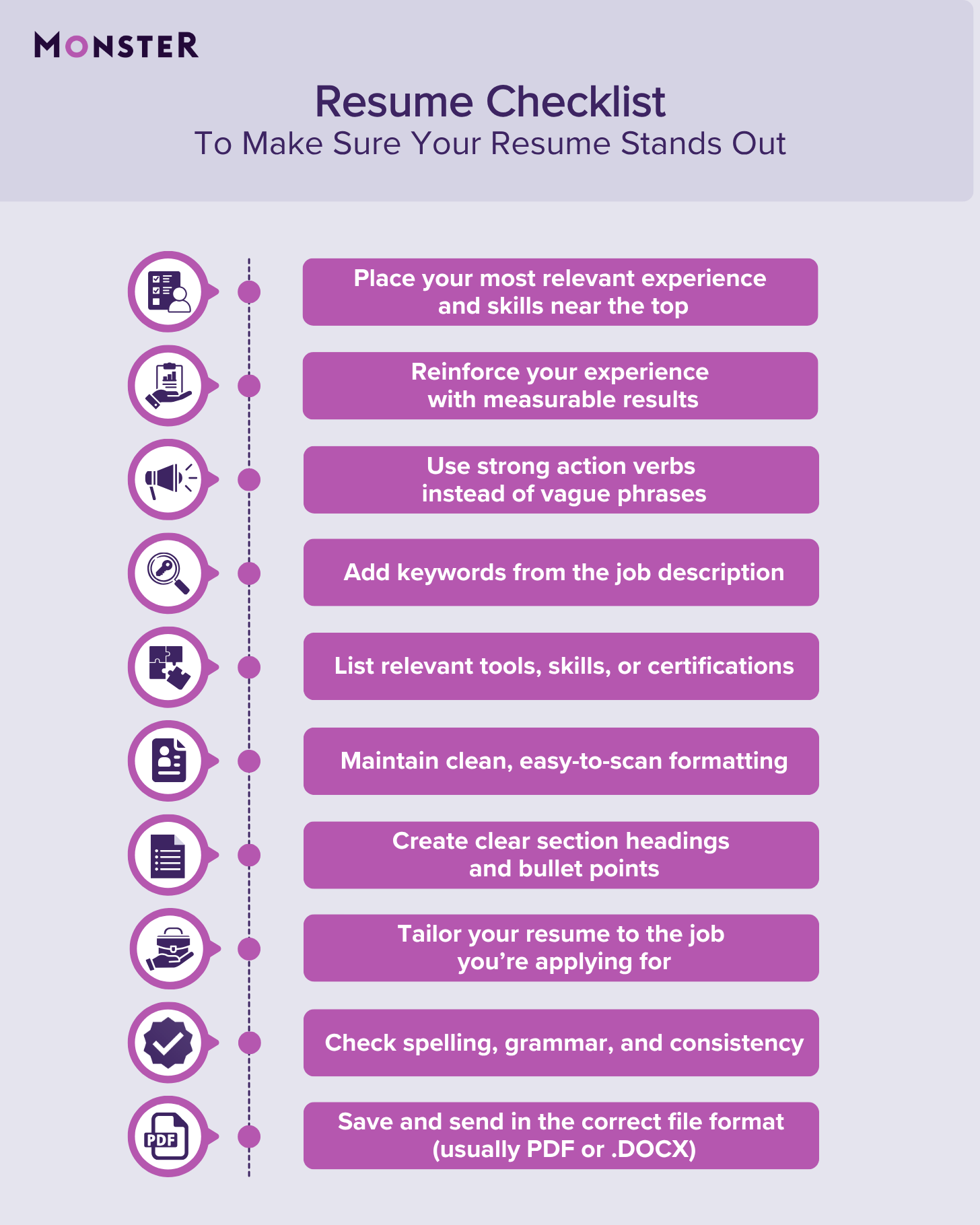
Resume Checklist: Make Sure Your Resume Stands Out
Check whether or not you’ve covered the key elements of a resume and completed the following before submitting:

Place your most relevant experience and skills near the top.
Reinforce your experience with measurable results.
Use strong action verbs instead of vague phrases.
Add keywords from the job description.
List relevant tools, skills, or certifications.
Maintain clean, easy-to-scan formatting.
Create clear section headings and bullet points.
Tailor your resume to the job you’re applying for.
Check spelling, grammar, and consistency.
Save and send in the correct file format (usually PDF or DOCX).
Build a Resume That Gets the Attention It Deserves
A clear, tailored, and results-focused resume makes it easier for employers to see your value quickly and move you forward in the hiring process. Tools like Monster’s Resume Builder help job seekers create polished, tailored resumes by organizing skills, achievements, and experience into clean, professional formats that stand out to employers and ATS.
As hiring continues to evolve, regularly updating and refining your resume ensures you’re ready for new opportunities whenever they appear.
Frequently Asked Questions
What are the three C’s of a resume?
The three C’s of a resume are clarity, conciseness, and consistency. A strong resume is easy to read, focuses only on relevant information, and uses consistent formatting, language, and structure throughout. When hiring managers can quickly understand your experience and value, your resume is more likely to stand out and move forward in the hiring process.
What is the 30-second rule for resumes?
The 30-second rule for resumes means hiring managers often spend 30 seconds or less scanning a resume before deciding whether to keep reading. To pass this quick review, place your most relevant skills, results, and job titles near the top. Use clear headings and bullet points, and make sure your resume quickly shows why you’re a strong match for the role.
What are the three F’s of resume writing?
The three F’s of resume writing are focus, formatting, and facts. Focus on tailoring your resume to the job you want, use clean and consistent formatting to improve readability, and include factual achievements supported by metrics or examples. Together, these elements help hiring managers quickly see your qualifications and the impact you can deliver.
What are the five P’s of a resume?
The five P’s of a resume are purpose, presentation, precision, proof, and personalization. Start with a clear purpose that aligns with the job, present your experience in a polished format, use precise language and measurable results, proofread carefully to avoid errors, and personalize each resume to match the specific role and employer.

Kirsten Chorpenning is a career advice writer who empowers job seekers to take control of their career paths using Monster’s comprehensive job search and resume tools. She specializes in helping job seekers find rewarding jobs in today’s dynamic work environment.
See More From Kirsten ChorpenningExplore Related Career Advice

Overqualified Hiring Stats: 57% Would Cut Resume Experience to Get Hired

Updated:
Sep 28, 2026
|
9 min read

20 First Job Interview Questions & Sample Answers: Tips to Land Your First Job
Updated:
Sep 24, 2026
|
20 min read

“Do You Have Any Questions for Me?” How to Answer in an Interview (30 Examples)
Updated:
Sep 18, 2026
|
14 min read



20 Companies That Pay 100% Health Insurance & Other Top Benefits
Updated:
Sep 10, 2026
|
14 min read


How Long of a Commute Is Too Long? 49% Have Turned Down a Job Due to the Commute
Updated:
Sep 8, 2026
|
11 min read

Manage Your Career Like an Expert
Take control of your professional journey with Monster’s expert resources. Explore advice, research, and tips to make informed decisions and advance your career with confidence.

Job Search
Discover strategies to get noticed, network effectively, and streamline your job search process.

Resumes
Get practical tips to create a resume or CV that stands out to employers and wins interviews.

Cover Letters
Learn how to craft a compelling cover letter that highlights your experience and fit for the role.

Career Paths
Explore career paths, industry trends, and growth opportunities to plan your next move.

Interviewing
Prepare for interviews with tips on answering common questions and following up effectively.

Career Development
Develop key skills and knowledge to grow in your current role or pivot to new opportunities.

Leaving a Job
Navigate job changes and career transitions with practical advice and planning resources.