
Resume Exaggeration Statistics: 45% Say Employers & Job Seekers Exaggerate Equally

Hiring is built around making a strong first impression, but where’s the line between presenting yourself favorably and stretching the truth?
Updated:
|

9 min read

Table of Contents


Monster’s Resume Confessions Report reveals a disconnect between what workers believe and what they’re willing to do. Nearly 6 in 10 U.S. adults (59%) say a resume should always be completely truthful, but 37% would exaggerate something on their resume to land their dream job if they knew they’d never be caught. Meanwhile, 45% believe employers and job seekers are equally guilty of exaggerating to land the hire or the job.
Workers also acknowledge exaggeration in their own job searches. More than 1 in 4 (27%) say they’ve intentionally included something that wasn’t completely accurate to improve their chances of getting hired.
The report explores how workers think about resume honesty, what candidates exaggerate, why they do it, and where they draw the line between presenting themselves favorably and being dishonest.
Key Findings
- Nearly half see exaggeration on both sides. 45% believe employers and job seekers exaggerate equally during the hiring process.
- Exaggeration is widely expected during hiring. 89% believe employers, job seekers, or both stretch the truth, while just 11% say neither side exaggerates.
- More than 1 in 4 admit to resume inaccuracies. 27% say they’ve intentionally included something on their resume that wasn’t completely accurate to improve their chances of getting hired.
- More than one-third would exaggerate without consequences. 37% say they’d exaggerate something on their resume to land their dream job if they knew they’d never be caught.
- Embellishing responsibilities is the most common change. 22% say they’ve made their responsibilities sound more impressive, while 11% have inflated their skills or experience.
- Candidates borrow language from job postings. 23% say they’ve copied wording directly from a job description into their resume to appear like a better match.
- Getting an interview is the top motivation. Among workers who have exaggerated, 38% say they did so to improve their chances of landing an interview.
- Honesty remains the standard for most workers. 59% believe a resume should always be completely truthful.
Workers See Exaggeration as a Problem on Both Sides of Hiring
Resume exaggeration may traditionally be viewed as a candidate issue, but workers are just as likely to believe employers stretch the truth.
When asked who exaggerates more during the hiring process:
- 45% say employers and job seekers exaggerate equally.
- 22% say job seekers exaggerate more.
- 22% say employers exaggerate more.
- 11% say neither exaggerates.
Altogether, 89% believe exaggeration occurs somewhere in the hiring process. These resume lies statistics show that the largest group doesn’t place responsibility solely on candidates or companies. Instead, workers appear to view hiring as a process where both sides emphasize their strengths as they try to make the best possible impression.
What Do Workers Exaggerate on Their Resumes?
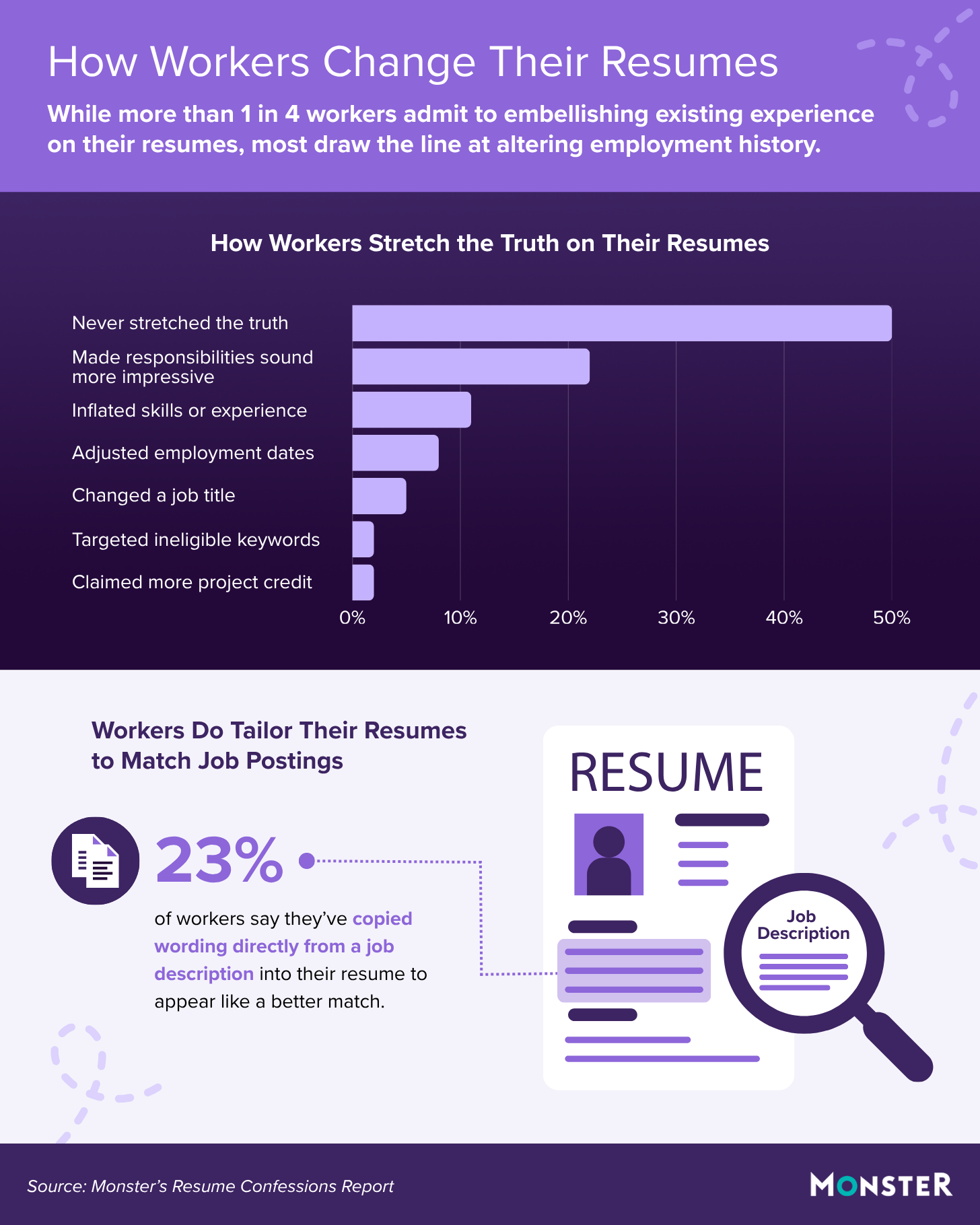
While more than 1 in 4 workers say they’ve intentionally included something on their resume that wasn’t completely accurate to improve their chances of getting hired, the most common changes involve embellishing existing experience.
When asked about the biggest change they’ve made on a resume:
- 50% say they’ve never stretched the truth.
- 22% have made responsibilities sound more impressive.
- 11% have inflated skills or experience.
- 8% have adjusted employment dates.
- 5% have changed a job title.
- 2% have used keywords they didn’t fully qualify for.
- 2% have claimed more credit for a project.
These lying-on-resumes statistics suggest that workers are more likely to enhance or reframe their experience than make more substantial changes to their employment history.
Candidates are also tailoring their resumes closely to individual openings. Nearly 1 in 4 workers (23%) say they’ve copied wording directly from a job description into their resume to appear like a better match.
Why Do Workers Exaggerate on Their Resumes?
Among workers who acknowledge exaggerating on their resumes, the opportunity to interview is the most common motivation.
When asked why they exaggerated on their resumes:
- 38% wanted to improve their chances of getting an interview.
- 29% believed they could do the job anyway.
- 13% urgently needed a job.
- 11% wanted to get past applicant tracking systems (ATS) or automated screening.
- 9% believed the job requirements were unrealistic.
The findings point to the pressures candidates may feel when trying to stand out during the application process. For many who exaggerate, the goal is to get an opportunity to compete for the position.
That distinction, however, doesn’t make inaccurate information risk-free. Candidates ultimately need to be able to support the skills, responsibilities, and accomplishments they include on their resumes.
Honesty Still Matters to Most Workers
Even though exaggeration is widely viewed as part of the hiring process, most workers still believe resumes should be accurate.
When asked which statement best matches their opinion:
- 59% say a resume should always be completely truthful.
- 24% say small exaggerations are acceptable.
- 11% say exaggeration is acceptable if the candidate can do the job.
- 6% say candidate exaggeration is fair because employers exaggerate job descriptions.
The results highlight a tension in how workers approach the hiring process. Candidates may feel pressure to present themselves as strongly as possible, but nearly 6 in 10 still believe that complete truthfulness should be the standard.
How to Strengthen Your Resume Without Exaggerating: 5 Steps
Candidates can make their experience more compelling by clearly communicating their qualifications, tailoring their resumes to the position, and demonstrating the impact of their work—all without stretching the truth.
- Step 1:
Focus on Accomplishments, Not Just Responsibilities
Instead of making responsibilities sound bigger than they were, explain what you accomplished while performing them. Include specific results, improvements, projects, or outcomes that demonstrate the value of your work.
- Step 2:
Quantify Your Impact When Possible
Numbers can make legitimate accomplishments on your resume more persuasive. Consider including metrics, such as revenue generated, customers supported, projects completed, time saved, team size, or performance improvements, when those figures accurately reflect your work.
- Step 3:
Tailor Your Resume to the Job
Review the job description and identify the experience and skills you genuinely have that are most relevant to the position. Prioritize those qualifications on your resume rather than adding skills or keywords you can’t confidently support.
- Step 4:
Use Strong, Accurate Language
There’s a difference between presenting your experience confidently and misrepresenting it. Use clear action verbs and specific descriptions to communicate your contributions without changing your title, employment history, or level of responsibility.
- Step 5:
Be Prepared to Discuss Everything You Include
Before submitting your resume, make sure you can comfortably explain every skill, accomplishment, project, and responsibility listed. If an interviewer asks for an example, you should be prepared to provide one.
Standing Out Without Stretching the Truth
Hiring requires both candidates and employers to communicate their strengths, but the resume exaggeration statistics in Monster’s Resume Confessions Report show that workers still draw a line between presenting experience favorably and being dishonest.
While 45% believe employers and job seekers exaggerate equally, and more than 1 in 4 workers admit to including something on their resume that wasn’t completely accurate, 59% still believe resumes should always be completely truthful.
For job seekers, the challenge is making their experience stand out without misrepresenting what they’ve done. Focusing on measurable accomplishments, relevant experience, and clear descriptions of real skills can help candidates build stronger applications while maintaining the authenticity that can lead to better long-term job matches.
For press inquiries, please contact Shanna Briggs at shanna.briggs@bold.com.
Methodology
The findings in the Monster Resume Confessions Report are based on a survey conducted by Pollfish on July 21–24, 2026, among 1,001 U.S. adults. Respondents answered a series of multiple-choice questions examining resume accuracy, resume exaggeration, hiring motivations, candidate ethics, and job application behavior.
Demographic Breakdown
The sample included adults across a range of industries, age groups, and career stages. Respondents identified their gender as 50% female and 50% male, and represented multiple generations, including 13% ages 18–24, 20% ages 25–34, 17% ages 35–44, 17% ages 45–54, 16% ages 55–64, and 17% ages 65 and older.
About Monster
Monster is a global leader in online job searching, resume building, and employment solutions. For over 30 years, the company has been a trusted authority for both job seekers and companies. Beyond the job search, Monster provides an intuitive Resume Builder and hundreds of resume templates to help candidates stand out against the competition, while offering employers a comprehensive resume database to source top talent. As a G2 category leader, Monster has been featured in Forbes, CNBC, CNN, and USA Today, sharing the career advice needed to bridge the gap between job seekers and hiring managers.

Vicki Salemi is a nationally recognized career expert who helps professionals navigate the hiring landscape and find the right fit on Monster. With over 15 years of experience in corporate recruiting and HR, she offers expert guidance on job search strategies, interview preparation, and career development to help candidates land their next role.
See More From Vicki SalemiExplore Related Career Advice

Overqualified Hiring Stats: 57% Would Cut Resume Experience to Get Hired
Updated:
Sep 28, 2026
|
9 min read

20 First Job Interview Questions & Sample Answers: Tips to Land Your First Job

Updated:
Sep 24, 2026
|
20 min read

“Do You Have Any Questions for Me?” How to Answer in an Interview (30 Examples)
Updated:
Sep 18, 2026
|
14 min read



20 Companies That Pay 100% Health Insurance & Other Top Benefits
Updated:
Sep 10, 2026
|
14 min read


How Long of a Commute Is Too Long? 49% Have Turned Down a Job Due to the Commute
Updated:
Sep 8, 2026
|
11 min read

Manage Your Career Like an Expert
Take control of your professional journey with Monster’s expert resources. Explore advice, research, and tips to make informed decisions and advance your career with confidence.

Job Search
Discover strategies to get noticed, network effectively, and streamline your job search process.

Resumes
Get practical tips to create a resume or CV that stands out to employers and wins interviews.

Cover Letters
Learn how to craft a compelling cover letter that highlights your experience and fit for the role.

Career Paths
Explore career paths, industry trends, and growth opportunities to plan your next move.

Interviewing
Prepare for interviews with tips on answering common questions and following up effectively.

Career Development
Develop key skills and knowledge to grow in your current role or pivot to new opportunities.

Leaving a Job
Navigate job changes and career transitions with practical advice and planning resources.