
How to Create a STAR Method Resume (40+ Examples)

Turn everyday job duties into results-driven resume bullet points with the STAR method, plus a copy-paste formula and examples by industry.
Updated:
|

read

Table of Contents


A STAR method resume helps you transform everyday tasks into clear, measurable achievements that show employers what you’ve accomplished and the value you bring.
You update your resume, swap in stronger verbs, maybe tweak a few bullet points, and still, it reads like a list of tasks instead of proof of what you’ve actually achieved. That’s where a structured approach like the STAR method helps: It turns routine responsibilities into clear, results-driven accomplishments employers can quickly recognize.
This guide shows you how to turn your experience into clear, results-focused bullet points using the STAR resume framework, with tips, formulas, and a variety of examples to help you strengthen your resume.
What Is the STAR Method for Resumes? Why It Works
The STAR method is a structured framework used to clearly and effectively describe professional achievements. It stands for situation, task, action, and result.
Although it was created to help job seekers answer behavioral interview questions with specific, results-focused examples, it works effectively on resumes when condensed into concise, accomplishment-focused bullet points rather than full stories.
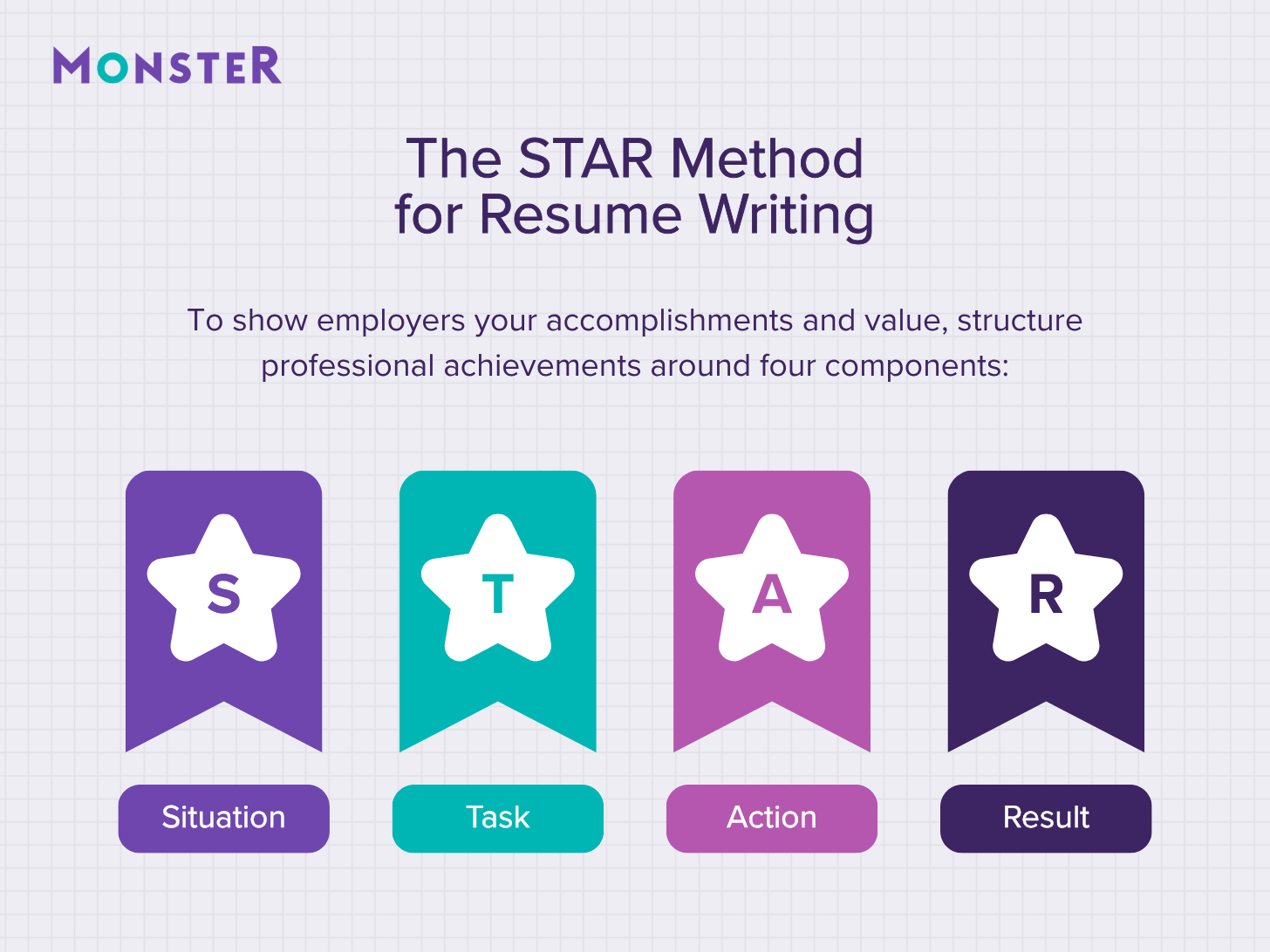
Breaking Down Each STAR Component for Resume Writing
Here’s how each part of the STAR framework applies to resume writing:
| STAR Component | Definition | Examples |
| Situation | The situation provides context for your accomplishment. This could be a challenge, a project, or a business need you faced. On a resume, the situation is often brief or implied rather than fully explained. | A busy holiday season A new system rollout A declining metric |
| Task | The task explains your responsibility or goal within that situation. What were you expected to do? What problem were you responsible for solving? | Improve customer satisfaction scores Train new hires Reduce processing time |
| Action | The action describes the specific steps you took to address the task or challenge. Start with strong action verbs and focus on what you personally contributed. | Implemented a new workflow Developed a training guide Analyzed performance data |
| Result | The result shows the outcome of your actions. Whenever possible, include measurable results like percentages, revenue, time savings, or productivity improvements. | Increased sales by 22% Reduced onboarding time by 30% Improved accuracy rates |
Why the STAR Method Strengthens Your Resume
Using the STAR method strengthens your resume by turning job duties into clear, results-focused achievements that show employers what you’ve accomplished.
Imagine you’re a recruiter comparing two resumes. One says “responsible for sales calls,” while the other says “made 60+ daily sales calls, tracked activity in Salesforce, and maintained a 22% conversion rate.” Who stands out more, the candidate who lists duties or the one who proves they can deliver results?
Overall, a STAR method resume helps you:
- Turn basic job duties into measurable accomplishments.
- Highlight critical thinking and problem-solving skills.
- Quantify your impact with metrics and results.
- Show employers the value you bring to a role.
- Create stronger, more persuasive resume bullet points.
STAR Method Resume Formula: A Simple Template
You can use this simple formula to write strong STAR method resume bullet points:
This structure keeps your bullet points concise while still showing context, action, and impact. If you’re unsure how to get started, try writing out a full STAR example first, then condense it into one clear bullet point using this formula.
For example:
- Situation: Customer wait times were increasing during peak hours.
- Task: Improve service speed and customer satisfaction.
- Action: Reorganized checkout workflow and trained team on faster processing steps.
- Result: Reduced average wait times by 25% and improved customer satisfaction scores.
And here’s how the example above becomes this bullet point:
Reorganized checkout workflow and trained staff on faster processing steps, reducing wait times by 25% and improving customer satisfaction scores.
How to Use the STAR Method in Resumes: Tips & Examples
A STAR method resume uses concise, results-focused bullet points to highlight your most relevant accomplishments in both the summary and work experience sections.
How to Write STAR Method Resume Bullet Points (With Examples)
Use this simple process to turn a basic duty into a results-focused bullet point:
- Review the job description for priorities. Highlight resume keywords like skills, tools, and outcomes the employer cares about (customer satisfaction, accuracy, revenue, efficiency, deadlines, etc.).
- Choose accomplishments that match those priorities. Pull from projects, process improvements, metrics you influenced, problems you solved, or times you supported a team goal.
- Draft the full STAR story. Write one to two sentences for situation, task, action, and result. You’ll trim it down in the next step.
- Condense it into one punchy bullet point. Lead with a strong verb and keep the context short. Aim for a clean action and impact statement.
- Add metrics when possible. Use numbers (e.g., percentage increase, time saved, error reduction, dollars saved, volume handled, or satisfaction scores). When exact numbers aren’t available, qualitative results (e.g., improved efficiency, stronger collaboration, or better customer satisfaction) are still valid and effective.
These before-and-after examples show how the STAR method turns weak bullets into clear accomplishments:
| Before: Weak Bullets | After: Strong Bullets |
| Managed social media accounts. | Launched an Instagram content strategy and ran targeted ads, resulting in 40% follower growth and a 15% increase in website traffic in six months. |
| Responsible for training staff. | Developed and delivered a training program for 25 new hires, reducing onboarding time by 30% and improving first-month productivity scores by 22%. |
| Answered customer questions. | Resolved an average of 60+ customer inquiries daily and reduced repeat contacts by 18% by improving troubleshooting steps and documentation. |
| Worked on a team project. | Collaborated with a cross-functional team to launch a new internal process, shortening turnaround time by 20% and improving handoffs between departments. |
| Supported sales. | Qualified inbound leads and improved follow-up workflows, increasing booked meetings by 25% month over month. |
 Pro Tip
Using structured resume templates helps you turn your experience into concise, accomplishment-driven bullet points more easily.
How to Use the STAR Method in Your Resume Summary (With Examples)
You can also use a condensed STAR approach in your resume summary to show value right away. Think of it as a one- or two-sentence highlight of your most relevant impact: what you do, how you do it, and the results you deliver.
Start with your role and strengths, then add one standout outcome. Here’s how:
| Before: Weak Summaries | After: Strong Summaries |
| Detail-oriented marketing professional with experience in social media and content creation. | Marketing professional who builds social media strategies that drive growth, including campaigns that increased followers by 40% and boosted website traffic by 15% in six months. |
| Customer service representative with strong communication skills. | Customer service representative who resolves high-volume inquiries efficiently and improves repeat-contact rates, reducing follow-up requests by 18% through stronger troubleshooting and documentation. |
| Experienced manager responsible for onboarding and training. | People manager who builds scalable onboarding programs, including training for 25 new hires that reduced ramp time by 30% and improved early productivity by 22%. |
| Administrative assistant with strong organizational and multitasking skills. | Administrative assistant who streamlined scheduling and document workflows for a 12-person team, reducing meeting conflicts by 25% and improving turnaround time on internal requests. |
| Sales associate with experience in retail and customer service. | Sales associate known for exceeding targets and improving customer experience, consistently surpassing monthly sales goals by 15% and increasing loyalty program sign-ups through proactive outreach. |
40+ STAR Method Examples on Resumes by Career Level & Industry
These STAR method resume examples show how to turn everyday responsibilities into measurable, resume-ready accomplishments across career levels and industries.
STAR Method Examples by Career Level
The STAR method adapts to every career stage by shifting the type of results you emphasize, from skills gained to strategic impact.
Students & Entry-Level Professionals
Use projects, internships, part-time work, or volunteer work on your resume to show results, focusing on contributions, skills gained, and the impact of your actions, even if outcomes are qualitative rather than strictly measurable.
Here are some examples:
- Coordinated a five-person group project to develop a marketing campaign, earning top presentation scores and recognition from faculty for strategic planning.
- Assisted with event planning for a campus organization by managing vendor communication and promotion, helping increase attendance compared to the previous semester.
- Completed a data analysis project using Excel and presented findings to classmates, improving report accuracy and receiving positive instructor feedback for clarity and insights.
Mid-Career Professionals
Highlight measurable results tied to performance, efficiency, or customer outcomes, focusing on improvements made, goals achieved, and problems solved.
Here are some examples:
- Streamlined monthly reporting processes by automating data collection and formatting, reducing preparation time by 35% and improving reporting accuracy.
- Managed a portfolio of client accounts and implemented proactive outreach strategies, increasing retention rates and strengthening long-term relationships.
- Coordinated cross-functional projects between operations and sales teams, improving communication and shortening project completion timelines by two weeks on average.
Leadership, Management, & Experienced Professionals
Emphasize strategic impact, leadership, and measurable business outcomes such as team performance, cost savings, revenue growth, and major process improvements.
Here are some examples:
- Led a team of 12 employees through a workflow redesign that improved productivity by 28% and reduced project turnaround times across the department.
- Implemented a new performance management system and coaching framework, increasing employee engagement scores and reducing turnover over one year.
- Oversaw a budget optimization initiative that identified cost-saving opportunities and reduced operational expenses by $75K annually without affecting service quality.
Career Changers
Highlight transferable skills and relevant achievements, reframing experience to show results and readiness for a new field.
Here are some examples:
- Transitioning from retail to administrative work: Managed inventory tracking and vendor communication for a high-volume store, improving stock accuracy and strengthening organizational and coordination skills.
- Transitioning from teaching to corporate training: Designed and delivered structured lesson plans for 120+ students, improving engagement and demonstrating strong presentation and program development abilities.
- Transitioning from hospitality to customer success: Resolved high-volume guest concerns and implemented service improvements, increasing satisfaction scores and building skills in relationship management and problem-solving.
STAR Method Examples by Industry
Here are practical STAR method resume examples across common industries to show how your responsibilities can translate into measurable results:
- Organized executive calendars and streamlined scheduling processes, reducing meeting conflicts by 30% and improving team efficiency.
- Implemented a digital filing system to replace paper records, cutting document retrieval time in half.
- Coordinated travel and event logistics for a 15-person team, ensuring on-time execution and staying within budget.
- Designed a new brand identity and social media graphics, increasing engagement by 40% within three months.
- Produced and edited promotional videos that boosted campaign click-through rates by 18%.
- Collaborated with marketing to redesign website visuals, improving user time on page and overall user experience.
- Resolved 60+ customer inquiries daily and improved first-call resolution rates by 20% through better documentation.
- De-escalated high-priority complaints and increased customer satisfaction survey scores over one quarter.
- Trained new representatives on service protocols, reducing average handling time across the team.
- Coordinated patient intake and scheduling, reducing appointment wait times and improving clinic flow.
- Implemented updated documentation procedures that improved chart accuracy and compliance standards.
- Educated patients on treatment plans and follow-up care, increasing adherence and satisfaction scores.
- Launched targeted email campaigns that increased open rates by 25% and drove higher conversions.
- Conducted market research and competitor analysis to refine messaging and improve campaign performance.
- Managed paid ad campaigns and optimized spend, improving return on ad spend over six months.
- Led cross-functional project teams to deliver initiatives on schedule, reducing delays by 15%.
- Created detailed project plans and tracking systems that improved milestone visibility and accountability.
- Identified workflow bottlenecks and implemented process improvements that shortened delivery timelines.
- Generated new business through outbound outreach, increasing monthly revenue by 20%.
- Built and maintained client relationships that improved retention and repeat sales.
- Implemented a follow-up system that improved lead conversion rates quarter over quarter.
- Diagnosed and repaired equipment issues, reducing downtime and improving operational efficiency.
- Implemented preventative maintenance schedules that extended equipment lifespan and reduced repair costs.
- Completed installations according to safety standards, maintaining compliance and minimizing incidents.
- Developed and deployed a new software feature that improved user functionality and reduced support tickets.
- Automated repetitive processes using scripting tools, saving 10+ hours per week in manual work.
- Identified and resolved system bugs, improving platform stability and user experience.
Common Mistakes When Using the STAR Method on Resumes
If your STAR format resume bullet points are too vague, too long, or missing key details, they won’t have the impact employers expect.
Here are the most common mistakes to avoid when using the STAR method on a resume:

Being too vague or skipping metrics. Include numbers (e.g., percentages, time saved, revenue, volume, or accuracy) whenever possible to show impact. When exact metrics aren’t available, qualitative results (e.g., improved efficiency, stronger collaboration, or better customer satisfaction) are still effective.
Writing paragraphs instead of bullet points. The STAR method should guide concise bullet points, not long stories, so keep each accomplishment to one clear, results-focused line.
Forgetting the results. Don’t omit the outcome. The change or improvement your action caused is often the most important part of a STAR bullet.
Using STAR for every single bullet. Not every resume bullet needs a full STAR structure, so use it for key accomplishments and keep simpler responsibilities brief when appropriate.
Turn Your Experience Into Impact With a STAR Method Resume
A strong STAR method resume does three powerful things: Clarifies your contributions, quantifies your results, and proves your value. As hiring becomes more competitive and more data-driven, resumes that show measurable outcomes win attention faster. The STAR method helps you accomplish that.
If you’re ready to put this into practice, Monster’s Resume Builder makes it easy to structure strong, results-focused bullet points with guided prompts, expert templates, and formatting that keeps your accomplishments sharp and scannable.
You bring the experience. The STAR method provides the structure. Your next step is to build it into a resume that helps you land interviews.

Kirsten Chorpenning is a career advice writer who empowers job seekers to take control of their career paths using Monster’s comprehensive job search and resume tools. She specializes in helping job seekers find rewarding jobs in today’s dynamic work environment.
See More From Kirsten ChorpenningExplore Related Career Advice
Cashier Career Paths: Monster Workforce Mobility Report (Volume 2)

Updated:
Oct 19, 2026
|
9 min read

Highest Paying Medical Jobs: 35 Top Healthcare Careers by Salary
Updated:
Oct 16, 2026
|
18 min read

How to Ask for a Raise at Work: Steps, Scripts, & Email Templates
Updated:
Oct 15, 2026
|
20 min read

Job Hugging Statistics: Nearly 9 in 10 Workers Have “Hugged” a Job
Updated:
Oct 13, 2026
|
9 min read

Nearly 3 in 10 LinkedIn Users Have Updated a Past Job After Leaving It
Updated:
Oct 7, 2026
|
7 min read

Employee Loyalty Statistics: 90% Say Companies Expect More Than They Give
Updated:
Oct 5, 2026
|
7 min read


Overqualified Hiring Stats: 57% Would Cut Resume Experience to Get Hired
Updated:
Sep 28, 2026
|
9 min read

20 First Job Interview Questions & Sample Answers: Tips to Land Your First Job
Updated:
Sep 24, 2026
|
20 min read
Manage Your Career Like an Expert
Take control of your professional journey with Monster’s expert resources. Explore advice, research, and tips to make informed decisions and advance your career with confidence.

Job Search
Discover strategies to get noticed, network effectively, and streamline your job search process.

Resumes
Get practical tips to create a resume or CV that stands out to employers and wins interviews.

Cover Letters
Learn how to craft a compelling cover letter that highlights your experience and fit for the role.

Career Paths
Explore career paths, industry trends, and growth opportunities to plan your next move.

Interviewing
Prepare for interviews with tips on answering common questions and following up effectively.

Career Development
Develop key skills and knowledge to grow in your current role or pivot to new opportunities.

Leaving a Job
Navigate job changes and career transitions with practical advice and planning resources.