
The 20 Stickiest Job Titles: Monster Workforce Mobility Report (Volume 1)

Across the roles Monster analyzed, most position changes kept the same title, but a “sticky” job title doesn’t mean a career is standing still.
Updated:
|

10 min read
Table of Contents


People often measure career progress through job titles. An assistant becomes a manager. A junior employee becomes a senior one. But a new job with the same title can still be a significant career move.
Someone may continue doing similar work while pursuing better pay, stronger benefits, a more manageable schedule, greater stability, or a healthier work environment. Career mobility isn’t always visible from the title alone.
To create Volume 1 of Monster’s Workforce Mobility Report, Monster analyzed resume data covering nearly 1 million (990,922) position changes across 20 high-volume roles. Monster recorded a position change when a resume showed a change in employer, job title, or both over time, then measured how often workers moved to a new employer while keeping the exact same recorded title to identify the “stickiest” job titles. The analysis measures position changes, not unique workers.
Key Findings
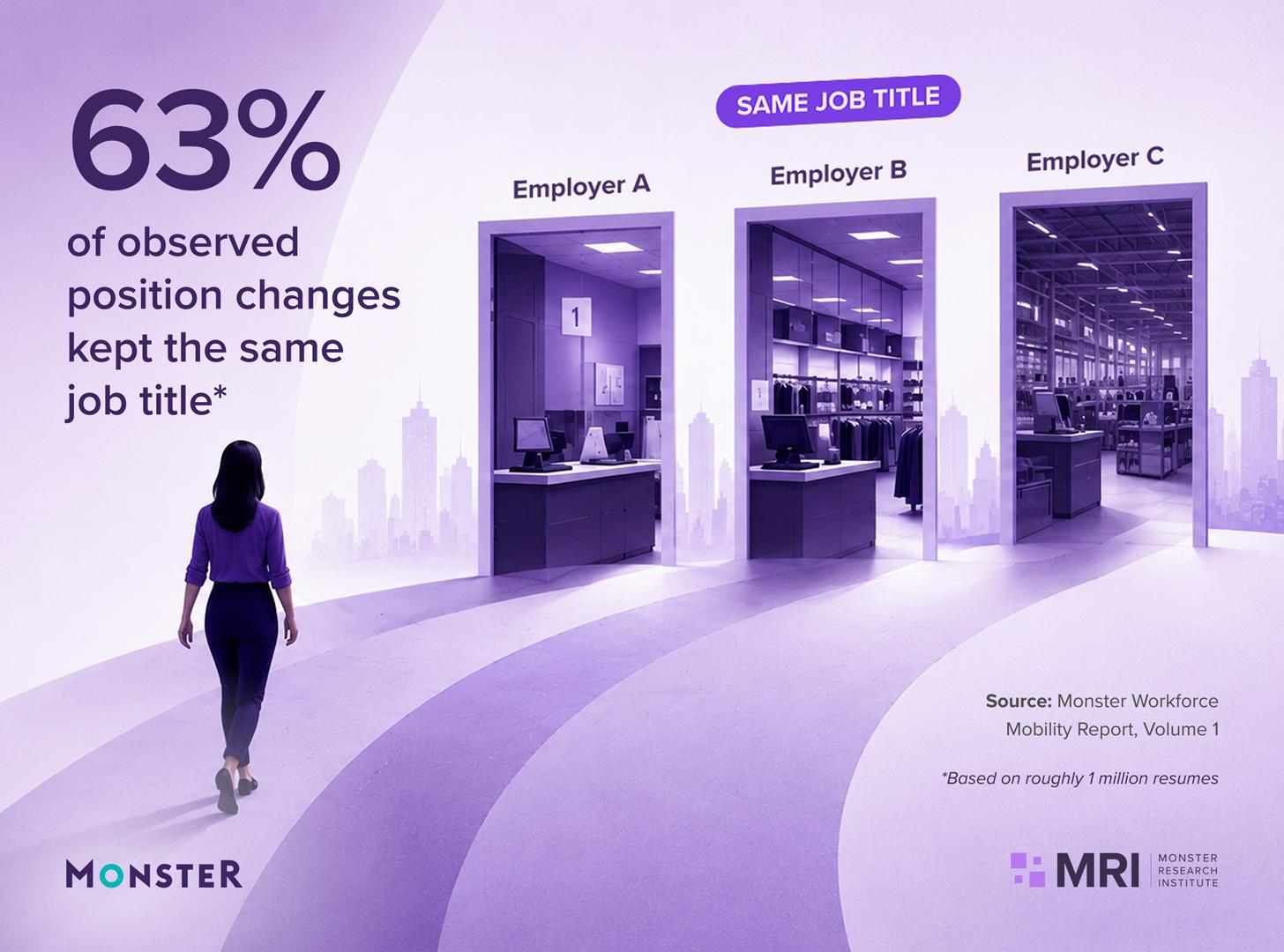
- Nearly two-thirds of position changes retained the same title. Of the 990,922 transitions analyzed, 620,413, or 63%, kept the exact same recorded title.
- Every title studied showed substantial continuity. More than half of transitions into each of the 20 roles came from the exact same title.
- Healthcare support roles led the ranking. Certified nursing assistant (CNA) had the highest exact-match rate at 72%, followed by medical assistant at 71%.
- Hospitality titles also ranked highly. Bartender placed third at 70%, followed by server at 67%.
- Customer-facing roles frequently retained their titles. Crew member and cashier each had same-title rates of 66%, while customer service representative had 63%.
- Even the lowest-ranked title stayed the same most of the time. Delivery driver retained the exact same title in 55% of observed transitions.
What Is a “Sticky” Job Title?
A sticky job title is one where a high percentage of people who move into the role previously held a position with the exact same recorded title.
For example, 72% of observed transitions into CNA positions came from another position recorded as “certified nursing assistant.” In other words, the employer changed, but the recorded job title stayed the same.
A sticky title doesn’t indicate how long someone stayed with an employer. It measures title continuity when people changed positions. It also doesn’t mean that two jobs with the same title were identical.
A cashier position at one employer may differ significantly from a cashier position somewhere else in pay, hours, workload, management, responsibilities, or advancement potential.
The 20 Stickiest Job Titles
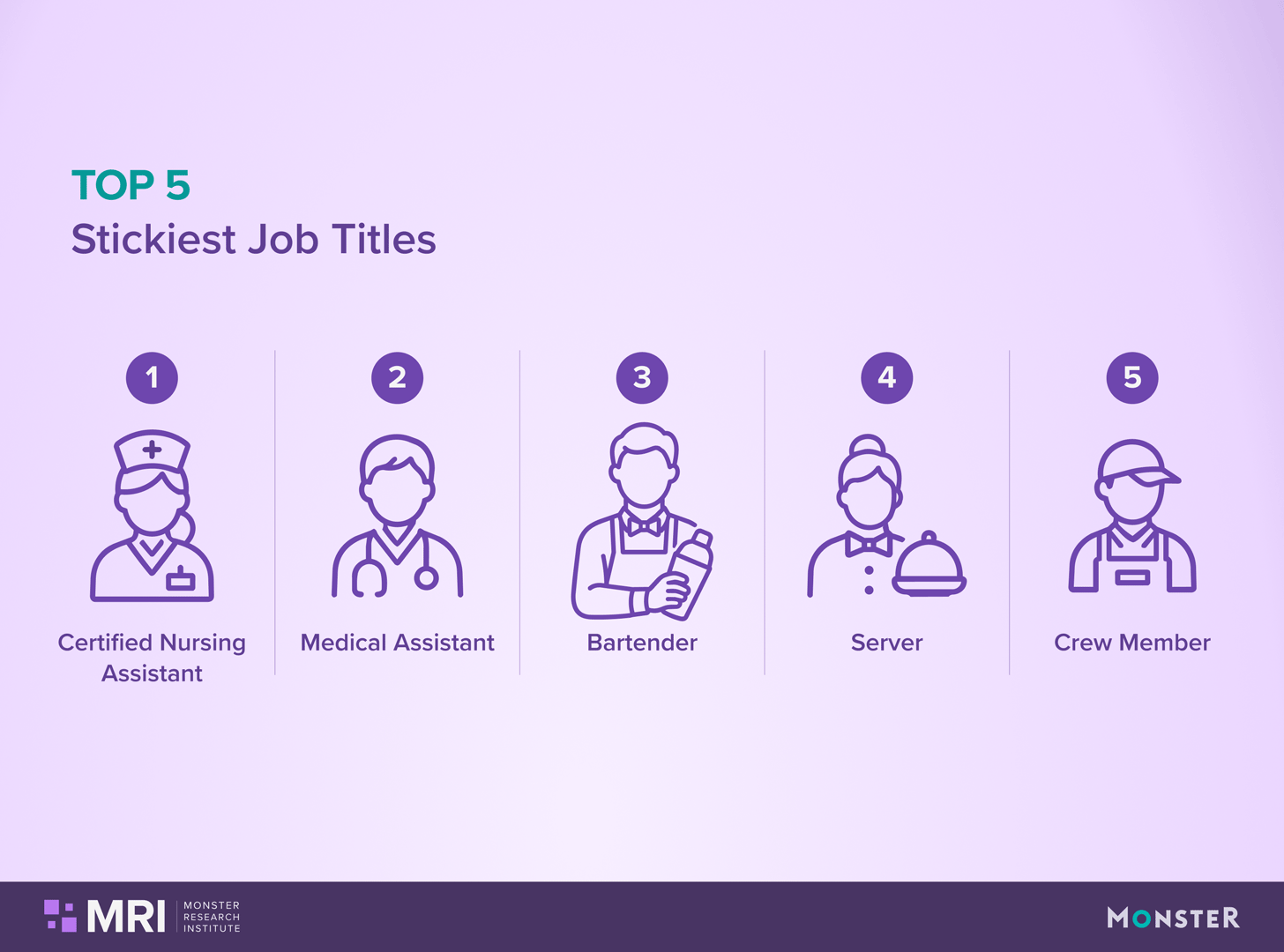
Certified nursing assistants, medical assistants, and bartenders are the three stickiest job titles, with the highest rates of same-title transitions.
Here’s the full ranking:
| Rank | Destination Job Title | Same-Title Transitions | Same-Title Rate |
| 1 | Certified Nursing Assistant | 30,167 | 72% |
| 2 | Medical Assistant | 21,575 | 71% |
| 3 | Bartender | 21,772 | 70% |
| 4 | Server | 48,952 | 67% |
| 5 | Crew Member | 38,682 | 66% |
| 6 | Cashier | 63,322 | 66% |
| 7 | Administration Assistant | 18,342 | 64% |
| 8 | Customer Service Representative | 40,821 | 63% |
| 9 | Security Officer | 18,986 | 63% |
| 10 | Barista | 16,738 | 63% |
| 11 | Manager | 53,970 | 62% |
| 12 | Team Member | 24,252 | 62% |
| 13 | Laborer | 16,865 | 62% |
| 14 | Sales | 50,312 | 61% |
| 15 | Receptionist | 22,281 | 60% |
| 16 | Cook | 18,783 | 60% |
| 17 | Warehouse Associate | 21,938 | 58% |
| 18 | Driver | 23,624 | 56% |
| 19 | Caregiver | 28,022 | 56% |
| 20 | Delivery Driver | 41,009 | 55% |
Note: Rankings are based on unrounded rates. Displayed percentages are rounded to the nearest whole number. Job titles are presented as recorded in the source data.
Healthcare & Hospitality Titles Were Especially Sticky
Healthcare and hospitality had some of the highest same-title rates in Monster’s analysis.
Healthcare
Certified nursing assistant and medical assistant ranked first and second, respectively. Of 42,126 transitions into CNA positions, 30,167 came from the exact same recorded title. For medical assistants, 21,575 of 30,245 transitions were same-title moves.
Both roles typically involve specialized training, credentials, or experience that workers can carry between employers, which may contribute to title stickiness.
Note: Monster’s analysis did not examine why these titles had high same-title rates, so this is a possible explanation rather than a finding of the report.
Hospitality
Hospitality roles also appeared throughout the ranking, with five titles retaining the same recorded title in at least 60% of transitions:
- Bartender: 70%
- Server: 67%
- Crew Member: 66%
- Barista: 63%
- Cook: 60%
These same-title moves can still involve meaningful differences between workplaces. For bartenders and servers, for example, changing employers may mean different customer volume, tips, hours, staffing, or management, even without a title change.
Why a Same-Title Move Can Still Be Progress
A new title is only one possible form of career growth. A same-title move can improve other aspects of a job, such as:
- Better compensation: A new employer may offer higher pay, commissions, tips, bonuses, or more reliable earnings.
- A better schedule: The position may provide predictable shifts, guaranteed hours, fewer nights or weekends, or more control over working time.
- Stronger benefits: Health insurance, paid time off, retirement contributions, tuition assistance, and other benefits may make a same-title job more valuable.
- Better working conditions: Staffing, workload, safety, equipment, management, and workplace culture can differ significantly between employers.
- Greater stability: A worker may find more dependable hours, steadier demand, or stronger long-term prospects.
- More opportunity to advance: The title may remain unchanged initially, but the new employer may offer better training, clearer promotion criteria, or more room to grow.
- A better location: A shorter or easier commute can materially improve someone’s workday, particularly when the job must be performed on-site.
Note: Monster’s analysis didn’t measure these factors, so they shouldn’t be interpreted as reasons the workers studied changed employers.
How to Evaluate a Same-Title Job Offer
When considering a job offer with the same title you already hold, look beyond the title to determine what the move could actually change.
Compare the pay, benefits, schedule, responsibilities, working conditions, and opportunities for growth by asking questions like:
- How does the total compensation compare?
- Are the hours guaranteed and predictable?
- When does benefits eligibility begin?
- What is the expected workload?
- Why is the position open?
- How is performance evaluated?
- How often are compensation reviews conducted?
- What training is available?
- How have others in the role advanced?
- How long do employees typically stay?
- Will the move improve the commute or schedule?
- What responsibilities or authority come with the position?
How to Show Growth When the Title Repeats
If you have the same job title at multiple companies on your resume, you can still show career growth by highlighting what changed from one role to the next.
Focus on:
- Results: Include measurable accomplishments related to sales, customer satisfaction, productivity, accuracy, efficiency, or training.
- Scope: Show changes in workload, transaction volume, customer type, team size, or level of responsibility.
- New capabilities: Identify systems, equipment, credentials, processes, or specialized tasks learned in each position.
- Leadership: Include training, mentoring, shift leadership, problem resolution, or opening and closing responsibilities.
- Increasing complexity: Explain when the same title involved more demanding customers, advanced work, or greater independence.
- Differences between roles: Avoid repeating the same duties for every employer. Highlight what was new, different, or more advanced in each position.
What the Stickiest Job Titles Reveal About Career Mobility
Every role in Monster’s analysis retained the same title in more than half of observed transitions, but career progress isn’t always visible through a title. Pay, benefits, schedules, working conditions, responsibilities, and advancement opportunities can all improve from one employer to the next.
When considering a new opportunity, ask: “Will this job improve my compensation, stability, working conditions, or future opportunities?” If so, a same-title move can still represent meaningful career progress.
Volume 2 of Monster’s Workforce Mobility Report will expand this picture by examining how workers move between different job titles.
For press inquiries, please contact Shanna Briggs at shanna.briggs@bold.com.
About the Monster Workforce Mobility Report
The Monster Workforce Mobility Report is a two-volume analysis of how workers move among employers and job titles. Volume 1 examines moves that retained the same recorded title, while Volume 2 will examine movement between different titles.
Methodology
Monster analyzed resume data covering 990,922 position changes recorded from January through July 2026 and ending in the 20 highest-volume destination job titles available in the dataset.
Resumes were tracked over time, producing “from” and “to” values for job title, employer, and location. A change in job title, employer, or both counted as a position change. Because a single resume or individual could contribute multiple transitions, the unit of analysis was position changes, not unique workers.
Same-title transitions required an exact match between the prior and destination job titles. Similar or equivalent occupations with differently recorded titles were counted as different.
The 990,922 position changes represent transitions ending in the 20 roles analyzed, not all position changes captured in the dataset. Because additional destination-title data were unavailable, the results should not be generalized to all job titles, position changes, or the broader U.S. workforce.
About Monster
Monster is a global leader in online job searching, resume building, and employment solutions. For over 30 years, the company has been a trusted authority for both job seekers and companies. Beyond the job search, Monster provides an intuitive Resume Builder and hundreds of resume templates to help candidates stand out against the competition, while offering employers a comprehensive resume database to source top talent. As a G2 category leader, Monster has been featured in Forbes, CNBC, CNN, and USA Today, sharing the career advice needed to bridge the gap between job seekers and hiring managers.

Vicki Salemi is a nationally recognized career expert who helps professionals navigate the hiring landscape and find the right fit on Monster. With over 15 years of experience in corporate recruiting and HR, she offers expert guidance on job search strategies, interview preparation, and career development to help candidates land their next role.
See More From Vicki SalemiExplore Related Career Advice


20 Companies That Pay 100% Health Insurance & Other Top Benefits

Updated:
Sep 10, 2026
|
14 min read


How Long of a Commute Is Too Long? 49% Have Turned Down a Job Due to the Commute
Updated:
Sep 8, 2026
|
11 min read

Job Hugging 2025, Volume 1: Comfort & Security Take Priority for 48% of Workers
Updated:
Sep 2, 2026
|
6 min read

Beauty Bias at Work Statistics: 88% Say Attractive People Have an Advantage
Updated:
Aug 31, 2026
|
8 min read


How to Put Transferable Skills on Your Resume: 120 Skills, Examples, & Tips
Updated:
Aug 27, 2026
|
16 min read
Manage Your Career Like an Expert
Take control of your professional journey with Monster’s expert resources. Explore advice, research, and tips to make informed decisions and advance your career with confidence.

Job Search
Discover strategies to get noticed, network effectively, and streamline your job search process.

Resumes
Get practical tips to create a resume or CV that stands out to employers and wins interviews.

Cover Letters
Learn how to craft a compelling cover letter that highlights your experience and fit for the role.

Career Paths
Explore career paths, industry trends, and growth opportunities to plan your next move.

Interviewing
Prepare for interviews with tips on answering common questions and following up effectively.

Career Development
Develop key skills and knowledge to grow in your current role or pivot to new opportunities.

Leaving a Job
Navigate job changes and career transitions with practical advice and planning resources.