
The Most Regretted College Majors (& the Least Regretted)

Regretting your major? You aren’t the only one, and you have options to make it work or make a switch.
Updated:
|

27 min read

Table of Contents


What You’ll Learn
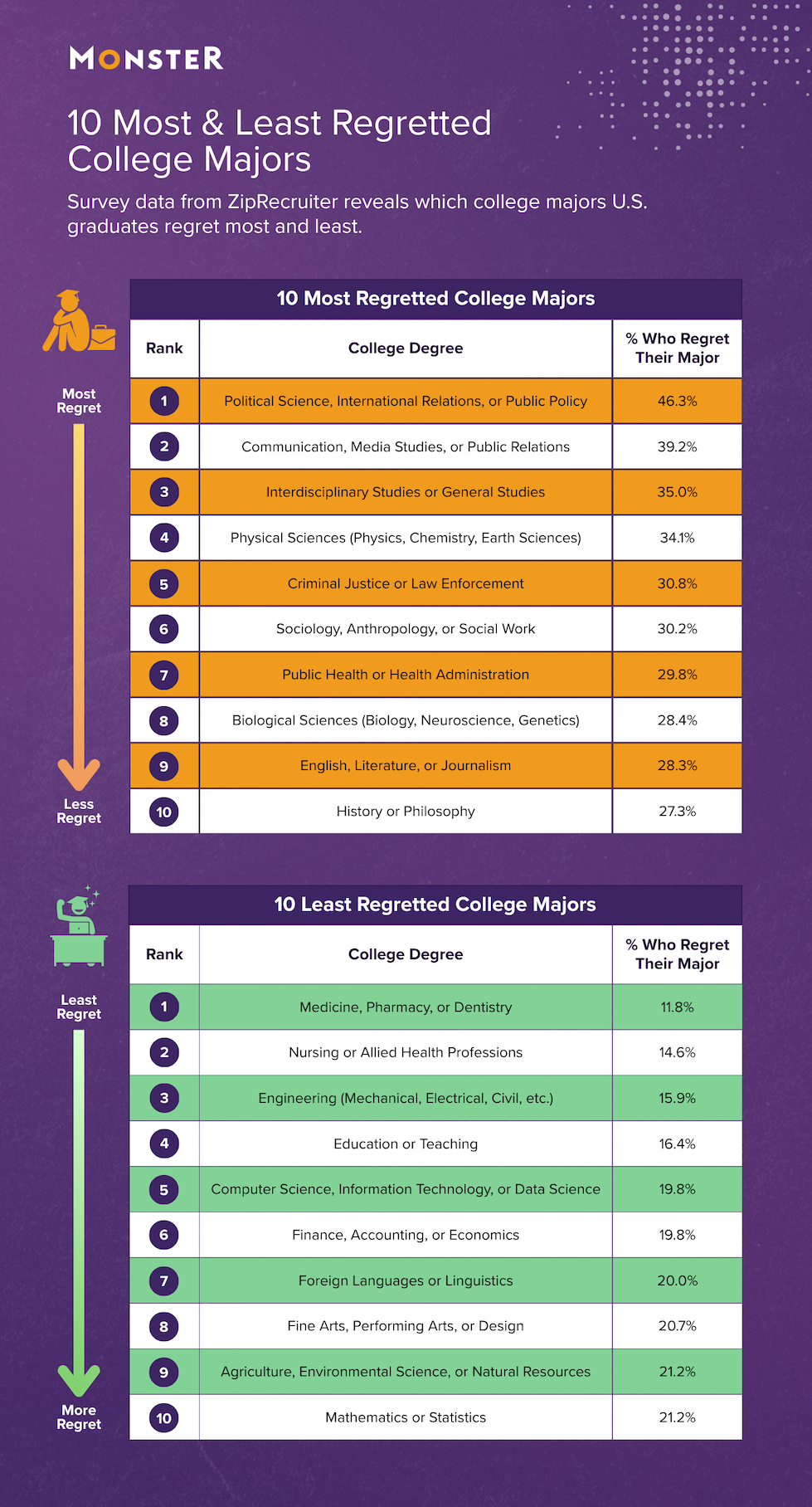
- “Political science, international relations, or public policy” is the most regretted major category, with 46.3% of graduates reporting regret, while “medicine, pharmacy, or dentistry” is the least regretted, at 11.8%.
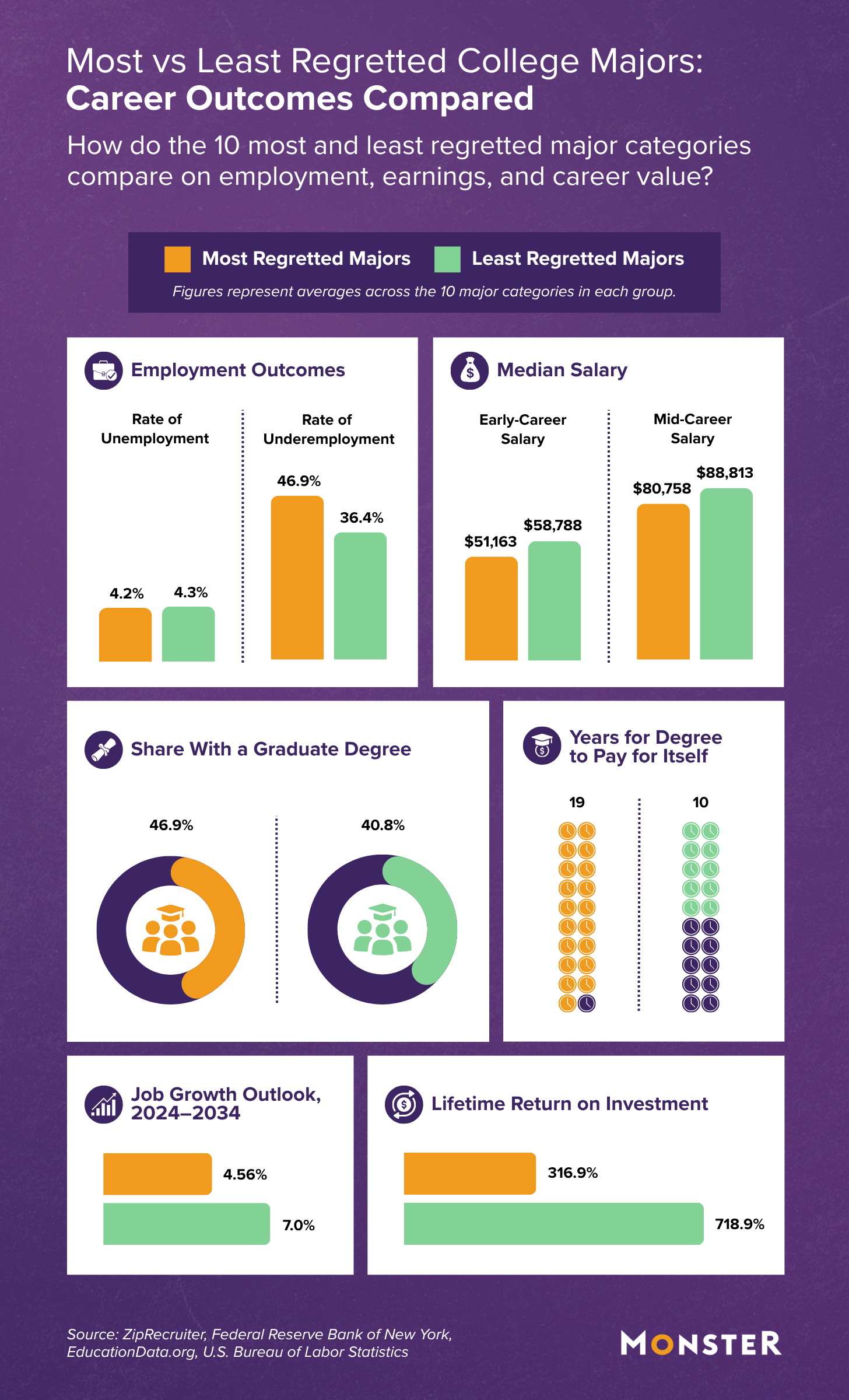
- The 10 most regretted majors have higher average underemployment, lower early- and mid-career salaries, and a lifetime ROI less than half that of the 10 least regretted majors.
- College major regret can be influenced by factors such as career prospects, earning potential, debt, unclear career paths, and the time it takes for a degree to pay for itself.
- Your major doesn’t necessarily determine your career, and transferable skills, targeted training, relevant experience, and strategic resume positioning can help you pivot.
- Students choosing a major can reduce the risk of future regret by comparing career options, realistic salaries, job demand, education costs, and marketable skills before making their decision.
Choosing a college major is one of the most expensive decisions many people make, but the degree you choose doesn’t always lead to the career or outcomes you expected. According to ZipRecruiter’s 2026 Graduate Survey, 20.5% of recent college graduates regret their major—meaning roughly 1 in 5 recent graduates would choose a different field of study if given the opportunity.
This guide ranks the most and least regretted college majors and explains why some are regretted more than others, using data on employment, earnings, return on investment (ROI), education, and job outlook to provide additional context. It also provides expert insights into how to choose a major more strategically or pivot toward a degree with stronger career potential.
How We Analyzed the Lists Below
To add context to ZipRecruiter’s degree-regret data, we used career, earnings, and labor market data from the Federal Reserve Bank of New York, the Education Data Initiative, and the U.S. Bureau of Labor Statistics (BLS).
- Employment and earnings: We used New York Fed data for unemployment, underemployment, and median wages, averaging corresponding majors when ZipRecruiter grouped multiple fields.
- ROI and payback period: We used Education Data estimates for lifetime ROI and the time it takes for a degree to pay for itself, averaging across corresponding majors when ZipRecruiter grouped multiple fields.
- Job outlook: We matched each degree category to a common occupation and used BLS data to report median pay and projected employment growth.
Note: Unemployment rates reflect graduates who are unemployed and actively seeking work. Underemployment rates reflect employed graduates working in jobs that typically don’t require a college degree.
Most & Least Regretted College Majors at a Glance
“Political science, international relations, or public policy” has the highest regret rate among the college major categories in ZipRecruiter’s report, while “medicine, pharmacy, or dentistry” has the lowest.
“Communication, media studies, or public relations” and “interdisciplinary or general studies” round out the three most regretted categories, while “nursing or allied health professions” and “engineering” join the three least regretted.
The tables below highlight the 10 major categories with the highest regret rates and the 10 with the lowest regret rates from ZipRecruiter’s full ranking of 25 categories.
Top 10 Most Regretted Majors: Salary & Career Trends
The 10 most regretted college majors in 2026 include “political science, international relations, or public policy,” “communication, media studies, or public relations,” and “interdisciplinary or general studies.”
Starting with the highest regret rate, here’s a closer look at each major and relevant career and job growth data:
- 1.
Political Science, International Relations, or Public Policy (46.3% Regret)
Political science focuses on government and political systems, international relations on global affairs, and public policy on the development and evaluation of policies. Graduates may pursue careers as policy analysts, political scientists, researchers, advocates, diplomats, or consultants, and some specialized career paths require graduate education.
Unemployment Rate 4.3% Underemployment Rate 46.5% Median Salary (Early Career) $57,000 Median Salary (Mid-Career) $90,000 Share With a Graduate Degree 48.7% Lifetime ROI 587.5% Years for Degree to Pay for Itself 12 Job Outlook Between 2024–2034 ↓3% (Political scientists) - 2.
Communication, Media Studies, or Public Relations (39.2% Regret)
Communication, media studies, and public relations examine how information is created, shared, and received across different audiences and platforms. Graduates may pursue careers as public relations specialists, communications specialists, media professionals, marketing specialists, writers, or content specialists, offering broad options rather than one defined occupational path.
Unemployment Rate 4.9% Underemployment Rate 47.7% Median Salary (Early Career) $54,000 Median Salary (Mid-Career) $86,667 Share With a Graduate Degree 22.3% Lifetime ROI 435.8% Years for Degree to Pay for Itself 14 Job Outlook Between 2024–2034 ↑5% (Public relations specialists) - 3.
Interdisciplinary Studies or General Studies (35.0% Regret)
Interdisciplinary and general studies programs allow students to study across multiple academic disciplines rather than specialize in one field. Graduates may pursue careers as business professionals, communications specialists, nonprofit program coordinators, government specialists, or other professionals, although the breadth of these degrees may provide less direct preparation for a specific occupation.
Unemployment Rate 3.9% Underemployment Rate 45.2% Median Salary (Early Career) $52,000 Median Salary (Mid-Career) $80,000 Share With a Graduate Degree 40.4% Lifetime ROI 322.3% Years for Degree to Pay for Itself 18 Job Outlook Between 2024–2034 N/A - 4.
Physical Sciences (Physics, Chemistry, Earth Sciences) (34.1% Regret)
Physical science degrees examine the nonliving natural world from different perspectives, with physics focusing on matter and energy, chemistry on substances and their interactions, and earth sciences on the planet and its systems. Graduates may become physicists, chemists, geoscientists, laboratory scientists, researchers, or educators, with advanced education often required for research-focused careers.
Unemployment Rate 4.3% Underemployment Rate 31.5% Median Salary (Early Career) $56,750 Median Salary (Mid-Career) $86,750 Share With a Graduate Degree 58.6% Lifetime ROI 474.6% Years for Degree to Pay for Itself 13 Job Outlook Between 2024–2034 ↑5% (Chemists) - 5.
Criminal Justice or Law Enforcement (30.8% Regret)
Criminal justice programs examine crime, courts, corrections, and the justice system, while law enforcement programs may focus more specifically on policing and public safety. Graduates may pursue careers as police officers, detectives, corrections officers, investigators, probation officers, or other public safety professionals.
Unemployment Rate 3.6% Underemployment Rate 65.8% Median Salary (Early Career) $50,000 Median Salary (Mid-Career) $80,000 Share With a Graduate Degree 24.6% Lifetime ROI 174.5% Years for Degree to Pay for Itself 23 Job Outlook Between 2024–2034 ↑3% (Detectives) - 6.
Sociology, Anthropology, or Social Work (30.2% Regret)
Sociology examines societies and social behavior, anthropology studies humans and cultures, and social work prepares students to support individuals, families, and communities. Graduates may pursue careers as social workers, community service specialists, researchers, nonprofit program coordinators, human services specialists, or policy analysts, with some occupations requiring graduate education or professional licensure.
Unemployment Rate 4.8% Underemployment Rate 45.8% Median Salary (Early Career) $45,967 Median Salary (Mid-Career) $68,000 Share With a Graduate Degree 47.0% Lifetime ROI 49.6% Years for Degree to Pay for Itself 34 Job Outlook Between 2024–2034 ↑6% (Social workers) - 7.
Public Health or Health Administration (29.8% Regret)
Public health focuses on improving health at the community and population levels, while health administration centers on managing healthcare organizations, programs, and services. Graduates may work as public health specialists, health educators, healthcare operations specialists, policy analysts, healthcare administrators, or healthcare managers, with qualifications varying by career path.
Unemployment Rate 3.8% Underemployment Rate 45.1% Median Salary (Early Career) $50,000 Median Salary (Mid-Career) $67,000 Share With a Graduate Degree 52.9% Lifetime ROI 425.5% Years for Degree to Pay for Itself 15 Job Outlook Between 2024–2034 ↑23% (Medical and health services managers) - 8.
Biological Sciences (Biology, Neuroscience, Genetics) (28.4% Regret)
Biological sciences examine living organisms and biological processes, with biology covering the field broadly and neuroscience and genetics focusing on the nervous system and heredity, respectively. Graduates may pursue careers as laboratory scientists, biotechnologists, healthcare professionals, environmental scientists, or educators, while many clinical and research careers require education beyond a bachelor’s degree.
Unemployment Rate 3.8% Underemployment Rate 46.7% Median Salary (Early Career) $47,667 Median Salary (Mid-Career) $87,667 Share With a Graduate Degree 65.1% Lifetime ROI 324.2% Years for Degree to Pay for Itself 18 Job Outlook Between 2024–2034 ↑4% (Microbiologists) - 9.
English, Literature, or Journalism (28.3% Regret)
English and literature programs emphasize written communication, critical analysis, and the study of texts, while journalism focuses on researching, reporting, and communicating news and information. Graduates may pursue careers as writers, editors, journalists, communications specialists, publishing professionals, marketing specialists, educators, or content developers.
Unemployment Rate 4.2% Underemployment Rate 45.9% Median Salary (Early Career) $48,500 Median Salary (Mid-Career) $81,500 Share With a Graduate Degree 55.4% Lifetime ROI 134.9% Years for Degree to Pay for Itself 21 Job Outlook Between 2024–2034 ↓4% (Journalists) - 10.
History or Philosophy (27.3% Regret)
History focuses on past societies, events, and change over time, while philosophy examines knowledge, ethics, reasoning, and human thought. Graduates may pursue careers as educators, lawyers, government specialists, researchers, communications specialists, museum professionals, or related roles, although some directly related occupations require graduate education.
Unemployment Rate 4.7% Underemployment Rate 48.6% Median Salary (Early Career) $49,750 Median Salary (Mid-Career) $80,000 Share With a Graduate Degree 54.2% Lifetime ROI 240.6% Years for Degree to Pay for Itself 19 Job Outlook Between 2024–2034 ↑2% (Historians)
Top 10 Least Regretted Majors: Salary & Career Trends
“Medicine, pharmacy, or dentistry” has the lowest regret rate of all 25 degree categories, followed by “nursing or allied health professions,” and “engineering.”
Below are the 10 majors with the lowest regret rates, starting with the least regretted, along with career and labor market data for added context.
- 1.
Medicine, Pharmacy, or Dentistry (11.8% Regret)
Medicine, pharmacy, and dentistry prepare students for distinct healthcare careers, including physicians, pharmacists, dentists, and related clinical roles. These fields generally provide clear career paths, although many require extensive education, professional degrees, licensing, or other credentials beyond a bachelor’s degree.
Unemployment Rate 5.6% Underemployment Rate 30.5% Median Salary (Early Career) $40,000 Median Salary (Mid-Career) $85,000 Share With a Graduate Degree 67.4% Lifetime ROI 570.8% Years for Degree to Pay for Itself 11 Job Outlook Between 2024–2034 ↑5% (Pharmacists) - 2.
Nursing or Allied Health Professions (14.6% Regret)
Nursing prepares students for roles in patient care, such as registered nurses, while allied health encompasses specialized healthcare occupations, including diagnostic, therapeutic, and technical professionals. These degrees often provide direct pathways into nursing and other healthcare support careers with clearly defined professional qualifications.
Unemployment Rate 4.2% Underemployment Rate 29.9% Median Salary (Early Career) $66,000 Median Salary (Mid-Career) $83,500 Share With a Graduate Degree 27.5% Lifetime ROI 732.3% Years for Degree to Pay for Itself 9 Job Outlook Between 2024–2034 ↑5% (Registered nurses) - 3.
Engineering (Mechanical, Electrical, Civil, etc.) (15.9% Regret)
Engineering applies mathematics, science, and technical principles to design and improve systems, structures, products, and processes. Mechanical, electrical, civil, and other engineering disciplines lead to specialized career paths, and this degree category has one of the shortest payback periods among the least regretted majors.
Unemployment Rate 3.9% Underemployment Rate 23.88% Median Salary (Early Career) $79,500 Median Salary (Mid-Career) $116,800 Share With a Graduate Degree 40.9% Lifetime ROI 1,091.7% Years for Degree to Pay for Itself 7 Job Outlook Between 2024–2034 ↑9% (Mechanical engineers) - 4.
Education or Teaching (16.4% Regret)
Education and teaching programs prepare students to work as teachers, instructional coordinators, and other education professionals in schools and learning environments. The field offers a relatively defined career path, but licensing and certification requirements vary by state and teaching role.
Unemployment Rate 2.4% Underemployment Rate 21.5% Median Salary (Early Career) $45,717 Median Salary (Mid-Career) $56,833 Share With a Graduate Degree 53.3% Lifetime ROI -51.6% Years for Degree to Pay for Itself Doesn’t pay for itself within 40 years Job Outlook Between 2024–2034 ↓2% (Elementary school teachers) - 5.
Computer Science, Information Technology, or Data Science (19.8% Regret)
Computer science focuses on computing and software, information technology on implementing and managing technology systems, and data science on extracting insights from data. Graduates may become software developers, IT specialists, data analysts, data scientists, systems analysts, or other technology professionals, offering a range of specialized career paths across industries.
Unemployment Rate 5.5% Underemployment Rate 31.2% Median Salary (Early Career) $69,333 Median Salary (Mid-Career) $105,333 Share With a Graduate Degree 26.7% Lifetime ROI 1,391.2% Years for Degree to Pay for Itself 5 Job Outlook Between 2024–2034 ↑34% (Data scientists) - 6.
Finance, Accounting, or Economics (19.8% Regret)
Finance focuses on managing money and investments, accounting on recording and analyzing financial information, and economics on how individuals, businesses, and economies allocate resources. Graduates may pursue careers as financial analysts, accountants, auditors, economists, advisors, or other business and finance professionals.
Unemployment Rate 3.0% Underemployment Rate 27.4% Median Salary (Early Career) $70,000 Median Salary (Mid-Career) $108,000 Share With a Graduate Degree 35.6% Lifetime ROI 1,365.6% Years for Degree to Pay for Itself 5 Job Outlook Between 2024–2034 ↑5% (Accountants) - 7.
Foreign Languages or Linguistics (20.0% Regret)
Foreign language programs develop proficiency in one or more languages alongside knowledge of their cultures and literature, while linguistics examines the structure, development, and use of language itself. Graduates may pursue careers as translators, interpreters, teachers, communications specialists, international business professionals, government specialists, or other professionals who use language expertise.
Unemployment Rate 1.6% Underemployment Rate 54.0% Median Salary (Early Career) $48,000 Median Salary (Mid-Career) $77,000 Share With a Graduate Degree 53.1% Lifetime ROI 82.8% Years for Degree to Pay for Itself 27 Job Outlook Between 2024–2034 ↑2% (Translators) - 8.
Fine Arts, Performing Arts, or Design (20.7% Regret)
Fine arts, performing arts, and design develop different forms of creative and technical expertise across visual art, performance, and design. Graduates may pursue careers as artists, performers, designers, art directors, or other creative professionals, with opportunities spanning employment, freelance work, and self-employment.
Unemployment Rate 6.8% Underemployment Rate 53.3% Median Salary (Early Career) $46,333 Median Salary (Mid-Career) $75,667 Share With a Graduate Degree 24.6% Lifetime ROI 295.2% Years for Degree to Pay for Itself 16 Job Outlook Between 2024–2034 0% (Fine artists) - 9.
Agriculture, Environmental Science, or Natural Resources (21.2% Regret)
Agriculture focuses on food production and agricultural systems, environmental science examines the natural environment and human impacts on it, and natural resources programs focus on managing land, water, wildlife, and other resources. Graduates may pursue careers as agricultural scientists, conservation scientists, environmental consultants, natural resource managers, or other scientific and technical roles.
Unemployment Rate 3.9% Underemployment Rate 53.8% Median Salary (Early Career) $53,000 Median Salary (Mid-Career) $80,000 Share With a Graduate Degree 27.2% Lifetime ROI 343.2% Years for Degree to Pay for Itself 14 Job Outlook Between 2024–2034 ↑5% (Agricultural and food science technicians) - 10.
Mathematics or Statistics (21.2% Regret)
Mathematics focuses on quantitative reasoning, mathematical theory, and problem-solving, while statistics centers on collecting, analyzing, and interpreting data. Graduates may pursue careers as mathematicians, statisticians, actuaries, data analysts, or other quantitative professionals across business, technology, government, research, and finance.
Unemployment Rate 5.8% Underemployment Rate 26.2% Median Salary (Early Career) $70,000 Median Salary (Mid-Career) $100,000 Share With a Graduate Degree 51.3% Lifetime ROI 1,367.7% Years for Degree to Pay for Itself 5.5 Job Outlook Between 2024–2034 ↑8% (Mathematicians)
Reflecting on the 10 Most & 10 Least Regretted College Majors
The least regretted college majors tend to have stronger career outcomes than the most regretted majors.
Although average unemployment rates are nearly identical, the least regretted majors have lower underemployment, higher early- and mid-career salaries, greater lifetime ROI, shorter payback periods, and stronger projected job growth.
The data reveals several notable differences between the most and least regretted majors:

Unemployment is nearly identical. The 10 most regretted majors have an average unemployment rate of 4.2%, compared with 4.3% for the 10 least regretted majors. This suggests unemployment alone does little to explain major regret.

Underemployment shows a much wider gap. The most regretted degrees have an average underemployment rate 10.5 percentage points higher, meaning graduates are more likely to work in jobs that don’t typically require a college degree.

Higher earnings may contribute to lower regret, but salary isn’t the whole story. The least regretted majors earn about $7,600 more early in their careers and $8,100 more by mid-career, on average. Lower-paying fields such as education, however, also rank among the least regretted, suggesting that a high salary alone doesn’t determine whether graduates are satisfied with their choice of major.

ROI shows the sharpest divide. The 10 least regretted majors have an average lifetime ROI of 718.9%, compared with 316.9% for the 10 most regretted majors. In other words, the average lifetime ROI for the least regretted majors is more than twice as high. They also take an average of 10 years to pay for themselves, compared with 19 years for the most regretted majors.

Job growth is stronger among the least regretted majors. Associated occupations have an average projected growth of 7% between 2024 and 2034, compared with 4.56% for the most regretted college degrees.

More education doesn’t necessarily correspond with less regret. The most regretted majors have a higher average share of graduates with advanced degrees, at 46.9% vs 40.8%. Combined with lower earnings, higher underemployment, and longer payback periods, this may suggest that additional education doesn’t always translate into the career or financial outcomes graduates expected.

Clearer, more hands-on career paths may contribute to lower regret. Several least regretted majors, including nursing, engineering, and education, prepare graduates for specific, applied careers. Broader majors offer more flexibility but may provide a less direct path from degree to job.
These patterns can’t definitively prove the cause of college major regret, but they suggest salary isn’t the only factor. Underemployment, education costs, job opportunities, and career paths may also play a role.
What Leads to College Major Regret (or Lack Thereof)?
College major regret often stems from a mismatch between what graduates expected from their degree and what they experience in the workforce. Salary, job opportunities, career options, and the cost of earning the degree can all shape whether someone feels their major was worthwhile.
Some common factors that can contribute to college major regret include:
- Limited job opportunities: Graduates may struggle to find work in their field when there are more qualified candidates than available jobs or when demand for workers declines.
- Lower-than-expected salaries: Graduates who earn less than they expected may question their choice of major, especially if earning the degree required a significant financial investment.
- High student debt compared to earnings: Graduates with high student loan payments and relatively low salaries may feel their degree hasn’t provided enough financial return to justify its cost.
- An unclear career path: Some majors build broad, transferable skills rather than preparing students for a specific career. While that flexibility can be valuable, graduates may have more difficulty identifying suitable jobs and determining how their degree applies to different career paths.
The same factors can help explain why graduates don’t regret their majors. A degree that leads to strong job prospects, competitive earnings, manageable debt, or a clear career path is more likely to feel like a worthwhile investment.
Does Your Major Determine Your Career?
Your college major can, and often does, influence your career options, but it doesn’t determine the work you can do. Many degrees build skills that apply across occupations and industries, giving graduates room to pursue careers beyond their field of study.
“In many instances, a bachelor’s degree holds more weight for an employer than the specific major,” shared Toni Frana, a career expert at Monster. Of course, “this is different for more technical or specialized fields where specific skills or certifications are required.”
Outside of these fields, employers may place greater emphasis on your transferable skills, relevant experience, and ability to demonstrate that you can perform the job.
That means regretting your major doesn’t mean you need to start over. Your education can provide a foundation for moving into an adjacent field or pursuing an entirely different career.
How to Choose a Major You Won’t Regret
There’s no way to guarantee you’ll never regret your college major, but you can make a more informed choice by considering career outcomes alongside your interests. Before committing to a field of study, research what the degree can realistically lead to and whether those outcomes align with your goals.
Consider the following:
- 1.
Research career options. Look beyond the most obvious job associated with a major. Identify several occupations graduates pursue, the qualifications they require, and how much flexibility the degree provides when choosing a career or finding a new path.
- 2.
Check employment prospects. Review unemployment and underemployment data for the major, along with projected job growth for careers you’re considering. Strong demand can mean more opportunities to put your degree to use after graduation.
- 3.
Set realistic salary expectations. Compare typical early- and mid-career earnings with the income you expect or need. Don’t base your decision solely on the highest salaries possible in a field.
- 4.
Consider cost and potential return. Estimate how much you’ll need to borrow and compare that with realistic earnings after graduation. A degree with solid earning potential can still create financial strain if you take on more debt than your expected income can comfortably support.
- 5.
Look for marketable skills. Consider what concrete skills you’ll graduate with and where employers need them. Technical, analytical, communication, research, and other transferable skills can give you options across occupations and industries.
- 6.
Balance passion with practicality. Choose a major you’ll enjoy studying, but also consider where it can lead after graduation. Look for a field that aligns with your interests and offers career paths that fit your goals.
What to Do If You Regret Your Major
Before deciding what to do about college major regret, pinpoint what you actually regret about your choice. Is it the subject itself, your career options, earning potential, or something else?
From there, you can decide whether changing majors, building on your existing degree, or gaining additional skills and experience offers the most practical path forward.
“Pivoting to a new career path is absolutely possible.”
—Toni Frana, Career Expert
Frana offers some reassurance for graduates considering a change:
“While it can be unsettling to realize the career path related to the degree you’ve earned is not for you, pivoting to something else is absolutely possible. There are a few things you can do to help you change course and move in the right direction for your goals.”
The following steps can help you evaluate your options and choose a path forward, whether you’re still in college or already have your degree.
- Step 1:
Evaluate Why You Regret Your Major
Start by identifying exactly what’s making you question your major. Common reasons include limited career prospects, lower-than-expected earning potential, changing interests, dissatisfaction with coursework, financial concerns, or discovering that the careers associated with the degree don’t match what you expected.
As you evaluate what’s not working, give equal attention to what you want instead. “Spending some time figuring out what you do want to do is critical,” Frana said. “What do you want to move toward in your career? Since the career path you have doesn’t feel right to you, what type of work do you think would fit better?”
Think about the specifics of your ideal work, too. Frana recommends considering factors such as how much interaction you want with others and whether you prefer working as an individual contributor or seeking a clear path to leadership.
- Step 2:
Decide How Much of a Change You Need
Next, consider how far your current path is from the one you want. The answer will depend on your career goals, how far you’ve progressed in your education, and the qualifications required for your target career.
Your options might include:
- Switching majors if you’re still in school and can change direction without adding significant time or cost to your education.
- Finishing your current degree if you’re close to graduating and your target career doesn’t require a specific major.
- Pivoting with the degree you already have if your skills and experience can transfer to another occupation or industry.
- Pursuing additional education or training if your target career has qualifications you don’t currently meet.
Before making a decision, research actual job requirements. Don’t assume that entering a different field automatically requires earning another bachelor’s degree.
And if changing direction means leaving a degree unfinished, weigh that decision carefully, but don’t treat it as a failure. An unfinished degree isn’t ideal for every career path, but it doesn’t prevent you from building a successful career through other education, skills, and experience.
- Step 3:
Look for Ways to Expand Your Qualifications
Before pursuing additional education, take stock of the qualifications you already have.
“Figure out what your top skills are so you can determine which are transferable to potential new roles,” Frana advised. When reflecting on your career, think about “what parts energize you, and what type of work you’re doing when you feel energized. Other ways to determine your skills include taking online skills assessments. Your university career center may also have many free resources available for alumni.”
Next, compare your skills and credentials with the requirements that appear consistently in job postings for your target career. This can help you pinpoint what you’re missing and choose the most efficient way to close those gaps.
Depending on the qualifications you need, consider:
- Adding to your current degree: If you’re still in college, a minor, certificate, or relevant electives can help you build skills in another field without changing your major.
- Completing targeted training: Individual courses, certificate programs, or technical training can help fill specific skill or credential gaps without requiring another degree.
- Pursuing an advanced degree: Graduate school may make sense if your target career requires one or specialized credentials.
Before enrolling, consider the time, cost, and career benefits to ensure that additional education is necessary for the path you want to pursue.
- Step 4:
Gain Experience in the Field You Want to Enter
Education can establish knowledge, but relevant experience gives you evidence that you can apply it. Look for ways to begin building experience in your target field even before you’re ready to make a full career change.
Depending on the career, that could include:
- Internships
- Volunteering
- Part-time jobs
- Freelance work
- Independent projects
- New responsibilities in your current role
For fields where employers expect portfolios or work samples, projects can be particularly useful for demonstrating skills you haven’t yet used professionally.
Prioritize opportunities that give you concrete results to discuss on your resume and in interviews. Relevant experience can strengthen your candidacy while also giving you a realistic preview of the career before you commit to it.
- Step 5:
Talk to Professionals in the Careers You’re Considering
Job descriptions can tell you what employers request, but professionals already working in the field can help you understand what a career is actually like and what it takes to enter it.
“As you begin to clarify and narrow down your new path, finding people who are doing the work you want to do and talking with them can be so helpful,” said Frana, who recommends informational interviews to ask about “what it’s like to be in the industry, and the challenges and opportunities for people who want to get started.”
Use your network, alumni or professional associations, LinkedIn, industry events, or personal connections to find people whose careers interest you. Ask about typical entry points, day-to-day responsibilities, career progression, and required vs preferred qualifications.
These conversations can also help you make more informed decisions about your next steps. As Frana explained, they can help you determine “whether you’ll need additional education or certifications to be a competitive candidate for the new role.”
- Step 6:
Position Your Degree & Skills Strategically
When your major doesn’t directly align with the job you want, your resume needs to make the connection for the employer. Start with the job description, identify the qualifications the employer prioritizes, and emphasize the parts of your background that demonstrate them.
“Ultimately, employers want to know how a candidate would perform in a role and deliver the results needed to meet company goals and objectives.” Frana recommends establishing that connection in the resume profile and carrying it through the work experience section.
Your resume might emphasize:
- Transferable skills that apply directly to the target role
- Relevant coursework that demonstrates knowledge related to your target field
- Career certifications, courses, or technical training that strengthen your qualifications
- Projects that demonstrate applicable knowledge or abilities
- Internships, freelance gigs, volunteer work, or other relevant experience
- Accomplishments from previous roles that demonstrate transferable results
How you describe that experience matters, too. “Highlighting the right skills and presenting the information as results and accomplishments instead of tasks allows employers to get a sense of what you can deliver,” Frana explained.
You can also adjust the emphasis of your education section without misrepresenting what you studied. For example, Frana suggests bolding the degree on your resume while leaving your major in regular font to draw more attention to the credential itself.
Here’s what that could look like for someone with a psychology degree applying for a marketing role:
EducationBachelor of Arts in Psychology
Boston University, Boston, MA | May 2026- Relevant Coursework: Consumer Behavior, Statistics, Research Methods
- Relevant Project: Consumer Behavior Research Study | Research Project | April 2026
- Designed and distributed a survey examining factors that influence consumer purchasing decisions.
- Analyzed response data and presented findings on consumer motivations and behavior.
- Identified three primary factors influencing purchase intent and translated findings into marketing recommendations.
A combination (hybrid) resume or a skills-forward, functional resume format can also bring relevant qualifications to the forefront when they aren’t obvious from your chronological work history.
Most importantly, don’t treat an unrelated major as something you need to hide. As Frana noted, “A candidate with the right skill set and accomplishments, as well as a degree, even if it isn’t directly related to the position, is a well-rounded candidate employers will consider.”
Let Go of Professional Regrets
Your career isn’t dictated by a decision you made about a college major at 18 or 20. If that choice no longer fits who you are or where you want to go, you have the power to change direction.
For students still choosing a major, the best protection against future regret is making an informed decision. Compare career paths, realistic salaries, job demand, education costs, and employer requirements. If you’ve already graduated, assess where you are, decide where you want to go, and identify the gaps you need to close.
Frequently Asked Questions
What percentage of graduates regret their major?
According to ZipRecruiter, 20.5% of recent college graduates regret their major, down from 21.5% the previous year. That means roughly 1 in 5 recent graduates would choose a different field of study if given the opportunity.
Which majors have the best job prospects?
Majors with strong job prospects tend to prepare graduates for fields with growing employer demand, lower underemployment, and clear career paths. In the data analyzed above, the 10 least-regretted majors were associated with an average projected job growth of 7%, compared with 4.56% for the 10 most regretted majors.
Can you still get a good job with a regretted major?
Yes, you can get a good job even if you regret your major. Many careers don’t require a specific field of study, and employers may prioritize relevant skills, experience, and accomplishments. Identify your transferable skills, research the qualifications for your target roles, and gain any additional experience, training, or credentials needed to close the gap.

Kirsten Chorpenning is a career advice writer who empowers job seekers to take control of their career paths using Monster’s comprehensive job search and resume tools. She specializes in helping job seekers find rewarding jobs in today’s dynamic work environment.
See More From Kirsten ChorpenningExplore Related Career Advice

Job Hugging Statistics: Nearly 9 in 10 Workers Have “Hugged” a Job

Updated:
Oct 13, 2026
|
9 min read

Nearly 3 in 10 LinkedIn Users Have Updated a Past Job After Leaving It
Updated:
Oct 7, 2026
|
7 min read

Employee Loyalty Statistics: 90% Say Companies Expect More Than They Give
Updated:
Oct 5, 2026
|
7 min read


Overqualified Hiring Stats: 57% Would Cut Resume Experience to Get Hired
Updated:
Sep 28, 2026
|
9 min read

20 First Job Interview Questions & Sample Answers: Tips to Land Your First Job
Updated:
Sep 24, 2026
|
20 min read

“Do You Have Any Questions for Me?” How to Answer in an Interview (30 Examples)
Updated:
Sep 18, 2026
|
14 min read


Manage Your Career Like an Expert
Take control of your professional journey with Monster’s expert resources. Explore advice, research, and tips to make informed decisions and advance your career with confidence.

Job Search
Discover strategies to get noticed, network effectively, and streamline your job search process.

Resumes
Get practical tips to create a resume or CV that stands out to employers and wins interviews.

Cover Letters
Learn how to craft a compelling cover letter that highlights your experience and fit for the role.

Career Paths
Explore career paths, industry trends, and growth opportunities to plan your next move.

Interviewing
Prepare for interviews with tips on answering common questions and following up effectively.

Career Development
Develop key skills and knowledge to grow in your current role or pivot to new opportunities.

Leaving a Job
Navigate job changes and career transitions with practical advice and planning resources.