

Free Flight Attendant Resume Templates & Examples
A flight attendant resume should highlight safety training, customer service excellence, and your ability to stay composed in high-pressure situations. Find a template below that conveys professionalism and approachability.
Real-World Resumes That Get Results
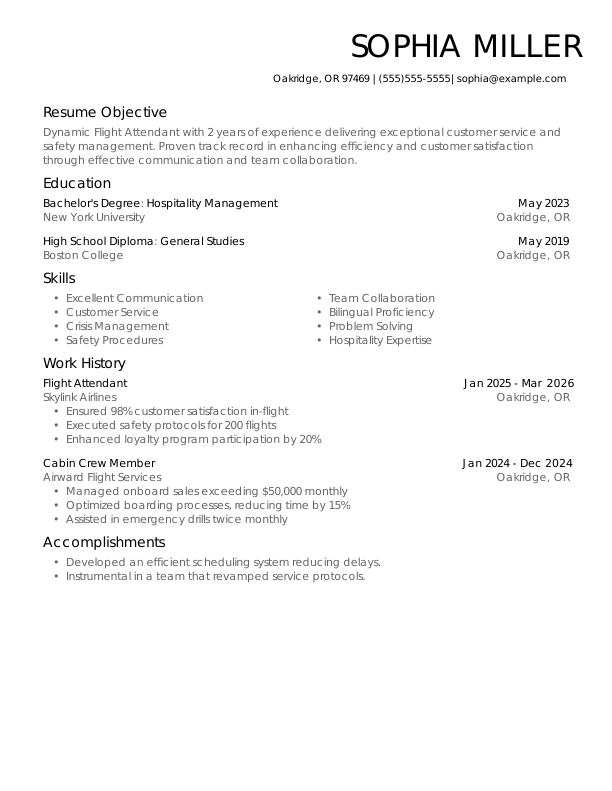
 Free
FreeFlight Attendant Entry-Level Resume
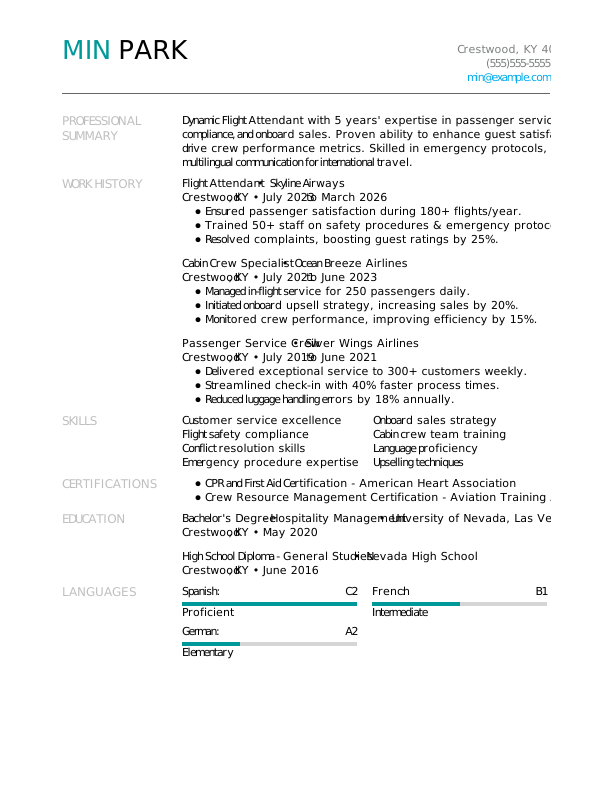
Flight Attendant Mid-Level Resume
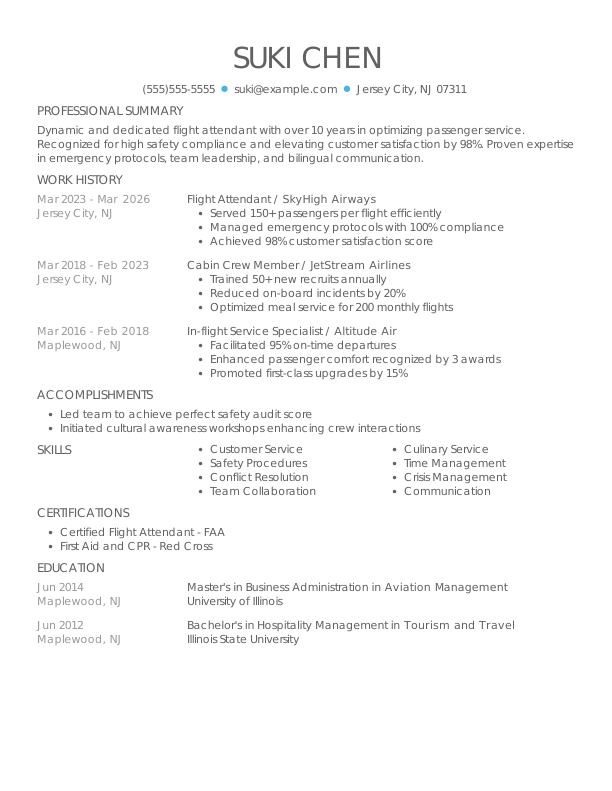
Flight Attendant Experienced Resume
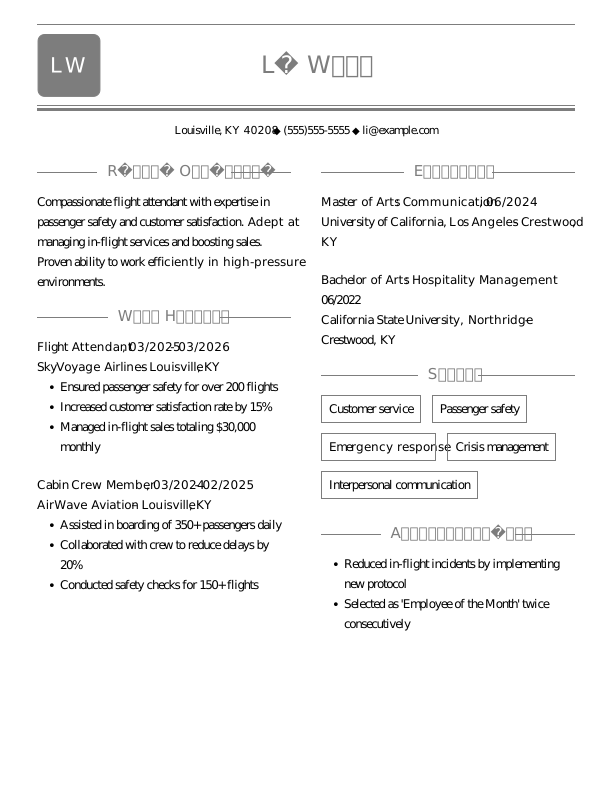
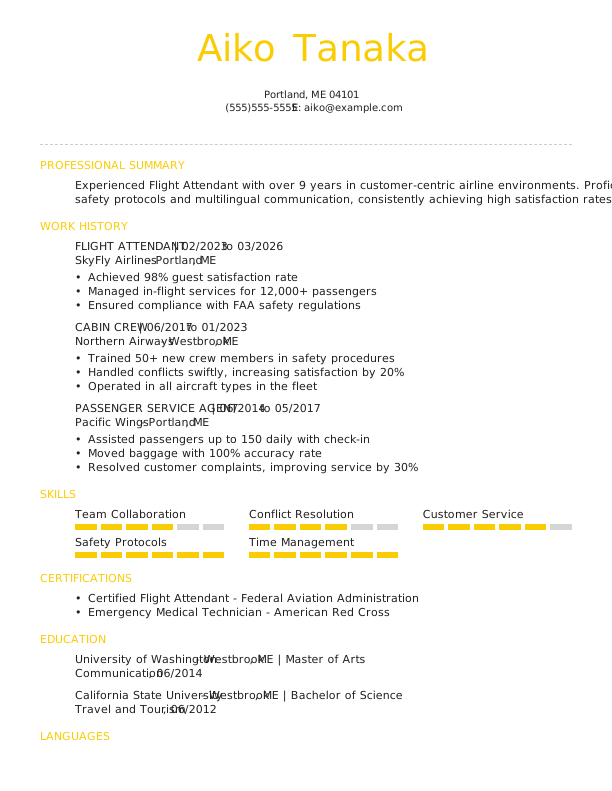
Flight Attendant Entry-Level Resume 1

Flight Attendant Mid-Level Resume 1
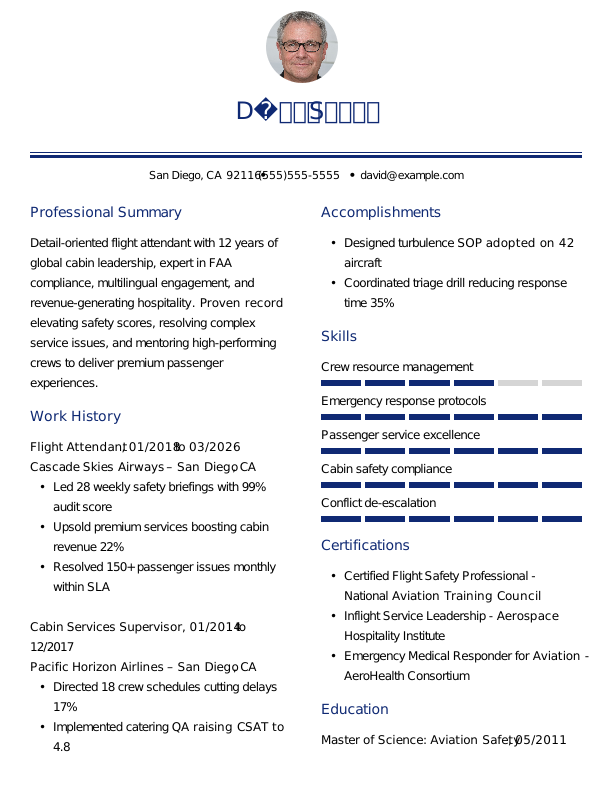

Flight Attendant Experienced Resume 1
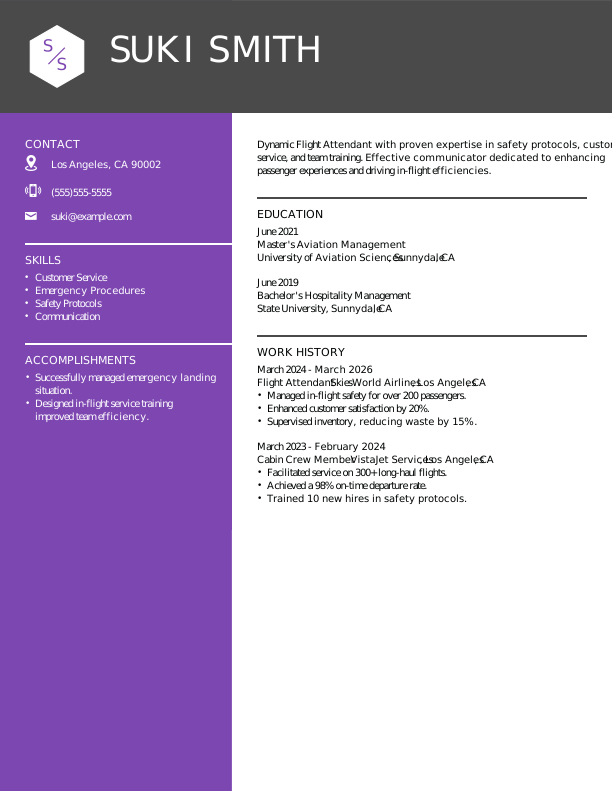
Flight Attendant Entry-Level Resume 2
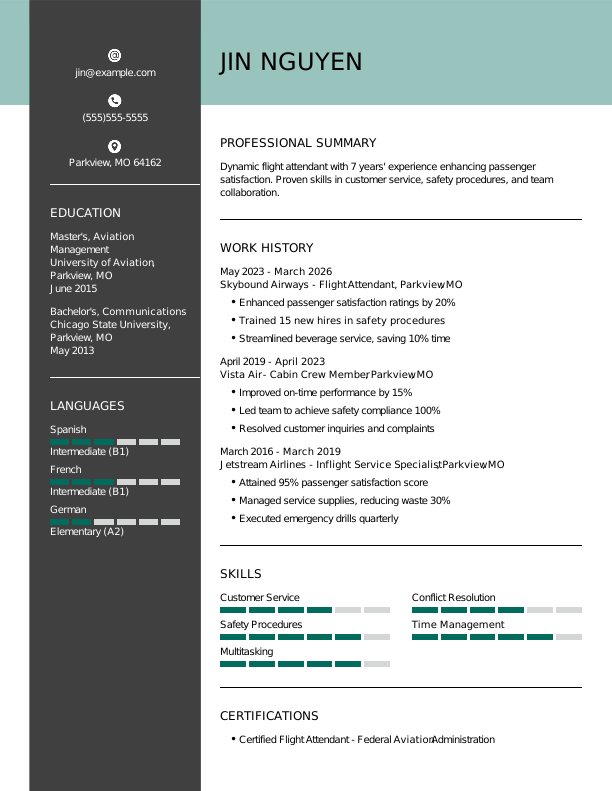

Flight Attendant Mid-Level Resume 2
Browse Free Resume Templates
- Accounts Payable
- Adjunct Professor
- Artist
- Auto Mechanic
- Baker
- Business Development Manager
- Business
- Certified Nursing Assistant
- Classic & Traditional
- Cleaner
- College Student
- Concierge
- Construction Worker
- Corporate
- Creative & Unique
- Custodian
- Customer Service
- Dental Assistant
- Direct Support Professional
- Entry-Level
- Hospitality & Food Service
- Front Desk Receptionist
- Healthcare
- High School
- Housekeeping
- Hvac Technician
- Hybrid
- Inventory Manager
- Logistics
- Maintenance
- Management
- Modern
- Mortgage Loan Processor
- Pet Sitter
- Phlebotomist
- Production
- Rbt
- Sales
- Security Services
- Restaurant Server
- Simple & Basic
- Social Work
- Teacher
- Technology
Resume Examples for Flight Attendants
Flight attendant resumes should combine safety credentials with customer service skills. Explore our templates, or create a personalized resume that reflects your aviation background.
Entry-Level Flight Attendant Resume
If you are applying to your first flight attendant role, this template helps you write a flight attendant resume by emphasizing your customer service background, language skills, and any hospitality or travel industry experience.

Mid-Career Flight Attendant Resume
An excellent choice for experienced flight attendants, this template effectively showcases recent achievements and prepares job seekers for advanced roles in the aviation industry.

Experienced Flight Attendant Resume
An ideal choice for seasoned flight attendants with over 10 years of experience, this template supports professionals seeking advanced roles in the aviation industry.

Flight Attendant Resume Template (Text)
The text resume below gives you a starting point for a flight attendant application. Paste it into your document and fill in your safety certifications, language skills, and airline experience.
Tao Nguyen
Miami, FL 33106
Professional Summary
Efficient Flight Attendant skilled in customer satisfaction, safety protocol, and time management. Proven track record in service excellence and conflict resolution. Ready to enhance passenger experience on every journey.
Work Experience
April 2024 – March 2026
SkyJet Airlines – Miami, FL
Flight Attendant
- Managed safety for 150+ passengers per flight
- Increased customer satisfaction by 20% through service
- Facilitated smooth boarding processes in under 30 minutes
April 2022 – March 2024
Eagle Airways – Miami, FL
Cabin Crew Member
- Conducted safety briefings for flights of 100+ capacity
- Resolved 95% of inflight issues effectively
- Coordinated onboard dining for swift service
March 2020 – March 2022
Pacific Wings Express – Tampa, FL
Passenger Service Agent
- Handled check-in for 200+ clients daily
- Reduced wait times by 15% via streamlined operations
- Demonstrated emergency procedures with efficiency
Education
June 2020
Washington State University Riverview, FL
Bachelor of Arts Communication
June 2016
Green Valley High School Riverview, FL
High School Diploma General Studies
Certifications
- Certified Flight Safety Professional – National Flight Safety Board
- Advanced Passenger Handling Techniques – International Aviation Training Institute
Skills
- Passenger service excellence
- Emergency procedures expertise
- Conflict resolution proficiency
- Fluent in flight communications
- Efficient boarding strategies
- In-depth safety protocol knowledge
- Effective time management
- Customer satisfaction enhancement
How to Write a Flight Attendant Resume
If you are wondering how to write a resume, start by showcasing your interpersonal skills and customer service experience in a clear format that grabs attention. Use the guidance below to emphasize your strengths and tailor your resume for the positions you’re pursuing.
1. Contact Info
Your contact information should be straightforward, professional, and prominently displayed at the top of your resume.
Include the following essential details:
- Full name
- Phone number
- Professional email address
- City and state (ZIP code is optional)
- LinkedIn profile or relevant portfolio (if applicable)
 PRO TIP
Avoid listing sensitive personal details such as Social Security numbers, religious beliefs, or full home addresses unless the employer explicitly requests them.
2. Resume Profile
A resume profile is a brief introductory section, typically comprising two to four sentences, that encapsulates your identity and key qualifications. Its main function is to serve as a compelling pitch for hiring managers, sparking their interest and motivating them to delve deeper into your resume.
This profile is prominently placed at the top of your resume and can be crafted as either a summary or an objective, each serving distinct purposes. Understanding these differences will help you choose the right approach for your job application:
- A resume summary presents essential experience, skills, and accomplishments relevant to customer service and safety within the aviation industry. This format is especially helpful for individuals with previous roles or transferable experience who want to highlight their contributions as skilled flight attendants.
- A resume objective emphasizes your career aspirations and what you aim to accomplish in your next role. It’s particularly beneficial for recent graduates, individuals switching careers, or those with limited experience seeking entry-level positions in fields such as hospitality or customer service.
Let’s examine a resume summary and a resume objective to understand their distinctions:
Flight attendant resume summary example:
Adaptable flight attendant with 6+ years of experience in diverse international airlines, ensuring passenger safety and comfort. Expertise in emergency procedures, customer service excellence, and cross-cultural communication skills. Commended for consistently improving passenger satisfaction and contributing to smooth flight operations.
Flight attendant resume objective example:
Recent graduate with a degree in hospitality management, eager to launch a career as a flight attendant in an airline that values exceptional customer service. Committed to safety and delivering outstanding experiences while contributing strong interpersonal skills and adaptability to improve passenger satisfaction.
3. Work Experience
The work experience on your resume serves as an important foundation for your candidacy. Employers examine not only job titles but also the depth of your contributions to gauge your overall impact.
Your history in service roles demonstrates that your skills and experience align perfectly with the demands of a flight attendant role, underscoring your readiness for this vibrant career.
The work experience section should contain:
- Job title
- Employer name and location
- Dates of employment (month/year)
- 3–5 bullet points describing your in-flight safety and customer service achievements
When crafting your work experience bullet points, use language that aligns with the flight attendant role. Start each point with a strong action verb (like “Assisted,” “Ensured,” “Facilitated”) to capture attention and convey impact.
Incorporate measurable achievements into your statements. Specific metrics or accomplishments can highlight your contributions and set you apart from other job seekers, showcasing your unique value in the competitive aviation industry.
In general, consider following the format of:
[action verb] + [responsibility] = [result/achievement]
For example:
Conducted safety demonstrations and provided exceptional in-flight service to over 150 passengers per flight, resulting in a customer satisfaction score of 95%.
Note that you can also flip the result/achievement with the responsibility:
Achieved a 20% increase in positive passenger feedback by implementing personalized service strategies during flights.
Discover more examples of work experience for flight attendants further down the page.
With these techniques in mind, your resume bullets may look something like:
- Ensured passenger safety and comfort for over 180 clients per flight, maintaining a satisfaction rate of 95%.
- Executed emergency protocols effectively during unforeseen situations, improving crew response time by 20%.
- Collaborated with a team of 5 flight attendants to streamline boarding processes, reducing average gate turnaround time by 15 minutes.
- Used in-flight service management software to track inventory and manage supplies efficiently.
- Trained new hires on safety procedures and customer service standards, resulting in improved team performance.
4. Skills
The skills section provides a concise overview of your abilities as a flight attendant, highlighting essential qualifications in customer service and safety protocols. It’s an ATS-friendly resume section that enables hiring managers to assess your fit for the role without difficulty.
Skills can be grouped into three key areas:
- Soft skills are personal qualities that shape how flight attendants interact with passengers and crew.
- Hard skills are specific, quantifiable abilities gained through education, training, or hands-on experience.
- Technical skills encompass the practical abilities required to operate industry-specific equipment and software.
5 Soft Skills for Your Resume or CV
- Effective communication
- Teamwork and collaboration
- Conflict resolution skills
- Cultural sensitivity awareness
- Time management skills
5 Hard Skills for Your Resume or CV
- Safety protocols compliance
- Emergency response procedures
- In-flight service management
- Cabin pressure control systems
- Passenger assistance techniques
In general, include a diverse range of skills that match the job requirements to showcase your strengths.
PRO TIP
If you’re a newer flight attendant, consider placing your skills section higher on your resume right after your summary. For those with more experience, it’s better to place this section lower and weave your skills into your work history descriptions.
5. Education
Understanding how to list education on your resume is important for demonstrating your academic qualifications. Start with your most recent or relevant degree, clearly stating the degree type and institution name.
If you’re fresh out of school, consider including optional details such as graduation year, GPA (if it’s 3.5 or above), any honors received, and relevant coursework that showcases your skills.
Flight attendant resume education section example:
Associate of Arts in Hospitality Management
City College of San Francisco, San Francisco, CA
Graduated: 2023 | Graduated with Honors
PRO TIP
When listing your educational qualifications on a resume, always place your degrees in reverse-chronological order, starting with the highest, such as a Bachelor of Arts in Aviation, followed by an Associate Degree in Airline Management.
6. Certifications
Certifications illustrate your qualifications and reflect your current knowledge in the airline industry. While they may not always fit into a traditional resume format, this section holds significant value for flight attendants. Airlines often require specific credentials for roles such as safety management and first aid training.
Be sure to present relevant certifications and licenses that improve your application. Keep them up to date and clearly formatted to make a positive impression on potential employers.
Flight attendant certification examples:
- Flight Attendant Certification | Federal Aviation Administration (FAA) | Expires: 03/2028
- Basic Life Support (BLS) | American Heart Association | Expires: 11/2027
- Emergency Evacuation Training | Airline Training Institute | Expires: 01/2028
- First Aid Certification | Red Cross | Expires: 10/2027
Start Building Your Job-Winning Resume
Use Your Existing Resume
Import your current resume to transfer your information to one of our professional templates.
Create a New Resume
Start fresh with a template that catches your eye and follow the prompts to add your details.
Tailor Your Work History to Beat the ATS
Your work experience section is a powerful tool for showcasing your contributions beyond just job titles. It allows you to highlight the measurable impact you’ve made on passengers, teams, and overall service quality in aviation. This detailed narrative also improves the odds of creating an ATS-friendly resume that applicant tracking systems (ATS) can easily scan.
To make your work history stand out, tailor it specifically to the flight attendant role you’re pursuing by incorporating relevant keywords from the job listing. Begin by closely reviewing the description to identify key skills and duties that recur throughout. By mirroring these elements in your experience descriptions, you increase your chances of aligning with what employers are seeking.
What’s a Fair Flight Attendant Salary?
Researching salary data is essential for assessing job offers, negotiating pay, and making strategic career moves. The information presented here comes from the U.S. Bureau of Labor Statistics (BLS) and outlines the most current nationwide averages for flight attendants.
Factors such as geographic location, years of experience, certifications, and area of expertise can significantly affect actual earnings. Flight attendants working for major airlines or in specialized safety or training roles typically earn higher salaries than those at regional carriers or in part-time positions.
| Arizona | $52,900 |
| California | $84,060 |
| Connecticut | $99,970 |
| Florida | $77,460 |
| Georgia | $79,480 |
| Idaho | $83,070 |
| Illinois | $71,670 |
| Massachusetts | $68,390 |
| Michigan | $80,240 |
| Minnesota | $56,870 |
| Nevada | $48,960 |
| New York | $117,580 |
| North Carolina | $73,420 |
| Ohio | $59,570 |
| Oregon | $72,620 |
| Pennsylvania | $53,760 |
| Texas | $54,750 |
| Utah | $60,450 |
| Virginia | $79,110 |
| Washington | $103,150 |
Key Takeaways
- Tailor your resume to the job description. Use the airline’s terminology when outlining your skills and duties—it improves chances with both ATS and hiring managers.
- Use quantifiable achievements to highlight your contributions. Include metrics like passenger satisfaction scores, number of flights served, or safety compliance records to make your experience stand out.
- Select a resume format that matches your experience level. Entry-level applicants might use a functional or combination format, while seasoned flight attendants often choose reverse-chronological layouts.
More Resume & CV Examples
- Automotive
- Aviation
- Bus Driver
- Cdl Driver
- Company Driver
- Courier
- Delivery Driver
- Driver
- Drone Pilot
- Dump Truck Driver
- Food Delivery Driver
- Mechanic
- Owner Operator
- Personal Driver
- Pilot
- Ramp Agent
- School Bus Driver
- Taxi Driver
- Transportation
- Truck Driver
- Uber Driver
Cover Letters for Your Resume
Browse our library of cover letter examples to complete your application. A resume will have a better chance of getting noticed.
Frequently Asked Questions
Last Update:
What resume format should I use for my flight attendant resume?
There are three main resume formats to consider when applying for a flight attendant position. The format you choose should reflect your experience level and highlight the skills that matter most to airlines seeking applicants:
- Chronological: The chronological resume is the most favored format, emphasizing your work experience through a detailed account of your responsibilities and achievements. This approach is particularly suitable for applicants with a consistent job history that reinforces their qualifications and adds credibility to their application.
- Functional: The functional resume, often referred to as a skills-based resume, emphasizes your qualifications and highlights an extensive skills section rather than focusing on chronological work history. This format benefits job seekers who may lack direct experience in the field or face employment gaps, allowing them to more prominently showcase their relevant abilities.
- Combination: The combination resume mixes chronological and functional formats, highlighting both skills and work history. This structure benefits professionals by showcasing their abilities while illustrating career growth. It’s ideal for those transitioning into fields or wanting to highlight diverse experiences.
Should I include a cover letter with my resume?
Yes, you should include a cover letter with your flight attendant application. A well-crafted cover letter improves your resume by allowing you to express your enthusiasm for the role and the airline while showcasing relevant customer service skills and experiences that may not be evident in your resume alone. This personalized approach can give you an advantage over job seekers who choose not to submit one.
If you’re unsure how to write a cover letter, there are plenty of resources available to assist you. You can find comprehensive guides, along with examples illustrating different styles and formats. These resources will help you create a compelling narrative that aligns with your qualifications and the airline’s values.
To make the writing process easier, consider using a cover letter generator, which provides templates and tailored suggestions to streamline your application for flight attendant roles.
How long should a flight attendant resume be?
For flight attendants with less than 10 years of experience, a one-page resume is ideal to efficiently showcase relevant skills, training, and customer service achievements. Highlight your certifications (e.g., CPR, first aid) and any language proficiencies that improve your candidacy.
Those in senior or specialized roles may extend their resumes to two pages if the information remains relevant and organized. Focus on leadership experience, safety protocol expertise, and notable contributions to team performance without including unnecessary filler content.
What keywords should I include to pass applicant tracking systems (ATS)?
To successfully navigate ATS, focus on incorporating keywords and phrases from the flight attendant job posting. Words like “customer service,” “safety procedures,” or “emergency response” can boost your chances of getting noticed. Tailor your resume to reflect these terms as they directly align with the role you’re applying for.
Additionally, be sure to list any relevant certifications, such as FAA Safety Training and First Aid/CPR, along with technical skills like skill in reservation systems or passenger management software. This showcases your qualifications clearly, making it easier for hiring managers to see your fit for the position.
Should I include volunteer or part-time customer service roles on my flight attendant resume?
Yes, including volunteer or part-time customer service roles is helpful. These experiences highlight your interpersonal skills and ability to handle diverse passenger needs, which are important for flight attendants, especially if you have limited formal airline experience.

Megan Dawkins is a career industry editor who empowers job seekers to take control of their career paths using Monster’s comprehensive job search and resume tools. She specializes in helping job seekers navigate the flexible job market.
See More From Megan Dawkins