

Free Construction Worker Resume Templates & Examples
Boost your chances of landing interviews with expertly designed construction worker free resume templates. These resources come with writing tips that will guide you in creating a standout resume or CV that showcases your skills to potential employers.
Real-World Resumes That Get Results
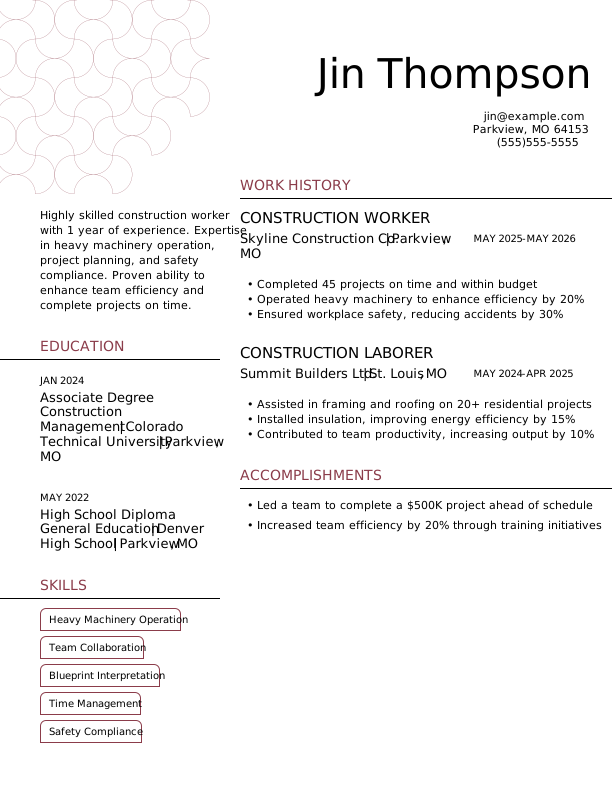
 Free
FreeConstruction Worker Entry-Level Resume
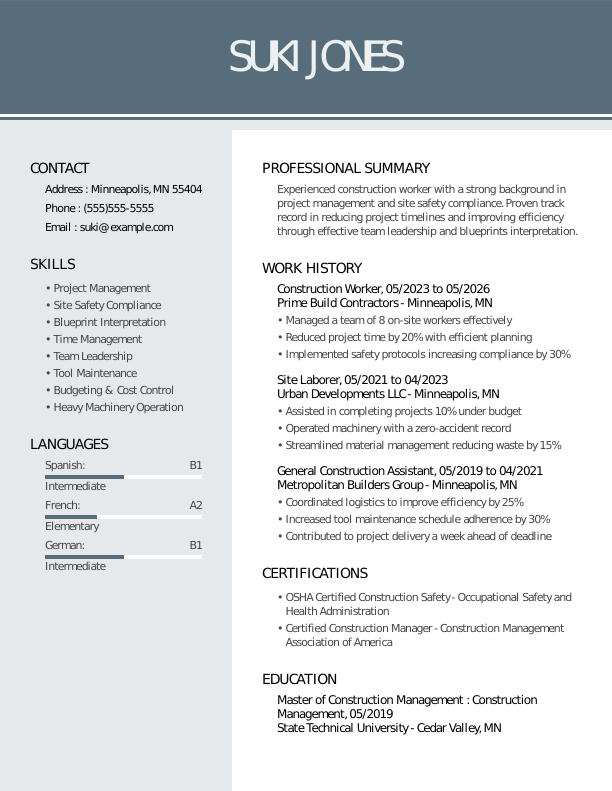
Construction Worker Mid-Level Resume
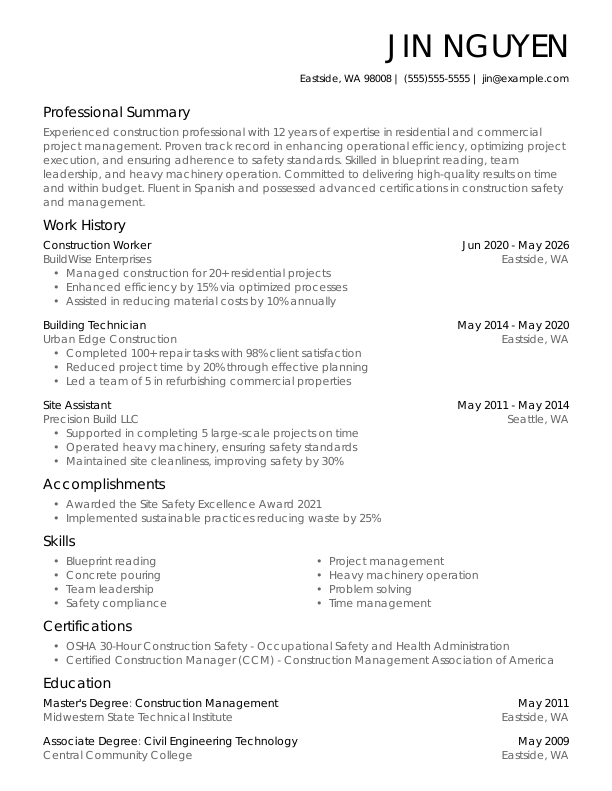
Construction Worker Experienced Resume

Construction Worker Entry-Level Resume 1


Construction Worker Mid-Level Resume 1


Construction Worker Experienced Resume 1


Construction Worker Entry-Level Resume 2


Construction Worker Mid-Level Resume 2
Browse Free Resume Templates
- Accounts Payable
- Adjunct Professor
- Artist
- ATS-Friendly
- Auto Mechanic
- Baker
- Business Development Manager
- Business
- Certified Nursing Assistant
- Classic & Traditional
- Cleaner
- College Student
- Concierge
- Construction Worker
- Corporate
- Creative & Unique
- Custodian
- Customer Service
- Dental Assistant
- Direct Support Professional
- Entry-Level
- Flight Attendant
- Hospitality & Food Service
- Front Desk Receptionist
- Healthcare
- High School
- Housekeeping
- Hvac Technician
- Inventory Manager
- Logistics
- Maintenance
- Management
- Modern
- Mortgage Loan Processor
- Pet Sitter
- Phlebotomist
- Production
- RBT
- Restaurant Server
- Sales
- Security Services
- Simple & Basic
- Social Work
- Teacher
- Technology
Resume Examples for Construction Workers
A construction worker’s resume or CV varies significantly based on their level of experience. Explore what to highlight at each stage and use our Resume Builder to create your own tailored document.
Entry-Level Construction Worker Resume
Ideal for recent graduates writing a resume with no experience, this template is also beneficial for those transitioning into construction work from different sectors.
Mid-Career Construction Worker Resume
A good fit for construction professionals with several years of experience, this template highlights recent project contributions and supports advancement into supervisory or specialized positions.
Experienced Construction Worker Resume
Ideal for seasoned construction professionals with over 10 years of experience, this template supports individuals seeking senior roles in project management or team leadership within the construction industry.
Construction Worker Resume Template (Text)
Use this customizable construction worker resume text format to copy, edit, and tailor directly in your document.
Aya Zhang
St. Louis, MO 63110
Professional Summary
Experienced Construction Worker specializing in efficient project management and compliance. Proven track record in residential and commercial projects with 15% time savings. Committed to safety and sustainability.
Work Experience
June 2023 – May 2026
Skyline Builders – St. Louis, MO
Construction Worker
- Constructed residential homes, reducing build time by 15%
- Led a team of 5 workers to win Project of the Year 2025
- Implemented safety measures, decreasing accidents by 30%
June 2020 – May 2023
Urban Development Corp – St. Louis, MO
Site Technician
- Executed foundation work, increasing efficiency by 20%
- Collaborated on commercial build improving material use by 10%
- Coordinated logistics for projects worth $3M annually
June 2019 – May 2020
Midwest Constructions – St. Louis, MO
Construction Assistant
- Assisted in installation saving 10% on material costs
- Helped manage a diverse team improving productivity by 15%
- Ensured compliance with regulations, reducing site fines
Education
May 2019
Ohio State University Parkview, MO
Master’s Construction Management
May 2017
University of Cincinnati Parkview, MO
Bachelor’s Civil Engineering
Certifications
- Certified Construction Manager – Construction Management Association of America
- OSHA Safety Certification – Occupational Safety and Health Administration
Skills
- Project Management
- Blueprint Reading
- Concrete Work
- Heavy Machinery Operation
- Team Leadership
- Safety Compliance
- Time Management
- Problem Solving
How to Write a Construction Worker Resume
As a construction worker, knowing how to write a resume means showcasing your practical skills and relevant experience in a clear, standout format. Use the guidance below to emphasize your strengths and tailor your resume for the specific jobs you want.
1. Contact Info
Your contact information should be clear, professional, and easy to find at the top of your resume.
Make sure to include:
- Full name
- Phone number
- Professional email address
- City and state (ZIP code is optional)
- LinkedIn profile or personal portfolio (if relevant)
- Construction certifications or licenses (if applicable)
 PRO TIP
Skip including sensitive personal information such as your Social Security number, marital status, or photographs unless the employer explicitly requests these details.
2. Resume Profile
A resume profile is a brief introductory section, typically spanning two to four sentences, that highlights your key qualifications and experience. It serves as a compelling pitch to capture hiring managers’ interest and motivate them to explore your resume further.
You will find the profile positioned at the top of your resume, functioning as either a summary or an objective, each tailored for different purposes. This strategic placement sets the tone for your application and encourages employers to read on:
- A resume summary highlights your key skills, relevant experience, and notable achievements to create a compelling first impression. This format is especially beneficial for those with a work history or transferable skills eager to showcase their contributions in the construction industry.
- A resume objective highlights your career aspirations and outlines what you aim to accomplish in your next role. It’s especially beneficial for recent construction graduates, professionals transitioning from other trades, or those with limited hands-on experience in the field.
Let’s take a look at an example of each to see how a resume summary and a resume objective differ:
Construction worker resume summary example:
Dedicated construction worker with 6+ years of experience in diverse project environments, including residential and commercial builds. Proficient in safety compliance, equipment operation, and teamwork collaboration. Acknowledged for consistently meeting deadlines while maintaining high standards of craftsmanship and safety on-site.
Construction worker resume objective example:
Recent graduate with a degree in Construction Management eager to launch a career in a dynamic construction environment. Committed to safety and teamwork, ready to contribute strong problem-solving abilities and attention to detail in residential or commercial projects.
3. Work Experience
The work experience on your resume serves as an important foundation. Employers review your job history to understand not just where you’ve worked, but the tangible impact you’ve made on projects and teams.
Your hands-on experience in various construction roles demonstrates your qualifications for the position, including your knowledge of safety protocols and project management.
The work experience section should contain:
- Job title
- Employer name and location
- Dates of employment (month/year)
- 3–5 bullet points describing your relevant responsibilities and achievements
Tailor your content to reflect the specific construction role you’re pursuing. Start each bullet point with an action verb (like “Constructed,” “Inspected,” “Maintained”) to create a strong impression of your responsibilities and achievements.
Incorporate quantifiable information or metrics whenever possible. Specific numbers, such as project completion times or cost reductions, highlight your contributions and help differentiate you in a competitive job market.
In general, consider following the format of:
[action verb] + [responsibility] = [result/achievement]
For example:
Constructed and maintained infrastructure for a 150-unit residential complex, ensuring compliance with safety regulations and achieving 95% on-time project delivery.
Note that you can also flip the result/achievement with the responsibility:
Improved worksite safety by 30% through the implementation of improved training programs and regular equipment inspections.
Explore more work experience examples for construction workers further down the page.
4. Skills
The skills section provides a concise overview of the abilities specific to construction work. This allows hiring managers to quickly assess qualifications and determine fit for the role.
Skills can be categorized into three distinct groups:
- Soft skills are personal qualities that influence how well construction workers collaborate on job sites. Examples include communication, problem-solving, teamwork, and adaptability.
- Hard skills are specific, measurable abilities gained through education, training, or hands-on experience. For a construction worker, examples include operating heavy machinery, reading blueprints, and performing concrete finishing.
- Technical skills refer to the specific knowledge and abilities required to perform tasks in a particular field. In construction, workers must be proficient with tools like power drills, scaffolding systems, and safety equipment to ensure projects are completed correctly and safely.
In general, aim to include a balanced array of relevant skills that align with the job requirements to showcase your full potential in the construction field. See below for more examples of skills for a construction worker resume.
PRO TIP
If you’re a newer construction worker, place your skills section higher on the resume, right after your summary. For those with more experience, it’s best to place this section lower and weave most of your skills into your work history for a more integrated approach.
5. Education
Understanding how to list education on your resume is essential for showcasing your expertise in construction. Begin by listing the most relevant skills related to the job you’re applying for, ensuring they reflect what employers seek.
For those new to the field, consider including certifications, tools you’re proficient with, or safety training that demonstrates your readiness and commitment to the profession.
Construction worker resume education section example:
High School Diploma
Lincoln High School, Springfield, IL
Graduated: 2020 | National Honor Society
PRO TIP
If you’re progressing from an Associate Degree in Construction Management to a Bachelor of Science in Construction Engineering, or have earned another relevant degree, list both in reverse-chronological order.
6. Certifications
Listing certifications on your resume can improve your qualifications, particularly when you have limited experience. Although this section may not be standard for every resume, it can significantly benefit professionals in the construction field. Employers often look for specific credentials required for specialized roles, such as OSHA certifications or safety training.
Focus on including only those certifications that directly support your application and align with the job requirements. Keeping these credentials current and clearly formatted will help you stand out to potential employers.
Construction worker certification examples:
- OSHA 10-Hour Construction Safety Certification | Occupational Safety and Health Administration | Expires: 01/2028
- Forklift Operator Certification | National Safety Council | Expires: 06/2027
- CPR and First Aid Certification | American Red Cross | Expires: 09/2028
- Hazardous Materials (HAZMAT) Certification | Environmental Protection Agency | Expires: 12/2027
Start Building Your Job-Winning Resume
Use Your Existing Resume
Import your current resume to transfer your information to one of our professional templates.
Create a New Resume
Start fresh with a template that catches your eye and follow the prompts to add your details.
Tailor Your Work History to Beat the ATS
Your work experience is more than a list of job titles. It’s an opportunity to demonstrate the measurable impact you’ve made on construction projects, safety protocols, and team efficiency. This approach also results in an ATS-friendly resume that applicant tracking systems can easily scan.
Popular Resume Bullets for Construction Workers
These examples are pulled from our most-used entries in the resume builder — based on what hiring managers respond to most.
- Constructed and renovated residential and commercial buildings, completing projects ahead of schedule by 20%.
- Operated heavy machinery, ensuring compliance with safety regulations and reducing workplace accidents by 15%.
- Collaborated with project managers and architects to plan workflows, improving team efficiency during construction phases.
- Trained new crew members on safety protocols and equipment operation, improving overall site safety awareness.
- Performed regular maintenance checks on tools and equipment, extending their lifespan by 10% and minimizing downtime.
Example of Skills for Construction Workers
Including the skills for your resume demonstrates to employers and ATS that you possess the abilities essential for a construction worker. Since resumes are often scanned quickly, ensure your skills are focused, relevant, and aligned with the job description.
The skills listed below reflect what is currently valued in the construction industry. These capabilities frequently appear in successful resumes and resonate well with hiring managers looking for qualified applicants.
5 Soft Skills for Your Resume or CV
- Team coordination
- Safety compliance awareness
- Effective communication skills
- Time management skill
- Conflict resolution techniques
5 Hard Skills for Your Resume or CV
- Blueprint reading
- Concrete pouring techniques
- Heavy machinery operation (excavators, bulldozers)
- Safety compliance (OSHA regulations)
- Framing and drywall installation
Key Takeaways
- Customize your resume to match the job posting. Use terminology from the employer’s description to resonate with both ATS and hiring managers.
- Highlight quantifiable accomplishments that demonstrate your skills. For example, mention projects completed ahead of schedule (e.g., reduced project timelines by 20%) or safety records (e.g., zero accidents over three years).
- Select a resume format that reflects your experience level. Entry-level workers might opt for a functional layout, while seasoned professionals should consider a reverse-chronological format.
More Resume & CV Examples
- Air Sealing Technician
- Aircraft Mechanic
- Architecture
- Auto Mechanic
- Automotive Technician
- Barber
- Boilermaker
- Budtender
- Carpenter
- Carpentry
- Construction Assistant
- Construction Management
- Construction Manager
- Construction Project Manager
- Construction
- Construction Superintendent
- Contractor
- Cosmetologist
- Diesel Mechanic
- Electrician
- Hair Stylist
- Handyman
- Heavy Equipment Operator
- Hvac Technician
- Industrial Electrician
- Journeyman Electrician
- Landscaper
- Lineman
- Machinist
- Painter
- Plumber
- Welder
- Equipment Operator
Frequently Asked Questions
Last Update:
What resume format should I use for my construction worker resume?
There are three primary resume formats to consider when applying for a construction worker position. Your choice should reflect your experience level and the specific skills or achievements you want to highlight:
- Chronological: The most popular format, a chronological resume highlights your work experience by detailing your responsibilities and achievements in reverse order. This structure is ideal for job seekers with a consistent job history that reinforces their qualifications and demonstrates reliability in the construction field.
- Functional: Also known as a skills-based resume, the functional resume emphasizes a summary of qualifications and an expanded skills section to showcase your relevant abilities. This approach shifts focus away from work history, benefiting applicants without relevant experience or those dealing with employment gaps.
- Combination: A combination resume integrates both chronological and functional elements, featuring a skills section alongside detailed work history. This format benefits construction workers by allowing them to emphasize their technical abilities and certifications while also showcasing their career growth and project experiences.
Should I include a cover letter with my resume?
Yes, you should include a cover letter with your construction worker job application. A thoughtful cover letter improves your resume by allowing you to showcase your skills and experiences that might not be detailed in your resume. It demonstrates to employers that you’re genuinely interested in the position and have taken the effort to personalize your application, which can set you apart from other applicants.
If you’re unsure how to craft a cover letter, don’t let that discourage you from including one. There are numerous resources available, including guides on writing a cover letter and examples tailored to various positions in the construction industry. Exploring different formats can also help you find the best fit for your background and experience.
For those looking to simplify the process, using tools like a cover letter generator can quickly provide structure and suggestions tailored to your specific job application needs.
How long should a construction worker’s resume be?
When creating a resume, professionals with fewer than 10 years of experience should aim for a one-page resume. This length allows you to showcase your skills, education, and relevant work history without overwhelming the reader. Focus on presenting clear and concise information that highlights your qualifications.
For those in senior or specialized positions, a two-page resume is acceptable if it remains focused and organized. Include details about leadership roles, advanced certifications, and significant projects. Prioritize clarity to ensure your expertise stands out without unnecessary filler.
Should I include volunteer work or side projects?
Yes, especially if you’re new to the construction field. Listing volunteer work or side projects demonstrates your practical skills and commitment to learning, helping you stand out when formal experience is limited.

Elizabeth Muenzen is a Certified Professional Resume Writer (CPRW) and member of the Professional Association of Resume Writers & Career Coaches who empowers job seekers to take control of their career paths using Monster’s comprehensive job search and resume tools.
See More From Elizabeth MuenzenExplore Related Career Advice





Canadian Resume Format Guide: How to Write a Canadian Resume (With Examples)

Updated:
May 8, 2026
|

12 min read

How to List Multiple Positions at the Same Company on Resumes: 3 Methods
Updated:
May 7, 2026
|
12 min read

Extracurricular Activities for Resumes: 10+ Examples & How to Include Them
Updated:
May 7, 2026
|
14 min read