


Free Cybersecurity Cover Letter Templates & Examples
A strong cybersecurity cover letter shows you can protect systems through risk assessment and incident response, while communicating clearly with technical and non-technical teams. Our free cover letter templates and step-by-step guidance help you highlight your most relevant skills so hiring managers can see your fit fast.
Real-World Cover Letters That Get Results
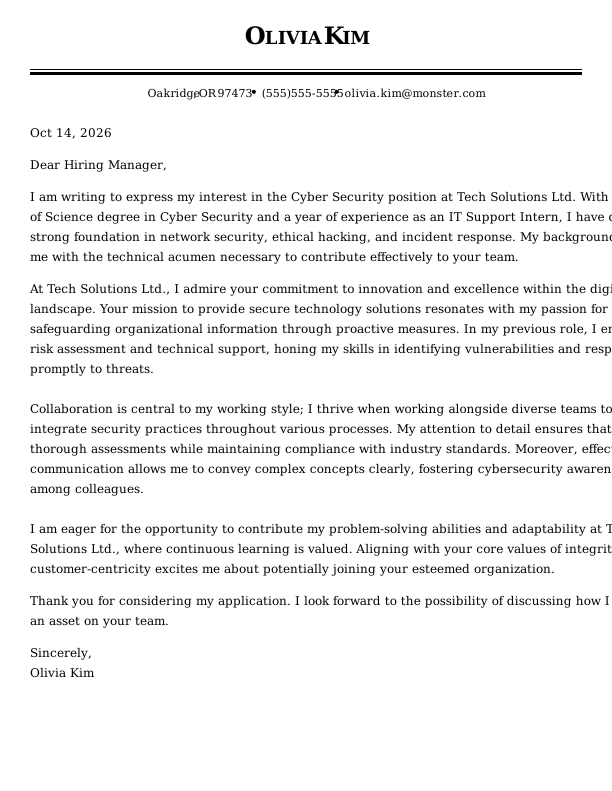
 Free
Security Entry-Level Cover Letter
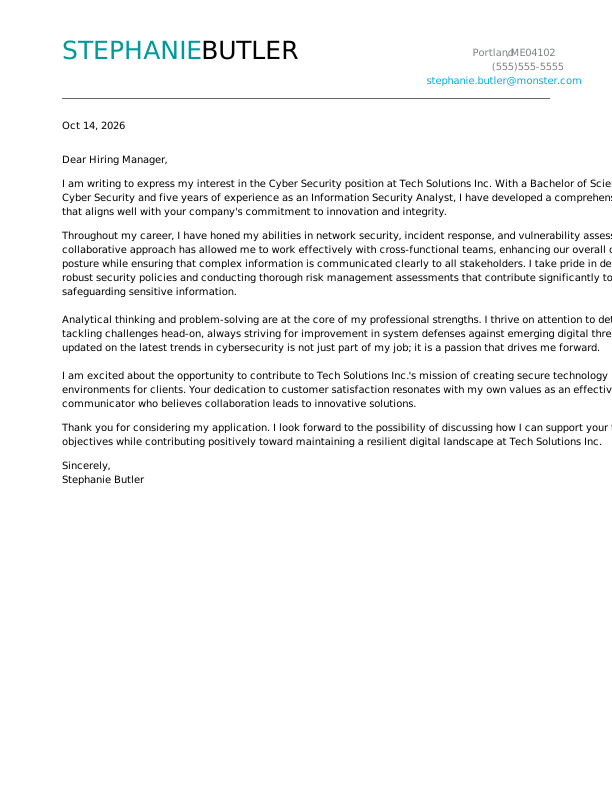
Security Mid-Level Cover Letter
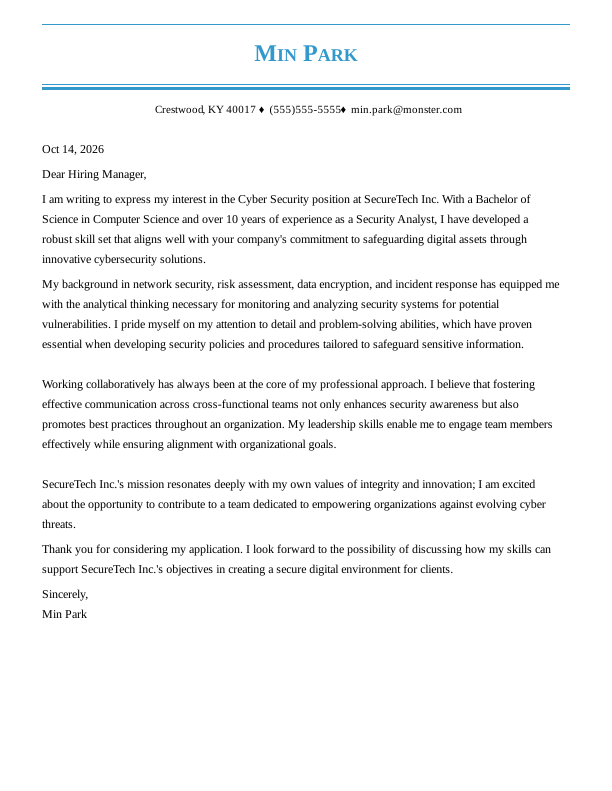
Security Experienced Cover Letter
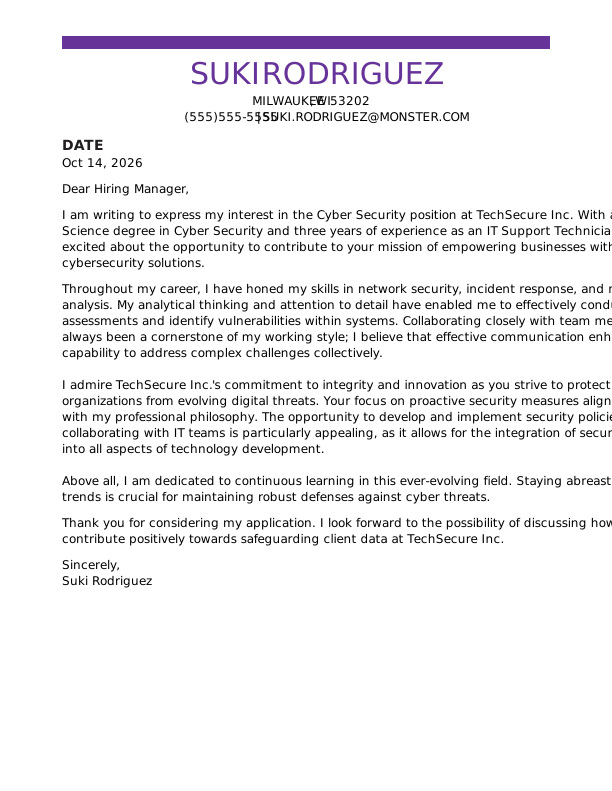
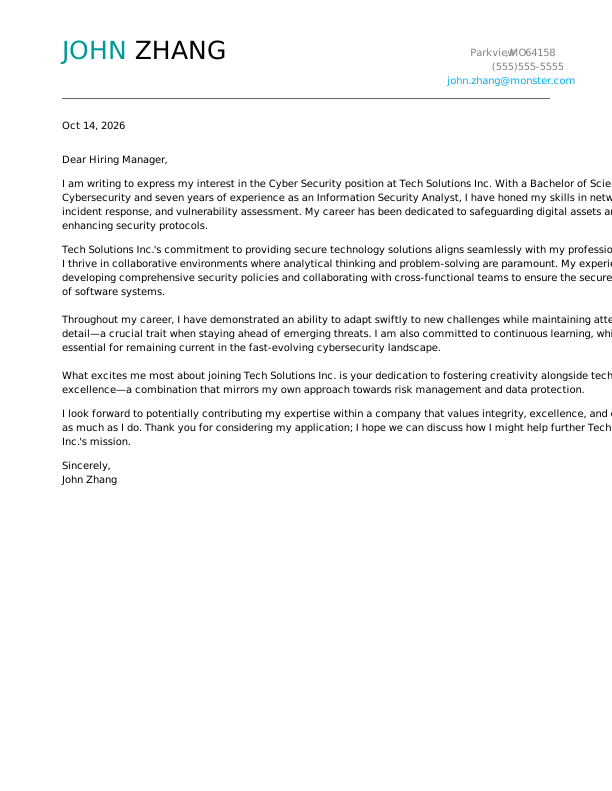
Security Entry-Level Cover Letter
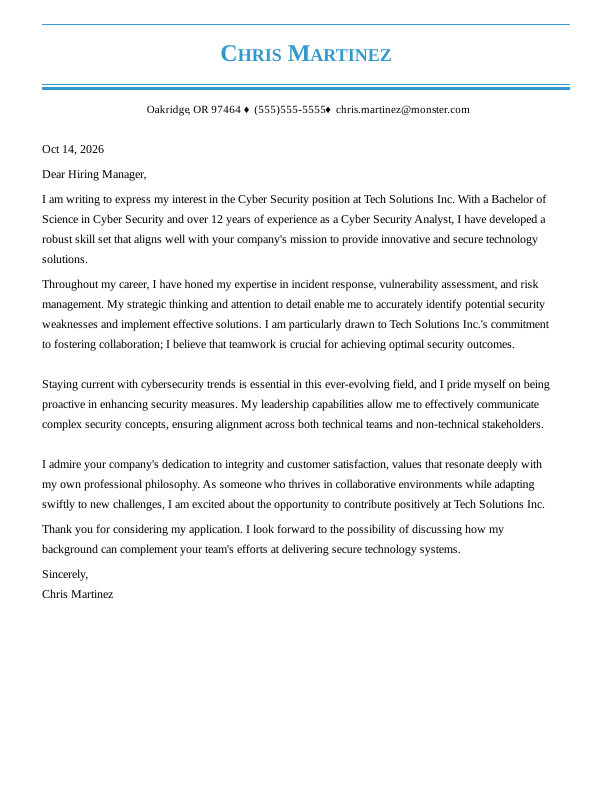
Security Mid-Level Cover Letter
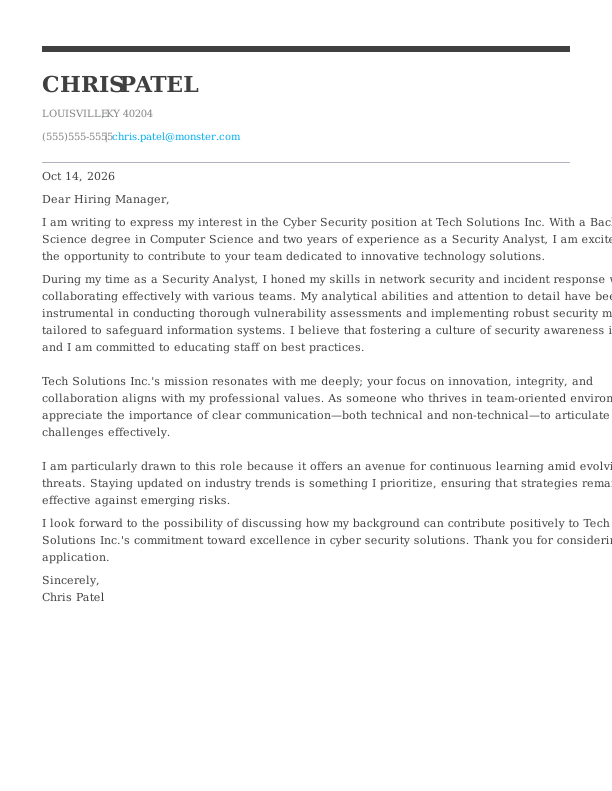
Security Experienced Cover Letter
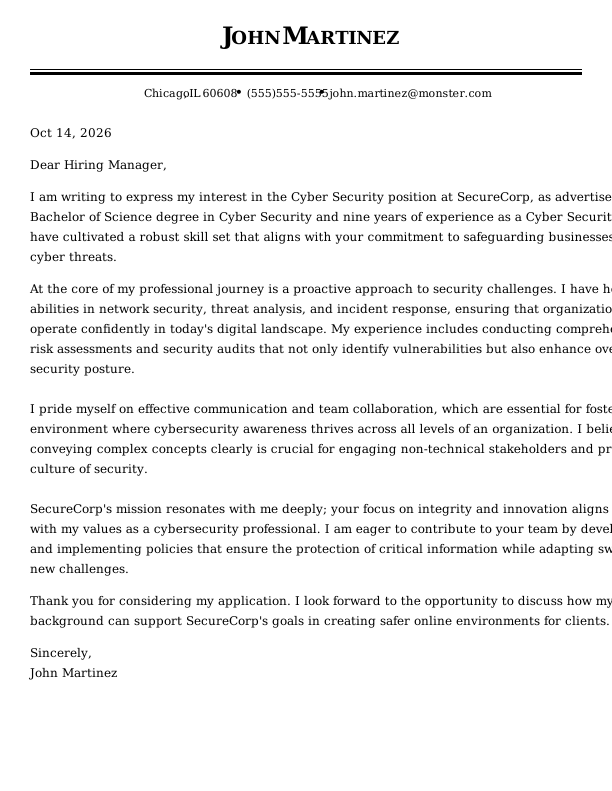
Security Entry-Level Cover Letter
Security Mid-Level Cover Letter
Browse Free Cover Letter Templates
- Academic
- Account Manager
- Accountant
- Accounts Payable
- Administrative Assistant
- Admissions Counselor
- Architecture
- Artist
- Assistant Principal
- Babysitter
- Barista
- Bartender
- Bookkeeper
- Brand Ambassador
- Business Analyst
- Business
- Caregiver
- Chef
- Civil Engineering
- Computer Science
- Construction
- Consulting
- Copywriter
- Cosmetology
- Custodian
- Customer Service
- Customer Service Representative
- Data Analyst
- Data Entry
- Dental Assistant
- Dental Hygienist
- Digital Marketing
- Electrical Engineering
- Emt
- Engineering
- Esthetician
- Event Coordinator
- Executive Assistant
- Finance
- Financial Analyst
- Firefighter
- Flight Attendant
- Graphic Designer
- Hair Stylist
- Healthcare
- Hr Generalist
- Investment Banking
- It
- Janitor
- Journalism
- Lab Technician
- Law Clerk
- Lawyer
- Librarian
- Logistics
- Makeup Artist
- Manager
- Marketing Coordinator
- Marketing
- Marketing Manager
- Massage Therapist
- Mechanic
- Mechanical Engineer
- Medical Assistant
- Non Profit
- Nursing
- Occupational Therapy
- Office Assistant
- Office Manager
- Operations Manager
- Paralegal
- Personal Trainer
- Pharmacist
- Pharmacy Technician
- Photographer
- Physician Assistant
- Pilot
- Police Officer
- Program Manager
- Project Manager
- Property Manager
- Psychology
- Receptionist
- Research Assistant
- Restaurant Manager
- Retail
- Sales
- Sales Manager
- School Counselor
- Security Officer
- Social Work
- Software Engineer
- Special Education Teacher
- Starbucks
- Substitute Teacher
- Teacher
- Teaching Assistant
- Truck Driver
- Vet Tech
- Veterinary Assistant
Cover Letter Examples for Cybersecurity Roles
Cover letter expectations for cybersecurity change as your career progresses and your responsibilities grow. Choose the template that matches your experience level so you can highlight the right training, certifications, incident response work, or risk management results.
Entry-Level Cybersecurity Cover Letter
Designed for recent graduates and career changers, this template demonstrates how to present cybersecurity coursework, hands-on lab training, and IT support experience with confidence when applying for initial security roles.
Mid-Career Cybersecurity Cover Letter
Tailored for candidates with several years of hands-on experience, this template shows how to highlight incident response leadership, vulnerability remediation, risk management assessments, and professional security certifications.
Experienced Cybersecurity Cover Letter
Ideal for senior security analysts and team leads, this template emphasizes cross-functional security strategy, enterprise threat hunting, incident response governance, and security policy development.
Cybersecurity Cover Letter Template (Text)
Copy this cybersecurity cover letter text, paste it into your document, and swap in your certifications like OSCP or your SOC metrics.
John Davis
Greenfield, IN 46142
(555)555-5555
john.davis@monster.com
Oct 14, 2026
Dear Hiring Manager,
I am writing to express my interest in the cybersecurity position at Tech Innovations Inc. With a Bachelor of Science in Cybersecurity and eight years of experience as an information security analyst, I have developed a strong foundation in risk assessment, incident response, and network security. My analytical mindset and attention to detail enable me to identify potential threats effectively while collaborating with teams to implement comprehensive security measures.
Tech Innovations Inc.’s commitment to innovation and excellence resonates deeply with my professional philosophy. I am particularly impressed by your focus on providing advanced cybersecurity solutions that empower organizations in today’s digital landscape. This aligns seamlessly with my passion for fostering secure environments through effective problem-solving and proactive strategies.
Throughout my career, I have successfully monitored security incidents, conducted thorough risk assessments, and contributed to developing robust security policies that adhere to industry standards. My ability to communicate complex concepts clearly has proven invaluable when engaging diverse audiences during training sessions aimed at promoting best practices in cybersecurity.
Being adaptable and a dedicated team player has allowed me not only to thrive but also contribute positively within collaborative settings. I eagerly anticipate the opportunity to bring my skills in vulnerability management and threat analysis to Tech Innovations Inc., helping further your mission of maintaining operational integrity for your clients.
Thank you for considering my application. I look forward to discussing how my background can contribute meaningfully at Tech Innovations Inc.
Sincerely,
John Davis
How to Write a Cybersecurity Cover Letter
Writing an effective cybersecurity cover letter requires showing hiring managers that you understand threat detection, incident response, and risk mitigation. Follow these steps to align your experience with a specific job posting.
1. Research & Prepare
Before writing, research the employer’s technology stack, security operations center (SOC) structure, and primary compliance requirements. Discovering whether the business prioritizes cloud security migrations, ransomware defense, or regulatory audits allows you to highlight the exact technical skills that matter most to the security team.
Gather actionable context by exploring these key information sources:
- Review the job description to confirm required security tools, SIEM or EDR platforms, and active certifications.
- Read the company’s technical or engineering blog posts to learn about recent security initiatives, system updates, or detection workflows.
- Research industry threat trends or compliance frameworks relevant to the organization’s sector to align your language with its daily security pressures.
2. Hook the Reader
Start your letter with an engaging opening line that demonstrates your ability to reduce risk and handle incidents effectively. Avoid generic statements like “I am writing to apply for the open cybersecurity position.” Instead, capture the hiring manager’s attention by leading with a concrete accomplishment or security metric.
Choose an opening line tailored to your experience using these example approaches:
- Incident response efficiency: “By tuning detection rules in Microsoft Sentinel and leading regular tabletop exercises, I reduced our average time to contain security incidents from 90 minutes to 25 minutes.”
- Threat detection engineering: “After deploying Sigma rules mapped to the MITRE ATT&CK framework for our primary threat vectors, I increased high-fidelity alerts by 35% while reducing false positives by 22%.”
- Governance and compliance: “I led an ISO 27001 gap assessment with our identity team, implementing compensating controls for privileged access ahead of our annual external audit.”
3. Tell Your Professional Story
Use the body of your letter to give hiring managers a clear view of your daily security impact. While your resume lists past positions and technical tools, your cover letter explains how you investigate alerts, patch vulnerabilities, and protect critical assets. Using specific numbers makes your accomplishments far more compelling.
Incorporate concrete benchmarks like these to illustrate your impact:
- Reduced mean time to contain (MTTC) from six hours to 45 minutes by refining alert triage workflows and updating phishing playbooks.
- Decreased critical vulnerability exposure across 18 internet-facing services by 62% within 60 days through coordinated patching schedules.
- Investigated an average of 120 security events monthly, achieving a 28% reduction in analyst false positives through rule optimization.
4. Showcase Your Skills
Rather than using broad self-descriptors like “detail-oriented” or “analytical,” illustrate how your skills resolve real security challenges. Showing the exact moments where your investigation, patching, or clear communication protected a system builds trust with the employer.
Connect your practical abilities directly to daily security needs using these examples:
- SIEM investigation: “I analyzed log sources in Splunk, traced suspicious activity to repeated failed logins, and documented my findings clearly so the team could block malicious actors safely.”
- Vulnerability management: “I ran staging environment scans using Nessus, prioritized system fixes based on exploitability, and coordinated directly with developers until patches were successfully deployed.”
- Incident communication: “During a suspected account compromise, I summarized our technical findings and recommended action steps clearly for executive leadership to keep decision-making fast.”
5. Explain Any Special Circumstances
If you have an employment gap, are changing career paths, or recently relocated, address it briefly in one or two direct sentences. Focus your explanation on your active certifications, hands-on lab practice, and current technical readiness so the manager knows you are prepared to manage security tools right away.
Frame your circumstances clearly using these straightforward approaches:
- Addressing an employment gap: “Following a four-month contract break, I maintained my technical edge by completing hands-on security labs weekly and reviewing web application security protocols.”
- Transitioning positions: “I am pivoting from IT support into application security, building secure software development workflows and completing hands-on code review training.”
- Handling relocation: “After moving to the area last fall, I updated my home lab infrastructure with new testing environments to keep my vulnerability analysis skills current.”
6. End With a Professional Goodbye
Conclude your letter with a polite, confident statement that invites the hiring manager to contact you for an interview. Keep your sign-off concise, thank the reader for their time, and express enthusiasm for discussing your security experience in detail.
Structure your final paragraph using this clear approach:
- Offer a clear next step: “I would welcome the opportunity to discuss how my incident response experience and vulnerability management skills can support your security team.”
- Express gratitude: “Thank you for your time and consideration.”
- End with a clean sign-off: “Best regards,” followed by your full name.
4 Tips for Formatting Your Cover Letter
When you apply for a cybersecurity position, hiring managers often scan your application quickly between managing security alerts and reviewing incident reports. They look rapidly for technical certifications, tool experience, and risk reduction metrics. A clean visual presentation with consistent spacing and logical organization makes your top achievements easy to spot and proves that you take pride in producing clear, professional documentation.

Keep It to One Page
Keep your cover letter to a single page, ideally between 250 and 400 words spread across three to four short paragraphs. Concise writing ensures that busy security managers can evaluate your certifications, vulnerability remediation work, and key performance metrics quickly without wasting time on fluff.

Use a Professional Font & Layout
Select standard, highly legible fonts such as Arial, Calibri, Georgia, or Helvetica in 10–12 pt size. Maintain clean 1-inch margins and use the exact same header design as your resume so your entire application package presents a unified, professional appearance.

Address the Hiring Manager Directly
Search the job posting, company site, or professional networking profiles to identify the specific security manager, CISO, or technical recruiter. If you cannot find an individual name, address your letter to “Dear Hiring Manager” or “Dear Security Team” rather than using outdated phrases.

Save & Send as a PDF
Save your final cover letter as a PDF to preserve your margins, line spacing, and general layout across different operating systems or mobile devices. Use a clean, professional filename like Firstname_Lastname_Cover_Letter.pdf or include a primary credential like CISSP_Cover_Letter.pdf to make your application easy for recruiters to organize.
Key Takeaways
- Demonstrate incident response readiness by sharing a specific example where you investigated an alert, contained a threat, and documented the timeline.
- Include clear performance metrics like mean time to detect (MTTD), mean time to respond (MTTR), or vulnerability remediation rates to prove technical impact.
- Tailor your letter to the employer by focusing on fast triage for managed security providers, enterprise risk reduction for IT teams, or compliance evidence for government contractors.
Browse Monster’s Resume Templates
Monster also has hundreds of ATS-friendly resume templates for all career levels and industries. Create a matching resume to help you land the interview.
Frequently Asked Questions
Last Update:
Do I really need a cover letter?
Yes, submitting a cover letter with your cybersecurity application is strongly recommended because it provides technical context that a resume cannot offer alone. While a resume lists certifications and tools, a cover letter explains how you handle real-world incidents, conduct risk assessments, and communicate technical findings. It also offers space to explain career shifts or gaps.
How long should my cover letter be?
A cybersecurity cover letter should stay within one page, targeting between 250 and 400 words. Hiring managers review applications quickly between managing security tasks, so direct, concise writing works best. Divide your text into three or four short paragraphs that focus strictly on your incident response experience, tool proficiency, and risk reduction results without adding extra clutter.
Should my cover letter match my resume?
Yes, your cybersecurity cover letter should match your resume’s visual formatting to present a polished, cohesive application package. Use the same font styles, margin sizes, color choices, and contact header across both documents. Instead of repeating your resume bullet points, use your cover letter to expand on a specific security accomplishment or explain how your technical background aligns with the team’s priorities.
Can I use AI to write my cover letter?
Using AI tools can help you outline your cybersecurity cover letter and organize your thoughts, but you should rewrite the draft heavily before submitting it. AI-generated text often uses generic phrasing that lacks the specific security tools, incident playbooks, and measurable metrics hiring managers look for. Personalizing your content ensures the letter accurately reflects your unique technical experience.
What should I include in my cover letter header?
Your cover letter header for a cybersecurity position should include your full name, phone number, professional email address, and general location. Beneath your contact information, add the current date, followed by the hiring manager’s name, title, and company address if available. Keeping this header identical to your resume header gives your entire application a clean, intentional presentation.

Vicki Salemi is a nationally recognized career expert who helps professionals navigate the hiring landscape and find the right fit on Monster. With over 15 years of experience in corporate recruiting and HR, she offers expert guidance on job search strategies, interview preparation, and career development to help candidates land their next role.
See More From Vicki SalemiExplore Related Career Advice







How to Write a Cover Letter for Internal Positions or Promotions (Examples & Tips)

Updated:
Apr 23, 2026
|
19 min read


Cover Letter vs Resume: What’s the Difference & Do You Need Both?

Updated:
Apr 23, 2026
|
18 min read