

Free Civil Engineer Cover Letter Templates & Examples
A strong civil engineer cover letter should show you can design responsibly and manage projects with clear communication, quality checks, and safety focus. Our free cover letter examples and step-by-step guidance help you present your experience in a way hiring managers can quickly connect to their needs.
Real-World Cover Letters That Get Results
 Free
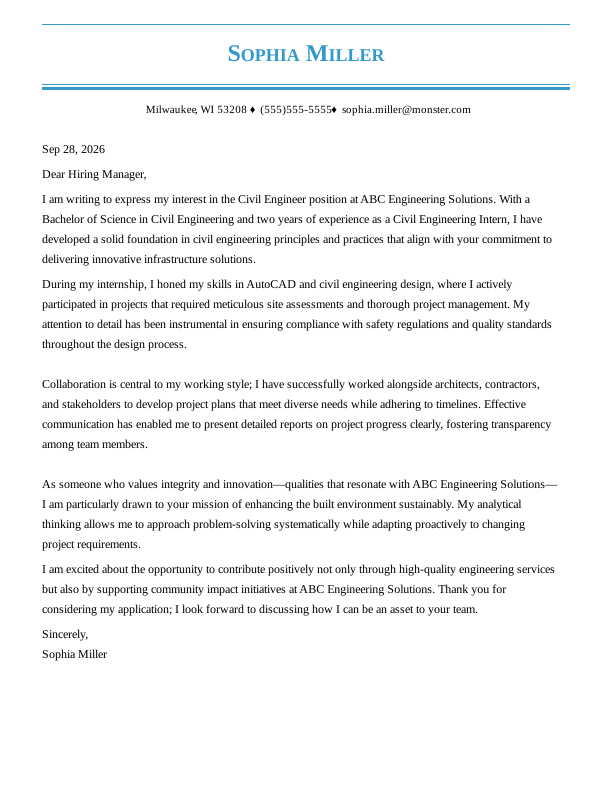
Civil Engineer Entry-Level Cover Letter
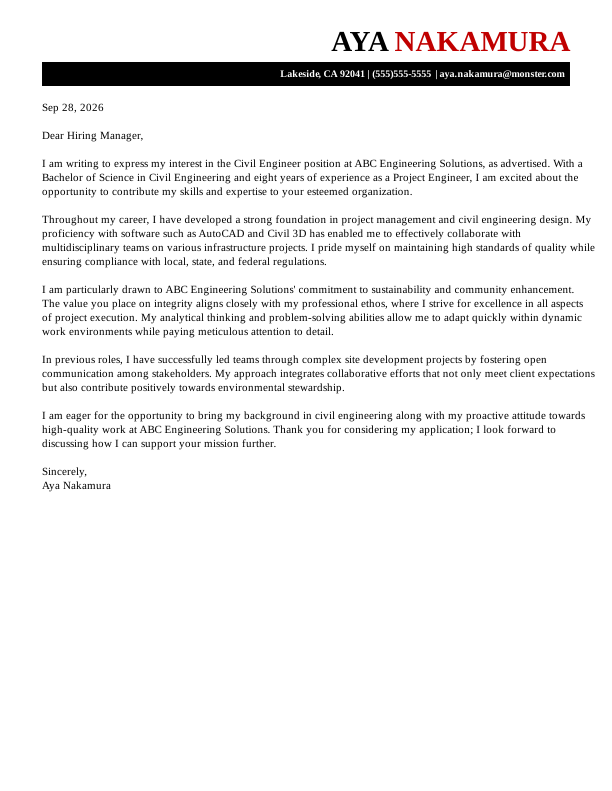
Civil Engineer Mid-Level Cover Letter
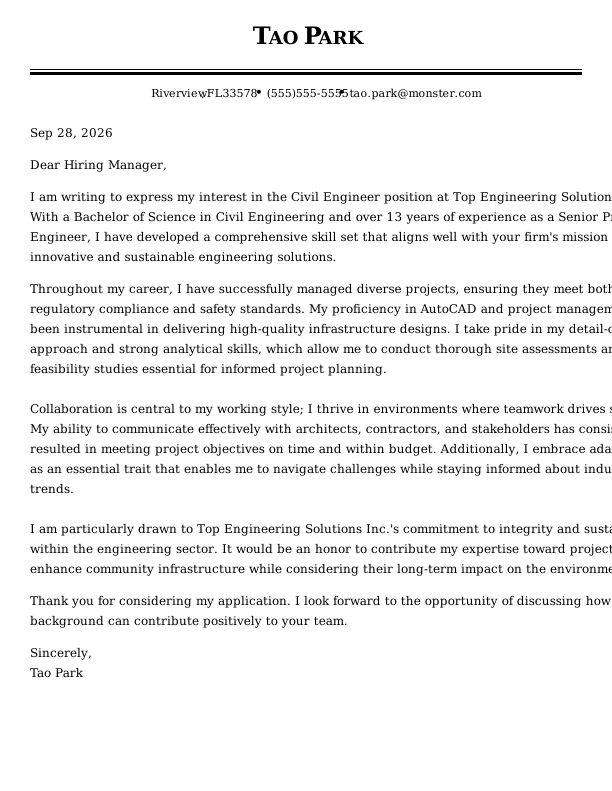
Civil Engineer Experienced Cover Letter
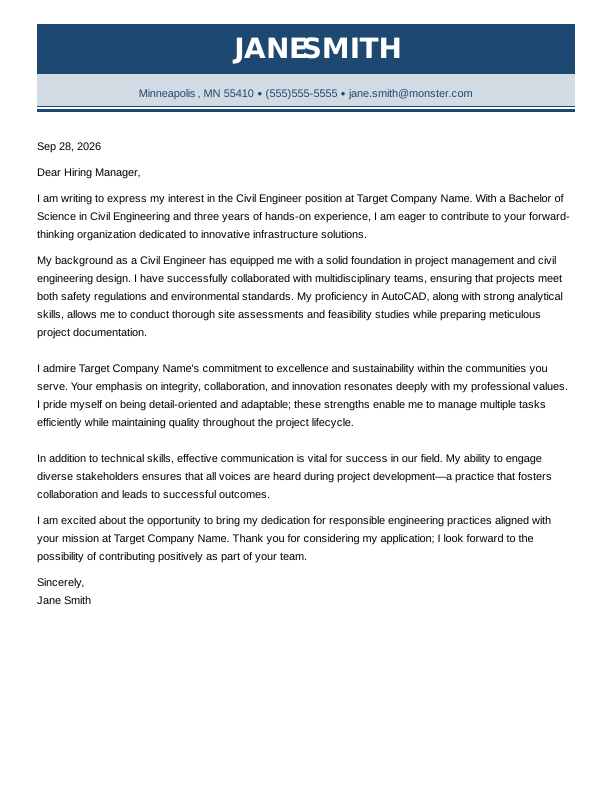
Civil Engineer Entry-Level Cover Letter
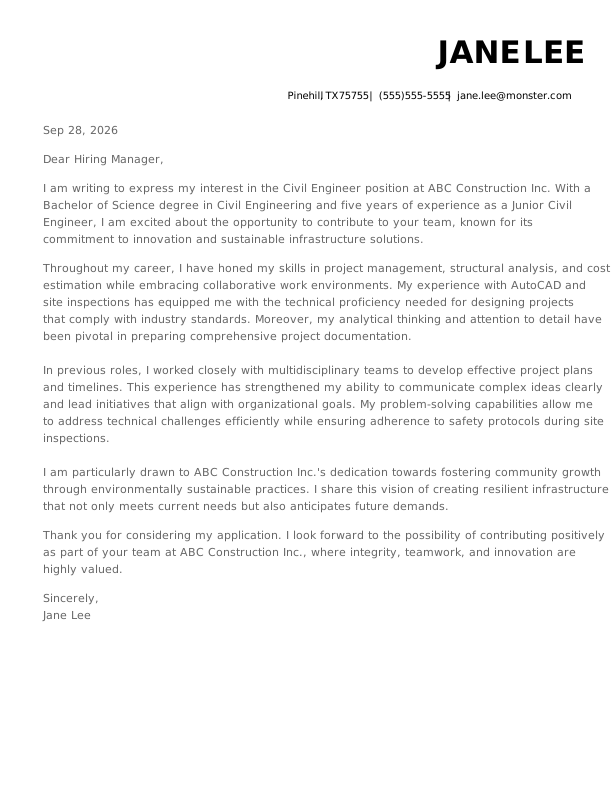
Civil Engineer Mid-Level Cover Letter
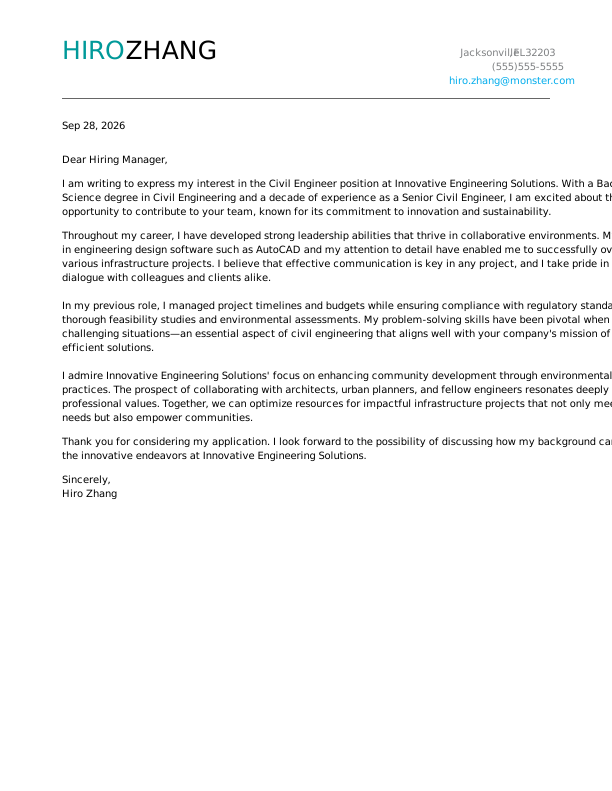
Civil Engineer Experienced Cover Letter
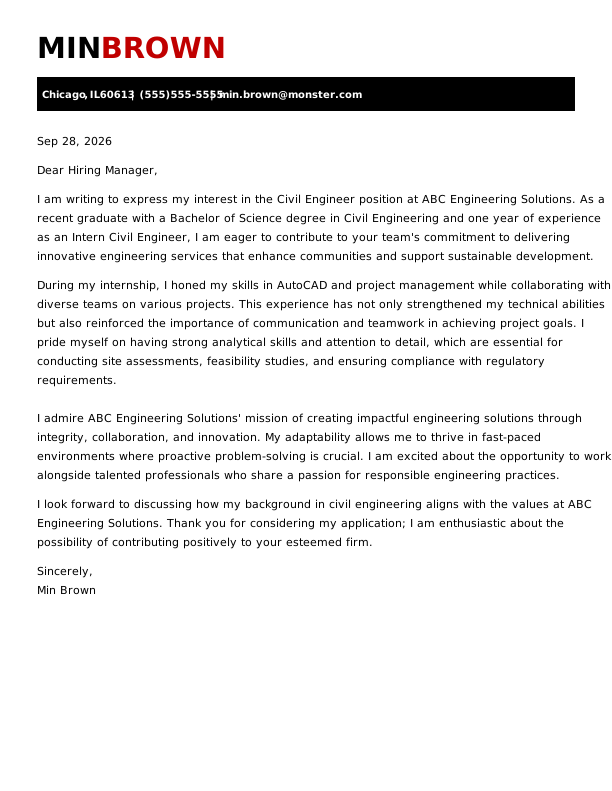
Civil Engineer Entry-Level Cover Letter
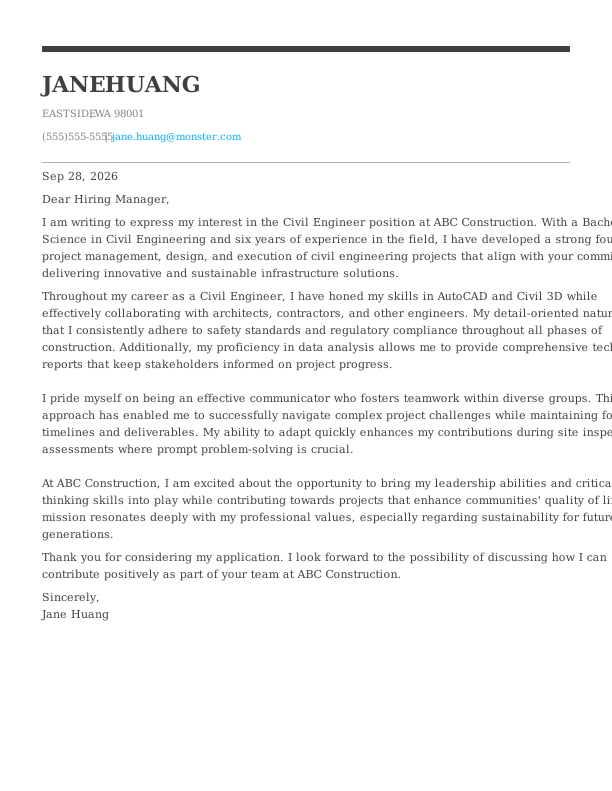
Civil Engineer Mid-Level Cover Letter
Browse Free Cover Letter Templates
- Academic
- Account Manager
- Accountant
- Accounts Payable
- Administrative Assistant
- Admissions Counselor
- Architecture
- Artist
- Assistant Principal
- Babysitter
- Barista
- Bartender
- Bookkeeper
- Brand Ambassador
- Business Analyst
- Business
- Caregiver
- Chef
- Civil Engineering
- Computer Science
- Construction
- Consulting
- Copywriter
- Cosmetology
- Custodian
- Customer Service
- Customer Service Representative
- Data Analyst
- Data Entry
- Dental Assistant
- Dental Hygienist
- Digital Marketing
- Electrical Engineering
- Emt
- Engineering
- Esthetician
- Event Coordinator
- Executive Assistant
- Finance
- Financial Analyst
- Firefighter
- Flight Attendant
- Graphic Designer
- Hair Stylist
- Healthcare
- Hr Generalist
- Investment Banking
- It
- Janitor
- Journalism
- Lab Technician
- Law Clerk
- Lawyer
- Librarian
- Logistics
- Makeup Artist
- Manager
- Marketing Coordinator
- Marketing
- Marketing Manager
- Massage Therapist
- Mechanic
- Mechanical Engineer
- Medical Assistant
- Non Profit
- Nursing
- Occupational Therapy
- Office Assistant
- Office Manager
- Operations Manager
- Paralegal
- Personal Trainer
- Pharmacist
- Pharmacy Technician
- Photographer
- Physician Assistant
- Pilot
- Police Officer
- Program Manager
- Project Manager
- Property Manager
- Psychology
- Receptionist
- Research Assistant
- Restaurant Manager
- Retail
- Sales
- Sales Manager
- School Counselor
- Security Officer
- Social Work
- Software Engineer
- Special Education Teacher
- Substitute Teacher
- Teacher
- Teaching Assistant
- Truck Driver
- Vet Tech
- Veterinary Assistant
- Web Developer
Cover Letter Examples for Civil Engineers
Cover letter requirements evolve as a civil engineer’s career progresses. Choose a template that matches your experience level so you can highlight the right skills, such as field training, design deliverables, or leadership in budgets and schedules.
Entry-Level Civil Engineer Cover Letter
Designed for recent graduates and career changers transitioning into civil engineering roles, this template offers a cover letter with little experience that still highlights fit and motivation.
Mid-Career Civil Engineer Cover Letter
Tailored to civil engineers several years into their careers, this template emphasizes project ownership, leading permitting or design reviews, and applying licensure goals.
Experienced Civil Engineer Cover Letter
Best suited for senior civil engineers, this template fits professionals who own project budgets and schedules, lead site assessments, and coordinate cross-functional stakeholders.
Civil Engineer Cover Letter Template (Text)
Paste this civil engineer cover letter text into your document, then adapt it by swapping in your project metrics, like bridge load calculations, and your target firm name.
Daniel Davis
Chicago, IL 60611
(555)555-5555
daniel.davis@monster.com
Sep 28, 2026
Dear Hiring Manager,
I am writing to express my interest in the Civil Engineer position at ABC Engineering Co. With a Bachelor of Science in Civil Engineering and nine years of experience as a Project Engineer, I am excited about the opportunity to contribute to your team, known for its commitment to innovative solutions and sustainable infrastructure.
Throughout my career, I have successfully managed various civil engineering projects from conception through completion. My proficiency in AutoCAD and Civil 3D has allowed me to create detailed designs while ensuring compliance with industry standards. I excel in conducting site assessments and collaborating with architects and contractors, fostering an environment where ideas can flourish.
I pride myself on being detail-oriented and analytical, always striving for high-quality outcomes. My strong communication skills enable me to prepare comprehensive technical reports and present complex information clearly to clients and stakeholders. Working collaboratively is fundamental for me; it not only enhances project efficiency but also encourages creative problem-solving amongst team members.
I admire ABC Engineering Co.’s dedication to integrity, innovation, and community impact. As someone who values adaptability within a collaborative environment, I am eager to bring my project management expertise along with my commitment to safety and quality control into your esteemed firm.
Thank you for considering my application. I look forward to the possibility of discussing how I can contribute positively towards the continued success of ABC Engineering Co.
Sincerely,
Daniel Davis
How to Write a Civil Engineer Cover Letter
As a civil engineer, knowing how to write a cover letter means translating your experience with blueprints, codes, and site plans into clear project examples. Learn how to write a cover letter using the steps below so you can tailor your material to one civil engineer job.
1. Research & Prepare
Start by researching what the engineering team is currently focused on.. Knowing their active priorities helps you tailor your cover letter to the exact design standards and tools they care about most.
Consider taking these steps during your prep:
- Identify key project requirements and required software from the job posting.
- Check local agency design manuals to see which codes take top priority.
- Review local council or board meeting minutes for updates on active project timelines and budgets.
2. Hook the Reader
Skip standard opening lines that just restate the job title. Instead, grab attention immediately by showcasing real engineering impact, such as permitting successes or design software expertise.
Here are a few ways to frame a strong opening hook:
- Focus on permitting efficiency: “I cut plan review cycles by 18% on a $6M roadway project by organizing stormwater calculations prior to submittal.”
- Highlight technical tool mastery: “For a major transit expansion, I modeled grading in Civil 3D and ran clash tests in Navisworks to eliminate field rework.”
- Demonstrate stakeholder leadership: “When mid-project ADA revisions were requested, I coordinated directly with inspectors and survey crews to keep work on schedule.”
3. Tell Your Professional Story
While your resume lists duties, your cover letter should explain the real-world results of your choices. Use specific metrics and scope details rather than vague phrases like “strong project management.”
Examples of impact-focused accomplishments include:
- Reduced change orders by 22% through value engineering on a bridge substructure.
- Delivered 1,800 linear feet of roadway grading with less than 3% schedule variance across multiple phases.
- Managed $6.4M in estimates, refining quantity takeoffs to save $85,000 in potential rework.
4. Showcase Your Skills
Instead of describing yourself with generic words like “detail-oriented,” share short stories that illustrate your engineering judgment in action. These examples show how you can bring technical skills to life:
- Quality control in construction: “Reviewed shop drawings against original plans to catch a grade mismatch before concrete was poured.”
- Applied civil design software: “Simulated stormwater flow in Civil 3D to evaluate how moving an inlet would perform during heavy storms.”
- Subcontractor collaboration: “Walked field crews through updated sequencing plans to guarantee safety compliance before restarting work.”
5. Explain Any Special Circumstances
Address career gaps, relocations, or industry shifts directly and briefly. Show that your skills and credentials remain up to date, giving hiring managers full confidence in your readiness.
These brief examples show how to address unique situations naturally:
- “After a six-month gap for family obligations, I stayed current by running weekly QA checks on survey data and documenting results for my local engineering mentor.”
- “I am pivoting from structural drafting into site civil to focus on grading and drainage design, having recently completed an EIT review while rebuilding my portfolio with StormCAD models.”
- “I relocated to Austin in April after working in Seattle, updating my Texas PE application status and familiarizing myself with local DOT field notes formats.”
6. End With a Professional Goodbye
Wrap up your letter with a clear request for an interview, a polite thank you, and a standard sign-off. Keep it focused and avoid generic phrases like “I look forward to hearing from you.”
Propose a specific conversation topic, such as: “I would welcome the opportunity to discuss your upcoming bridge inspection goals.”
Express appreciation for their consideration, then close professionally with “Sincerely” or “Best regards,” followed by your full name.
4 Tips for Formatting Your Cover Letter
Hiring managers usually scan applications in seconds. Follow these tips to help the hiring manager quickly spot site experience, project scope, and key skills like permitting or design calculations.

Keep It to One Page
Keep your letter short and easy to skim. Aim for 250–400 words over three to four brief paragraphs. Highlight key details like your PE license, a solid project result, and tools like AutoCAD Civil 3D.

Use a Professional Font & Layout
Use clean fonts like Arial or Helvetica at 10–12 pt with 1-inch margins so your letter is easy to read. Match the layout and header style of your resume for a clean, consistent look.

Match Your Header to Your Resume
Use the same contact details, header design, and font choices on both your resume and cover letter. A matching style creates a polished presentation across all your application materials.

Use Bullet Points for Key Achievements
Use three to four bullet points to showcase your top civil engineering wins, like meeting project timelines, staying under budget, or achieving zero safety incidents. Bullet points make key accomplishments quick and easy to read.
Top-Paying States for Civil Engineer Roles
Knowing what civil engineers earn helps you compare offers, plan your career path, and negotiate with confidence. Salary ranges below are based on the U.S. Bureau of Labor Statistics (BLS) and reflect recent nationwide averages.
Keep in mind that pay can vary by location, project type, years of experience, and whether you work in consulting firms, government agencies, or in-house engineering teams. Specialized work like transportation or structural projects may also affect compensation. Your schedule and licensing status can play a role too.
| Alabama | $104,270 |
| Alaska | $115,250 |
| Arizona | $97,630 |
| Arkansas | $88,250 |
| California | $122,050 |
| Connecticut | $108,950 |
| Delaware | $105,080 |
| District of Columbia | $115,370 |
| Florida | $105,830 |
| Georgia | $97,220 |
| Hawaii | $97,590 |
| Idaho | $96,980 |
| Illinois | $104,430 |
| Indiana | $96,510 |
| Iowa | $96,450 |
| Kansas | $96,880 |
| Kentucky | $99,830 |
| Louisiana | $107,690 |
| Maine | $97,780 |
| Maryland | $105,910 |
| Massachusetts | $115,780 |
| Michigan | $93,670 |
| Minnesota | $106,880 |
| Mississippi | $115,570 |
| Missouri | $97,050 |
| Montana | $86,270 |
| Nebraska | $101,800 |
| Nevada | $105,950 |
| New Hampshire | $94,210 |
| New Jersey | $114,220 |
| New Mexico | $108,000 |
| New York | $116,630 |
| North Carolina | $100,500 |
| North Dakota | $95,750 |
| Ohio | $97,590 |
| Oklahoma | $104,330 |
| Oregon | $110,280 |
| Pennsylvania | $98,860 |
| Rhode Island | $116,550 |
| South Carolina | $104,430 |
| South Dakota | $96,590 |
| Tennessee | $102,150 |
| Texas | $103,010 |
| Utah | $96,620 |
| Vermont | $95,190 |
| Virginia | $101,020 |
| Washington | $112,740 |
| West Virginia | $91,880 |
| Wisconsin | $96,450 |
| Wyoming | $99,540 |
| Guam | $75,240 |
| Puerto Rico | $72,160 |
Key Takeaways
- Tailor your cover letter to the engineering team’s current projects, design tools, and local codes.
- Showcase quantifiable engineering achievements and specific technical software expertise rather than generic descriptions.
- Keep your letter concise, professional, and visually aligned with your resume layout.
Browse Monster’s Resume Templates
Monster also has hundreds of ATS-friendly resume templates for all career levels and industries. Create a matching resume to help you land the interview.
- Aerospace Engineer
- Agricultural Engineer
- Ai Engineer
- Automation Engineer
- Bim Engineer
- Biomedical Engineering
- Chemical Engineering
- Civil Engineer
- Controls Engineer
- Design Engineer
- Electrical Engineer
- Embedded Systems Engineer
- Engineering Manager
- Engineering Project Manager
- Engineering
- Enterprise Architect
- Environmental Engineer
- Field Engineer
- Industrial Engineer
- Mechanical Engineer
- Petroleum Engineer
- Robotics Engineer
- System Engineer
- Test Engineer
Frequently Asked Questions
Last Update:
Do I really need a cover letter?
Yes, writing a cover letter is a great idea, especially in engineering where clear communication matters just as much as technical skills.
While your resume lists your software proficiency and project history, a cover letter tells the real-world story behind those numbers. It highlights how you manage site challenges, collaborate with multidisciplinary teams, and align with a company’s goals, giving hiring managers a complete picture of your professional judgment.
How long should my cover letter be?
Your cover letter should always fit on a single page, ideally staying between 250 and 400 words spread across three to four brief paragraphs.
This concise length ensures hiring managers can quickly skim your letter, grasp your key engineering achievements, and evaluate your communication style without getting bogged down by unnecessary details. Keeping it brief shows you respect their time and know how to communicate clearly.
Should my cover letter match my resume?
Yes, your cover letter should match your resume in both visual style and formatting. Using the same contact details, header design, font choices, and margins creates a clean, cohesive presentation across all your application materials.
This polished consistency makes it easy for hiring managers to connect your cover letter directly to your resume while reinforcing your professional attention to detail from the very first glance.
What should I include in my cover letter header?
Your cover letter header should include your full name, phone number, professional email address, and LinkedIn profile or portfolio link. You can also add the date and the employer’s contact information below your own details.
How do I write a cover letter for an internal position?
When applying for an internal engineering role, focus on highlighting your proven track record within the company and how your current experience directly translates to the new team’s goals.
Mention specific projects you have successfully delivered, internal tools or processes you already master, and how your institutional knowledge reduces onboarding time. Keep the tone professional yet familiar, emphasizing your continued dedication to the company’s long-term mission.

Toni Frana is a Certified Professional Resume Writer (CPRW), member of the Professional Association of Resume Writers & Career Coaches, and career expert who empowers job seekers to take control of their career paths using Monster’s comprehensive job search and resume tools.
See More From Toni FranaExplore Related Career Advice







How to Write a Cover Letter for Internal Positions or Promotions (Examples & Tips)

Updated:
Apr 23, 2026
|
19 min read


Cover Letter vs Resume: What’s the Difference & Do You Need Both?

Updated:
Apr 23, 2026
|
18 min read