

Free Dentist Cover Letter Templates & Examples
A strong dentist cover letter shows you deliver gentle, high-quality clinical care, build patient trust, and manage treatment plans effectively. Our cover letter examples and step-by-step guidance help you highlight your clinical skills and create a polished, confident application for hiring managers.
Real-World Cover Letters That Get Results
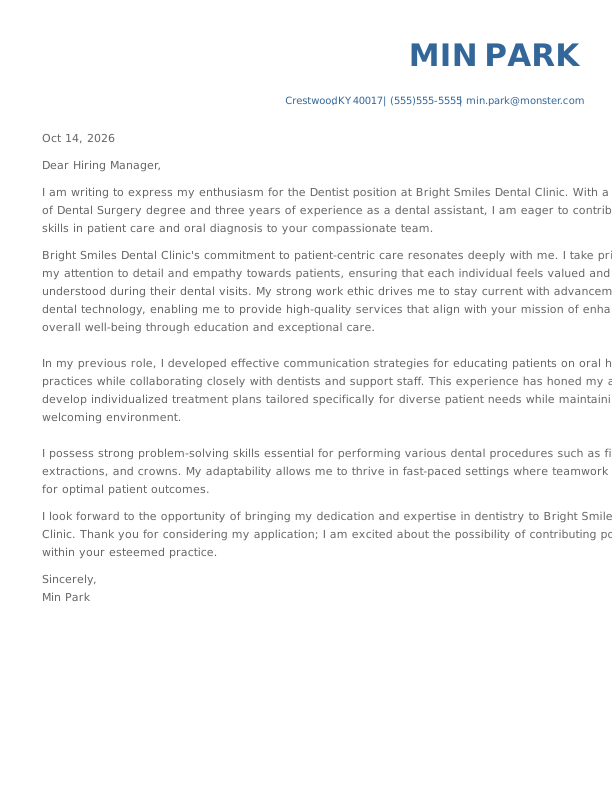
 Free
Dentist Entry-Level Cover Letter
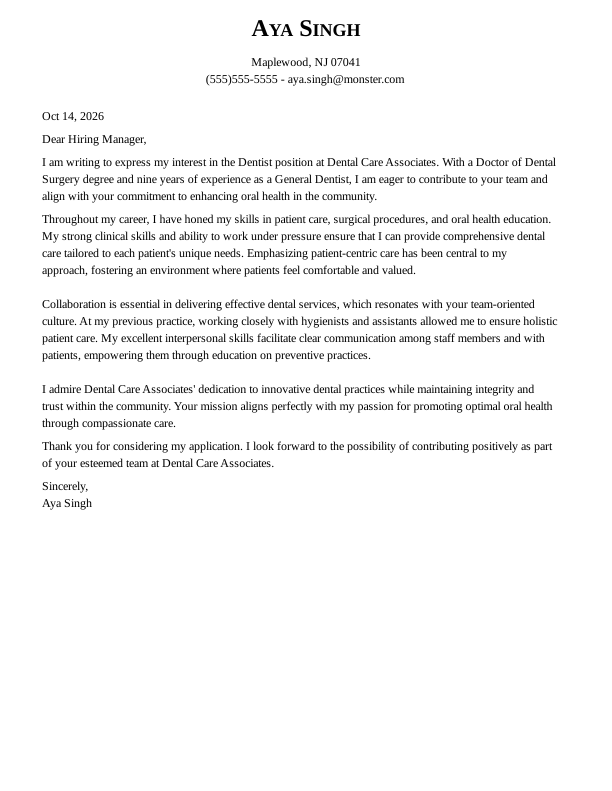
Dentist Mid-Level Cover Letter
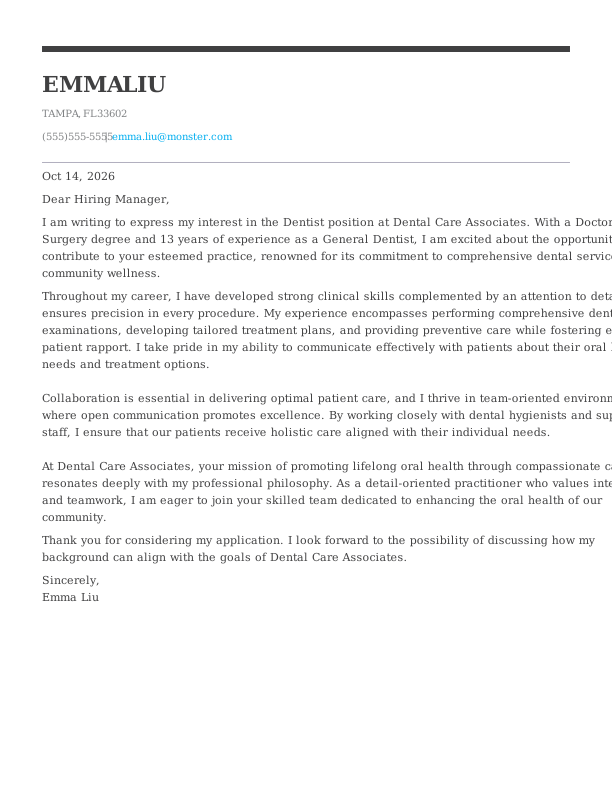
Dentist Experienced Cover Letter
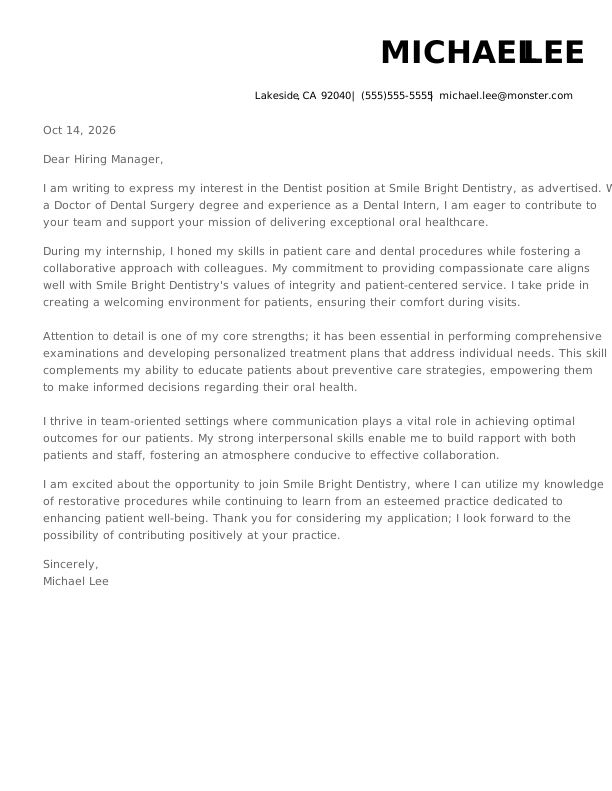
Dentist Entry-Level Cover Letter
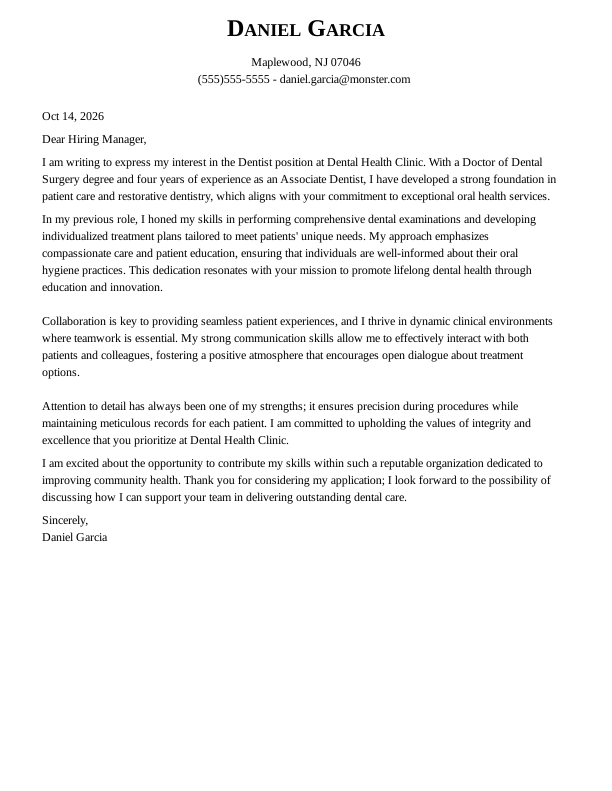
Dentist Mid-Level Cover Letter
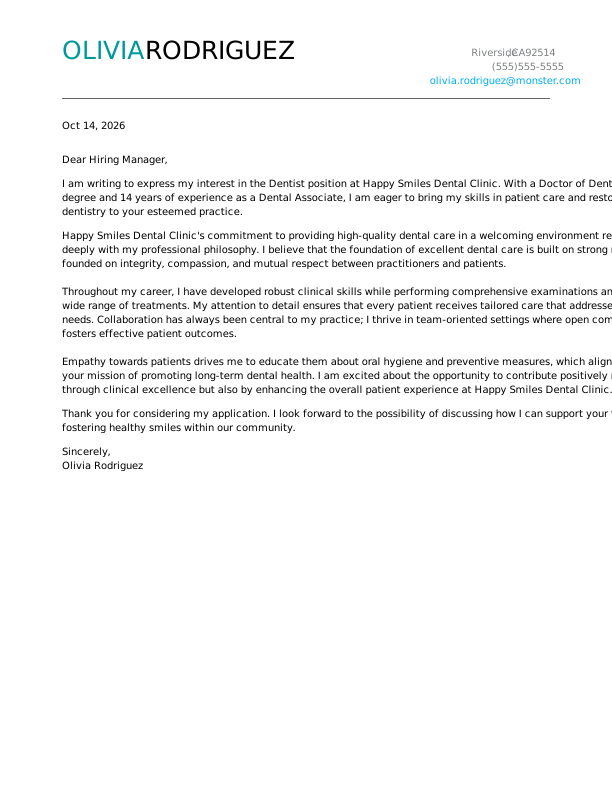
Dentist Experienced Cover Letter
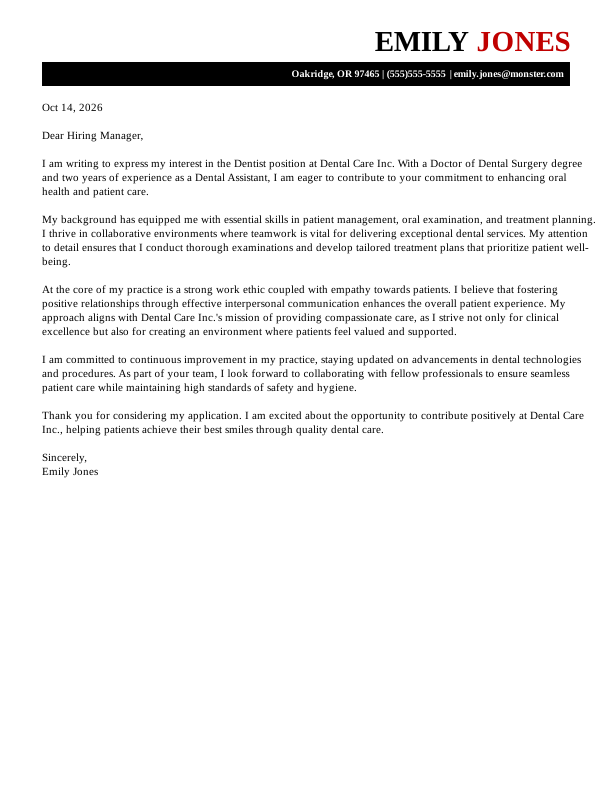
Dentist Entry-Level Cover Letter
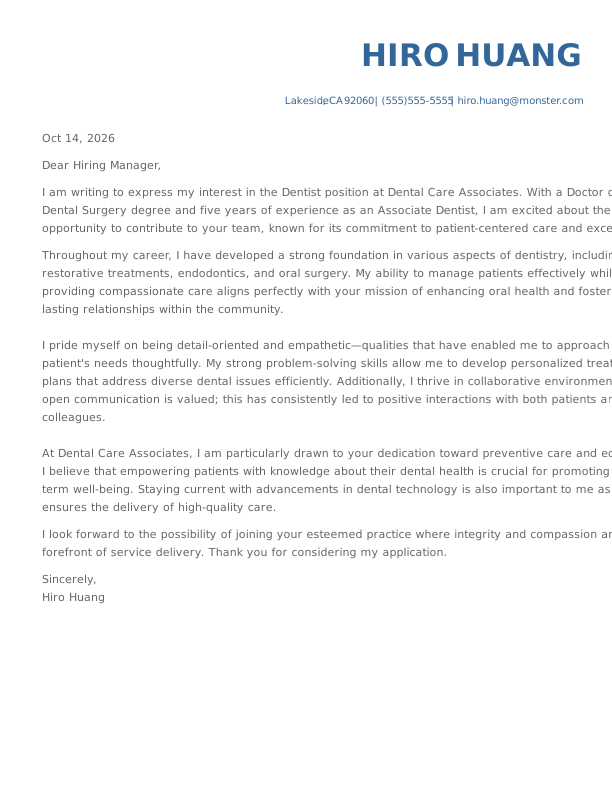
Dentist Mid-Level Cover Letter
Browse Free Cover Letter Templates
- Academic
- Account Manager
- Accountant
- Accounts Payable
- Administrative Assistant
- Admissions Counselor
- Architecture
- Artist
- Assistant Principal
- Babysitter
- Barista
- Bartender
- Bookkeeper
- Brand Ambassador
- Business Analyst
- Business
- Caregiver
- Chef
- Civil Engineering
- Computer Science
- Construction
- Consulting
- Copywriter
- Cosmetology
- Custodian
- Customer Service
- Customer Service Representative
- Data Analyst
- Data Entry
- Dental Assistant
- Dental Hygienist
- Digital Marketing
- Electrical Engineering
- Emt
- Engineering
- Esthetician
- Event Coordinator
- Executive Assistant
- Finance
- Financial Analyst
- Firefighter
- Flight Attendant
- Graphic Designer
- Hair Stylist
- Healthcare
- Hr Generalist
- Investment Banking
- It
- Janitor
- Journalism
- Lab Technician
- Law Clerk
- Lawyer
- Librarian
- Logistics
- Makeup Artist
- Manager
- Marketing Coordinator
- Marketing
- Marketing Manager
- Massage Therapist
- Mechanic
- Mechanical Engineer
- Medical Assistant
- Non Profit
- Nursing
- Occupational Therapy
- Office Assistant
- Office Manager
- Operations Manager
- Paralegal
- Personal Trainer
- Pharmacist
- Pharmacy Technician
- Photographer
- Physician Assistant
- Pilot
- Police Officer
- Program Manager
- Project Manager
- Property Manager
- Psychology
- Receptionist
- Research Assistant
- Restaurant Manager
- Retail
- Sales
- Sales Manager
- School Counselor
- Security Officer
- Social Work
- Software Engineer
- Special Education Teacher
- Substitute Teacher
- Teacher
- Teaching Assistant
- Truck Driver
- Vet Tech
- Veterinary Assistant
- Web Developer
Cover Letter Examples for Dentists
As a dentist advances from new graduate to experienced clinician, cover letter priorities change. Choose the template that matches your career stage so you can highlight relevant training, patient-care experience, and outcomes like treatment planning, chairside skills, or practice leadership.
Entry-Level Dentist Cover Letter
Ideal for recent graduates and career changers, this cover letter template helps you showcase your clinical training, education, and foundational skills in patient care, diagnostics, and preventive dentistry.
Mid-Career Dentist Cover Letter
Designed for dentists with several years of clinical practice, this template helps you highlight your experience managing complex treatment plans, leading chairside teams, and maintaining high standards of patient care.
Experienced Dentist Cover Letter
Tailored for seasoned practitioners, this template highlights your clinical expertise, leadership in practice management, mentorship of hygiene and support staff, and long-term commitment to community oral health.
Dentist Cover Letter Template (Text)
Copy this dentist cover letter template, paste it into your document, and swap in your patient-care experience and any specialty training or clinic names.
Emma Lee
Riverside, CA 92510
(555)555-5555
emma.lee@monster.com
Oct 14, 2026
Dear Hiring Manager,
I am writing to express my interest in the dentist position at Dental Health Clinic. With a Doctor of Dental Surgery degree and seven years of experience as an associate dentist, I am eager to contribute my skills and expertise to your esteemed clinic, which is known for its commitment to exceptional patient care and community wellness.
Throughout my career, I have developed a strong foundation in patient care and clinical skills. My experience includes conducting thorough dental examinations, diagnosing oral health conditions, and implementing individualized treatment plans tailored to each patient’s needs. This aligns with your mission of providing personalized approaches to dental health.
My proficiency in various dental procedures such as fillings, extractions, and root canals has been complemented by effective communication skills that foster strong relationships with patients. I believe that educating patients about oral hygiene practices is essential for promoting preventive care—a value that resonates with the core principles of Dental Health Clinic.
I pride myself on being detail-oriented and organized in managing multiple tasks efficiently while ensuring a compassionate atmosphere for all patients. My ability to collaborate effectively with dental hygienists and support staff reflects my commitment to teamwork in delivering optimal patient outcomes.
I am enthusiastic about the opportunity to join a team that shares my dedication to enhancing quality of life through advanced dental techniques. Thank you for considering my application; I look forward to the possibility of contributing positively at Dental Health Clinic.
Sincerely,
Emma Lee
How to Write a Dentist Cover Letter
Writing a strong cover letter as a dentist means showing how you combine clinical skills with a gentle, patient-centered approach to care. Following a clear structure ensures you present your diagnostic capabilities, procedural experience, and practice fit in a focused message for every application.
1. Research & Prepare
Before you start writing, research the practice to understand its patient demographics, clinical focus, and daily operations. Knowing whether the clinic prioritizes general family care, same-day restorative procedures, or specialized treatments allows you to tailor your message to its exact needs.
Here are a few places to gather helpful details before drafting your letter:
- Review the job description to identify required software, digital imaging tools, and clinical duties.
- Check the state dental board website to confirm licensing requirements and continuing education expectations.
- Scan recent clinic announcements or local news to learn about practice expansions or community health initiatives.
2. Hook the Reader
Grab the hiring manager’s attention right away by sharing a specific clinical result or chairside achievement rather than using a standard opening sentence. Highlighting your experience with patient flow, clinical efficiency, or care quality shows you can contribute immediately to the practice.
Here are examples of strong openings that show clinical skill in action:
- “In my previous role, I averaged 22 minutes per restorative appointment while keeping same-day crown preparations on track using digital impressions and chairside CAD-CAM technology.”
- “After updating our periodontal documentation protocols, I ensured full probing depth charts for every recall patient and reduced missing records by 30% over two quarters.”
- “By collaborating with our front desk team on pre-visit patient communications, I helped cut appointment no-shows by 15% through coordinated text reminders.”
3. Tell Your Professional Story
Your resume lists your dental degree and clinical rotations, but your cover letter explains the actual impact you have on patient outcomes and daily practice flow. Adding concrete metrics helps dental directors picture your clinical efficiency and communication strengths.
Here are a few ways to turn routine clinical tasks into clear accomplishment statements:
- Reduced average patient wait times from 18 minutes to 9 minutes by streamlining check-in procedures and verifying insurance prior to appointments.
- Increased new-patient treatment acceptance rates from 62% to 74% over six months by standardizing case presentations and follow-up communications.
- Completed an average of 28 restorative cases per week while maintaining a 98% on-time appointment completion rate.
4. Showcase Your Skills
Rather than simply stating that you have strong clinical skills or a great chairside manner, describe a real moment where you put those skills to work in the clinic. Pointing to specific procedures, imaging software, or patient interactions proves you can handle the daily demands of a dental practice.
Here are practical examples of key clinical skills in action:
- Digital X-rays and diagnostics: “I took digital bitewing images, reviewed alignment on-screen, and retook captures immediately when clarity was insufficient for an accurate diagnosis.”
- Treatment plan communication: “I explained exam findings and procedure options in plain terms, using intraoral camera photos to help patients understand their treatment before moving forward.”
- Charting and safety: “I updated patient records immediately following each procedure and verified medical histories in our EHR software to ensure complete safety before prescribing medications.”
5. Explain Any Special Circumstances
If you have a gap in practice, are transitioning between dental specialties, or recently relocated to a new state, address it clearly in one or two sentences before steering the conversation back to your clinical readiness. Practices want to see that your state license is current and that your clinical skills are sharp.
Here are simple ways to explain different career scenarios:
- “After taking time off for family leave, I maintained my clinical readiness by completing continuing education courses in restorative dentistry and assisting with same-day crown procedures.”
- “I am expanding my focus into cosmetic and implant dentistry, having recently completed advanced training in CAD-CAM workflows and implant placement techniques.”
- “Since relocating to Arizona last fall, I have completed all state licensing requirements and am ready to begin practicing immediately.”
6. End With a Professional Goodbye
Close your cover letter with a polite, confident call to action that invites the hiring manager to connect with you. Avoid passive closing lines, and instead offer a specific topic for discussion during an interview.
You can write, “I would welcome the opportunity to discuss how my clinical experience, diagnostic skills, and patient-centered approach can support your practice goals.”
Follow this with “Thank you for your time and consideration,” and end with a professional closing like “Sincerely” or “Best regards.”
4 Tips for Formatting Your Cover Letter
Dental professionals are expected to maintain precision and clear documentation, so a neatly structured cover letter reflects your attention to detail from the very beginning. Take the time to organize your page and use these formatting tips to ensure your top clinical qualifications stand out during a quick scan.

Use a Professional Font & Layout
Choose a clean, easy-to-read font like Arial, Calibri, Georgia, or Helvetica set between 10 pt and 12 pt. Use standard 1-inch margins on all sides and align your document header with your resume to present a consistent, highly professional application.

Address the Hiring Manager Directly
Look for the name of the lead dentist, practice manager, or clinic director on the job posting, practice website, or professional directory. Addressing the hiring manager by name shows attention to detail, but if no specific name is available, professional greetings like “Dear Hiring Manager” or “Dear Dental Team” work well.

Match Your Header to Your Resume
Use the same name styling, degree credentials, contact details, and font choices for both your cover letter header and your resume header. Creating a consistent header across your documents helps the hiring team connect your materials instantly during review.

Save & Send as a PDF
Save your cover letter as a PDF to preserve your margins, line spacing, and formatting across different devices and operating systems. Name the file clearly using a standard format like Firstname_Lastname_Cover_Letter.pdf so recruiters can identify your application easily.
Top-Paying States for Dentist Roles
Knowing what dentists earn helps you compare offers, plan your career path, and negotiate with confidence. The salary information below is based on the U.S. Bureau of Labor Statistics (BLS) and reflects the most recent nationwide averages for dentists.
Keep in mind that pay can vary a lot depending on where you practice, how long you have been working, and the type of practice setting. For example, high-demand specialties and busy private practices may offer different compensation than general dentistry roles or lower-volume locations.
| Alabama | $230,260 |
| Alaska | $202,250 |
| Arizona | $258,450 |
| Arkansas | $188,920 |
| California | $184,350 |
| Connecticut | $290,670 |
| Delaware | $228,740 |
| Florida | $196,320 |
| Georgia | $203,300 |
| Hawaii | $136,200 |
| Idaho | $173,570 |
| Illinois | $240,740 |
| Indiana | $209,500 |
| Iowa | $216,520 |
| Kansas | $292,360 |
| Kentucky | $179,380 |
| Louisiana | $249,170 |
| Maine | $224,080 |
| Maryland | $203,500 |
| Massachusetts | $218,190 |
| Michigan | $202,390 |
| Minnesota | $224,700 |
| Mississippi | $143,020 |
| Missouri | $225,340 |
| Montana | $223,020 |
| Nebraska | $185,360 |
| Nevada | $146,480 |
| New Hampshire | $176,780 |
| New Jersey | $195,230 |
| New Mexico | $207,820 |
| New York | $185,590 |
| North Carolina | $205,990 |
| North Dakota | $224,300 |
| Ohio | $219,770 |
| Oklahoma | $214,790 |
| Oregon | $209,670 |
| Pennsylvania | $201,540 |
| South Carolina | $246,490 |
| South Dakota | $166,690 |
| Tennessee | $191,880 |
| Texas | $244,950 |
| Utah | $148,860 |
| Vermont | $240,740 |
| Virginia | $228,290 |
| Washington | $203,780 |
| West Virginia | $198,990 |
| Wisconsin | $234,770 |
| Wyoming | $154,030 |
| Puerto Rico | $87,230 |
Key Takeaways
- Show your diagnostic and clinical abilities by sharing a specific example of how you explained a treatment plan and secured patient trust.
- Support your experience with clear metrics, such as treatment acceptance rates, appointment wait times, or procedural volume.
- Tailor your letter to the practice environment, focusing on chairside efficiency for private practices, compliance for dental service organizations, or community health access for public clinics.
More Cover Letter Examples
Browse Monster’s Resume Templates
Monster also has hundreds of ATS-friendly resume templates for all career levels and industries. Create a matching resume to help you land the interview.
Frequently Asked Questions
Last Update:
Do I really need a cover letter?
Yes. Including a cover letter is strongly recommended for a dentist application, even if the job posting lists it as optional. While your resume outlines your education, license, and clinical duties, a cover letter explains your care philosophy, patient communication style, and practice fit. It also gives you space to explain relevant context, such as a career transition, relocation, or employment gap.
How long should my cover letter be?
A dentist cover letter should fit on a single page and stay between 250 and 400 words. Clinical directors and practice managers review applications quickly, so concise writing helps your main strengths stand out right away. Focus on three or four short paragraphs that highlight your most relevant clinical accomplishments, procedural experience, and dedication to patient care.
Should my cover letter match my resume?
Yes, your dentist cover letter should match your resume’s visual formatting to present a clean, unified application package. Use the same font style, text size, margins, and contact header across both documents. While the visual design matches, your cover letter text should expand on specific clinical successes and care strategies rather than repeating your resume line for line.
What should I include in my cover letter header?
Your cover letter header should display your full name, clinical credentials, phone number, professional email address, and current city and state. Below that personal information, add the date, followed by the hiring manager’s name, title, and practice address if available. Keeping this header identical to your resume header creates a cohesive visual presentation.
How do I write a cover letter for an internal position?
When writing a cover letter for an internal dentist position, restate your commitment to the practice by highlighting your familiarity with its clinical workflows, patient care protocols, and team structure. Mention specific contributions you have made in your current role, such as improving appointment efficiency or patient retention, and explain how you plan to support the clinic in this advanced position.

Kirsten Chorpenning is a career advice writer who empowers job seekers to take control of their career paths using Monster’s comprehensive job search and resume tools. She specializes in helping job seekers find rewarding jobs in today’s dynamic work environment.
See More From Kirsten ChorpenningExplore Related Career Advice







How to Write a Cover Letter for Internal Positions or Promotions (Examples & Tips)
Updated:
Apr 23, 2026
|
19 min read


Cover Letter vs Resume: What’s the Difference & Do You Need Both?

Updated:
Apr 23, 2026
|
18 min read