

Free Physician Cover Letter Templates & Examples
A strong physician cover letter shows you can deliver compassionate, high-quality patient care while collaborating smoothly across healthcare teams. Our cover letter templates and practical tips help you present your clinical skills and medical background clearly so hiring managers see your value.
Real-World Cover Letters That Get Results
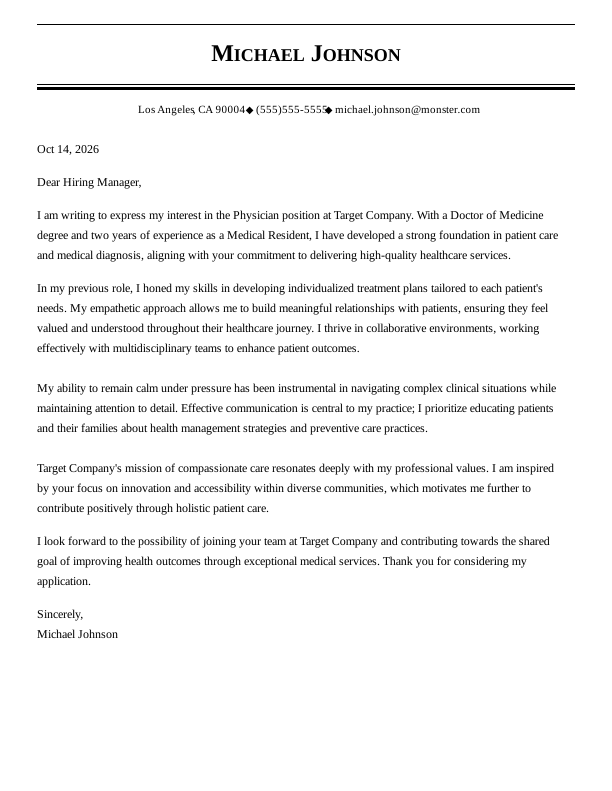
 Free
Physician Entry-Level Cover Letter
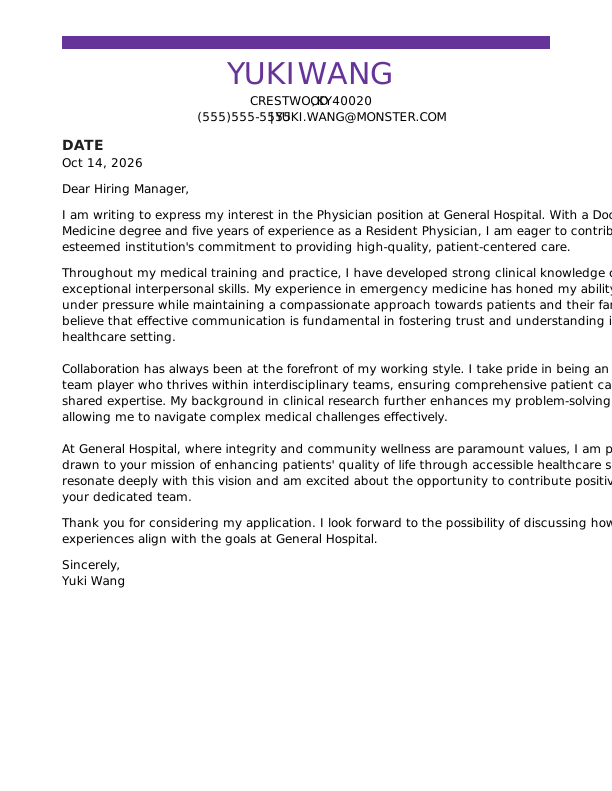
Physician Mid-Level Cover Letter
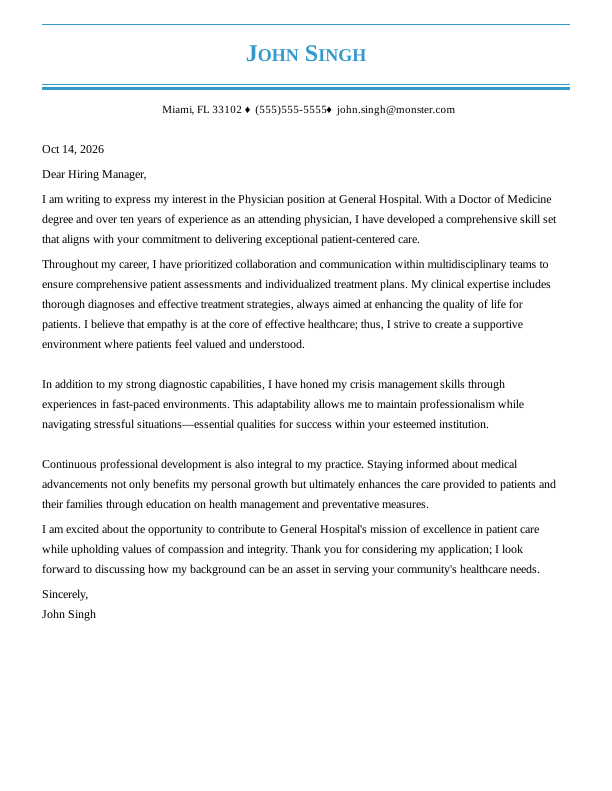
Physician Experienced Cover Letter
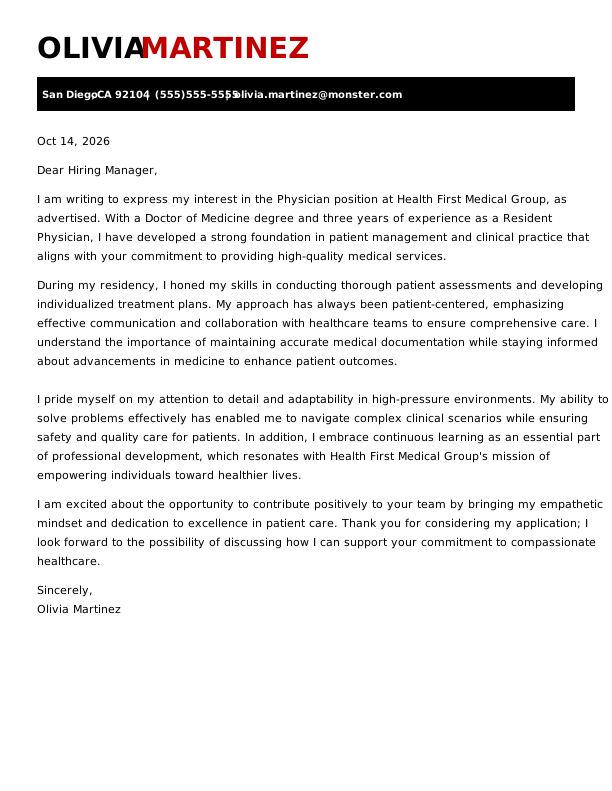
Physician Entry-Level Cover Letter
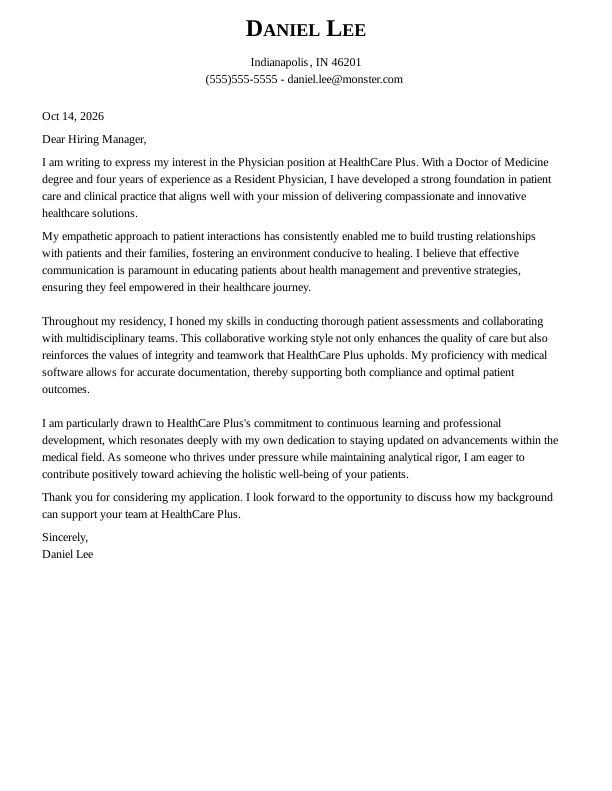
Physician Mid-Level Cover Letter
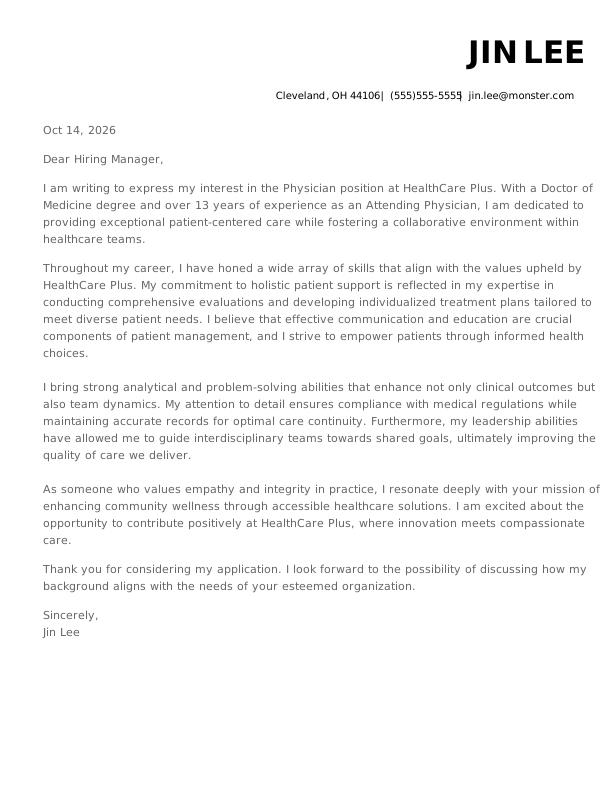
Physician Experienced Cover Letter
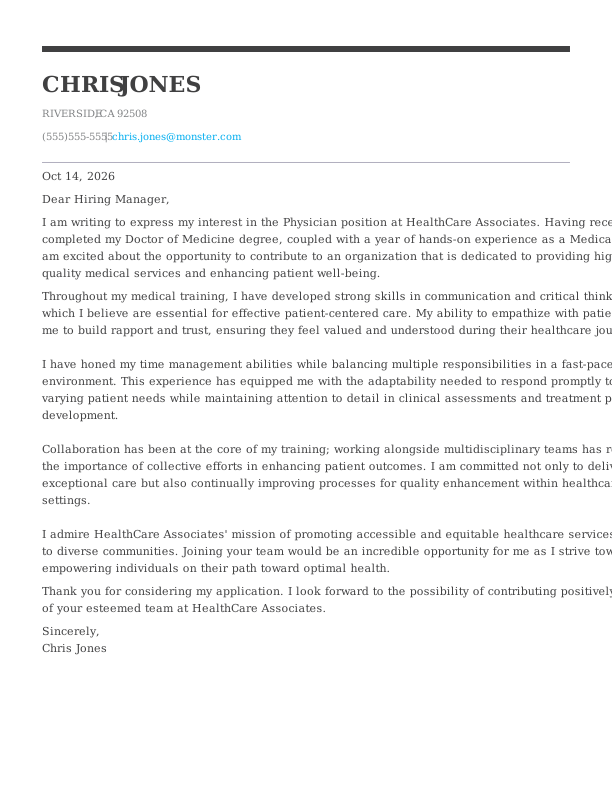
Physician Entry-Level Cover Letter
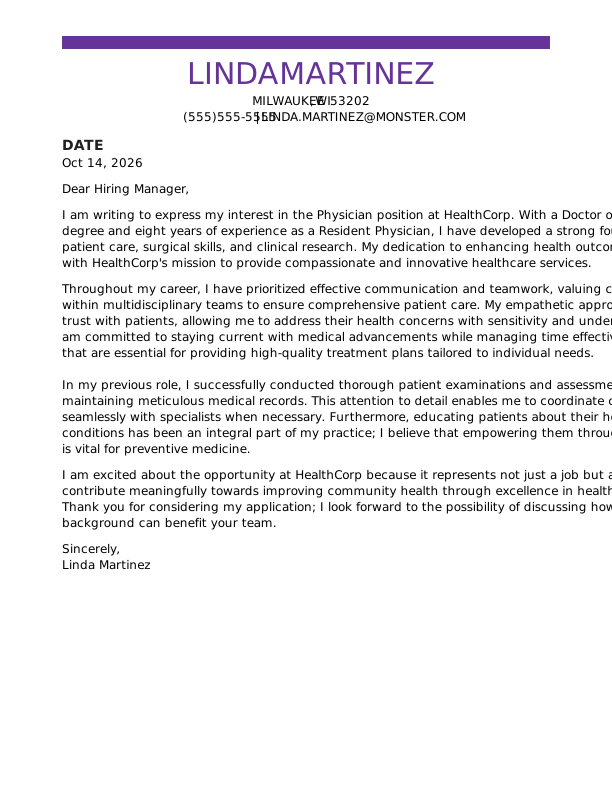
Physician Mid-Level Cover Letter
Browse Free Cover Letter Templates
- Academic
- Account Manager
- Accountant
- Accounts Payable
- Administrative Assistant
- Admissions Counselor
- Architecture
- Artist
- Assistant Principal
- Babysitter
- Barista
- Bartender
- Bookkeeper
- Brand Ambassador
- Business Analyst
- Business
- Caregiver
- Chef
- Civil Engineering
- Computer Science
- Construction
- Consulting
- Copywriter
- Cosmetology
- Custodian
- Customer Service
- Customer Service Representative
- Data Analyst
- Data Entry
- Dental Assistant
- Dental Hygienist
- Digital Marketing
- Electrical Engineering
- Emt
- Engineering
- Esthetician
- Event Coordinator
- Executive Assistant
- Finance
- Financial Analyst
- Firefighter
- Flight Attendant
- Graphic Designer
- Hair Stylist
- Healthcare
- Hr Generalist
- Investment Banking
- It
- Janitor
- Journalism
- Lab Technician
- Law Clerk
- Lawyer
- Librarian
- Logistics
- Makeup Artist
- Manager
- Marketing Coordinator
- Marketing
- Marketing Manager
- Massage Therapist
- Mechanic
- Mechanical Engineer
- Medical Assistant
- Non Profit
- Nursing
- Occupational Therapy
- Office Assistant
- Office Manager
- Operations Manager
- Paralegal
- Personal Trainer
- Pharmacist
- Pharmacy Technician
- Photographer
- Physician Assistant
- Pilot
- Police Officer
- Program Manager
- Project Manager
- Property Manager
- Psychology
- Receptionist
- Research Assistant
- Restaurant Manager
- Retail
- Sales
- Sales Manager
- School Counselor
- Security Officer
- Social Work
- Software Engineer
- Special Education Teacher
- Substitute Teacher
- Teacher
- Teaching Assistant
- Truck Driver
- Vet Tech
- Veterinary Assistant
- Web Developer
Cover Letter Examples for Physicians
Cover letter expectations change as a physician’s career progresses, especially from clinical training to broader patient management and leadership. Choose the template that matches your experience level so you can highlight the right skills, rotations, certifications, or outcomes.
Entry-Level Physician Cover Letter
Designed for recent medical graduates, residents, and career changers, this template helps you highlight your clinical training, foundational skills, and readiness to learn.
Mid-Career Physician Cover Letter
Designed for physicians with several years of clinical practice, this template emphasizes independent patient management, specialized expertise, and effective team leadership.
Experienced Physician Cover Letter
Best suited for senior physicians and department leaders, this template highlights strategic care management, clinical leadership, and a strong track record of quality patient outcomes.
Physician Cover Letter Template (Text)
Copy this physician cover letter template, paste it into your document, and swap in your specialties, patient-care outcomes, and target hospital or clinic.
Stephanie Butler
Portland, ME 04102
(555)555-5555
stephanie.butler@monster.com
Oct 14, 2026
Dear Hiring Manager,
I am writing to express my interest in the Physician position at Advanced Health Systems. With a Doctor of Medicine degree and seven years of experience as a resident physician, I am committed to providing high-quality, patient-centered care that aligns with your organization’s mission of improving health outcomes through innovation and collaboration.
Throughout my medical career, I have developed strong analytical skills and a deep empathy for patients, which enables me to approach complex medical situations with compassion and insight. My experience in patient care has equipped me with the ability to perform thorough evaluations, develop accurate diagnoses, and create effective treatment plans tailored to individual needs. Collaboration is central to my working style; I thrive in interdisciplinary teams where open communication fosters trust and enhances patient outcomes.
At Advanced Health Systems, I appreciate your commitment to preventive health initiatives and community engagement. I share these values deeply as they resonate with my belief in the importance of education for patients regarding their health management options. Continuous learning is also essential for me; participating in ongoing professional development allows me to stay abreast of innovative practices that can improve clinical excellence.
I am excited about the opportunity to contribute positively to your team by delivering exceptional healthcare solutions while fostering an environment built on integrity and compassion. Thank you for considering my application; I look forward to discussing how my background can align with the goals at Advanced Health Systems.
Sincerely,
Stephanie Butler
How to Write a Physician Cover Letter
Writing a cover letter for a physician role means translating your clinical training and patient care achievements into clear, persuasive language. Use the steps below to shape your medical experience into a story that matches your target position.
1. Research & Prepare
Before you start writing, take time to learn about the clinical setting and how the practice operates. Look into the patient population it serves, its primary quality goals, and the electronic health records (EHR) system it uses. Understanding its current focus helps you highlight your most relevant clinical strengths.
Use these research steps to gather key details for your letter:
- Review the job description to match your board certifications, state medical licenses, and shift expectations directly to its requirements.
- Look up CMS quality reports or facility quality dashboards to see which clinical measures the organization prioritizes.
- Check local medical board standards or credentialing details to ensure you describe your clinical scope and eligibility accurately.
2. Hook the Reader
Your opening paragraph needs to capture attention right away by showing you understand the daily realities of the role. Skip generic opening lines like “I am writing to apply for the position.” Instead, lead with a concrete clinical achievement, metric, or care outcome that instantly proves your value.
Consider these opening examples tailored to different clinical focus areas:
- Quality improvement rounds: “On my current inpatient service, I helped lower 30-day sepsis readmission rates from 4.2% to 2.8% over eight months by implementing standardized early-antibiotic protocols with our emergency team.”
- Clinical documentation: “As an attending physician, I led structured EHR note standardization across our department, raising our CMS core measure compliance from 84% to 96%.”
- Care team leadership: “In my ICU role, I coordinated daily interprofessional huddles that reduced our average code response prep times by 12 minutes.”
3. Tell Your Professional Story
While your resume details your education and employment history, your cover letter gives you space to explain how you handle clinical decisions under pressure. Use specific figures and results—such as patient volume or turnaround times—to make your accomplishments easy to visualize.
Here are ways to describe your daily impact with clear context:
- Shortened patient wait times for specialty consults from 12 days to 5 days by streamlining care coordination across outpatient clinics.
- Improved diabetes management for a panel of 200 patients, raising overall A1c control rates by 14% through structured follow-ups.
- Maintained a daily census of 18 acute care patients while keeping chart documentation compliance at 99%.
4. Showcase Your Skills
Rather than simply stating that you have strong communication or analytical skills, describe real clinical moments that prove them. Select a key requirement from the job posting and share a brief example of how you apply that skill in your daily practice.
Use examples like these to illustrate core competencies:
- Clinical documentation: “I complete my assessment notes immediately following patient rounds so the entire care team has clear, real-time updates for ongoing treatment.”
- Diagnostic reasoning: “When complex symptoms do not match an initial impression, I systematically review lab trends and document differential diagnoses before adjusting the care plan.”
- Patient communication: “I explain complex diagnoses using simple, accessible language and always pause to answer questions so patients feel confident in their care plans.”
5. Explain Any Special Circumstances
If you have an employment gap, are relocating, or are changing specialties, address it briefly and directly. Keeping your explanation simple prevents hiring managers from making assumptions and keeps the focus on your current qualifications and active medical license.
Here are a few ways to explain common situations smoothly:
- “After taking time off for family commitments, I maintained my clinical readiness through continuing medical education and kept my state medical license fully active.”
- “I am transitioning from hospital medicine to outpatient primary care after completing dedicated fellowship hours in preventive health and chronic disease management.”
- “Following my recent move to the area, I transferred my medical license and DEA registration, and I am fully credentialed to start practicing immediately.”
6. End With a Professional Goodbye
Close your letter with a brief, confident paragraph that expresses your enthusiasm and suggests a logical next step. Avoid passive phrases like “I hope to hear from you soon.”
Instead, invite a conversation about how your background aligns with the goals of their medical team: “I would welcome the opportunity to discuss how my clinical experience and patient-centered approach can support your department’s goals. Thank you for your time and consideration.”
Close with a warm, professional sign-off such as “Sincerely” or “Best regards,” followed by your full name.
4 Tips for Formatting Your Cover Letter
A well-formatted cover letter ensures busy medical directors and healthcare recruiters can quickly review your qualifications. Clear spacing, structured sections, and professional fonts make your document easy to navigate, helping you make a strong impression during a fast initial scan.

Keep It to One Page
Healthcare hiring managers review applications between patient rounds and administrative duties, so concise documents are essential. Keep your letter to 250–400 words spread over three to four short paragraphs. Focus on your board status, key clinical experience, and major patient outcomes.

Use a Professional Font & Layout
Select standard, highly legible fonts like Arial, Calibri, or Georgia in 10-to-12-point size. Set 1-inch margins on all sides and match your cover letter header to your resume header for a polished, cohesive look.

Address the Hiring Manager Directly
Check the job listing, practice directory, or professional networks to identify the medical director or physician recruiter handling the search. If you cannot find a specific name, opening with “Dear Hiring Manager” or “Dear Search Committee” works well.

Save & Send as a PDF
Export your completed letter as a PDF file to keep your formatting intact across different operating systems and devices. Name the file clearly, using a format like Firstname_Lastname_Cover_Letter.pdf.
Top-Paying States for Physician Roles
Knowing what physicians earn helps you compare offers, plan your training path, and negotiate with confidence. Salary figures below are based on the U.S. Bureau of Labor Statistics (BLS) and reflect the latest nationwide averages for physicians.
Keep in mind that your actual income can vary a lot based on specialty, years of experience, and practice setting. Location also matters, since demand and cost of living differ by region. The type of employer you work for can influence pay structure too, including whether you’re employed or contracted.
| Alabama | $260,290 |
| Alaska | $310,920 |
| Arizona | $306,890 |
| Arkansas | $250,090 |
| California | $298,620 |
| Connecticut | $362,890 |
| Delaware | $238,210 |
| District of Columbia | $279,760 |
| Florida | $283,490 |
| Georgia | $406,430 |
| Hawaii | $304,950 |
| Idaho | $322,630 |
| Illinois | $265,720 |
| Indiana | $312,000 |
| Iowa | $367,810 |
| Kansas | $244,390 |
| Kentucky | $307,100 |
| Louisiana | $312,990 |
| Maine | $344,170 |
| Maryland | $344,370 |
| Massachusetts | $329,640 |
| Michigan | $336,490 |
| Minnesota | $367,300 |
| Mississippi | $302,540 |
| Missouri | $367,020 |
| Montana | $275,990 |
| Nebraska | $340,130 |
| Nevada | $349,580 |
| New Hampshire | $362,740 |
| New Jersey | $287,550 |
| New Mexico | $336,110 |
| New York | $255,300 |
| North Carolina | $268,830 |
| North Dakota | $378,390 |
| Ohio | $332,400 |
| Oklahoma | $288,280 |
| Oregon | $301,990 |
| Pennsylvania | $377,110 |
| Rhode Island | $373,330 |
| South Carolina | $320,620 |
| South Dakota | $340,910 |
| Tennessee | $294,790 |
| Texas | $301,420 |
| Utah | $269,090 |
| Vermont | $376,050 |
| Virginia | $332,430 |
| Washington | $323,530 |
| West Virginia | $345,480 |
| Wisconsin | $338,860 |
| Wyoming | $373,100 |
| Puerto Rico | $174,790 |
Key Takeaways
- Focus your cover letter on concrete clinical accomplishments and patient care outcomes rather than generic descriptions of your duties.
- Tailor your messaging to match the specific healthcare setting, whether it is a fast-paced hospital, an outpatient clinic, or an academic medical center.
- Keep your letter structured, limited to a single page, and formatted with clean spacing so busy hiring managers can review it quickly.
More Cover Letter Examples
Browse Monster’s Resume Templates
Monster also has hundreds of ATS-friendly resume templates for all career levels and industries. Create a matching resume to help you land the interview.
Frequently Asked Questions
Last Update:
Do I really need a cover letter?
Yes, including a cover letter is a great way to set yourself apart, even when it’s listed as optional. While your resume details your training and work history, a letter gives you space to explain your care philosophy, communication approach, and motivation for joining the team. It is especially useful for explaining career pivots, relocations, or gaps in clinical practice.
How long should my cover letter be?
A physician cover letter should fit on one page and be between 250 and 400 words. Medical directors and recruiters appreciate concise messaging that gets straight to the point. Divide your content into three or four short paragraphs that focus strictly on your top clinical qualifications, certifications, and measurable patient outcomes.
Should my cover letter match my resume?
Yes, your cover letter should match your resume in its visual style, including font choice, margins, and header formatting. The text should expand on your accomplishments rather than repeat your resume bullets word-for-word, however. Use your letter to provide context around key career milestones and explain why you want to join this specific organization.
How do I address my cover letter if I don’t know the hiring manager’s name?
If you don’t know the hiring manager’s name, try checking the job posting, practice directory, or online professional profiles to find the department lead or recruiter. You can also call the clinic or human resources office to ask for the correct contact name. If you still cannot find it, using “Dear Hiring Manager” or “Dear Physician Recruiter” is perfectly acceptable.
Should I mention salary expectations in my cover letter?
Only include salary expectations if the job posting explicitly asks you to provide them. When requested, state a flexible salary range based on market research for your specialty and geographic location. Mention that you look forward to discussing the complete compensation package, including benefits and incentive structures, during the interview process.

Vicki Salemi is a nationally recognized career expert who helps professionals navigate the hiring landscape and find the right fit on Monster. With over 15 years of experience in corporate recruiting and HR, she offers expert guidance on job search strategies, interview preparation, and career development to help candidates land their next role.
See More From Vicki SalemiExplore Related Career Advice







How to Write a Cover Letter for Internal Positions or Promotions (Examples & Tips)

Updated:
Apr 23, 2026
|
19 min read


Cover Letter vs Resume: What’s the Difference & Do You Need Both?

Updated:
Apr 23, 2026
|
18 min read