

Free Nanny Cover Letter Templates & Examples
A strong nanny cover letter highlights relevant childcare experience, clear safety protocols, and daily routine management in simple, conversational language. Our free templates and step-by-step guidance help you present your practical caregiving skills so parents can quickly trust your experience.
Real-World Cover Letters That Get Results
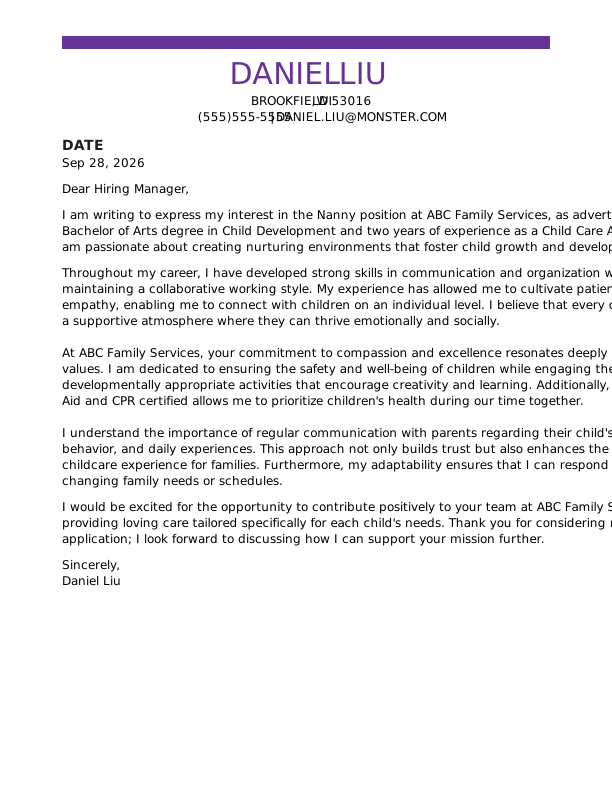
 Free
Nanny Entry-Level Cover Letter
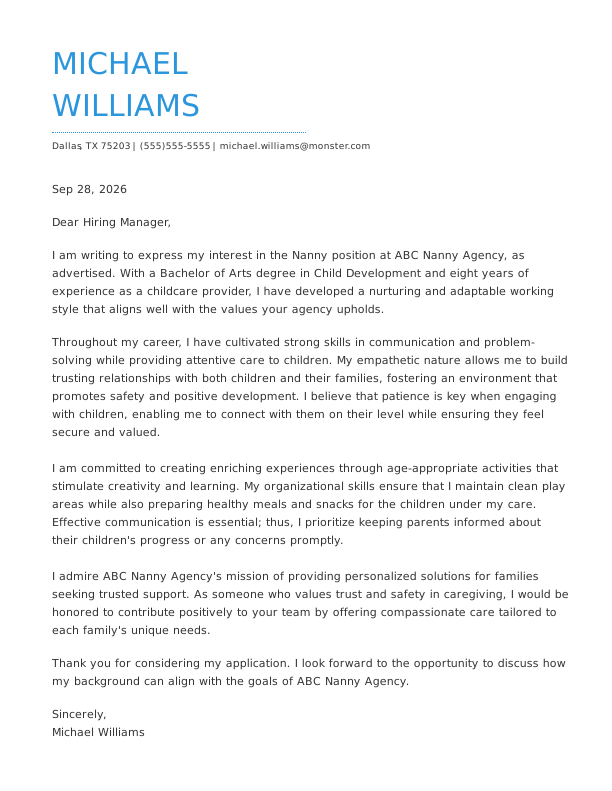
Nanny Mid-Level Cover Letter
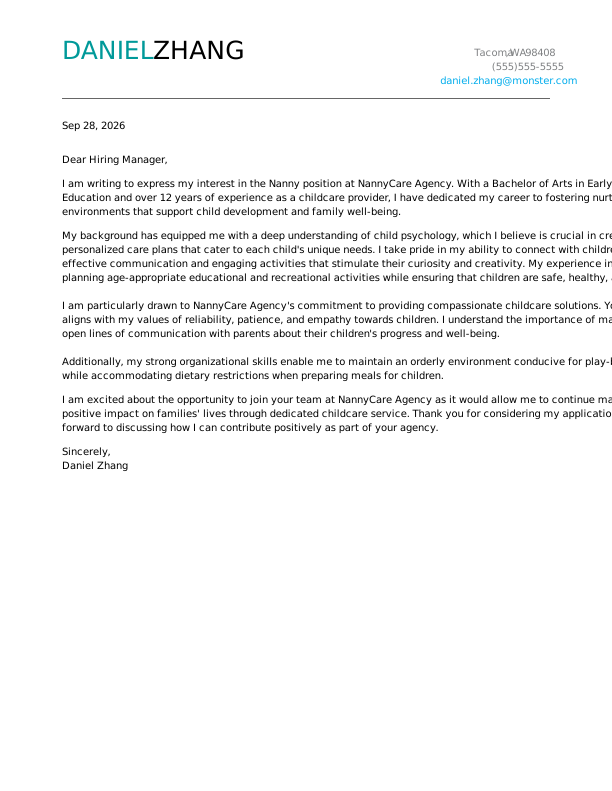
Nanny Experienced Cover Letter
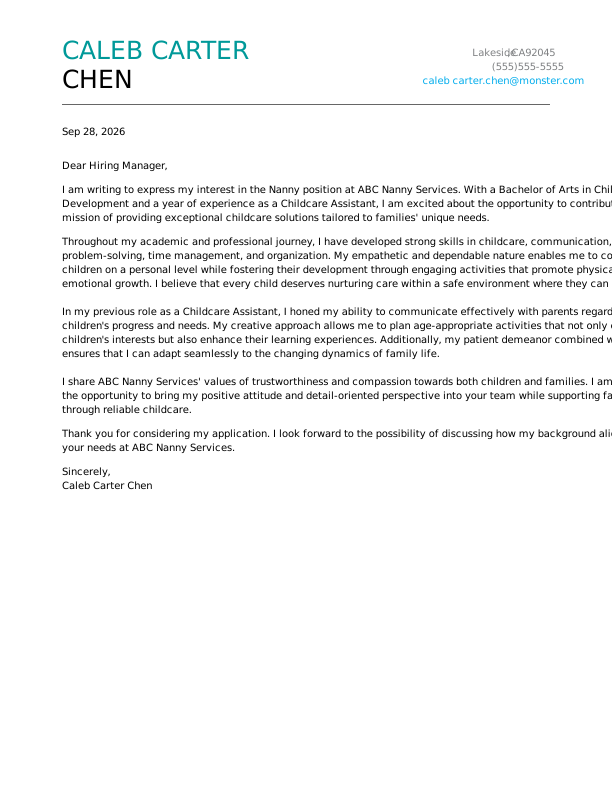
Nanny Entry-Level Cover Letter
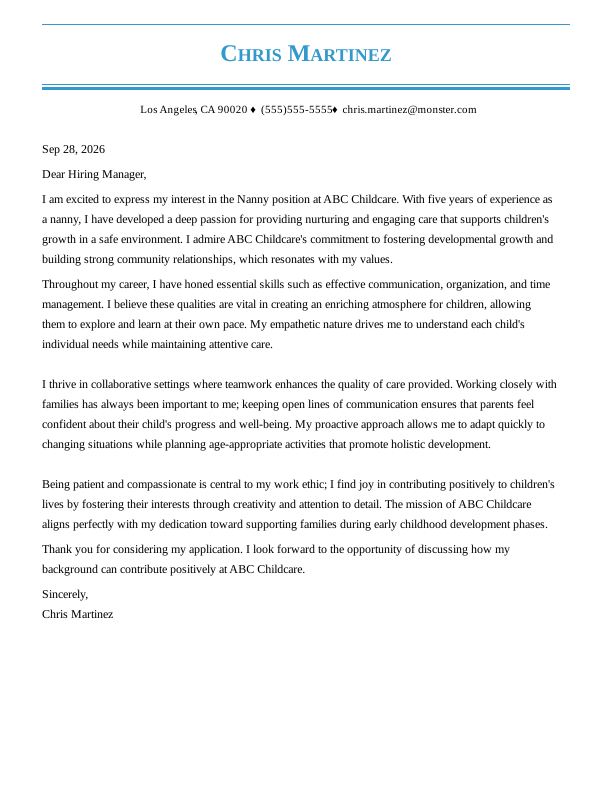
Nanny Mid-Level Cover Letter
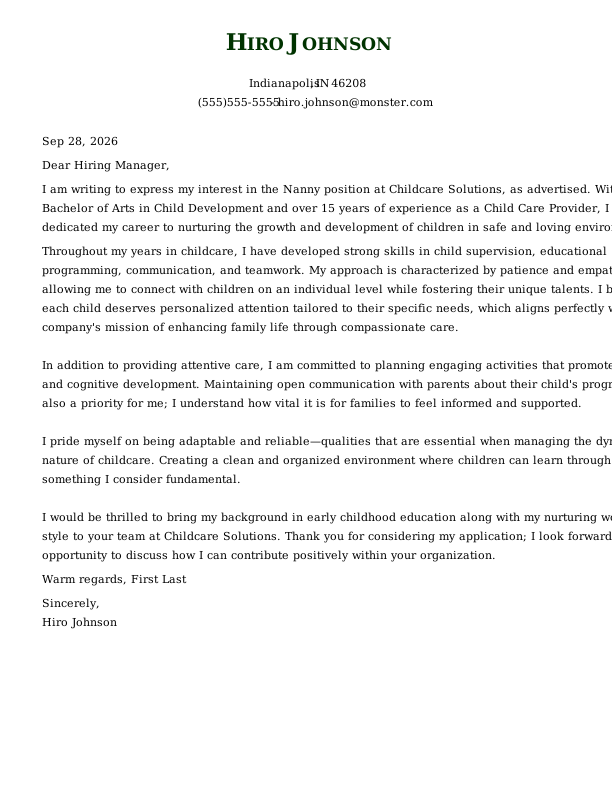
Nanny Experienced Cover Letter
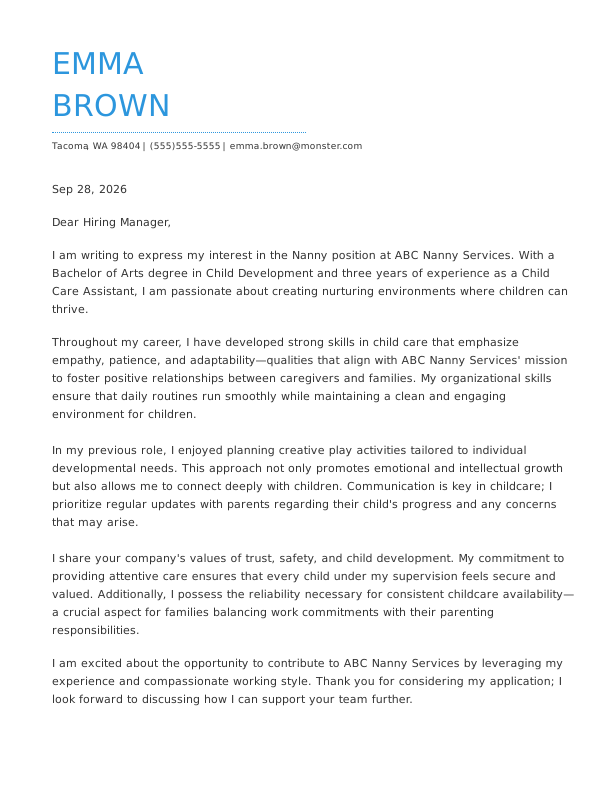
Nanny Entry-Level Cover Letter
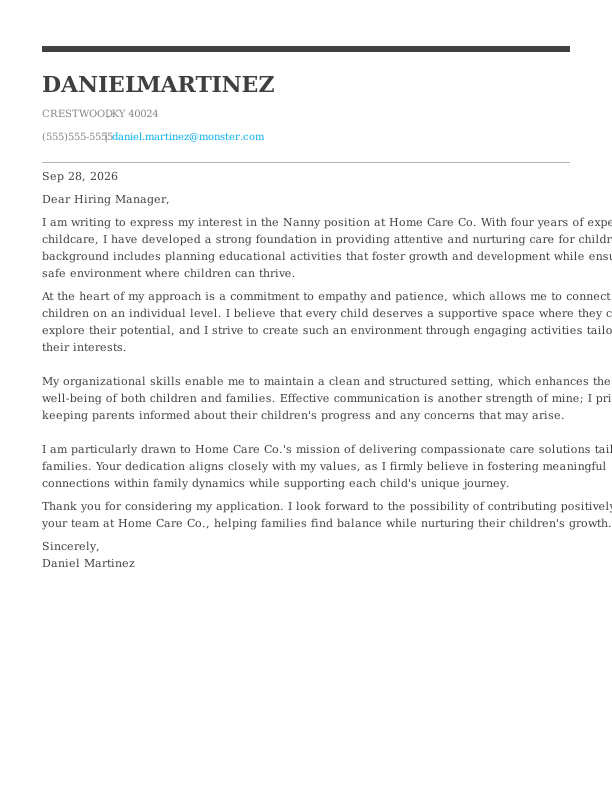
Nanny Mid-Level Cover Letter
Browse Free Cover Letter Templates
- Academic
- Account Manager
- Accountant
- Accounts Payable
- Administrative Assistant
- Admissions Counselor
- Architecture
- Artist
- Assistant Principal
- Babysitter
- Barista
- Bartender
- Bookkeeper
- Brand Ambassador
- Business Analyst
- Business
- Caregiver
- Chef
- Civil Engineering
- Computer Science
- Construction
- Consulting
- Copywriter
- Cosmetology
- Custodian
- Customer Service
- Customer Service Representative
- Data Analyst
- Data Entry
- Dental Assistant
- Dental Hygienist
- Digital Marketing
- Electrical Engineering
- Emt
- Engineering
- Esthetician
- Event Coordinator
- Executive Assistant
- Finance
- Financial Analyst
- Firefighter
- Flight Attendant
- Graphic Designer
- Hair Stylist
- Healthcare
- Hr Generalist
- Investment Banking
- It
- Janitor
- Journalism
- Lab Technician
- Law Clerk
- Lawyer
- Librarian
- Logistics
- Makeup Artist
- Manager
- Marketing Coordinator
- Marketing
- Marketing Manager
- Massage Therapist
- Mechanic
- Mechanical Engineer
- Medical Assistant
- Non Profit
- Nursing
- Occupational Therapy
- Office Assistant
- Office Manager
- Operations Manager
- Paralegal
- Personal Trainer
- Pharmacist
- Pharmacy Technician
- Photographer
- Physician Assistant
- Pilot
- Police Officer
- Program Manager
- Project Manager
- Property Manager
- Psychology
- Receptionist
- Research Assistant
- Restaurant Manager
- Retail
- Sales
- Sales Manager
- School Counselor
- Security Officer
- Social Work
- Software Engineer
- Special Education Teacher
- Substitute Teacher
- Teacher
- Teaching Assistant
- Truck Driver
- Vet Tech
- Veterinary Assistant
- Web Developer
Cover Letter Examples for Nannies
Cover letter expectations evolve as you progress through different career stages in childcare. Explore these examples to see how to position your experience, whether you are beginning your journey or leading long-term care routines.
Entry-Level Nanny Cover Letter
Discover how to highlight your foundational training and core caregiving enthusiasm when starting your nanny career.
Mid-Career Nanny Cover Letter
Learn how to showcase established routine management, meal preparation, and strong family partnerships as a mid-career caregiver.
Experienced Nanny Cover Letter
See how seasoned caregivers demonstrate comprehensive early childhood expertise, tailored care planning, and high-level household leadership.
Nanny Cover Letter Template (Text)
Copy this nanny cover letter template, paste it into your document, and swap in your childcare experience, routines you’ve managed, and the family you’re applying to.
Amanda Turner
Miami, FL 33139
(555)555-5555
amanda.turner@monster.com
Sep 28, 2026
Dear Hiring Manager,
I am excited to apply for the Nanny position at Bright Futures Nanny Agency. With a Bachelor of Arts in Child Development and nine years of experience as a Childcare Specialist, I have cultivated a deep understanding of children’s needs and development. My background has equipped me with essential skills in childcare management, early childhood education, and effective communication.
At the core of my approach is a nurturing and empathetic attitude towards children. I believe that every child deserves an environment where they feel safe, loved, and supported in their growth. My warm demeanor allows me to engage meaningfully with children while planning age-appropriate activities that foster physical, emotional, and intellectual development.
Maintaining open lines of communication with parents is crucial; I prioritize sharing updates about children’s progress and any insights that contribute to their well-being. I am highly organized in managing daily routines while ensuring cleanliness in play areas and adhering to any dietary preferences outlined by families.
I resonate deeply with your agency’s mission to empower families through dependable childcare solutions. My adaptable nature enables me to navigate dynamic environments gracefully while upholding safety protocols at all times.
Thank you for considering my application. I am eager to contribute positively as part of your team at Bright Futures Nanny Agency, where together we can create harmonious home environments that support children’s thriving futures.
Sincerely,
Amanda Turner
How to Write a Nanny Cover Letter
Writing a great nanny cover letter means showing parents exactly how you will care for their children. By sharing real examples of your daily routines, safety habits, and communication skills, you build instant trust. Follow these straightforward steps to organize your letter and highlight why you are the right fit for the family.
1. Research & Prepare
Before drafting your letter, take time to understand the family’s daily life and expectations. Grounding your letter in these details shows you are ready to jump in seamlessly. Here are three key ways to research the role before writing:
- Review the job description carefully for required certifications like First Aid, CPR, or specific driving expectations.
- Note any mentioned parenting philosophies, educational approaches, or preferred activity styles to align your messaging.
- Check local nanny guidelines or agency requirements to ensure your qualifications meet state standards.
2. Hook the Reader
Start your letter with an engaging opening that grabs the family’s attention immediately. Instead of using generic lines like “I love working with kids,” mention a specific routine or skill that shows your hands-on approach.
Consider these strong examples for your intro:
- Morning routine mastery: “I built a 7:00 to 9:00 bedtime and breakfast flow for two toddlers, using a visual schedule and consistent wind-down steps so naps stayed on track within two weeks.”
- Health and safety documentation: “During my last role, I tracked meals, sleep duration, and symptoms in a shared log after every outing, and I updated parents within 10 minutes of any fever or injury call.”
- Developmental play planning: “I ran a weekly STEAM rotation with age based activities for three children, rotating sensory bins every Friday and keeping behavior smoother by reducing overstimulation after screen time.”
3. Tell Your Professional Story
While your resume outlines your past jobs, your cover letter lets you explain how you handle daily caregiving. Sharing specific numbers and measurable outcomes helps parents visualize the real impact you bring to their home.
Here are clear examples of how to quantify your childcare experience:
- Managed daily routines for three children under age five, keeping meal and nap schedules 100% on track.
- Reduced missed medication doses by 90% by using daily checklists and confirming instructions at each handoff.
- Handled up to three school-age kids simultaneously during after-school hours while completing homework support in under 30 minutes per child on average.
4. Showcase Your Skills
Connect your core strengths directly to what the family needs most. Rather than listing broad adjectives, describe a moment when your caregiving skills created a positive result for a child or family.
Explore these lead-ins to highlight your key abilities:
- Daily routine planning: “I set up our morning schedule with visual cues, then adjusted it when my toddler woke up early so meals, nap time, and transitions still stayed calm.”
- Child safety and supervision: “I did a quick home scan for choking hazards before snack time, then stayed within arm’s reach while redirecting play near the stairs.”
- Parent communication: “I wrote brief updates in the shared app after school pickup, and I called right away to align on bedtime steps when my notes showed a sleep issue.”
5. Explain Any Special Circumstances
If you have an employment gap, career transition, or recent relocation, address it briefly and positively. Keep your explanation to one or two clear sentences that reassure parents that your caregiving skills are current and reliable.
Use these examples to guide your explanation:
- “After a six-month break between families, I completed my CPR and First Aid renewal and returned to full-time caregiving in May.”
- “I am pivoting from childcare assistant work into nannying by building a consistent routine using daily notes and age-based learning plans during my current role with two toddlers.”
- “I moved from Austin to Seattle last fall, and I have local references plus an up-to-date background check that is valid for the state.”
6. End With a Professional Goodbye
Wrap up your cover letter with a polite, professional closing that invites the next conversation. State clearly how eager you are to discuss the position and thank the family for their time and consideration.
In your last paragraph, use concrete wording like, “I’d love to talk with you about your daily routine and how I can support homework time and bedtime smoothly.” Finish with “Best regards” for a clean, professional goodbye.
4 Tips for Formatting Your Cover Letter
A clean, well-formatted cover letter makes a wonderful first impression on busy parents and hiring managers. Clear layout, thoughtful spacing, and standard fonts ensure your qualifications are easy to read at a glance, helping your application stand out instantly.

Keep It to One Page
Keep your cover letter to a single page, aiming for 250 to 400 words across three or four concise paragraphs. A focused letter highlights your caregiving style, routine experience, and safety credentials without overwhelming the reader.

Use a Professional Font & Layout
Select classic fonts like Arial, Calibri, or Georgia at a 10- to 12-point size to maintain excellent readability across all devices. Pair simple typography with standard one-inch margins and match your letter’s header to your resume for a polished, cohesive presentation.

Address the Hiring Manager Directly
Greeting the reader by name shows attention to detail and immediate interest in the family. If the job posting does not list a contact name, use a warm greeting like “Dear Hiring Family” or “Dear Hiring Manager” rather than outdated formal phrasing.

Save & Send as a PDF
Save your finished cover letter as a PDF file to lock in your layout and prevent formatting shifts when opened on different devices. Name the file clearly with your full name, such as Firstname_Lastname_Cover_Letter.pdf.
Key Takeaways
- Highlight your hands-on experience with daily routines, safety habits, and age-appropriate care to build immediate trust with parents.
- Include clear examples and relevant numbers to demonstrate the positive impact of your caregiving in previous roles.
- Keep your formatting clean, professional, and limited to one page so busy families can quickly review your qualifications.
More Cover Letter Examples
Browse Monster’s Resume Templates
Monster also has hundreds of ATS-friendly resume templates for all career levels and industries. Create a matching resume to help you land the interview.
Frequently Asked Questions
Last Update:
Do I really need a cover letter?
You need a cover letter for a nanny job because it allows you to explain your personal caregiving style, daily routine management, and safety protocols in ways a resume cannot. Including a letter shows genuine interest in the family and offers helpful context about your passion for childcare, communication habits, and overall reliability.
How long should my cover letter be?
Your nanny cover letter should be one page long, ideally between 250 and 400 words. Keeping your text concise ensures busy parents or agency recruiters can easily scan your key experience, safety certifications, and childcare achievements without getting bogged down in unnecessary detail.
Should my cover letter match my resume?
Your cover letter should match your resume in visual style, using the same fonts, layout, and contact header to present a unified application. While the design matches, the text should expand on specific accomplishments and personal care philosophies rather than simply repeating resume bullet points.
Should I mention salary expectations in my cover letter?
You should mention salary expectations in your cover letter only if the job post explicitly asks for them. In those cases, state a flexible salary range based on local market rates for your experience level, noting that you are open to discussing total compensation based on the full role expectations.
How do I write a cover letter for an internal position?
When writing a cover letter for an internal nanny position, focus on your familiarity with the family’s existing routines, household expectations, and childcare goals. Highlight recent achievements, such as successfully managing daily schedule transitions or organizing educational play, while expressing enthusiasm for taking on added responsibilities within the home.

Vicki Salemi is a nationally recognized career expert who helps professionals navigate the hiring landscape and find the right fit on Monster. With over 15 years of experience in corporate recruiting and HR, she offers expert guidance on job search strategies, interview preparation, and career development to help candidates land their next role.
See More From Vicki SalemiExplore Related Career Advice







How to Write a Cover Letter for Internal Positions or Promotions (Examples & Tips)

Updated:
Apr 23, 2026
|
19 min read


Cover Letter vs Resume: What’s the Difference & Do You Need Both?

Updated:
Apr 23, 2026
|
18 min read