

Free Education Cover Letter Templates & Examples
A strong education cover letter shows you can support student growth, build inclusive learning environments, and manage classrooms effectively. Our cover letter examples and step-by-step guidance help you highlight your teaching impact and build a clear, confident application for hiring managers.
Real-World Cover Letters That Get Results
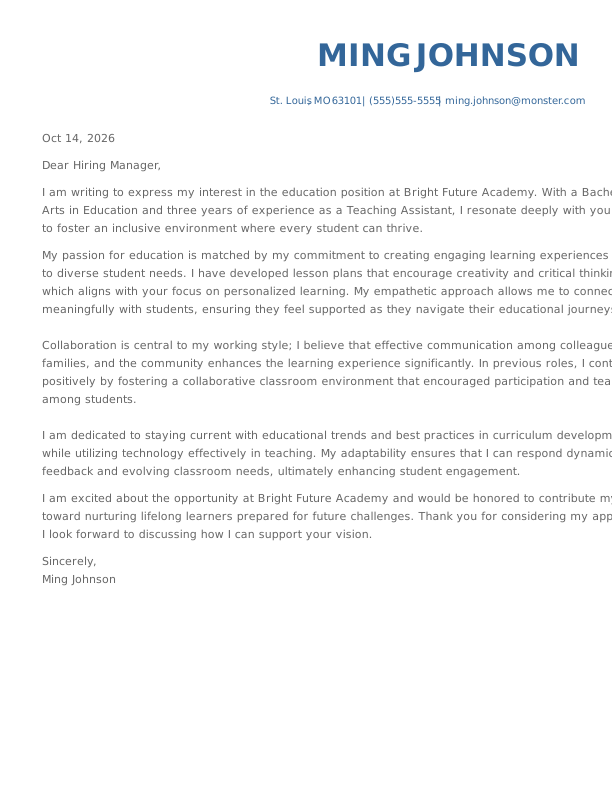
 Free
Education Entry-Level Cover Letter
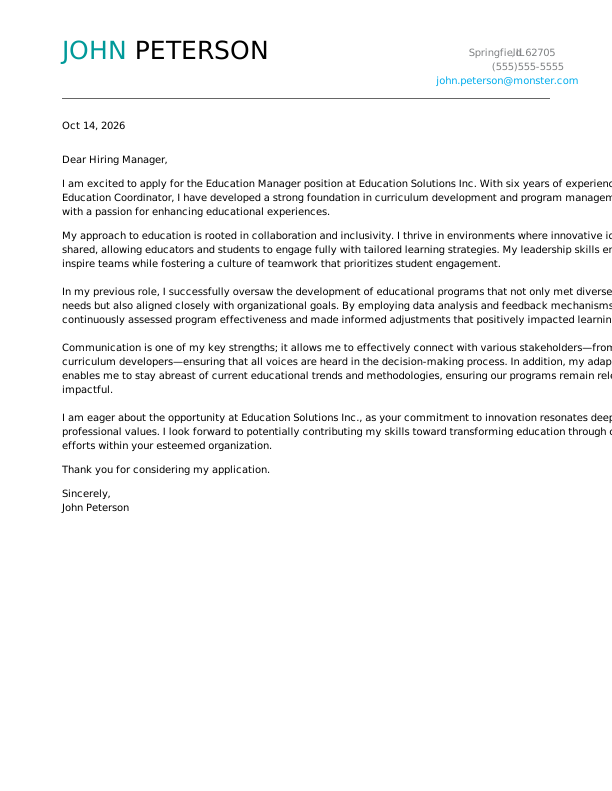
Education Mid-Level Cover Letter
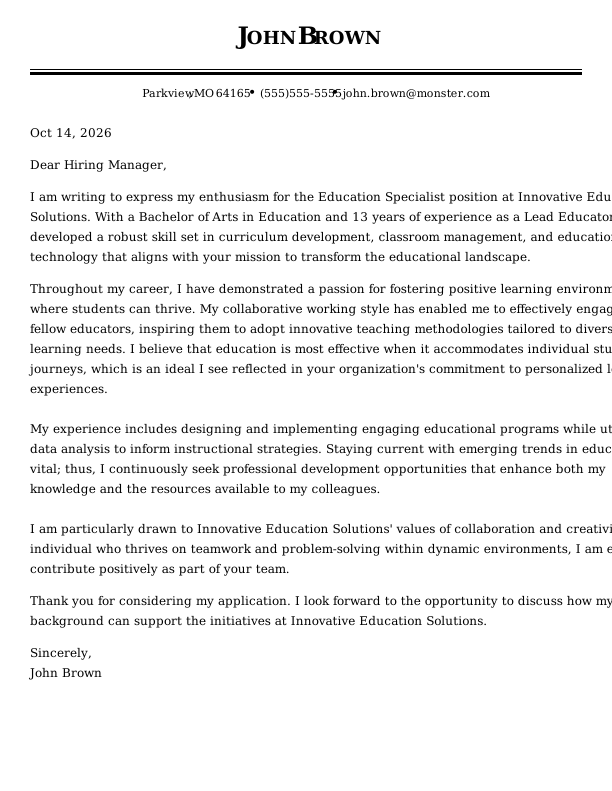
Education Experienced Cover Letter
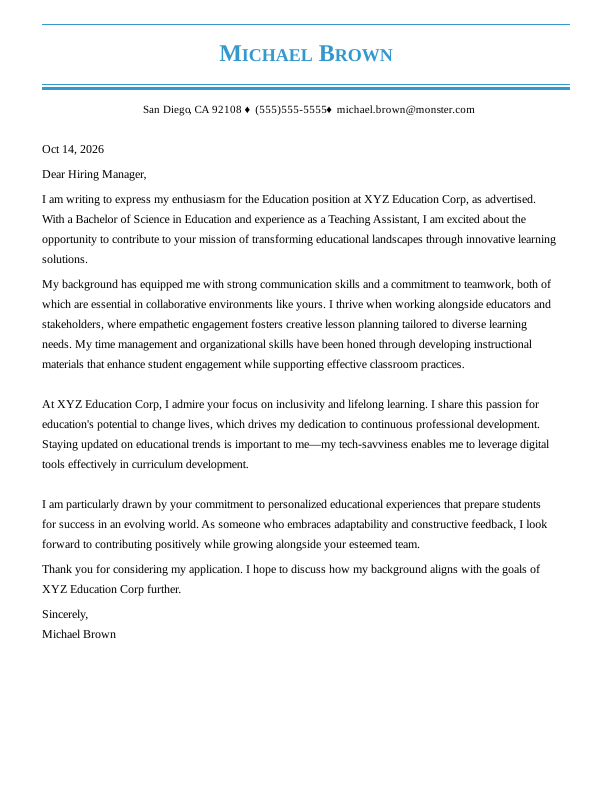
Education Entry-Level Cover Letter
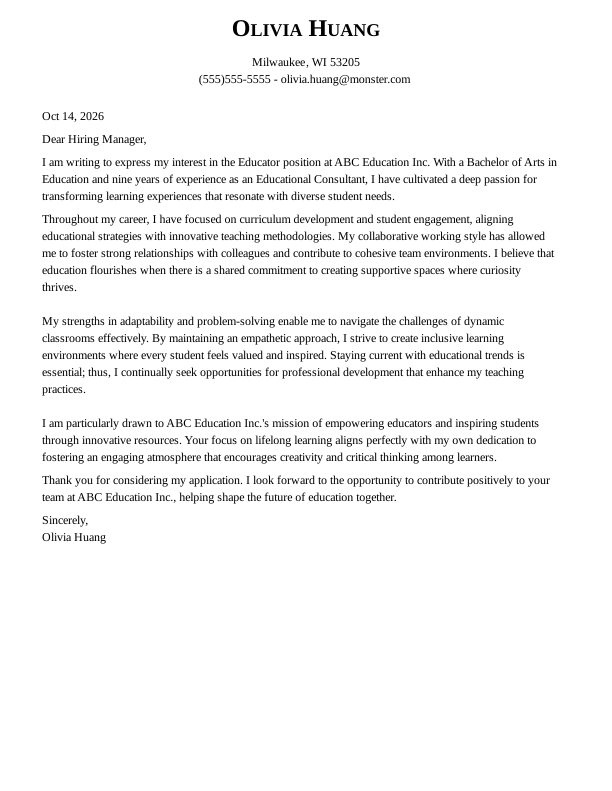
Education Mid-Level Cover Letter
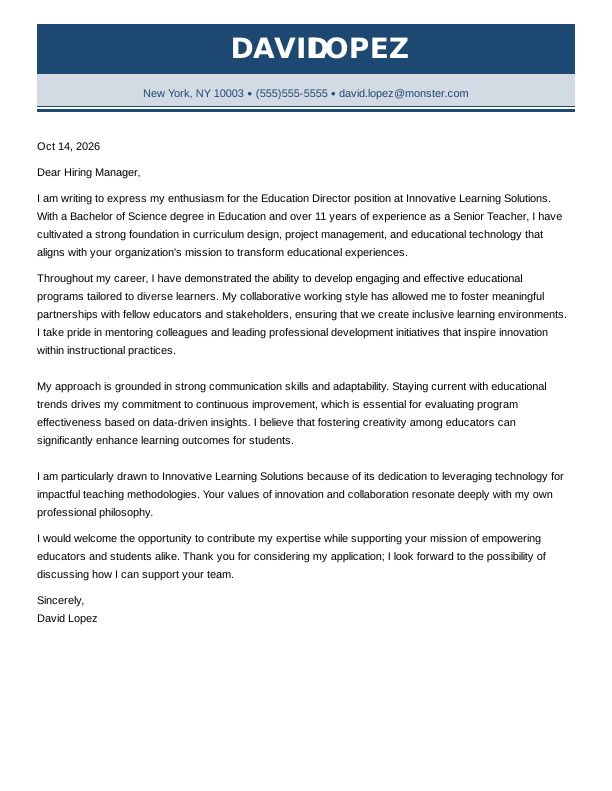
Education Experienced Cover Letter
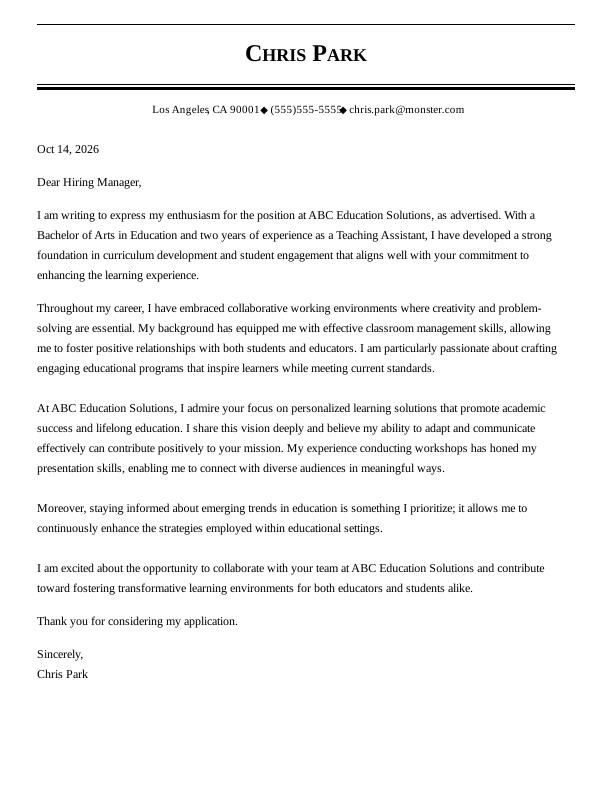
Education Entry-Level Cover Letter
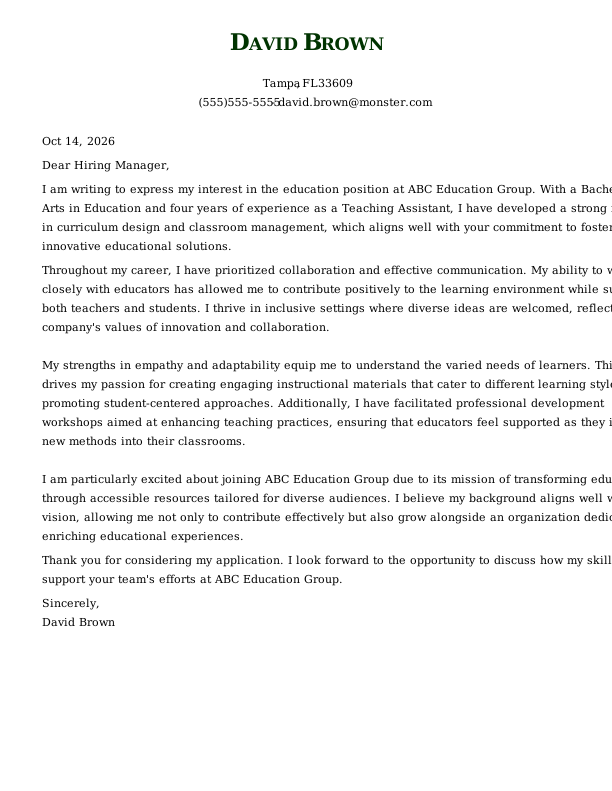
Education Mid-Level Cover Letter
Browse Free Cover Letter Templates
- Academic
- Account Manager
- Accountant
- Accounts Payable
- Administrative Assistant
- Admissions Counselor
- Architecture
- Artist
- Assistant Principal
- Babysitter
- Barista
- Bartender
- Bookkeeper
- Brand Ambassador
- Business Analyst
- Business
- Caregiver
- Chef
- Civil Engineering
- Computer Science
- Construction
- Consulting
- Copywriter
- Cosmetology
- Custodian
- Customer Service
- Customer Service Representative
- Data Analyst
- Data Entry
- Dental Assistant
- Dental Hygienist
- Digital Marketing
- Electrical Engineering
- Emt
- Engineering
- Esthetician
- Event Coordinator
- Executive Assistant
- Finance
- Financial Analyst
- Firefighter
- Flight Attendant
- Graphic Designer
- Hair Stylist
- Healthcare
- Hr Generalist
- Investment Banking
- It
- Janitor
- Journalism
- Lab Technician
- Law Clerk
- Lawyer
- Librarian
- Logistics
- Makeup Artist
- Manager
- Marketing Coordinator
- Marketing
- Marketing Manager
- Massage Therapist
- Mechanic
- Mechanical Engineer
- Medical Assistant
- Non Profit
- Nursing
- Occupational Therapy
- Office Assistant
- Office Manager
- Operations Manager
- Paralegal
- Personal Trainer
- Pharmacist
- Pharmacy Technician
- Photographer
- Physician Assistant
- Pilot
- Police Officer
- Program Manager
- Project Manager
- Property Manager
- Psychology
- Receptionist
- Research Assistant
- Restaurant Manager
- Retail
- Sales
- Sales Manager
- School Counselor
- Security Officer
- Social Work
- Software Engineer
- Special Education Teacher
- Substitute Teacher
- Teacher
- Teaching Assistant
- Truck Driver
- Vet Tech
- Veterinary Assistant
- Web Developer
Cover Letter Examples for Educations
Cover letter expectations change as an education professional’s career progresses, especially from student teaching or early classroom work to leadership and program design. Choose the template that matches your experience level so you can highlight the right training, certifications, and outcomes.
Entry-Level Education Cover Letter
Ideal for recent graduates and career changers, this template helps you showcase student teaching experience, academic achievements, and core skills in lesson planning, classroom management, and student engagement.
Mid-Career Education Cover Letter
Designed for educators with several years of experience, this template helps you highlight your expertise in curriculum design, data-driven instruction, program coordination, and collaborative teaching practices.
Experienced Education Cover Letter
Tailored for senior educators and specialists, this template highlights your leadership in curriculum development, staff mentorship, instructional coaching, and long-term improvements in student outcomes.
Education Cover Letter Template (Text)
Copy this education cover letter template, paste it into your document, and swap in your relevant coursework, GPA or program name, and target school.
Aiko Brown
Greenfield, IN 46148
(555)555-5555
aiko.brown@monster.com
Oct 14, 2026
Dear Hiring Manager,
I am writing to express my interest in the education specialist position at Target Company. With a Bachelor of Science degree in Education and five years of teaching experience, I am passionate about enhancing educational experiences and committed to fostering student success.
Throughout my career, I have been dedicated to curriculum development and classroom management, ensuring that all students are engaged and supported. My ability to communicate effectively has allowed me to build strong relationships with students, parents, and colleagues alike. Collaboration is at the heart of my working style; I thrive in team-oriented environments where diverse ideas can come together to create innovative solutions.
In my previous role as a teacher, I designed engaging lesson plans that aligned with curriculum standards while meeting the needs of various learners. This experience has equipped me with valuable skills in assessment and evaluation which are essential for continuous improvement in educational programs. Moreover, I have conducted training sessions for fellow educators focused on integrating technology into teaching methodologies—a crucial aspect for modern learning environments.
The mission of Target Company resonates deeply with me; your commitment to inclusivity and collaboration aligns perfectly with my values as an educator. I am eager to contribute my skills in curriculum development and professional development workshops as part of your team.
Thank you for considering my application. I look forward to the opportunity to discuss how my background could align with the goals at Target Company.
Sincerely,
Aiko Brown
How to Write an Education Cover Letter
Writing a strong cover letter for an education role means showing how your lesson planning, classroom management, and teaching methods help students succeed. Following a clear structure ensures you present your instructional experience and passion for learning in a focused message for every job application.
1. Research & Prepare
Before you begin writing, research the school or organization to understand its educational philosophy, student demographics, and current academic goals. Knowing whether they prioritize specific learning management systems, standardized testing growth, or inclusive community programs helps you tailor your experience directly to their needs.
Here are a few places to gather helpful details before drafting your letter:
- Review the job description to identify required teaching certifications, subject area standards, and preferred learning platforms.
- Explore the school or district website to learn about current curriculum initiatives, accreditation goals, and community programs.
- Check state department of education guidelines to ensure your licensing and endorsement details match the position requirements.
2. Hook the Reader
Grab the hiring manager’s attention in your opening lines by sharing a concrete instructional achievement rather than using a standard introductory phrase. Demonstrating early on how you improve student engagement or academic performance proves you can bring immediate value to their school.
Here are examples of strong openings that show educational impact in action:
- “In my 10th-grade algebra block, I used targeted formative assessments to guide re-teaching, raising overall student skill mastery from 61% to 78% by spring.”
- “I updated our civics pacing guide to align with district benchmarks and led weekly team planning sessions to tighten our standards-based grading practices.”
- “As a special education teacher, I incorporated Universal Design for Learning strategies into daily co-planning, reducing behavior referrals by 25% over one semester.”
3. Tell Your Professional Story
Your resume lists your degrees, certifications, and past schools, but your cover letter explains how your teaching methods solve real learning challenges. Adding specific metrics and student outcomes helps school administrators picture the actual impact of your classroom leadership.
Here are a few ways to turn routine teaching duties into clear accomplishment statements:
- Completed 180 hours of clinical fieldwork and documented 45 student observations to guide individualized learning recommendations.
- Maintained a 3.8 GPA during teacher preparation coursework while completing a capstone curriculum project scored at 94%.
- Organized peer tutoring groups and structured study plans that raised average student quiz scores from 74% to 88%.
4. Showcase Your Skills
Rather than simply stating that you are dedicated or skilled in classroom management, describe a real moment where you put your teaching philosophy into practice. Highlighting how you handle lesson adaptations, technology integration, or student feedback proves you are ready for the daily demands of the classroom.
Here are practical examples of key educational skills in action:
- Curriculum alignment: “I used my coursework in curriculum design to build a structured study unit, then applied that same framework to align daily lessons with state standards.”
- Learning tools: “I set up a digital resource hub in Canvas to organize supplementary reading materials, allowing students to access study guides easily for group review.”
- Collaboration: “I shared my unit plans with grade-level peers, gathered feedback on lesson pacing, and refined the activities to better support struggling readers.”
5. Explain Any Special Circumstances
If you have a gap in your teaching history, are transitioning from another field into education, or recently relocated, address it clearly in a sentence or two before shifting back to your classroom readiness. School leaders want to know that your teaching credentials are active and that your knowledge of current learning standards is up to date.
Here are simple ways to frame different career scenarios:
- “After taking time away from teaching for family reasons, I completed my license renewal requirements and taught online classes using Google Classroom.”
- “I am transitioning from corporate training into K-12 education after completing my student teaching requirements and building standards-aligned lesson plans.”
- “Since relocating to Austin last fall, I transferred my teaching license to Texas and am ready to begin leading a classroom immediately.”
6. End With a Professional Goodbye
Close your cover letter with a polite, proactive statement that expresses interest in an interview and thanks the reader for their time. A clear closing invites the hiring principal or director to take the next step without relying on passive language.
For example, you can write, “I would welcome the opportunity to discuss how my lesson planning, classroom management, and student-centered approach can support your school’s reading goals.”
Follow this with “Thank you for your time and consideration,” and sign off with a professional closing like “Sincerely” or “Best regards.”
4 Tips for Formatting Your Cover Letter
School administrators often scan dozens of applications during hiring windows, so a well-formatted cover letter shows that you value clear communication and attention to detail. Taking time to format your document neatly ensures your top qualifications stand out during a fast review.

Match Your Header to Your Resume
Use the same name styling, contact information, font choices, and layout for both your cover letter header and your resume header. Creating a consistent visual header across your application documents presents a polished, unified personal brand that school recruiters recognize instantly.

Use Bullet Points for Key Achievements
Use three or four bullet points to highlight your top achievements, such as student test score improvements, academic honors, or specialized curriculum projects. Bullet points break up dense paragraphs, making your most impressive qualifications easy for administrators to scan and digest quickly.

Balance Spacing & Margins
Set line spacing to 1.0 or 1.15 with a blank line between paragraphs to keep your cover letter readable and uncluttered. Maintain uniform margins between 0.75 inches and 1 inch on all sides to create a balanced layout that looks professional both on screen and in print.

Save & Send as a PDF
Save your completed cover letter as a PDF to preserve your formatting, margins, and font choices across different operating systems and screening tools. Label the document with a clear file name like Firstname_Lastname_Cover_Letter.pdf so it remains easily identifiable for hiring teams.
Top-Paying States for Education Roles
Knowing what education professionals earn across the country helps you compare job offers and plan your next step. Salary ranges can vary based on where you work, your years of experience, and your specialty, such as early childhood, special education, or higher ed. The U.S. Bureau of Labor Statistics (BLS) provides nationwide salary data that can help you benchmark roles like yours with more confidence.
Keep in mind that district budgets, school type, and additional credentials may shift what you’re offered in practice.
| Alabama | $121,850 |
| Alaska | $133,760 |
| Arizona | $121,610 |
| Arkansas | $111,360 |
| California | $147,610 |
| Connecticut | $144,930 |
| Delaware | $158,310 |
| District of Columbia | $139,480 |
| Florida | $102,600 |
| Georgia | $135,540 |
| Hawaii | $110,020 |
| Idaho | $105,400 |
| Illinois | $116,050 |
| Indiana | $115,310 |
| Iowa | $111,330 |
| Kansas | $126,870 |
| Kentucky | $133,810 |
| Louisiana | $118,100 |
| Maine | $105,130 |
| Maryland | $142,160 |
| Massachusetts | $137,210 |
| Michigan | $128,240 |
| Minnesota | $118,190 |
| Mississippi | $116,140 |
| Missouri | $124,710 |
| Montana | $111,650 |
| Nebraska | $115,590 |
| Nevada | $109,850 |
| New Hampshire | $130,570 |
| New Jersey | $147,820 |
| New Mexico | $112,990 |
| New York | $157,840 |
| North Carolina | $117,560 |
| North Dakota | $122,790 |
| Ohio | $105,100 |
| Oklahoma | $127,440 |
| Oregon | $131,490 |
| Pennsylvania | $118,990 |
| Rhode Island | $128,760 |
| South Carolina | $104,230 |
| South Dakota | $127,840 |
| Tennessee | $131,180 |
| Texas | $122,220 |
| Utah | $138,270 |
| Vermont | $117,330 |
| Virginia | $137,250 |
| Washington | $154,210 |
| West Virginia | $111,710 |
| Wisconsin | $142,290 |
| Wyoming | $121,160 |
| Guam | $121,940 |
| Puerto Rico | $99,020 |
| Virgin Islands | $80,060 |
Key Takeaways
- Focus your cover letter on measurable student growth by sharing a specific example of how your instruction improved academic outcomes.
- Include clear performance metrics, such as assessment pass rates, attendance improvements, or student growth percentiles.
- Tailor your experience to the educational setting, emphasizing standards-based planning for public schools, data-driven interventions for charter schools, or curriculum design for higher education.
More Cover Letter Examples
Browse Monster’s Resume Templates
Monster also has hundreds of ATS-friendly resume templates for all career levels and industries. Create a matching resume to help you land the interview.
- Art Teacher
- Dance Instructor
- Dance Teacher
- Education
- Elementary School Teacher
- English Teacher
- Esl Teacher
- Flight Instructor
- Kindergarten Teacher
- Math Teacher
- Music Teacher
- Physical Education Teacher
- Preschool Teacher
- Science Teacher
- Social Studies Teacher
- Spanish Teacher
- Special Education Teacher
- Substitute Teacher
- Teacher Assistant
- Teacher
Frequently Asked Questions
Last Update:
Do I really need a cover letter?
Yes. Including an education cover letter is strongly recommended, even when listed as optional. While a resume summarizes your degrees and work history, a cover letter explains your teaching philosophy, classroom management style, and personal motivation. It also gives you an opportunity to explain career transitions or employment gaps while showing genuine enthusiasm for the specific school or district.
How long should my cover letter be?
An education cover letter should fit on a single page and stay between 250 and 400 words. School administrators often review applications quickly, so concise writing helps your main qualifications stand out right away. Focus on three or four short paragraphs that highlight your most relevant teaching successes, certifications, and instructional skills rather than listing every past duty.
Should my cover letter match my resume?
Yes, your education cover letter should match your resume’s visual formatting so your application feels cohesive. Use the same font, line spacing, margins, and contact header on both documents. In the text itself, avoid repeating your resume line for line, and instead use the letter to expand on specific classroom accomplishments and explain your approach to teaching.
How do I address my cover letter if I don’t know the hiring manager’s name?
To address an education cover letter without a contact name, check the job posting, school directory, or LinkedIn for the principal, department chair, or recruiter leading the search. If you still cannot find a specific name, use professional greetings like “Dear Hiring Manager” or “Dear Education Selection Committee” instead of outdated options like “To Whom It May Concern.”
Can I use AI to write my cover letter?
Yes, you can use AI tools to help outline your education cover letter, organize your ideas, and build a solid initial draft. However, you should heavily edit the generated text to add your personal teaching experiences, specific student outcomes, and authentic voice. School hiring managers easily spot generic AI phrasing, so personalizing the details is essential for making a lasting impression.

Kirsten Chorpenning is a career advice writer who empowers job seekers to take control of their career paths using Monster’s comprehensive job search and resume tools. She specializes in helping job seekers find rewarding jobs in today’s dynamic work environment.
See More From Kirsten ChorpenningExplore Related Career Advice







How to Write a Cover Letter for Internal Positions or Promotions (Examples & Tips)
Updated:
Apr 23, 2026
|
19 min read


Cover Letter vs Resume: What’s the Difference & Do You Need Both?

Updated:
Apr 23, 2026
|
18 min read