

Free Library Assistant Cover Letter Templates & Examples
A well-written library assistant cover letter shows how you support patrons and keep daily operations running smoothly. Use our free cover letter examples and simple guide to highlight your customer service, cataloging skills, and community focus.
Real-World Cover Letters That Get Results
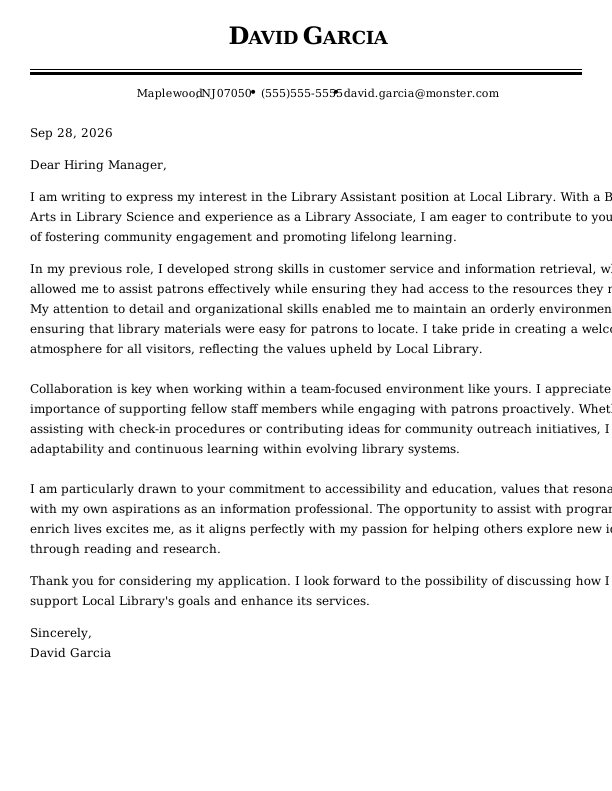
 Free
Library Assistant Entry-Level Cover Letter
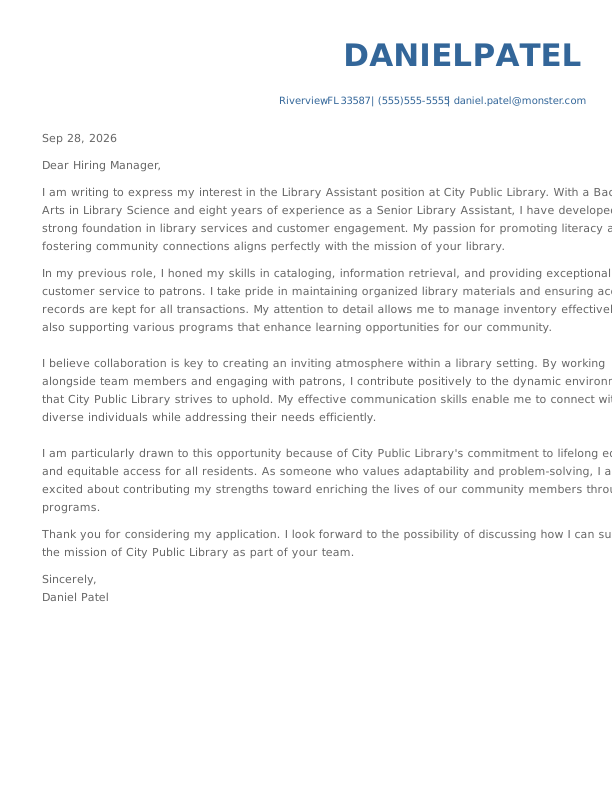
Library Assistant Mid-Level Cover Letter
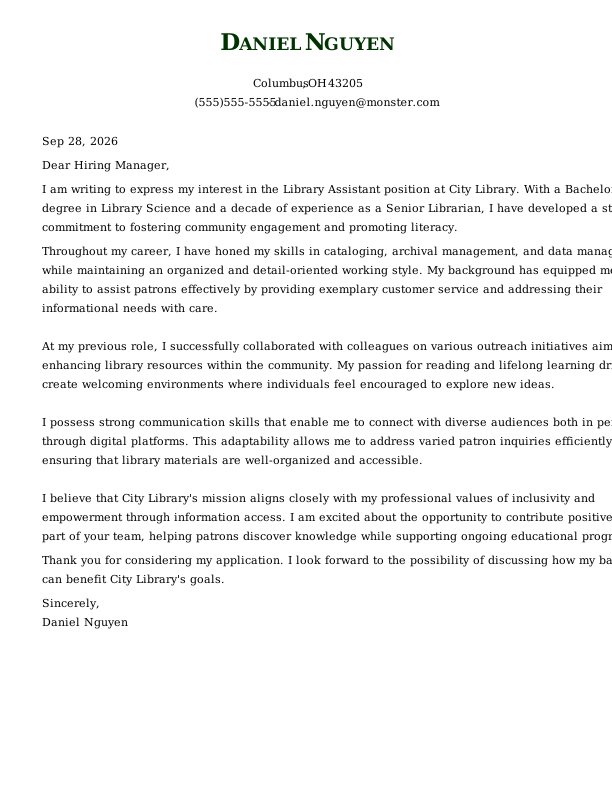
Library Assistant Experienced Cover Letter
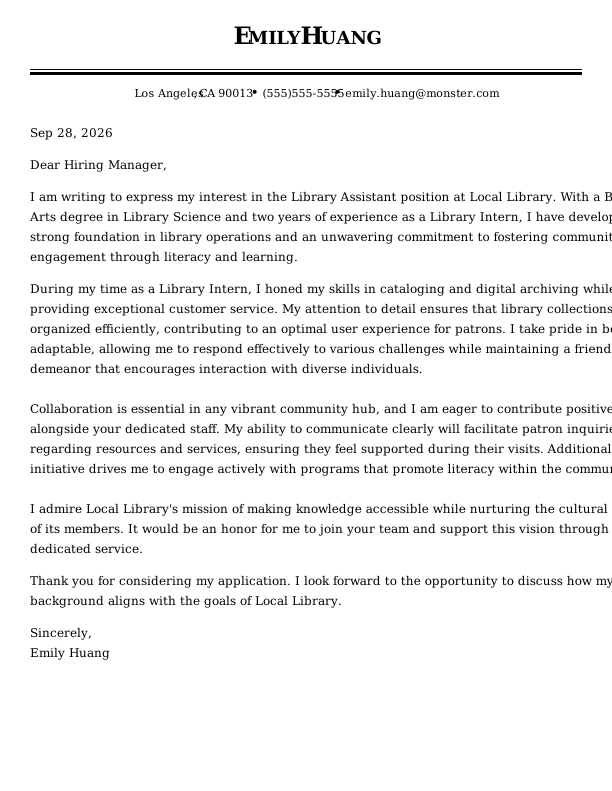
Library Assistant Entry-Level Cover Letter
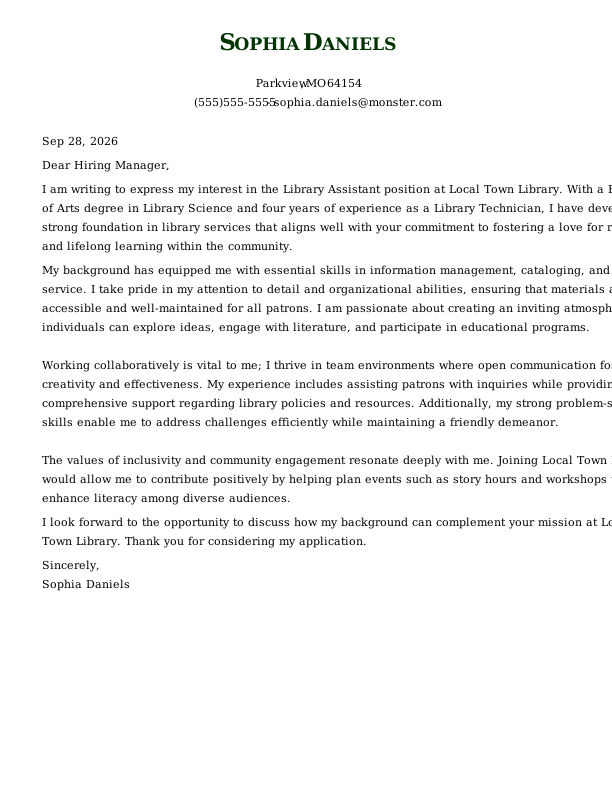
Library Assistant Mid-Level Cover Letter
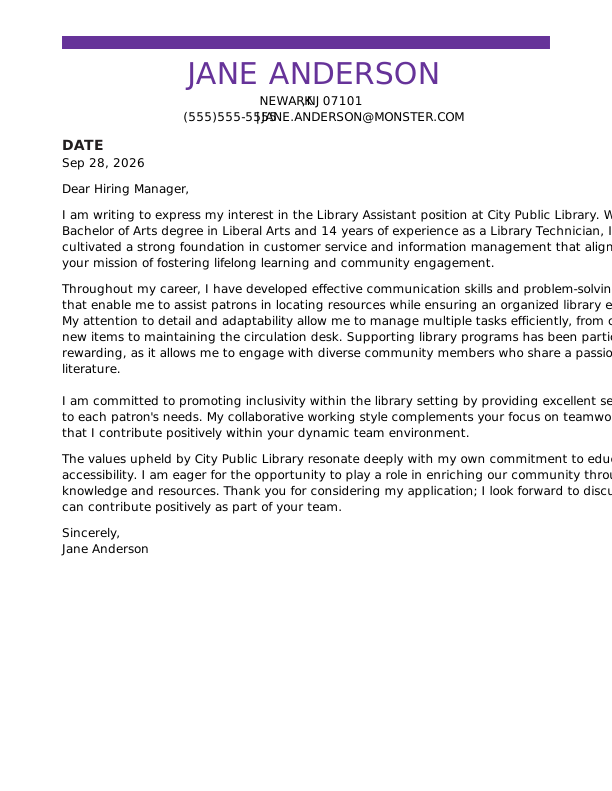
Library Assistant Experienced Cover Letter
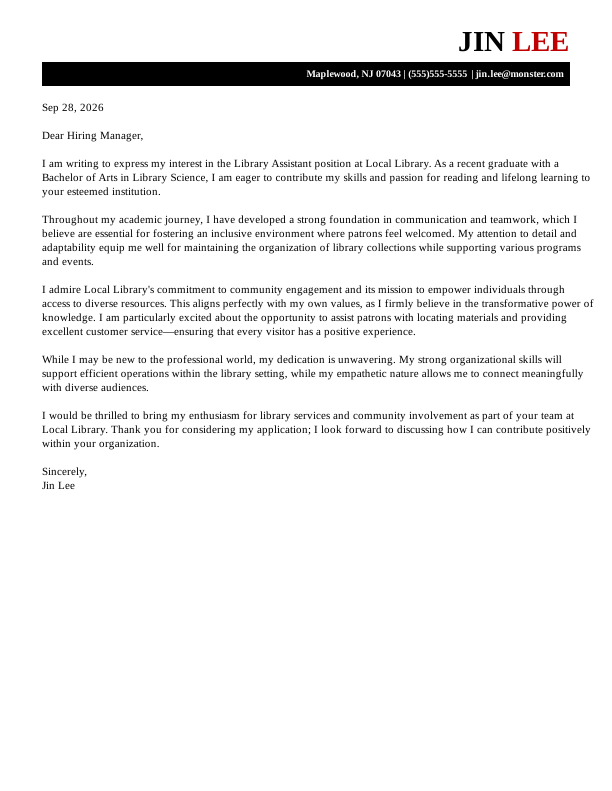
Library Assistant Entry-Level Cover Letter
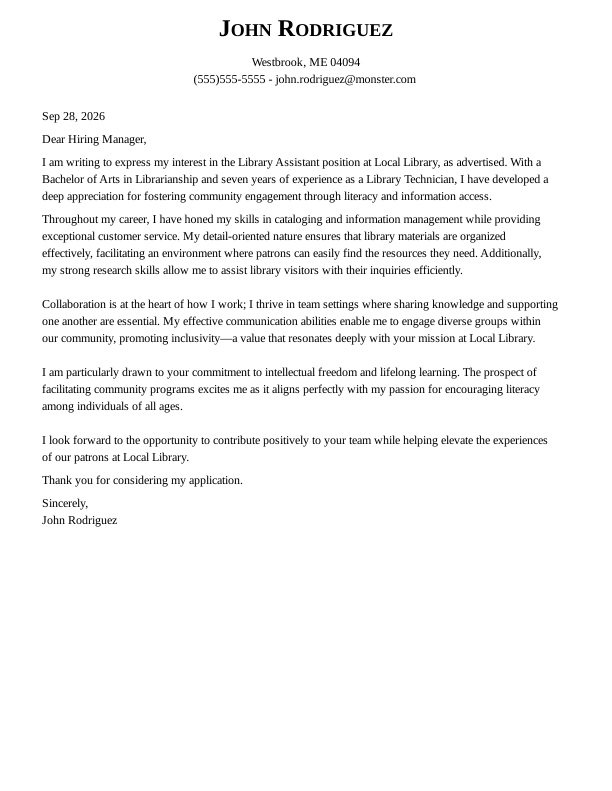
Library Assistant Mid-Level Cover Letter
Browse Free Cover Letter Templates
- Academic
- Account Manager
- Accountant
- Accounts Payable
- Administrative Assistant
- Admissions Counselor
- Architecture
- Artist
- Assistant Principal
- Babysitter
- Barista
- Bartender
- Bookkeeper
- Brand Ambassador
- Business Analyst
- Business
- Caregiver
- Chef
- Civil Engineering
- Computer Science
- Construction
- Consulting
- Copywriter
- Cosmetology
- Custodian
- Customer Service
- Customer Service Representative
- Data Analyst
- Data Entry
- Dental Assistant
- Dental Hygienist
- Digital Marketing
- Electrical Engineering
- Emt
- Engineering
- Esthetician
- Event Coordinator
- Executive Assistant
- Finance
- Financial Analyst
- Firefighter
- Flight Attendant
- Graphic Designer
- Hair Stylist
- Healthcare
- Hr Generalist
- Investment Banking
- It
- Janitor
- Journalism
- Lab Technician
- Law Clerk
- Lawyer
- Librarian
- Logistics
- Makeup Artist
- Manager
- Marketing Coordinator
- Marketing
- Marketing Manager
- Massage Therapist
- Mechanic
- Mechanical Engineer
- Medical Assistant
- Non Profit
- Nursing
- Occupational Therapy
- Office Assistant
- Office Manager
- Operations Manager
- Paralegal
- Personal Trainer
- Pharmacist
- Pharmacy Technician
- Photographer
- Physician Assistant
- Pilot
- Police Officer
- Program Manager
- Project Manager
- Property Manager
- Psychology
- Receptionist
- Research Assistant
- Restaurant Manager
- Retail
- Sales
- Sales Manager
- School Counselor
- Security Officer
- Social Work
- Software Engineer
- Special Education Teacher
- Substitute Teacher
- Teacher
- Teaching Assistant
- Truck Driver
- Vet Tech
- Veterinary Assistant
- Web Developer
Cover Letter Examples for Library Assistants
Cover letter requirements for a library assistant change as your career progresses from learning basic circulation and cataloging to taking on more independent support. Choose the template that matches your experience level so you can spotlight the right skills, training, and accomplishments for your stage.
Entry-Level Library Assistant Cover Letter
Perfect for recent graduates and career changers, this entry-level template helps you showcase transferable customer service skills and educational background to prove you are ready to assist library patrons.
Mid-Career Library Assistant Cover Letter
Designed for library assistants with a few years of experience, this template highlights your ability to manage circulation records, support cataloging, and keep daily library services running reliably.
Experienced Library Assistant Cover Letter
Ideal for senior library assistants, this template focuses on handling complex patron inquiries, managing archival records, and leading community outreach projects.
Library Assistant Cover Letter Template (Text)
Copy this library assistant cover letter text, paste it into your document, and swap in your volunteer hours, cataloging experience, and the library name.
Michael Martinez
Louisville, KY 40207
(555)555-5555
michael.martinez@monster.com
Sep 28, 2026
Dear Hiring Manager,
I am writing to express my interest in the library assistant position at the Local Public Library. With a Bachelor of Arts in Library Science and a genuine passion for literature and community engagement, I am excited about the opportunity to contribute to your mission of fostering a love for reading and lifelong learning.
Throughout my academic journey, I have honed essential skills such as communication, organization, and customer service. My ability to adapt and demonstrate creative thinking has prepared me well for collaborative environments. I thrive in teamwork settings where diverse ideas come together to enhance community resources.
I understand that your library serves as an invaluable resource hub, offering access to books, digital media, and educational programs. My detail-oriented nature ensures that I can assist patrons efficiently while maintaining an organized environment conducive to learning. Additionally, my commitment to promoting literacy aligns with your values of inclusivity and empowerment through knowledge.
Although my professional experience is limited as a recent graduate, I bring strong problem-solving abilities and dependability that will benefit both staff collaboration and patron support. I look forward to assisting with library collections management while contributing positively during programs and events.
Thank you for considering my application. I am eager about the possibility of joining your team at the Local Public Library, where we can collectively enhance our community’s engagement with information resources.
Sincerely,
Michael Martinez
How to Write a Library Assistant Cover Letter
Writing a great library assistant cover letter means turning your past experience and skills into clear statements that prove you’re an asset to any library’s operations. You want to show how you help patrons find resources, keep materials organized, and manage circulation systems.
Follow these simple steps to build a cover letter that fits your experience and catches the hiring manager’s eye.
1. Research & Prepare
Before typing your letter, spend a few minutes learning how the library operates day to day. Check what tools, catalogs, and community programs it highlights so you can match your experience to its specific needs.
Here are a few quick ways to gather useful details before you write:
- Scan the job posting for specific cataloging software, integrated library systems, or circulation tools.
- Explore the library’s website to learn about its current programs, such as reading groups or community events.
- Look up general library guidelines or service standards to see what values the organization prioritizes.
2. Hook the Reader
Skip generic openings like “I am writing to apply for this position.” Instead, open with a line that highlights your hands-on experience, showing right away that you can manage circulation tasks, assist visitors, or organize collections.
You can frame your opening line in a few different ways:
- Focus on circulation volume: “I processed an average of 250 holds per week using barcode scanning software, helping reduce checkout delays by 20% during busy hours.”
- Focus on collection care: “After helping reorganize a collection of 600 books, I updated the catalog records and created clear shelf guides so visitors could find titles easily.”
- Focus on patron service: “Whenever visitors needed help finding reference materials, I guided them through search filters and showed them how to locate reliable sources.”
3. Tell Your Professional Story
While your resume lists your past job titles, your cover letter helps you explain how you assisted patrons and kept things running smoothly. Use simple metrics to make your experience easy to picture, showing the real impact of your work.
Here are examples of how you can show your daily impact:
- Reduced visitor checkout wait times by 25% by reorganizing holds processing during peak library hours.
- Handled an average of 180 to 220 circulation transactions each day while keeping a 98% accuracy rate on status updates.
- Resolved 35 research requests per week by building custom reading lists, raising patron satisfaction ratings from 4.2 to 4.7 out of 5.
4. Showcase Your Skills
Rather than stating that you are detail-oriented, describe a situation where you used your skills to solve a problem. Take a requirement from the job posting and explain how you handled a similar task from start to finish.
Here are a few simple ways to demonstrate core skills in action:
- Cataloging support: “I checked an item’s digital record before shelving it because I noticed the call number on the spine did not match the system entry.”
- Circulation and holds: “I processed an urgent hold request and verified pickup permissions so the correct patron could access the reserved book without delay.”
- Patron communication: “When a student felt overwhelmed by research options, I asked open questions to understand their topic and walked them through database search steps.”
5. Explain Any Special Circumstances
If you have an employment gap, a career change, or a recent relocation, explain it in one or two plain sentences. Hiring managers simply want to know that your customer service skills are strong and that you understand basic library systems.
These brief sentences show how to address unique situations naturally:
- “After taking time away for caregiving, I kept my skills sharp by volunteering at my local branch and completing customer service training.”
- “I am transitioning from retail into library work by gaining practical circulation experience as a part-time volunteer checking items in and out.”
- “Since moving to a new city last fall, I have kept up with library workflows by volunteering with local media collections.”
6. End With a Professional Goodbye
Close your letter with a polite thank you and a clear suggestion for next steps. Keep your sign-off brief and ensure your message stays professional and easy to read.
Wrap up your letter with a simple closing like this:
“I would welcome the opportunity to discuss how I can help your visitors find resources and keep your collections organized. Thank you for your time and consideration.”
Then, finish with a classic sign-off like “Sincerely” or “Best regards,” followed by your full name.
4 Tips for Formatting Your Cover Letter
A clean, organized layout matters as much as the text itself. Hiring managers often scan cover letters while managing busy circulation desks, so a clear visual presentation helps them spot your customer service experience right away. Follow these key tips for proper line spacing, margins, and consistent fonts for a standout cover letter:

Use a Professional Font & Layout
Choose clear fonts like Arial, Calibri, or Georgia set at 10 to 12 points so your letter remains easy to read on screen or on paper. Any cover letter design elements—like banners or decorative headers—should be subtle and professional.

Match Your Header to Your Resume
Match your letter’s header style to your resume so your application documents look like a polished set. Keep your name, phone number, email, and location formatted the same way on both documents. Identical headers help the hiring manager connect your documents instantly during a quick review.

Balance Spacing & Margins
Set your line spacing to 1.15 and leave a blank line between paragraphs to make your writing easy to scan. Maintain balanced margins so your letter has a neat frame that looks organized whether hiring managers view it on a monitor or printed out.

Save & Send as a PDF
Always export your cover letter as a PDF before submitting it online. A PDF keeps your fonts, spacing, and paragraph alignment intact across different computers and system viewers. Save your file using a clean format like Firstname_Lastname_Cover_Letter.pdf.
Top-Paying States for Library Assistant Roles
Knowing what library assistants earn can help you compare offers and plan your next career step. Salary data in the U.S. comes from the U.S. Bureau of Labor Statistics (BLS) and reflects recent nationwide averages for this role.
Your actual pay can vary based on where you work, your experience level, and whether the job is in a public library, school, university, or private organization. Shifts and part-time versus full-time schedules may also affect annual earnings.
| Alabama | $28,550 |
| Alaska | $47,020 |
| Arizona | $39,200 |
| Arkansas | $30,930 |
| California | $50,460 |
| Connecticut | $41,130 |
| Delaware | $34,820 |
| District of Columbia | $54,980 |
| Florida | $35,820 |
| Georgia | $33,920 |
| Hawaii | $34,570 |
| Idaho | $29,360 |
| Illinois | $35,380 |
| Indiana | $29,080 |
| Iowa | $30,990 |
| Kansas | $30,530 |
| Kentucky | $28,060 |
| Louisiana | $30,890 |
| Maine | $40,420 |
| Maryland | $41,320 |
| Massachusetts | $43,400 |
| Michigan | $33,760 |
| Minnesota | $38,260 |
| Mississippi | $23,280 |
| Missouri | $31,980 |
| Montana | $34,630 |
| Nebraska | $28,490 |
| Nevada | $44,590 |
| New Hampshire | $36,740 |
| New Jersey | $41,520 |
| New Mexico | $34,460 |
| New York | $39,670 |
| North Carolina | $31,970 |
| North Dakota | $32,630 |
| Ohio | $32,970 |
| Oklahoma | $29,910 |
| Oregon | $41,970 |
| Pennsylvania | $32,750 |
| Rhode Island | $36,870 |
| South Carolina | $31,880 |
| Tennessee | $32,810 |
| Texas | $29,360 |
| Utah | $33,860 |
| Vermont | $38,180 |
| Virginia | $38,610 |
| Washington | $46,860 |
| West Virginia | $30,210 |
| Wisconsin | $38,870 |
| Wyoming | $35,890 |
| Puerto Rico | $23,300 |
Key Takeaways
- Highlight your customer service skills and cataloging accuracy to show you can support patrons and keep collections organized.
- Include concrete numbers like daily checkouts handled or research requests filled to show the impact of your work experience.
- Tailor your letter to match the specific role, whether that’s a public branch focused on community events or an academic library focused on research.
More Cover Letter Examples
Browse Monster’s Resume Templates
Monster also has hundreds of ATS-friendly resume templates for all career levels and industries. Create a matching resume to help you land the interview.
Frequently Asked Questions
Last Update:
Do I really need a cover letter?
Yes, submitting a cover letter for a library assistant position is always a good idea, even when listed as optional. It lets you explain how you interact with patrons, solve research questions, and stay organized in ways a standard resume cannot. It also gives you a great space to explain a career transition, address an employment gap, or share your genuine enthusiasm for serving the local community.
How long should my cover letter be?
Keep your library assistant cover letter one-page long, aiming for 250 to 400 words. Hiring managers review applications between daily operational tasks, so concise writing helps your main qualifications stand out. Focus on three to four short paragraphs that highlight your relevant customer service experience, cataloging skills, and passion for helping readers access information.
Should my cover letter match my resume?
Yes, your cover letter should match your resume’s visual design so your application feels cohesive. Use the same font, layout style, and contact header across both pages. While the visual style should match, the text should expand on one or two specific experiences—like organizing a collection or helping patrons—rather than simply repeating your resume bullet points.
How do I address my cover letter if I don’t know the hiring manager’s name?
If you don’t know the hiring manager’s name when addressing your cover letter, check the library’s official website or staff directory to find the name of the head librarian, branch manager, or recruiter. If you cannot locate a specific name after checking, use a welcoming greeting like “Dear Hiring Manager” or “Dear Library Services Team.” Avoid using outdated phrases like “To Whom It May Concern.”
What should I include in my cover letter header?
Your header should include your full name, phone number, professional email address, and current city and state, followed by the date. Below that, include the recipient’s name, title, and library name when available. Ensure the font, alignment, and overall layout match your resume header so both pages look like a matching pair.

Megan Dawkins is a career industry editor who empowers job seekers to take control of their career paths using Monster’s comprehensive job search and resume tools. She specializes in helping job seekers navigate the flexible job market.
See More From Megan DawkinsExplore Related Career Advice






How to Write a Cover Letter for Internal Positions or Promotions (Examples & Tips)

Updated:
Apr 23, 2026
|
19 min read


Cover Letter vs Resume: What’s the Difference & Do You Need Both?

Updated:
Apr 23, 2026
|
18 min read