

Free Law Enforcement Cover Letter Templates & Examples
Demonstrating level-headed decision-making under pressure is essential for a strong law enforcement cover letter. Our free examples and straightforward guide help you effectively highlight your field experience, report accuracy, and dedication to keeping communities safe.
Real-World Cover Letters That Get Results
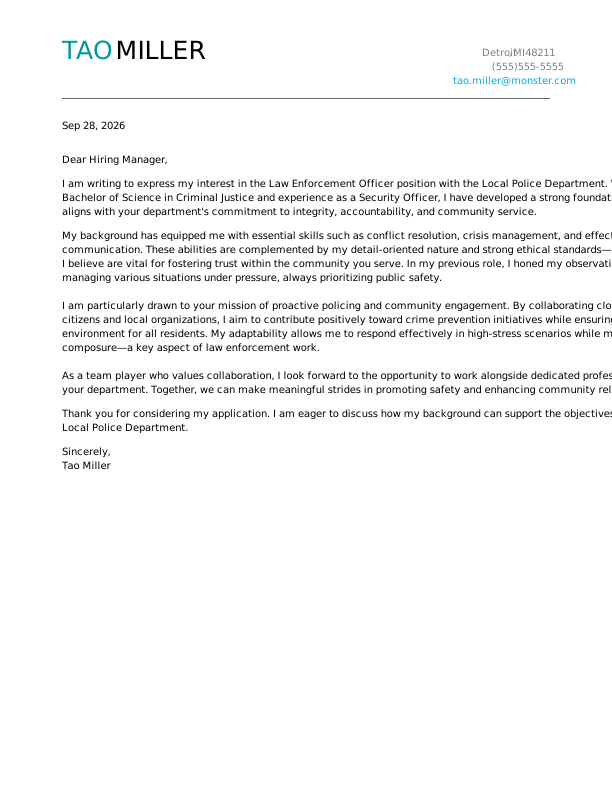
 Free
Law Enforcement Entry-Level Cover Letter
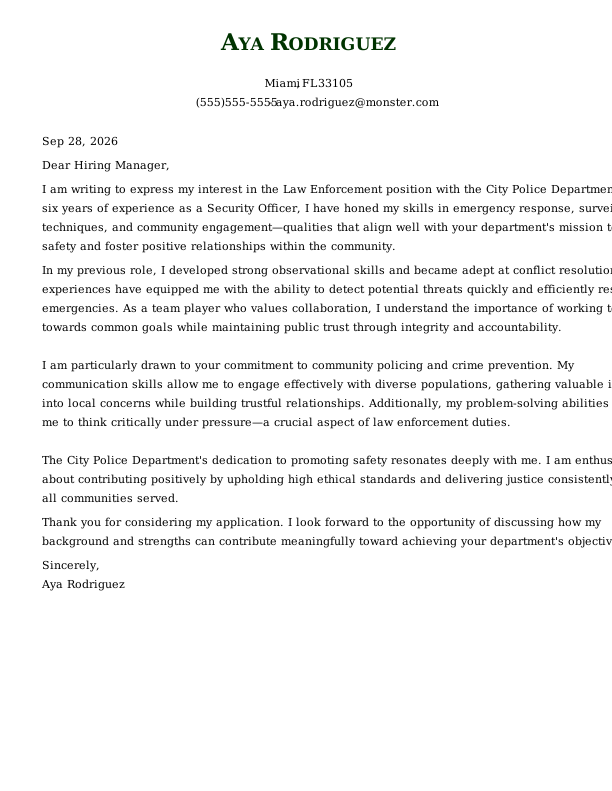
Law Enforcement Mid-Level Cover Letter
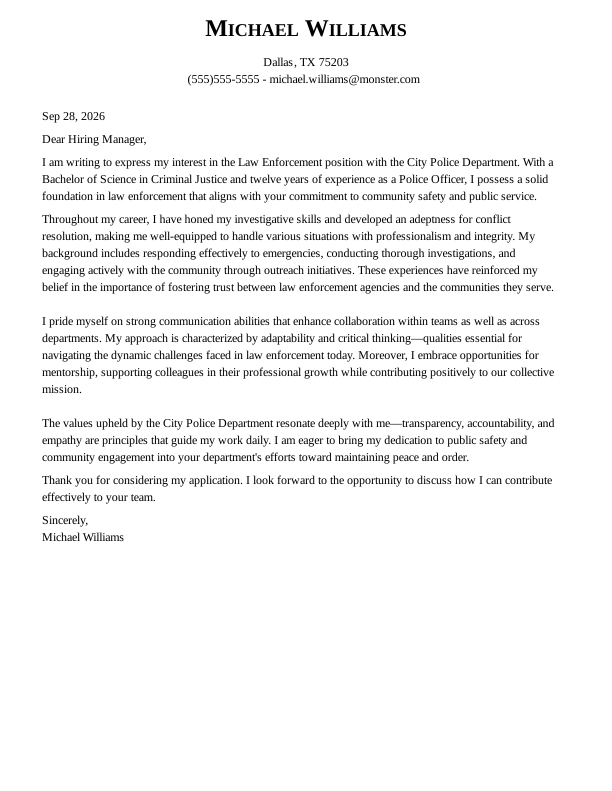
Law Enforcement Experienced Cover Letter
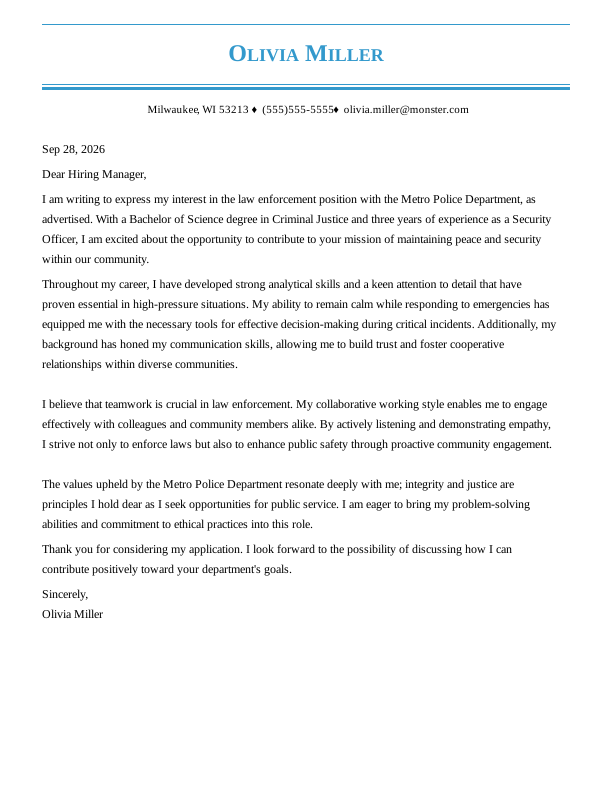
Law Enforcement Entry-Level Cover Letter
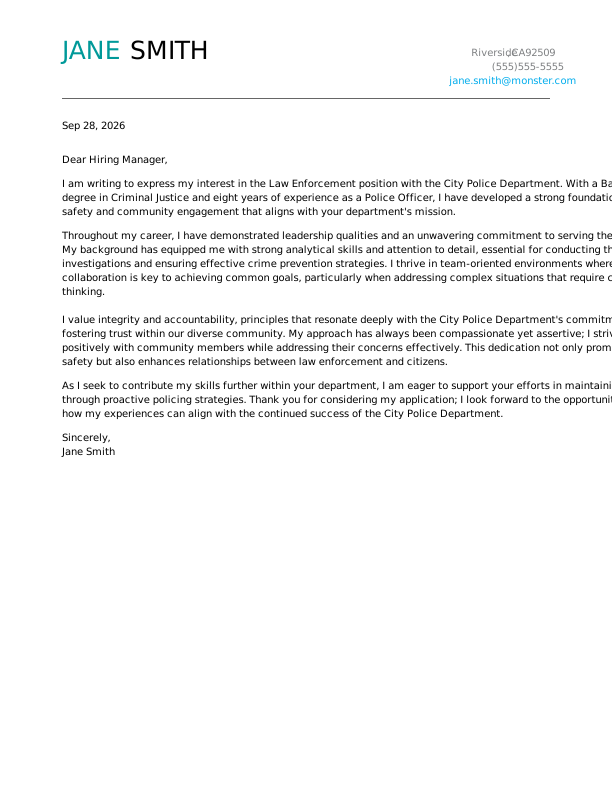
Law Enforcement Mid-Level Cover Letter
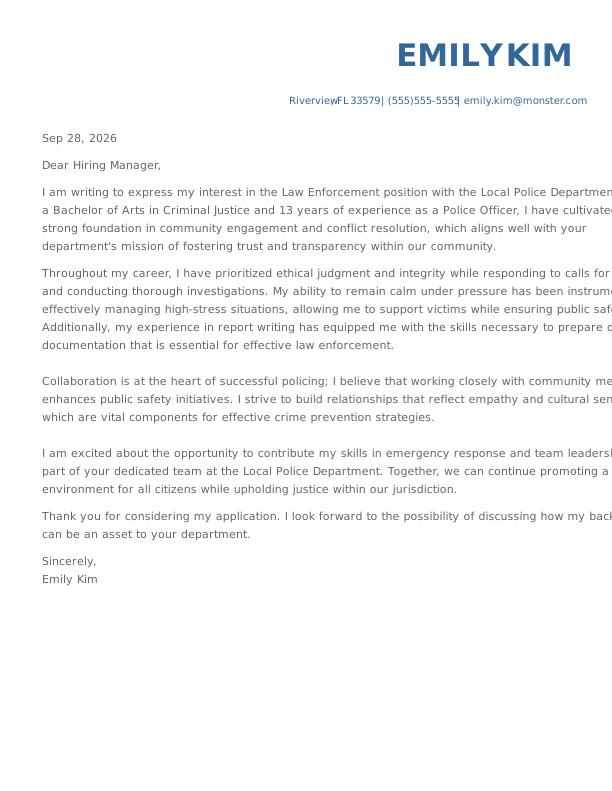
Law Enforcement Experienced Cover Letter
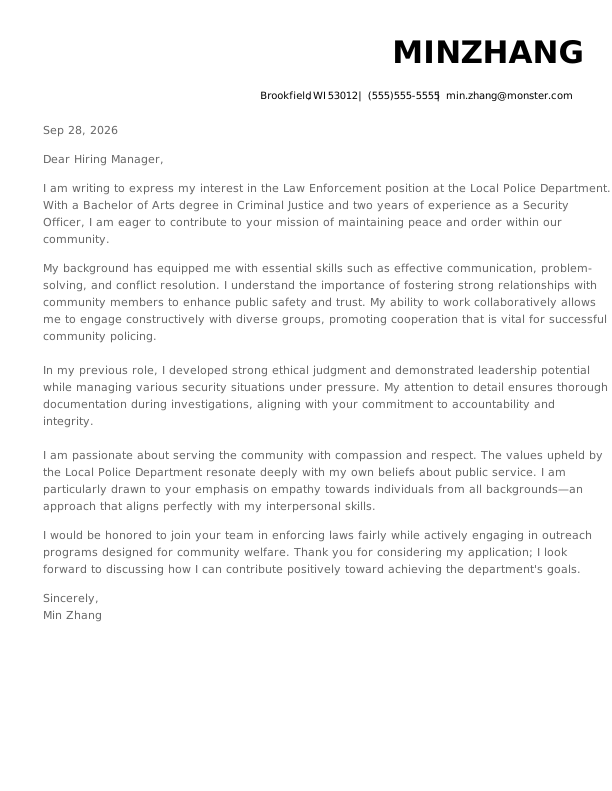
Law Enforcement Entry-Level Cover Letter
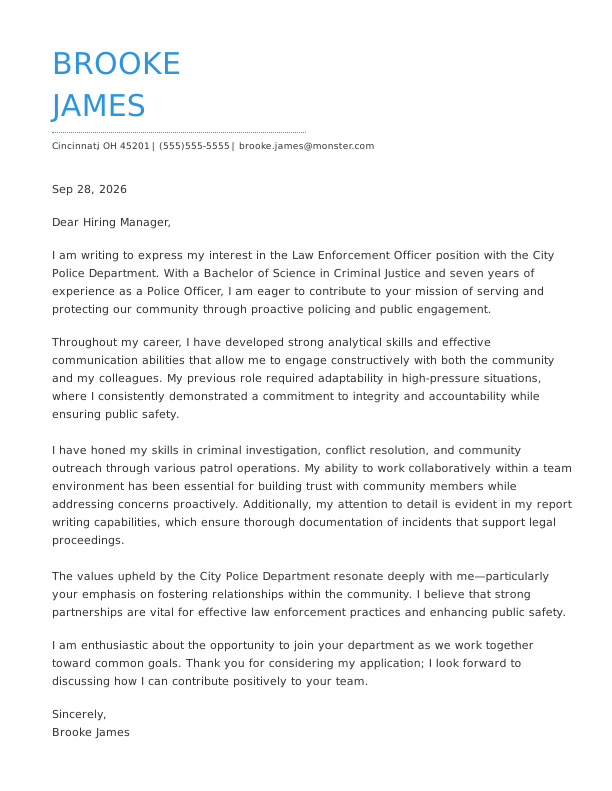
Law Enforcement Mid-Level Cover Letter
Browse Free Cover Letter Templates
- Academic
- Account Manager
- Accountant
- Accounts Payable
- Administrative Assistant
- Admissions Counselor
- Architecture
- Artist
- Assistant Principal
- Babysitter
- Barista
- Bartender
- Bookkeeper
- Brand Ambassador
- Business Analyst
- Business
- Caregiver
- Chef
- Civil Engineering
- Computer Science
- Construction
- Consulting
- Copywriter
- Cosmetology
- Custodian
- Customer Service
- Customer Service Representative
- Data Analyst
- Data Entry
- Dental Assistant
- Dental Hygienist
- Digital Marketing
- Electrical Engineering
- Emt
- Engineering
- Esthetician
- Event Coordinator
- Executive Assistant
- Finance
- Financial Analyst
- Firefighter
- Flight Attendant
- Graphic Designer
- Hair Stylist
- Healthcare
- Hr Generalist
- Investment Banking
- It
- Janitor
- Journalism
- Lab Technician
- Law Clerk
- Lawyer
- Librarian
- Logistics
- Makeup Artist
- Manager
- Marketing Coordinator
- Marketing
- Marketing Manager
- Massage Therapist
- Mechanic
- Mechanical Engineer
- Medical Assistant
- Non Profit
- Nursing
- Occupational Therapy
- Office Assistant
- Office Manager
- Operations Manager
- Paralegal
- Personal Trainer
- Pharmacist
- Pharmacy Technician
- Photographer
- Physician Assistant
- Pilot
- Police Officer
- Program Manager
- Project Manager
- Property Manager
- Psychology
- Receptionist
- Research Assistant
- Restaurant Manager
- Retail
- Sales
- Sales Manager
- School Counselor
- Security Officer
- Social Work
- Software Engineer
- Special Education Teacher
- Substitute Teacher
- Teacher
- Teaching Assistant
- Truck Driver
- Vet Tech
- Veterinary Assistant
- Web Developer
Cover Letter Examples for Law Enforcement Jobs
Cover letter requirements evolve as a law enforcement career progresses, especially from academy training to later roles with more responsibility. Choose the template that matches your experience level so you can highlight the right skills, such as field work, report writing, investigations, or leadership in day-to-day operations.
Entry-Level Law Enforcement Cover Letter
Perfect for recent criminal justice graduates and career changers, this entry-level template helps you highlight relevant training, conflict resolution skills, and ethical standards to prove you are ready to serve.
Mid-Career Law Enforcement Cover Letter
Designed for law enforcement professionals with a few years of field experience, this template highlights your ability to manage emergency responses, conduct thorough investigations, and build trust within the community.
Experienced Law Enforcement Cover Letter
Ideal for senior officers and leaders, this template focuses on directing complex investigations, mentoring junior staff, and driving community outreach while upholding agency standards.
Law Enforcement Cover Letter Template (Text)
Copy this law enforcement cover letter text into your document and tailor it with your own unit experience, certifications, and agency name for the role.
Hiro Patel
Eastside, WA 98013
(555)555-5555
hiro.patel@monster.com
Sep 28, 2026
Dear Hiring Manager,
I am writing to express my strong interest in the law enforcement position at the National Police Department. With a Bachelor of Science degree in Criminal Justice and nine years of experience as a police officer, I am eager to bring my skills and dedication to your esteemed department, which is renowned for its commitment to integrity, accountability, and community engagement.
Throughout my career, I have developed a solid foundation in conflict resolution, investigation techniques, and crisis management. My approach has always been team-oriented; I believe that collaboration fosters stronger community relationships and more effective policing. My leadership experience has equipped me with strong communication skills that allow me to engage with diverse communities effectively while promoting public safety.
In my previous role, I was tasked with conducting patrols, responding promptly to emergencies, investigating crimes thoroughly, and preparing detailed reports. These responsibilities honed my attention to detail and problem-solving abilities under pressure—qualities essential for maintaining public order. Additionally, I have embraced opportunities for ongoing professional development that align with your department’s mission of enhancing community quality through proactive policing.
I admire the National Police Department’s values of service and respect towards citizens while upholding ethical standards. As someone who shares these principles, deeply rooted in empathy and responsibility towards our communities, I am excited about the opportunity to contribute positively.
Thank you for considering my application. I look forward to discussing how my background can support the goals of your department.
Sincerely,
Hiro Patel
How to Write a Law Enforcement Cover Letter
Writing a great cover letter for a law enforcement role means turning your real-world training and field experience into clear proof of your capabilities. You want to show how you handle high-stress situations, complete accurate incident reports, and maintain public trust. Follow these simple steps to build a cover letter that highlights your strengths and catches the hiring manager’s eye.
1. Research & Prepare
Before you start writing, take time to learn about the agency and its current priorities. Check its required certifications, operational focus, and recent community programs so you can tailor your letter to match what the hiring team needs right now.
Here are a few practical ways to gather useful details before you write:
- Read the job posting carefully for required POST certifications, state licenses, or specific reporting software.
- Review the agency’s annual report or budget summary to learn about current goals like traffic safety or neighborhood outreach.
- Check local news reports to see recent departmental initiatives, community programs, or safety updates.
2. Hook the Reader
Skip generic opening lines like “I am writing to apply for this position.” Instead, open with a sentence that highlights your report accuracy or decision-making under pressure to grab the reader’s attention right away.
You can frame your opening line in a few different ways:
- Focus on incident response: “In my previous role, I handled priority dispatch calls following body-worn camera guidelines and completed all scene documentation within policy timeframes.”
- Focus on report accuracy: “I reduced report revisions by 30% over six months by standardizing narrative checks and evidence logs before supervisor reviews.”
- Focus on training and safety: “During annual de-escalation training, I led scenario-based judgment drills focused on use-of-force guidelines and clear radio communication.”
3. Tell Your Professional Story
Your law enforcement cover letter should frame a story explaining how you managed real risks and handled difficult calls. Use simple, concrete metrics to help the hiring team easily picture your daily impact on shift.
Check out these examples of how to highlight results:
- Coordinated patrol coverage for 18 officers across two districts, helping improve average response times by 12% over six months.
- Reduced repeat property crimes by 9% by expanding neighborhood contact and logging suspect information into a central database.
- Assisted investigators on 46 cases by preparing clear evidence summaries within 24 hours of intake, cutting administrative delays.
4. Showcase Your Skills
Rather than simply stating that you have good judgment, describe a situation where you followed policy and communicated clearly under pressure. Pick a requirement from the job posting and explain how you handled it step by step.
Here are a few simple ways to demonstrate core skills in action:
- Report writing: “I wrote a clear incident narrative in the CAD system using only observed facts, carefully checking all details before submitting it.”
- De-escalation communication: “When an agitated individual began shouting, I lowered my tone, acknowledged their concerns, and kept my questions focused entirely on immediate safety.”
- Evidence handling: “I logged chain-of-custody details in our case management system immediately after collecting evidence, ensuring items were sealed strictly according to department rules.”
5. Explain Any Special Circumstances
If you have an employment gap, a career transition, or an out-of-state relocation, explain it simply in one or two plain sentences. Hiring managers care most about active credentials and hands-on experience.
These examples show how to address unique situations naturally:
- “After taking medical leave, I kept my credentials active by completing annual firearms qualifications and refresher training before returning to duty.”
- “I am transitioning from corrections to patrol work by volunteering with a K-9 unit and completing updated POST academy coursework.”
- “Since relocating to Texas in May, I have completed the out-of-state credential transfer process and hold an active state license.”
6. End With a Professional Goodbye
Close your letter with a polite thank you and a clear suggestion for a next step. Keeping your closing brief ensures your message stays professional and direct.
Wrap up your letter with a practical closing like this:
“I would welcome the opportunity to discuss how I apply de-escalation techniques during high-stress calls and support your department’s community safety goals. Thank you for your time and consideration.”
Finish with a classic sign-off like “Sincerely” or “Best regards,” followed by your full name.
4 Tips for Formatting Your Cover Letter
Hiring managers often scan applications between shifts, so clean formatting makes your strongest qualifications easy to spot. A well-organized page shows you take pride in clear communication and organization. Keep these simple guidelines in mind regarding fonts, headers, and spacing to structure a standout cover letter.

Match Your Header to Your Resume
Use the same name, contact details, and header styling on both your cover letter and your resume. Keeping your contact block identical across both documents creates a cohesive application package and helps hiring managers quickly verify your details during review.

Use Bullet Points for Key Achievements
Break up dense text by using three or four bullet points to highlight major achievements, such as improved response times, case closure rates, or specialized training certifications. Bullets make it easy for a recruiter to scan your key accomplishments in seconds.

Balance Spacing & Margins
Set your line spacing to 1.15 and leave a blank line between paragraphs to keep your text readable. Use uniform margins between 0.75 and 1 inch so your cover letter looks balanced on screen and remains neat if printed for an interview file.

Save & Send as a PDF
Always export your cover letter as a PDF before submitting it online. A PDF keeps your formatting, margins, and fonts intact across different computers and applicant tracking systems. Save your file using a clean naming format like Firstname_Lastname_Cover_Letter.pdf.
Top-Paying States for Law Enforcement Roles
Knowing what law enforcement professionals earn across the country helps you compare offers and plan your next step. Salary ranges vary based on factors like location, years of experience, assignment, and agency type, so two people with the same job title can see different pay. The figures below come from the U.S. Bureau of Labor Statistics (BLS) and reflect the most recent nationwide averages for relevant roles.
Keep in mind that shift schedules, specialty units, and required certifications can also affect what you take home.
| Alabama | $68,850 |
| Arizona | $83,080 |
| Arkansas | $60,160 |
| California | $146,040 |
| Connecticut | $80,170 |
| Delaware | $80,080 |
| District of Columbia | $93,410 |
| Florida | $63,650 |
| Georgia | $68,430 |
| Idaho | $76,780 |
| Illinois | $72,760 |
| Indiana | $65,330 |
| Iowa | $67,750 |
| Kansas | $54,480 |
| Kentucky | $61,570 |
| Louisiana | $89,850 |
| Maine | $67,110 |
| Maryland | $82,500 |
| Massachusetts | $92,950 |
| Michigan | $76,180 |
| Minnesota | $82,740 |
| Mississippi | $86,910 |
| Missouri | $77,820 |
| Nebraska | $76,340 |
| Nevada | $76,680 |
| New Hampshire | $80,620 |
| New Jersey | $83,050 |
| New Mexico | $66,090 |
| New York | $95,760 |
| North Carolina | $60,130 |
| Ohio | $76,240 |
| Oklahoma | $57,740 |
| Oregon | $97,770 |
| Pennsylvania | $79,970 |
| Rhode Island | $90,260 |
| South Carolina | $71,780 |
| South Dakota | $69,890 |
| Tennessee | $63,460 |
| Texas | $86,290 |
| Utah | $77,930 |
| Vermont | $72,000 |
| Virginia | $88,860 |
| Washington | $70,570 |
| West Virginia | $74,230 |
| Wisconsin | $99,340 |
| Wyoming | $75,540 |
| Puerto Rico | $78,030 |
Key Takeaways
- Highlight your ability to use sound judgment, de-escalation, and clear decision-making during high-stress field situations.
- Include clear metrics like response times, shift sizes managed, or case closure figures to prove your operational impact.
- Tailor your letter to the agency’s primary mission, whether that focus is community-oriented municipal patrol, institutional corrections, or federal investigations.
Browse Monster’s Resume Templates
Monster also has hundreds of ATS-friendly resume templates for all career levels and industries. Create a matching resume to help you land the interview.
Frequently Asked Questions
Last Update:
Do I really need a cover letter?
Yes, submitting a cover letter is strongly recommended for law enforcement roles, even when listed as optional. A resume details your certifications and work history, but a cover letter lets you explain your approach to decision-making, de-escalation, and public service. It also gives you space to explain a career transition, address a work gap, or share your genuine interest in joining that specific agency.
How long should my cover letter be?
Keep your cover letter to a single page, aiming for 250 to 400 words. Hiring managers review many applications while managing busy operational schedules, so concise writing helps your key qualifications stand out. Focus on three to four brief paragraphs that highlight your relevant field experience, certifications, and dedication to public safety.
Should my cover letter match my resume?
Yes, your cover letter should match your resume’s visual formatting so your application looks unified. Use the same font style, colors, and contact header across both pages. While the design should match, the text should expand on one or two specific experiences—such as leading a team call or improving report accuracy—rather than repeating your resume bullet points word for word.
What should I include in my cover letter header?
In your cover letter header, include your full name, phone number, professional email address, and city and state, followed by the date. Below your information, add the recipient’s name, title, and agency name when available. Ensure the font style, alignment, and overall layout match your resume header so both documents form a matching pair.
How do I write a cover letter for an internal position?
When writing a cover letter for an internal position, focus on your familiarity with the agency’s reporting software, evidence guidelines, and daily workflows. Highlight how you coordinate with supervisors, dispatch, and partner units to keep operations running smoothly. Mention specific achievements, such as reducing report backlogs or mentoring new personnel, and outline your commitment to taking on expanded leadership responsibilities within the agency.

Megan Dawkins is a career industry editor who empowers job seekers to take control of their career paths using Monster’s comprehensive job search and resume tools. She specializes in helping job seekers navigate the flexible job market.
See More From Megan DawkinsExplore Related Career Advice







How to Write a Cover Letter for Internal Positions or Promotions (Examples & Tips)

Updated:
Apr 23, 2026
|
19 min read


Cover Letter vs Resume: What’s the Difference & Do You Need Both?

Updated:
Apr 23, 2026
|
18 min read