

Free Legal Cover Letter Templates & Examples
A strong legal cover letter shows how your analytical skills, attention to detail, and practical casework make you an asset to a team. Writing a clear, targeted letter helps hiring managers quickly see your ability to manage legal risks and protect clients.
Real-World Cover Letters That Get Results
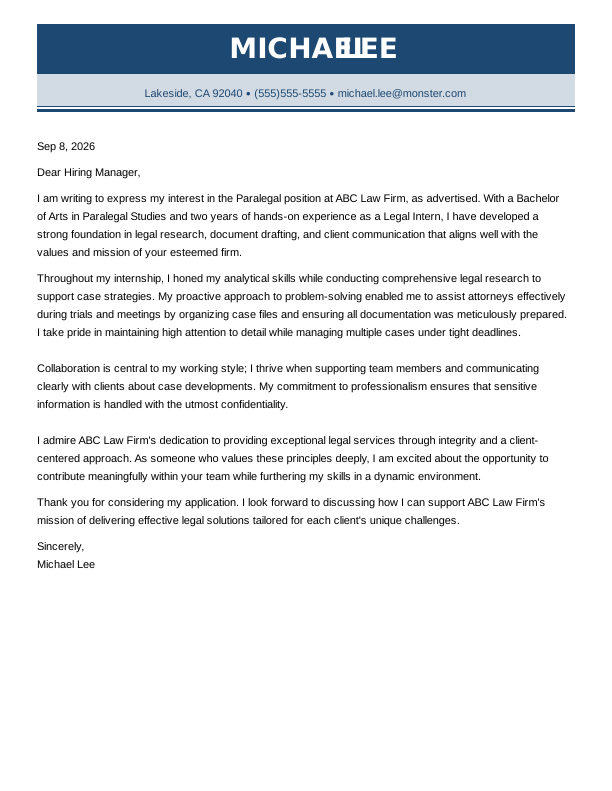
 Free
Legal Entry-Level Cover Letter
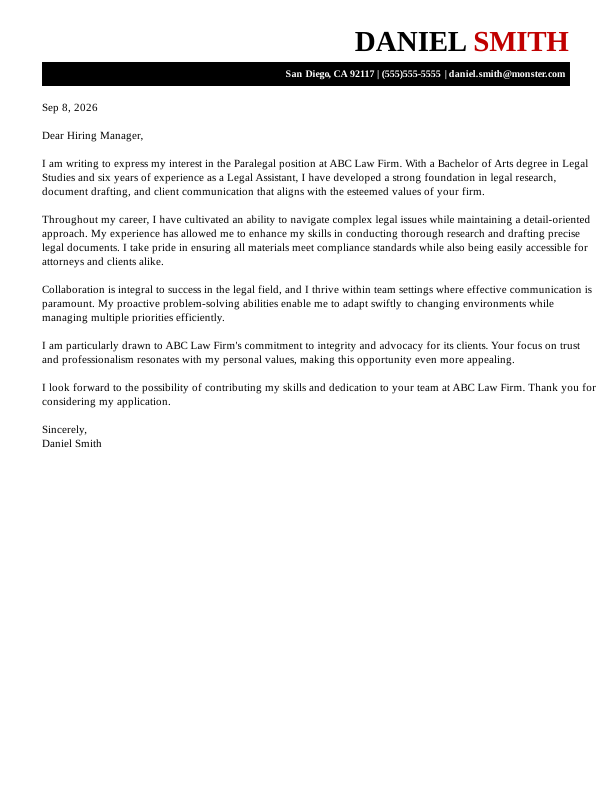
Legal Mid-Level Cover Letter
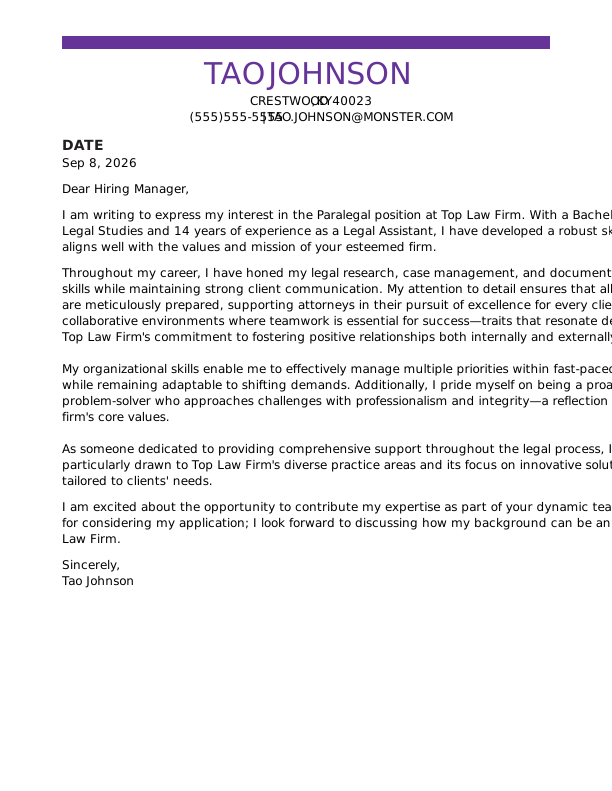
Legal Experienced Cover Letter
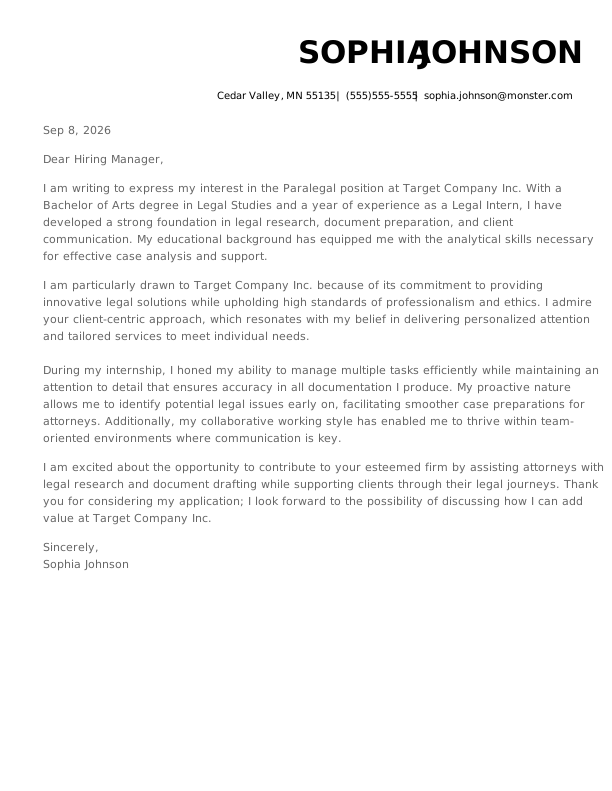
Legal Entry-Level Cover Letter
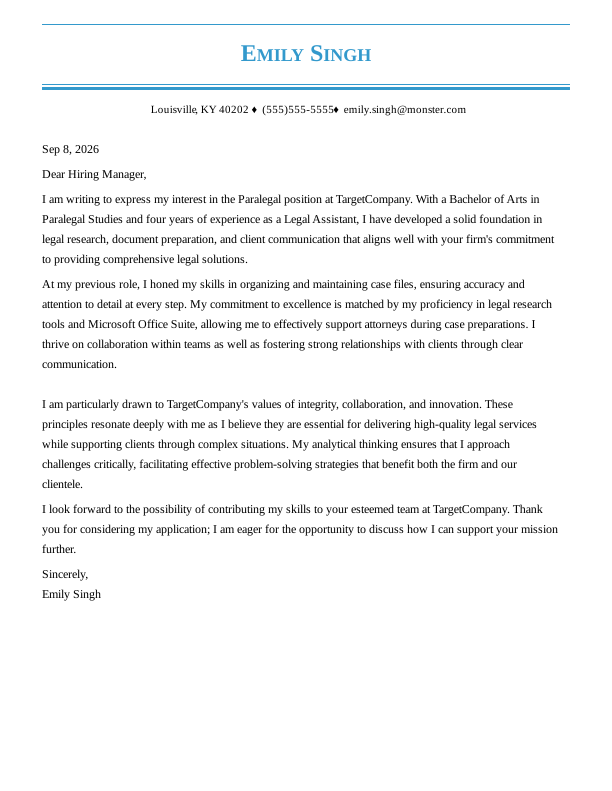
Legal Mid-Level Cover Letter
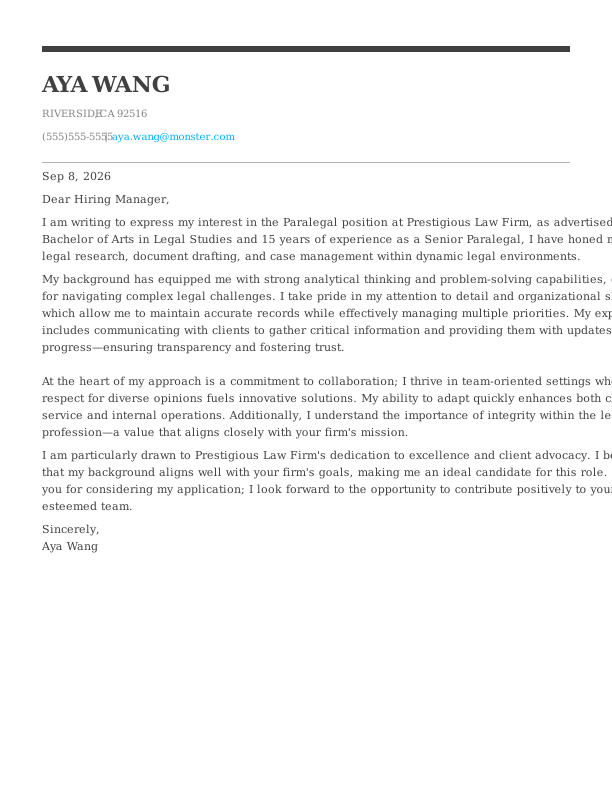
Legal Experienced Cover Letter
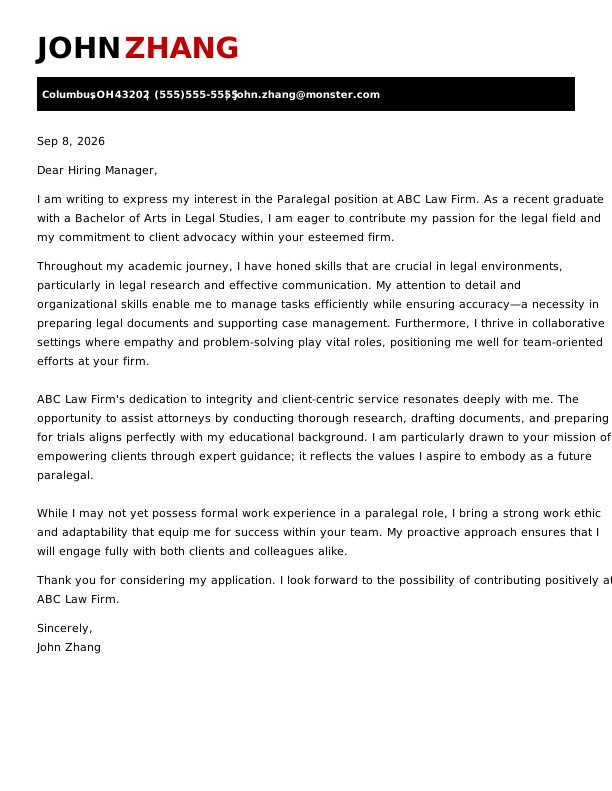
Legal Entry-Level Cover Letter
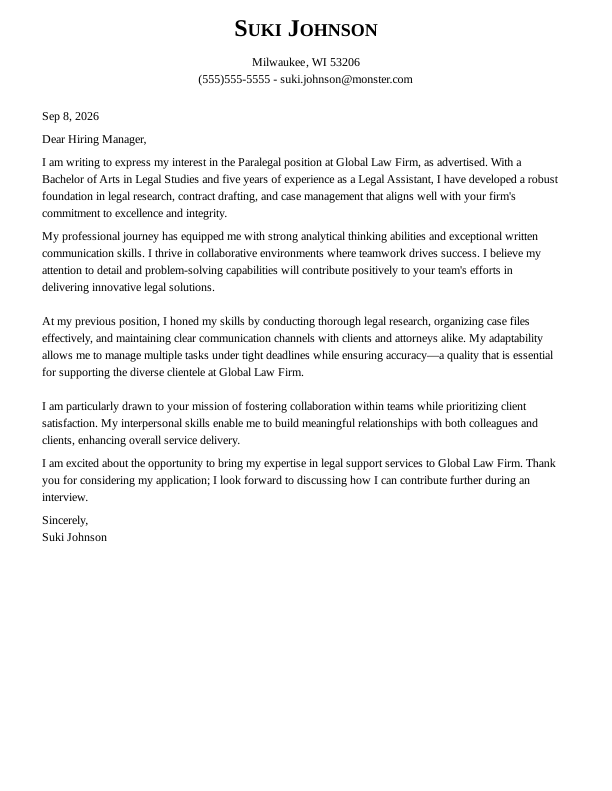
Legal Mid-Level Cover Letter
Browse Free Cover Letter Templates
- Academic
- Account Manager
- Accountant
- Accounts Payable
- Administrative Assistant
- Admissions Counselor
- Architecture
- Artist
- Assistant Principal
- Babysitter
- Barista
- Bartender
- Bookkeeper
- Brand Ambassador
- Business Analyst
- Business
- Caregiver
- Chef
- Civil Engineering
- Computer Science
- Construction
- Consulting
- Copywriter
- Cosmetology
- Custodian
- Customer Service
- Customer Service Representative
- Data Analyst
- Data Entry
- Dental Assistant
- Dental Hygienist
- Digital Marketing
- Electrical Engineering
- Emt
- Engineering
- Esthetician
- Event Coordinator
- Executive Assistant
- Finance
- Financial Analyst
- Firefighter
- Flight Attendant
- Graphic Designer
- Hair Stylist
- Healthcare
- Hr Generalist
- Investment Banking
- It
- Janitor
- Journalism
- Lab Technician
- Law Clerk
- Lawyer
- Librarian
- Logistics
- Makeup Artist
- Manager
- Marketing Coordinator
- Marketing
- Marketing Manager
- Massage Therapist
- Mechanic
- Mechanical Engineer
- Medical Assistant
- Non Profit
- Nursing
- Occupational Therapy
- Office Assistant
- Office Manager
- Operations Manager
- Paralegal
- Personal Trainer
- Pharmacist
- Pharmacy Technician
- Photographer
- Physician Assistant
- Pilot
- Police Officer
- Program Manager
- Project Manager
- Property Manager
- Psychology
- Receptionist
- Research Assistant
- Restaurant Manager
- Retail
- Sales
- Sales Manager
- School Counselor
- Security Officer
- Social Work
- Software Engineer
- Special Education Teacher
- Substitute Teacher
- Teacher
- Teaching Assistant
- Truck Driver
- Vet Tech
- Veterinary Assistant
- Web Developer
Cover Letter Examples for Legal Jobs
Cover letter requirements for a legal professional change as your career progresses, especially from first case work to broader responsibility. Choose the template that matches your experience level so you can highlight the right skills, training, and accomplishments for entry-level, mid-career, or experienced roles.
Entry-Level Legal Cover Letter
Designed for recent law school graduates or professionals entering the field, this option focuses on foundational legal knowledge, research skills, and transferable academic or internship experience.
Mid-Career Legal Cover Letter
Ideal for legal professionals with several years of experience, this template highlights case execution, document drafting, client communication, and growing responsibilities within a practice group.
Experienced Legal Cover Letter
Suited for senior attorneys and legal advisors, this template emphasizes strategic leadership, complex risk management, high-stakes negotiations, and team mentorship.
Legal Cover Letter Template (Text)
Copy this legal cover letter template into your document and adapt it by swapping in your casework examples, bar admission details, and target firm name.
Min Huang
Greenfield, IN 46144
(555)555-5555
min.huang@monster.com
Oct 14, 2026
Dear Hiring Manager,
I am writing to express my interest in the legal consultant position at Target Company No.1. With a Bachelor of Arts degree in Legal Studies and over seven years of experience as a legal assistant, I have honed my skills in legal research, contract drafting, and client communication within dynamic environments. My professional journey has instilled a detail-oriented approach and an analytical mindset, which I believe align well with your company’s commitment to transparency and excellence.
At my previous role, I successfully collaborated with cross-functional teams to address legal issues proactively while ensuring compliance with relevant regulations. My ability to think critically has enabled me to navigate complex legal landscapes effectively, making me adept at identifying potential risks and formulating solutions that uphold organizational integrity.
Furthermore, I thrive in collaborative settings where effective communication is paramount. My experience includes training internal stakeholders on legal matters, enhancing their understanding of compliance requirements while fostering an atmosphere of trust within the team.
The core values at Target Company No.1 resonate deeply with me—particularly your focus on ethical practices and community engagement. I am eager to contribute my expertise in retail law and regulatory affairs towards supporting your mission of delivering quality products responsibly.
Thank you for considering my application. I look forward to the opportunity to discuss how my background can complement your team’s efforts toward continued success.
Sincerely,
Min Huang
How to Write a Legal Cover Letter
Writing a strong legal cover letter means turning your real-world experience into a clear, convincing story. Instead of listing basic duties, focus on how you research issues, manage risk, and support clients or attorneys under real deadlines. Use these steps to structure your letter and show employers you are ready for the job.
1. Research & Prepare
Before you start writing, take time to understand how the firm or organization operates day to day. Every legal employer has distinct priorities, whether that means managing high-volume litigation, drafting commercial agreements, or maintaining regulatory compliance. Tailoring your cover letter to its specific practice areas and workflow makes your application stand out right away.
To gather useful background before writing, try these steps:
- Review the job posting to identify specific software, case management platforms, or legal databases the team uses.
- Read recent firm press releases, news articles, or company updates to learn about current litigation, deal activity, or compliance challenges.
- Look up relevant state bar guidelines or practice group news to understand the local legal environment.
2. Hook the Reader
Start your letter with an opening that grabs attention and demonstrates immediate value. Skip generic openers that simply state the job title you are applying for. Instead, show that you understand procedural work, issue spotting, and risk management from day one.
Consider these opening approaches depending on your primary background:
- For a litigation or discovery focus: “Last quarter, I cut discovery turnaround time by 30% by standardizing our electronic review workflow and managing custodian checklists.”
- For a regulatory or transactional focus: “When new privacy regulations were introduced, I updated our contract playbook and successfully renegotiated eight vendor agreements to meet compliance deadlines.”
- For a courtroom or trial prep focus: “Preparing for a wage-and-hour trial, I organized court-ready exhibit binders and filed key motions early to build a strong record for our lead trial counsel.”
3. Tell Your Professional Story
Use the body of your letter to show how you handle real legal responsibilities and strict deadlines. While your resume lists your employment history, your cover letter lets you explain the scope of your work using concrete details and metrics. Concrete details help hiring managers visualize how you will handle their workload.
Here are a few ways to describe your past achievements with clear metrics:
- Managed an active docket of 60 open matters while meeting every court filing deadline over a six-month period.
- Shortened contract review times by 30% after creating standard redline guides for 120 commercial agreements.
- Reduced outside counsel expenses by $18,000 in one quarter by drafting reusable clauses for 45 vendor contracts.
4. Showcase Your Skills
Instead of using vague buzzwords like “hardworking” or “detail-oriented,” give specific examples of how you put your skills into action. Match your strengths to the key requirements listed in the job description to show you have the exact experience the employer needs.
You can highlight your core legal abilities by focusing on specific tasks like these:
- Contract review: “I redlined a complex vendor contract to tighten indemnity provisions and catch a missing termination notice before the signing deadline.”
- Legal research: “Using legal databases like Westlaw, I prepared a detailed memorandum on recent case law to help our team select the strongest legal argument.”
- Client communication: “I explained complex case updates to non-lawyer clients in plain language and logged their feedback in our case management system for quick follow-up.”
5. Explain Any Special Circumstances
If you have an employment gap, are changing practice areas, or are relocating, address it directly in one or two simple sentences. Legal hiring managers care most about your current qualifications, active bar admissions, and practical skills. Briefly explaining your situation prevents employers from making incorrect assumptions about your work history.
Use these simple phrasing ideas to address common situations:
- Addressing a work gap: “During a nine-month career break, I kept my skills sharp by completing continuing legal education courses and assisting with contract reviews on a freelance basis.”
- Changing specialties: “I am moving into litigation support by taking on discovery work and case drafting while preparing for the upcoming bar exam.”
- Relocating to a new area: “After relocating recently, I am fully prepared to handle local matters under my current state bar admission.”
6. End With a Professional Goodbye
Close your letter with a brief, polite statement that proposes a clear next step and thanks the reader for their time. Avoid overused phrases that sound passive or standard. Instead, suggest a brief discussion about how your background matches their current team needs.
For example, you might write: “I would welcome the opportunity to discuss how my contract review and risk management experience can support your current practice. Thank you for your time and consideration.”
Close with a standard sign-off like “Sincerely” or “Best regards,” followed by your full name.
4 Tips for Formatting Your Cover Letter
How your cover letter looks is just as important as what it says. Legal hiring managers often scan applications between meetings or court filings, so a clean layout helps them find key details like your bar admissions, core practice areas, and relevant experience right away. Taking time to format your letter professionally ensures your application looks organized and easy to read on any device.

Keep It to One Page
Keep your legal cover letter to a single page, ideally between 250 and 400 words spread across three to four short paragraphs. A concise letter respects the reader’s time and forces you to focus on your strongest achievements. Make sure to cover essential details like your degree or bar admission, primary practice areas, and at least one concrete work accomplishment.

Match Your Header to Your Resume
Use the same header style, font, and contact information block on both your cover letter and resume. Matching your document designs creates a polished, professional package that looks cohesive. It also helps hiring managers quickly connect your application materials when reviewing multiple files.

Balance Spacing & Margins
Set your line spacing between 1.0 and 1.15, and leave a clear blank line between paragraphs so the text does not feel crowded. Use standard margins between 0.75 inches and 1 inch on all sides. This layout ensures your letter looks clean on screen and prints neatly on standard paper without crowding the page.

Save & Send as a PDF
Save your completed cover letter as a PDF file before submitting your application. Converting your file to a PDF preserves your margins, spacing, and formatting across different operating systems and application tracking systems. Use a clear file name like Firstname_Lastname_Cover_Letter.pdf so the employer can easily identify your document.
Top-Paying States for Legal Roles
Knowing what legal professionals earn can help you compare job offers, plan your next career move, and negotiate with confidence. Salary ranges vary widely by role and setting, so looking at a reliable benchmark matters.
The data below is sourced from the U.S. Bureau of Labor Statistics (BLS) and reflects the most recent nationwide averages for legal occupations. Your actual pay may differ based on location, years of experience, practice area, and employer type, such as law firms versus in-house roles.
| Alabama | $93,270 |
| Alaska | $110,240 |
| Arizona | $119,230 |
| Arkansas | $103,990 |
| California | $186,670 |
| Connecticut | $138,470 |
| Delaware | $134,180 |
| District of Columbia | $209,570 |
| Florida | $112,070 |
| Georgia | $131,710 |
| Hawaii | $104,300 |
| Idaho | $88,150 |
| Illinois | $140,100 |
| Indiana | $113,250 |
| Iowa | $88,860 |
| Kansas | $98,500 |
| Kentucky | $94,940 |
| Louisiana | $94,310 |
| Maine | $96,510 |
| Maryland | $128,620 |
| Massachusetts | $174,530 |
| Michigan | $114,770 |
| Minnesota | $127,290 |
| Mississippi | $84,270 |
| Missouri | $118,150 |
| Montana | $88,490 |
| Nebraska | $104,270 |
| Nevada | $60,690 |
| New Hampshire | $123,500 |
| New Jersey | $144,170 |
| New Mexico | $103,220 |
| New York | $172,450 |
| North Carolina | $115,790 |
| North Dakota | $98,310 |
| Ohio | $113,470 |
| Oklahoma | $99,330 |
| Oregon | $116,830 |
| Pennsylvania | $116,900 |
| Rhode Island | $103,560 |
| South Carolina | $89,490 |
| South Dakota | $98,700 |
| Tennessee | $109,850 |
| Texas | $121,730 |
| Utah | $108,890 |
| Vermont | $120,100 |
| Virginia | $151,210 |
| Washington | $130,550 |
| West Virginia | $89,070 |
| Wisconsin | $115,630 |
| Wyoming | $95,880 |
| Guam | $91,970 |
| Puerto Rico | $64,930 |
| Virgin Islands | $96,110 |
Key Takeaways
- Show your legal issue-spotting and risk-management skills by explaining how you identified a liability in a document and corrected it before filing.
- Support your experience with clear metrics, such as discovery turnaround times, contract cycle reductions, or the total number of active matters managed.
- Tailor your letter’s focus to the employer, emphasizing research depth for law firms, policy adherence for corporate legal teams, or statutory compliance for government agencies.
More Cover Letter Examples
Browse Monster’s Resume Templates
Monster also has hundreds of ATS-friendly resume templates for all career levels and industries. Create a matching resume to help you land the interview.
Frequently Asked Questions
Last Update:
Do I really need a cover letter?
Yes. You should always include a cover letter for legal roles, even when an employer lists it as optional. While your resume outlines your credentials, a cover letter lets you explain the practical strategy behind your casework and demonstrate strong written communication. It also gives you space to explain a career transition or work gap while showing direct interest in the organization’s specific practice areas.
How long should my cover letter be?
A legal cover letter should fit on one page and run between 250 and 400 words. Keeping your text concise shows respect for the reader’s time and proves you can communicate key facts clearly under space constraints. Focus on three to four short paragraphs that highlight your strongest qualifications, major legal accomplishments, and relevant certifications rather than repeating your full resume.
Should my cover letter match my resume?
Your cover letter should match your resume’s visual formatting to create a clean, unified application package. Use identical fonts, margins, colors, and contact header layouts across both documents so they look intentional and organized. The content of your cover letter should expand on key achievements or explain your interest in the position rather than repeating your resume bullet points.
How do I address my cover letter if I don’t know the hiring manager’s name?
Try to find the specific contact person by checking the job posting, firm website, or LinkedIn for practice group leaders or legal recruiters. Taking a few minutes to research demonstrates professional diligence and attention to detail. If you still cannot locate a name, use a professional greeting such as “Dear Hiring Manager” or “Dear Legal Recruiting Team.”
Can I use AI to write my cover letter?
You can use AI tools to generate initial outlines, structure your thoughts, or overcome writer’s block when drafting your letter. However, you must edit the content thoroughly so it reflects your authentic voice, actual casework, and specific practice experience. Hiring managers can easily spot generic AI phrasing, so personalizing your letter with real examples is essential.

Kirsten Chorpenning is a career advice writer who empowers job seekers to take control of their career paths using Monster’s comprehensive job search and resume tools. She specializes in helping job seekers find rewarding jobs in today’s dynamic work environment.
See More From Kirsten ChorpenningExplore Related Career Advice







How to Write a Cover Letter for Internal Positions or Promotions (Examples & Tips)
Updated:
Apr 23, 2026
|
19 min read


Cover Letter vs Resume: What’s the Difference & Do You Need Both?

Updated:
Apr 23, 2026
|
18 min read