

Free Attorney Cover Letter Templates & Examples
A strong attorney cover letter must show how you put your legal skills into action. Whether you are drafting motions, advising clients, or negotiating contracts, a clear letter highlights your real-world impact. Explore our free attorney cover letter examples and step-by-step guidance below to build a standout application.
Real-World Cover Letters That Get Results
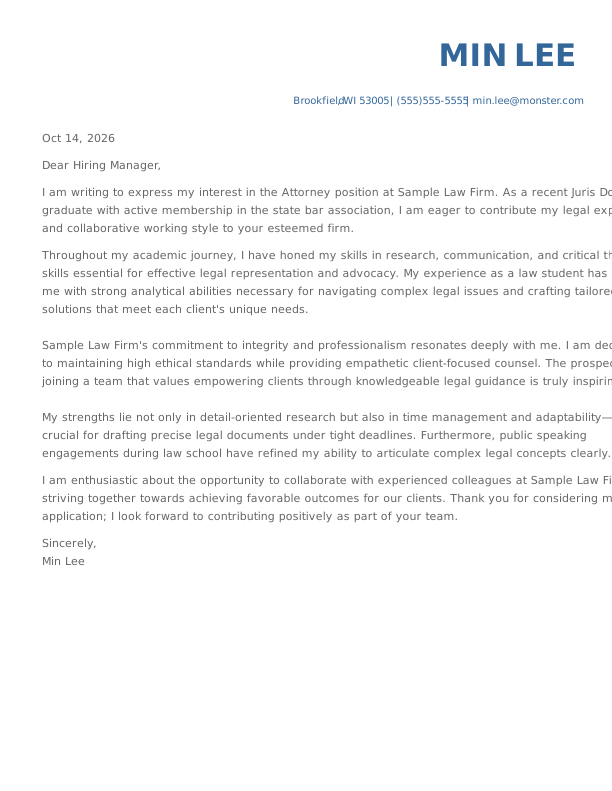
 Free
Attorney Entry-Level Cover Letter
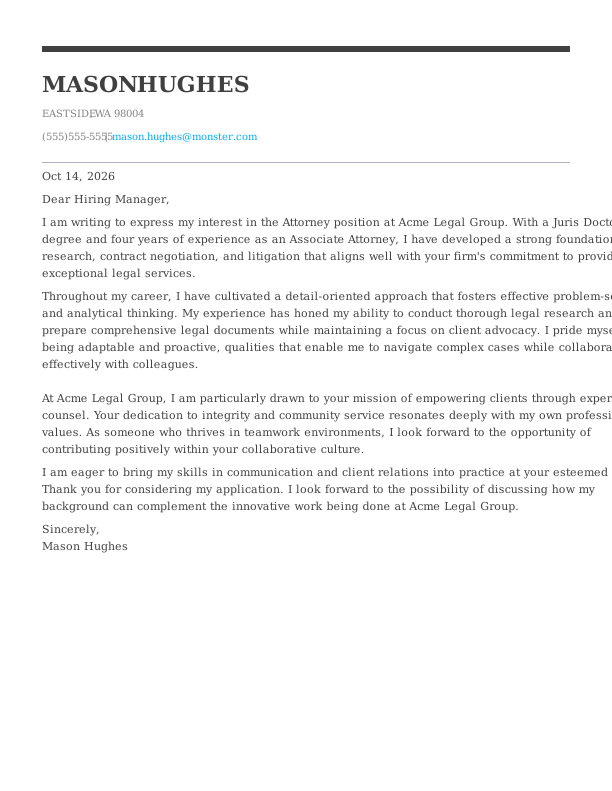
Attorney Mid-Level Cover Letter
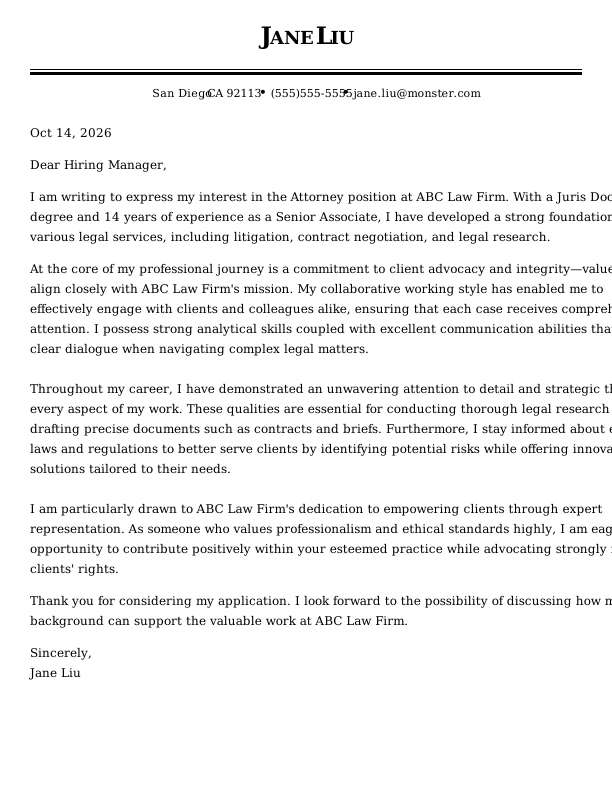
Attorney Experienced Cover Letter
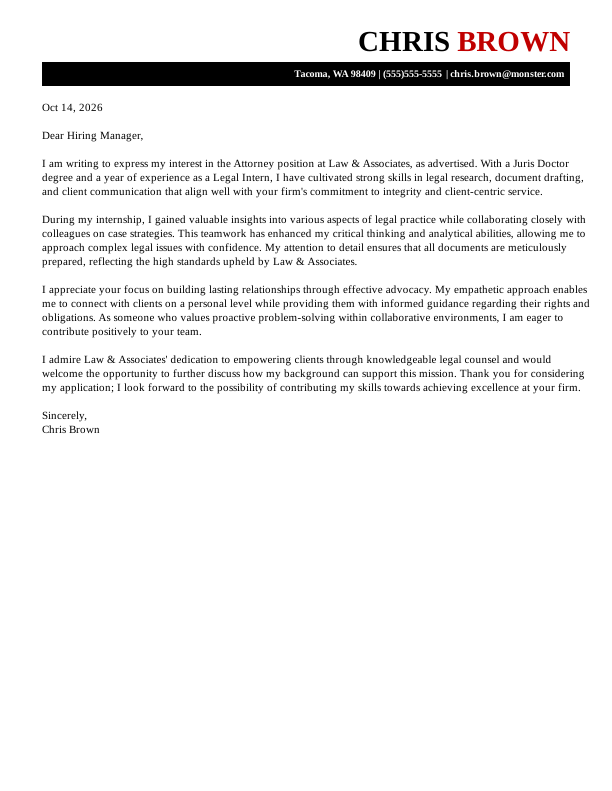
Attorney Entry-Level Cover Letter
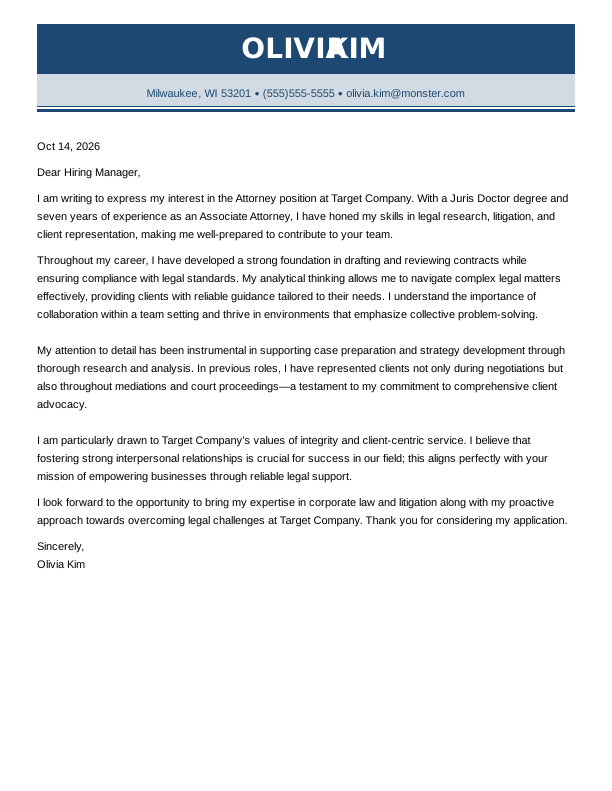
Attorney Mid-Level Cover Letter
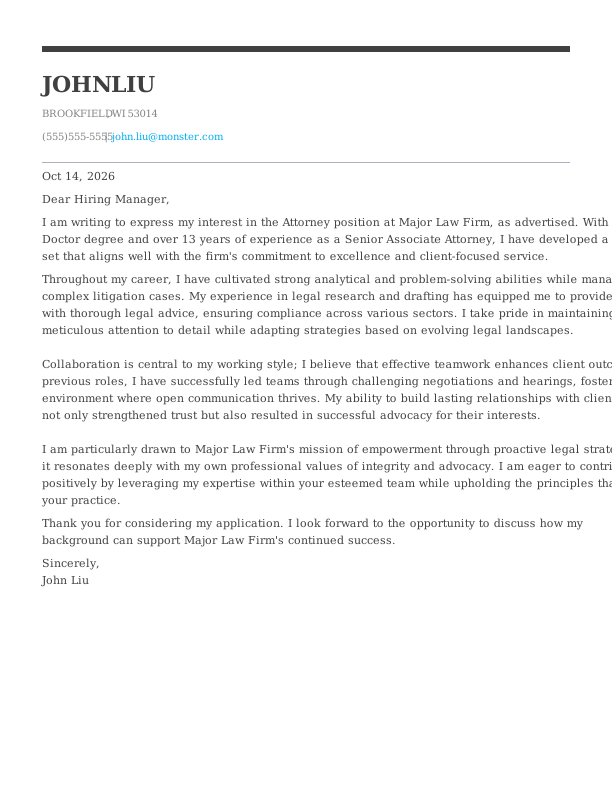
Attorney Experienced Cover Letter
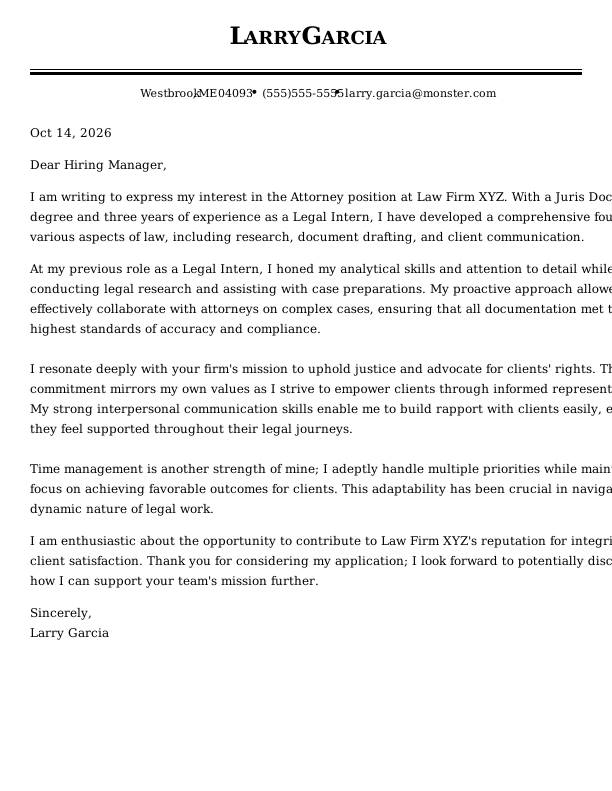
Attorney Entry-Level Cover Letter
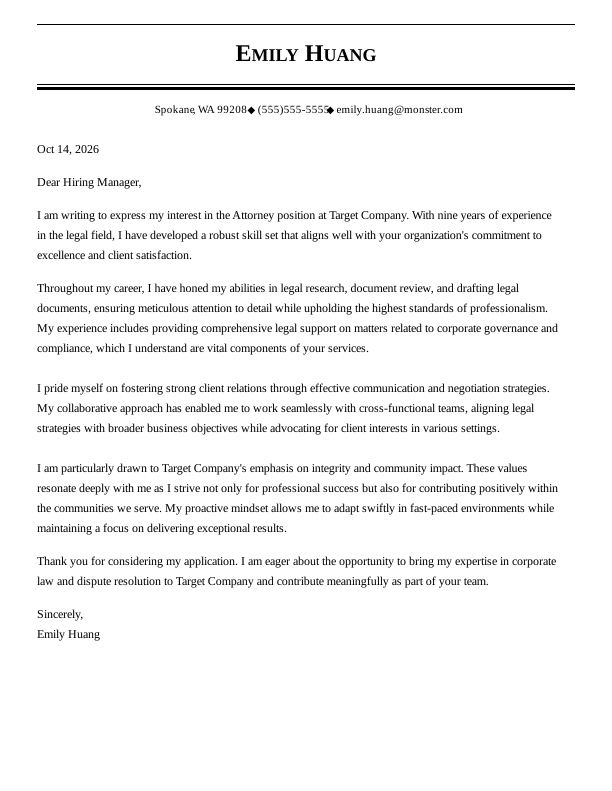
Attorney Mid-Level Cover Letter
Browse Free Cover Letter Templates
- Academic
- Account Manager
- Accountant
- Accounts Payable
- Administrative Assistant
- Admissions Counselor
- Architecture
- Artist
- Assistant Principal
- Babysitter
- Barista
- Bartender
- Bookkeeper
- Brand Ambassador
- Business Analyst
- Business
- Caregiver
- Chef
- Civil Engineering
- Computer Science
- Construction
- Consulting
- Copywriter
- Cosmetology
- Custodian
- Customer Service
- Customer Service Representative
- Data Analyst
- Data Entry
- Dental Assistant
- Dental Hygienist
- Digital Marketing
- Electrical Engineering
- Emt
- Engineering
- Esthetician
- Event Coordinator
- Executive Assistant
- Finance
- Financial Analyst
- Firefighter
- Flight Attendant
- Graphic Designer
- Hair Stylist
- Healthcare
- Hr Generalist
- Investment Banking
- It
- Janitor
- Journalism
- Lab Technician
- Law Clerk
- Lawyer
- Librarian
- Logistics
- Makeup Artist
- Manager
- Marketing Coordinator
- Marketing
- Marketing Manager
- Massage Therapist
- Mechanic
- Mechanical Engineer
- Medical Assistant
- Non Profit
- Nursing
- Occupational Therapy
- Office Assistant
- Office Manager
- Operations Manager
- Paralegal
- Personal Trainer
- Pharmacist
- Pharmacy Technician
- Photographer
- Physician Assistant
- Pilot
- Police Officer
- Program Manager
- Project Manager
- Property Manager
- Psychology
- Receptionist
- Research Assistant
- Restaurant Manager
- Retail
- Sales
- Sales Manager
- School Counselor
- Security Officer
- Social Work
- Software Engineer
- Special Education Teacher
- Substitute Teacher
- Teacher
- Teaching Assistant
- Truck Driver
- Vet Tech
- Veterinary Assistant
- Web Developer
Cover Letter Examples for Attorneys
Expectations for attorneys shift as they gain experience, moving from core legal research and drafting toward managing complex matters and leading teams. Choose the sample below that matches your career stage to showcase your skills, training, and achievements effectively.
Entry-Level Attorney Cover Letter
Designed for recent graduates and new bar members, this entry-level cover letter template helps you confidently highlight your foundational research skills, legal training, and transferable strengths.
Mid-Career Attorney Cover Letter
Designed for attorneys with a few years of practice, this mid-career template helps you highlight your growing independence in managing cases, drafting key documents, and handling client relationships.
Experienced Attorney Cover Letter
Tailored for senior attorneys, this template helps you emphasize high-level case strategy, complex negotiations, and a long track record of delivering positive outcomes for clients and firms.
Attorney Cover Letter Template (Text)
Copy this attorney cover letter template into your document, then adapt it by swapping in your case experience and bar admissions or firm name for the role.
Jane Liu
Oakridge, OR 97472
(555)555-5555
jane.liu@monster.com
Oct 14, 2026
Dear Hiring Manager,
I am writing to express my interest in the attorney position at ABC Law Firm. With a Juris Doctor degree and eight years of experience as an associate attorney, I have developed a comprehensive skill set that aligns well with the needs of your esteemed firm.
Throughout my career, I have honed my abilities in litigation, legal research, and contract negotiation. My strong analytical skills enable me to develop effective case strategies while ensuring compliance with all legal procedures. I pride myself on being detail-oriented and committed to delivering accurate and high-quality work for my clients.
At the core of my professional ethos is a dedication to client advocacy. I believe that fostering lasting relationships built on trust is essential for achieving positive outcomes in legal matters. My strategic thinking and problem-solving capabilities allow me to navigate complex cases efficiently while maintaining open lines of communication with clients.
I am particularly drawn to ABC Law Firm because of its commitment to integrity and excellence in providing tailored legal services across various areas, including corporate law, family law, personal injury, and estate planning. Your mission resonates deeply with my values as an attorney who strives for both professionalism and empathy when representing clients.
I look forward to the possibility of contributing positively to your team through collaborative efforts that prioritize client satisfaction. Thank you for considering my application; I hope we can discuss how I can support ABC Law Firm’s continued success.
Sincerely,
Jane Liu
How to Write an Attorney Cover Letter
A great cover letter shows how your legal knowledge translates into real-world results. Instead of just listing your credentials, use your cover letter to explain how you solve problems, handle client matters, and manage caseloads. Follow these simple steps to build a persuasive letter.
1. Research & Prepare
Take time to understand what the law firm or organization values before you start typing. Reviewing its main practice areas, recent high-profile cases, and client base helps you tailor your message to its exact operational needs.
Use these quick strategies to gather useful context for your application:
- Review the job posting to identify required bar admissions, key legal tools, and core practice area expectations.
- Check the firm’s website or recent news mentions to see what types of cases or transactions currently drive its workload.
- Look up recent regulatory changes or state bar guidelines that affect the specific field you are applying to.
2. Hook the Reader
Start with a strong opening line that highlights your relevant legal experience right away. Hiring partners scan applications, so skip generic statements and immediately show that you understand their practice area and daily legal workflow.
Here are a few ways you can write a compelling intro line:
- Litigation focus: “As a licensed attorney with four years of civil litigation experience, I have successfully prepared over 30 cases for trial and managed complex discovery schedules.”
- Transactional focus: “Over the past three years, I have negotiated and drafted high-value commercial contracts while keeping legal risk to a minimum for corporate clients.”
- General practice focus: “My background in legal research and motion practice allows me to step in immediately and support your firm’s busy family law docket.”
3. Tell Your Professional Story
Use the body of your letter to connect your past achievements to the goals of your new employer. Specific metrics and clear case outcomes help hiring managers see the scale of your past responsibilities far better than broad claims can.
Notice how these examples turn basic tasks into impressive results:
- Secured summary judgment in a breach-of-contract dispute involving $500,000 in potential damages after drafting a winning brief.
- Streamlined document review workflows across parallel litigation matters, cutting attorney review time by 25% while maintaining complete accuracy.
- Managed an active caseload of 35 individual client files, meeting every court deadline and maintaining a 95% favorable settlement rate.
4. Showcase Your Skills
Show how you apply your skills during high-stakes moments rather than simply claiming you are detail-oriented or hard-working. Pick key requirements mentioned in the job ad and describe how you put those abilities to work.
Here is how you can highlight key legal skills in action:
- Legal Research: Mention how you use tools like Westlaw or LexisNexis to uncover controlling precedent and draft persuasive legal arguments.
- Client Advocacy: Describe how you explain complex legal options clearly to clients, helping them make informed choices during stressful situations.
- Document Drafting: Point to your experience drafting clear, accurate pleadings, motions, settlement agreements, or transactional contracts under tight deadlines.
5. Explain Any Special Circumstances
If you have a career gap, are changing practice areas, or are relocating to a new city, explain it simply in one or two brief sentences. Hiring managers appreciate directness, especially when you clarify that your bar membership is active and ready for use.
Consider these simple approaches for common situations:
- Practice area transition: “After spending four years in general civil litigation, I am pivoting to employment law by completing targeted CLE courses and staying up-to-date on state labor regulations.”
- Relocation: “I recently relocated to Chicago, and my Illinois bar admission is active and in good standing.”
- Employment gap: “Following a brief break from active practice to care for a family member, I maintained my legal edge through volunteer legal clinic work and required CLE hours.”
6. End With a Professional Goodbye
Wrap up your letter with a polite, professional conclusion that invites the employer to connect. Keep this section short so your core accomplishments remain the focus of the page.
State your interest in an interview, thank the reader for their time, and close professionally. For example: “I would welcome the opportunity to discuss how my litigation experience and client advocacy can support your team’s upcoming docket. Thank you for your time and consideration.”
Finish with a classic sign-off like “Sincerely” or “Best regards.”
4 Tips for Formatting Your Cover Letter
Legal work demands clear, organized, and error-free writing. How your cover letter looks on the page gives hiring managers their very first impression of your attention to detail. A clean layout with clear spacing makes it easy for a busy partner or recruiter to scan your top qualifications in seconds.

Keep It to One Page
Keep your cover letter to a single page, usually between 250 and 400 words. Hiring managers review many applications at once, so staying concise shows that you know how to highlight essential information efficiently. Focus on three or four brief paragraphs covering your bar status, practice area strengths, and top achievements.

Address the Hiring Manager Directly
Whenever possible, address your cover letter to the specific hiring partner, recruiting director, or department head. Look for names on the job posting, the law firm’s team directory, or LinkedIn. If you cannot find a specific contact name after checking, using “Dear Hiring Manager” or “Dear Legal Recruiting Team” keeps your salutation professional and appropriate.

Match Your Header to Your Resume
Use the exact same header layout, font styles, and contact details on both your cover letter and resume. This creates a polished, cohesive application package that looks intentional. Presenting a clean, unified aesthetic mirrors the care and precision expected in professional legal filings and client documents.

Save & Send as a PDF
Export your completed cover letter as a PDF file before submitting your application. Converting to PDF preserves your exact margins, font formatting, and spacing across different screens and operating systems. Title the document clearly using a simple format like Firstname_Lastname_Cover_Letter.pdf so it is easy for recruiters to save and organize.
Key Takeaways
- Showcase your research and drafting abilities by sharing a specific example where your written work helped secure a positive case outcome.
- Include concrete numbers like caseload volume, settlement amounts, or time saved to demonstrate the real impact of your legal work.
- Tailor your messaging to the organization by focusing on client growth for private firms, contract efficiency for in-house teams, or regulatory compliance for government roles.
More Cover Letter Examples
Browse Monster’s Resume Templates
Monster also has hundreds of ATS-friendly resume templates for all career levels and industries. Create a matching resume to help you land the interview.
Frequently Asked Questions
Last Update:
Do I really need a cover letter?
Yes. Including a cover letter for an attorney role is highly recommended, even if the job posting marks it as optional. While your resume lists your credentials, a letter lets you explain your case strategies, client communication approach, and specific interest in the firm. Writing a strong letter demonstrates genuine interest and proves your written advocacy skills right away.
How long should my cover letter be?
An attorney cover letter should be one page long, ideally between 250 and 400 words. Legal recruiters and hiring partners often review applications quickly, so a concise letter is easier to scan. Sticking to three or four focused paragraphs allows you to highlight your strongest achievements and bar admissions without overwhelming the reader.
Should my cover letter match my resume?
Your attorney cover letter should match your resume’s header, font choices, and overall design style. Using a consistent layout makes your application look polished and complete. Beyond design, your letter should expand on your resume by telling the story behind a major case win or explaining how your experience fits this firm’s needs.
How do I address my cover letter if I don’t know the hiring manager’s name?
Address your attorney cover letter using professional group titles like “Dear Hiring Manager” or “Dear Legal Recruiting Team” if you cannot locate a specific contact name. Try searching the firm’s website, LinkedIn, or the job listing first for a partner or recruiter name. Avoid using older phrases like “To Whom It May Concern.”
Should I mention salary expectations in my cover letter?
You should only mention salary expectations in an attorney cover letter if the job listing explicitly asks for them. If requested, provide a broad salary range based on local market research for your practice area and experience level. You can note that you are open to discussing total compensation, including performance bonuses and firm benefits.

Megan Dawkins is a career industry editor who empowers job seekers to take control of their career paths using Monster’s comprehensive job search and resume tools. She specializes in helping job seekers navigate the flexible job market.
See More From Megan DawkinsExplore Related Career Advice







How to Write a Cover Letter for Internal Positions or Promotions (Examples & Tips)

Updated:
Apr 23, 2026
|
19 min read


Cover Letter vs Resume: What’s the Difference & Do You Need Both?

Updated:
Apr 23, 2026
|
18 min read