

Free Administrative Cover Letter Templates & Examples
A strong administrative cover letter shows how you manage schedules, handle requests, and keep records accurate. Our examples and advice help you present your experience clearly, showing hiring managers how you support daily operations.
Real-World Cover Letters That Get Results
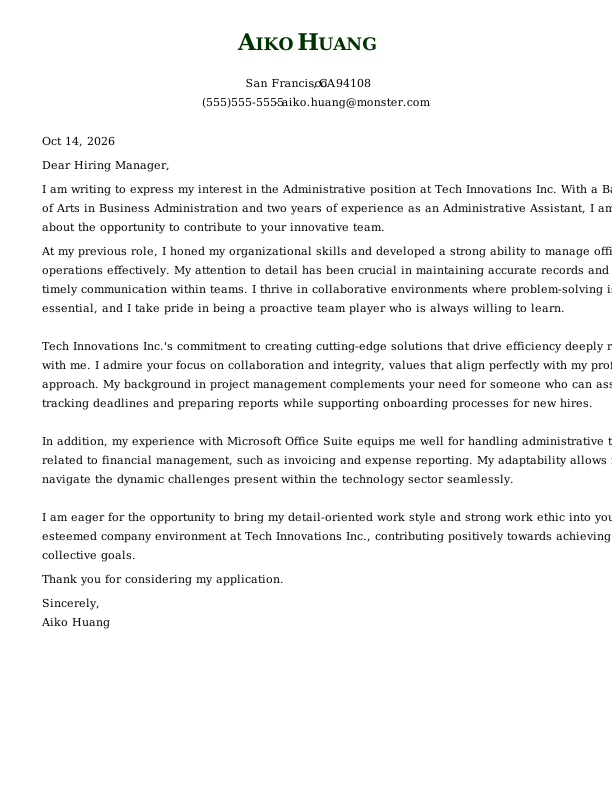
 Free
Administrative Entry-Level Cover Letter
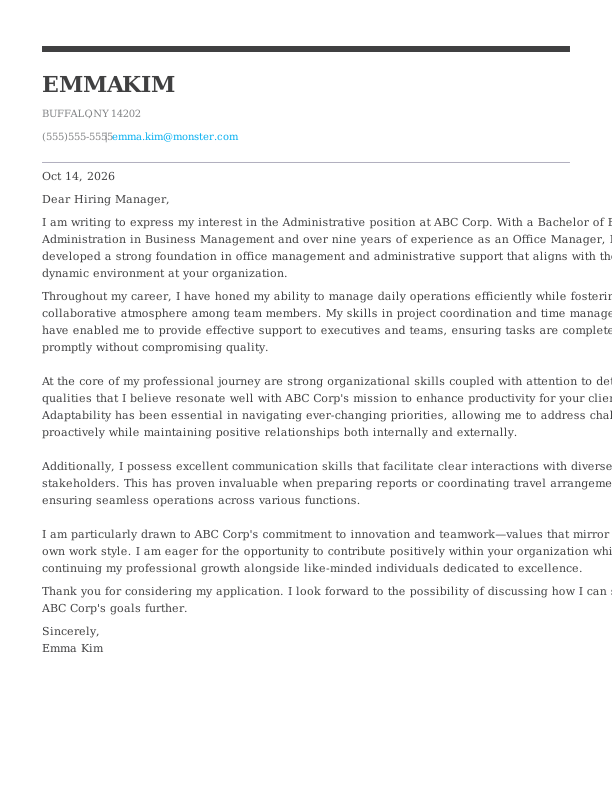
Administrative Mid-Level Cover Letter
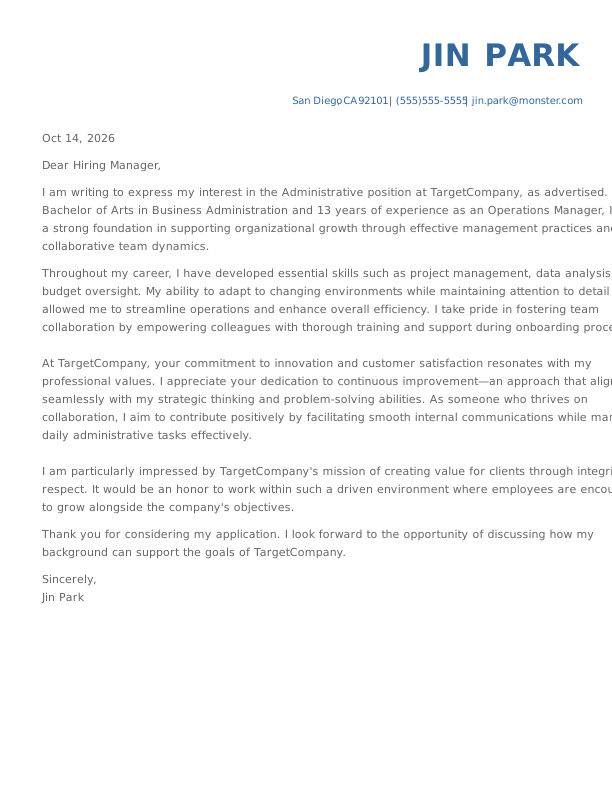
Administrative Experienced Cover Letter
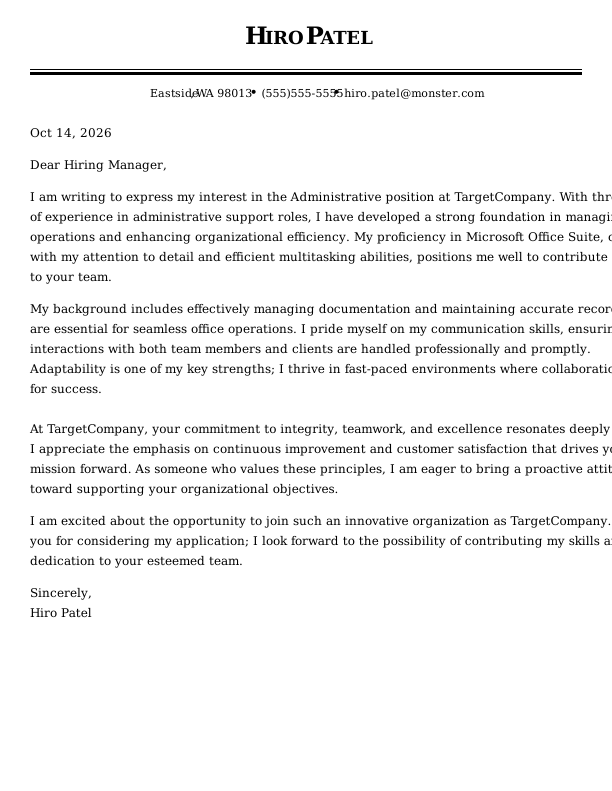
Administrative Entry-Level Cover Letter
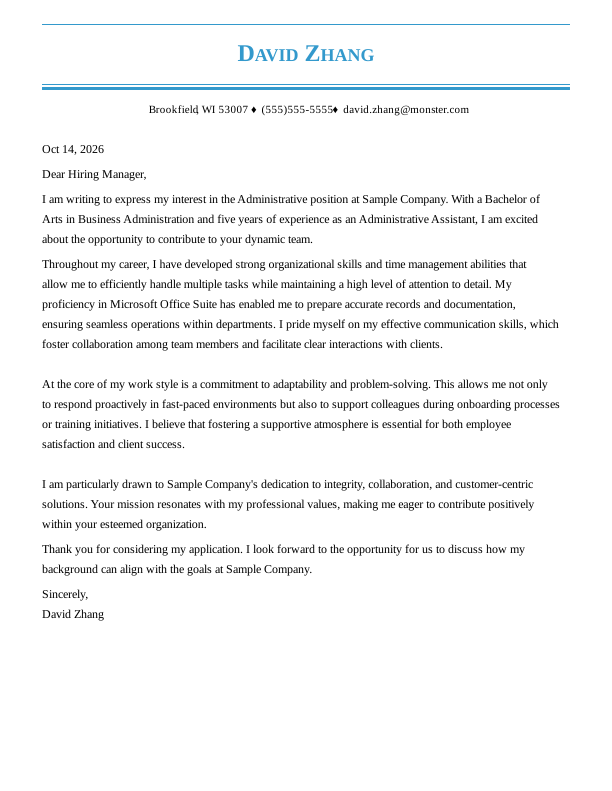
Administrative Mid-Level Cover Letter
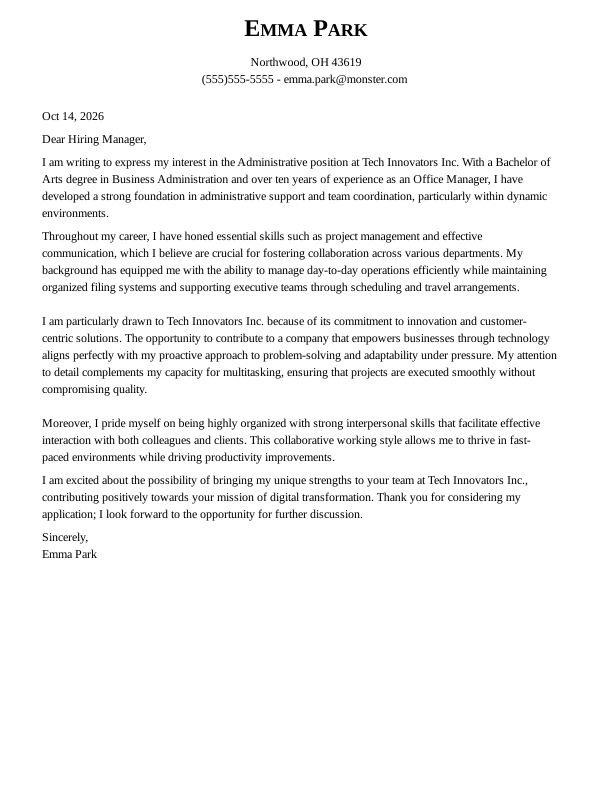
Administrative Experienced Cover Letter
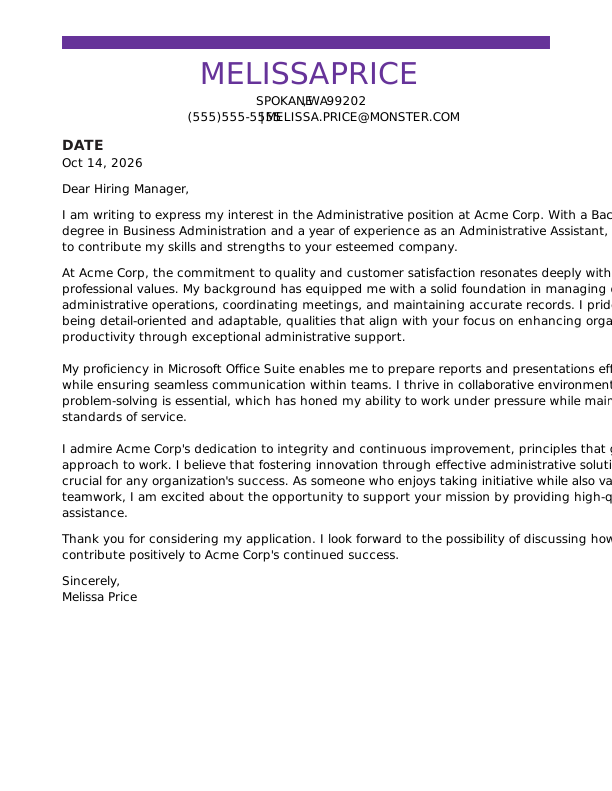
Administrative Entry-Level Cover Letter
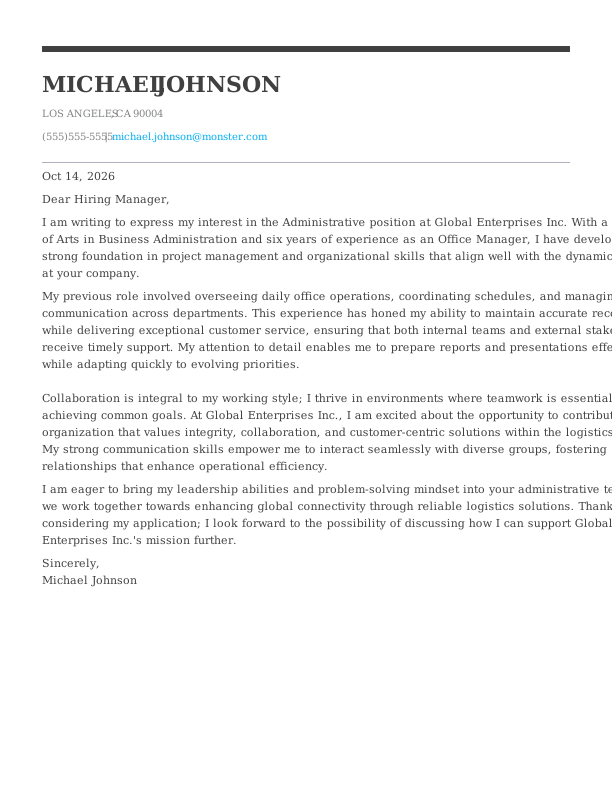
Administrative Mid-Level Cover Letter
Browse Free Cover Letter Templates
- Academic
- Account Manager
- Accountant
- Accounts Payable
- Administrative Assistant
- Admissions Counselor
- Architecture
- Artist
- Assistant Principal
- Babysitter
- Barista
- Bartender
- Bookkeeper
- Brand Ambassador
- Business Analyst
- Business
- Caregiver
- Chef
- Civil Engineering
- Computer Science
- Construction
- Consulting
- Copywriter
- Cosmetology
- Custodian
- Customer Service
- Customer Service Representative
- Data Analyst
- Data Entry
- Dental Assistant
- Dental Hygienist
- Digital Marketing
- Electrical Engineering
- Emt
- Engineering
- Esthetician
- Event Coordinator
- Executive Assistant
- Finance
- Financial Analyst
- Firefighter
- Flight Attendant
- Graphic Designer
- Hair Stylist
- Healthcare
- Hr Generalist
- Investment Banking
- It
- Janitor
- Journalism
- Lab Technician
- Law Clerk
- Lawyer
- Librarian
- Logistics
- Makeup Artist
- Manager
- Marketing Coordinator
- Marketing
- Marketing Manager
- Massage Therapist
- Mechanic
- Mechanical Engineer
- Medical Assistant
- Non Profit
- Nursing
- Occupational Therapy
- Office Assistant
- Office Manager
- Operations Manager
- Paralegal
- Personal Trainer
- Pharmacist
- Pharmacy Technician
- Photographer
- Physician Assistant
- Pilot
- Police Officer
- Program Manager
- Project Manager
- Property Manager
- Psychology
- Receptionist
- Research Assistant
- Restaurant Manager
- Retail
- Sales
- Sales Manager
- School Counselor
- Security Officer
- Social Work
- Software Engineer
- Special Education Teacher
- Substitute Teacher
- Teacher
- Teaching Assistant
- Truck Driver
- Vet Tech
- Veterinary Assistant
- Web Developer
Cover Letter Examples for Administrative Professionals
Cover letter expectations evolve as an administrative career progresses, especially as you move from entry-level support to broader coordination and leadership. Choose the template that matches your experience level so you can spotlight the right skills, training, and accomplishments for your next role.
Entry-Level Administrative Cover Letter
Ideal for recent graduates and career changers transitioning into administrative roles, this sample shows how to highlight transferable strengths and foundational training when building a cover letter with limited direct experience.
Mid-Career Administrative Cover Letter
Best suited for administrative professionals with several years of experience, this cover letter example fits job seekers who manage daily office operations, coordinate team projects, and handle executive scheduling or vendor communication.
Experienced Administrative Cover Letter
Seasoned administrative professionals should use this sample to show how they can oversee complex operations, manage budgets, and lead cross-functional office workflows.
Administrative Cover Letter Template (Text)
Copy this administrative cover letter template, paste it into your document, and customize it with your scheduling metrics or the office you’ve supported.
Emma Garcia
Eastside, WA 98012
(555)555-5555
emma.garcia@monster.com
Oct 14, 2026
Dear Hiring Manager,
I am writing to express my interest in the administrative position at TargetCompany, as advertised. With a Bachelor of Arts degree in Business Administration and four years of experience as an office assistant, I have developed a strong foundation in administrative support and a keen understanding of the organizational dynamics that drive operational success.
Throughout my career, I have honed my communication, time management, and problem-solving skills while working collaboratively within team environments. My attention to detail and proactive approach enable me to manage multiple tasks effectively while maintaining high standards of confidentiality and professionalism.
At TargetCompany, known for its commitment to innovation and excellence, I am excited about the opportunity to contribute positively to your team. Your focus on delivering top-tier solutions resonates with my own dedication to providing exceptional service. I thrive in dynamic settings where adaptability is key; thus, I welcome the challenges that come with coordinating daily administrative activities while supporting executives through various organizational tasks.
I believe that fostering effective communication across departments is essential for enhancing workflow efficiency—a principle I prioritize in every role. Furthermore, my experience organizing company events has equipped me with the logistical skills necessary for ensuring seamless operations.
Thank you for considering my application. I look forward to the possibility of discussing how my background aligns with the goals of TargetCompany.
Sincerely,
Emma Garcia
How to Write an Administrative Cover Letter
Writing a strong administrative cover letter means grounding your experience in real office tools and daily workflows. Follow these steps to organize your details and match the specific demands of your target role.
1. Research & Prepare
Before writing, learn how the department operates daily, including its primary software, calendar systems, and recordkeeping methods. Reviewing current company goals helps you tailor your letter to the exact operational priorities you will support.
To build a strong foundation for your cover letter, gather key background information using these sources:
- Scan the job posting for specific software requirements like Microsoft Outlook, SharePoint, or internal database systems.
- Review the company website to understand its core services, organizational culture, and document management style.
- Check relevant industry or professional association sites to identify standard administrative certifications or preferred skill sets.
2. Hook the Reader
Capture the hiring manager’s interest immediately by showing you understand the day-to-day administrative systems that keep an office running. Instead of using generic opening statements, highlight a specific operational result you delivered.
These examples show how to craft a strong, impact-driven opening sentence:
- Systems control: “I reduced meeting no-shows by 18% by updating scheduling guidelines, setting up automated reminders, and refreshing our shared agenda template.”
- Process accuracy: “I cut invoice rework from 6% to 2% over three months by standardizing intake checks and tracking recurring exceptions in Excel.”
- Stakeholder coordination: “After setting up a weekly status check with team leads, I created a central action tracker that raised on-time deliverable rates from 74% to 86%.”
3. Tell Your Professional Story
While your resume lists your core duties, your cover letter explains how your work improved daily operations. Using specific numbers helps hiring managers picture the volume and efficiency of your work far better than broad claims about being organized.
Here are a few ways to describe your administrative achievements using measurable outcomes:
- Managed scheduling for 42 appointments per week and reduced average response times from three days to same-day confirmations.
- Processed $18,000 in monthly vendor invoices with a 99% accuracy rate after updating the internal expense checklist.
- Reduced document errors by 25% by standardizing intake forms and maintaining clear file versions across six active projects.
4. Showcase Your Skills
Avoid generic statements by linking key job requirements to concrete actions from your experience. Describing how you handled a specific task gives hiring managers clear evidence of your problem-solving abilities and attention to detail.
Consider these practical examples of translating common administrative skills into real-world achievements:
- Scheduling software: “I coordinated complex team calendars in Outlook, verifying time zones and attendee availability before issuing final invites.”
- Document handling: “I prepared accurate meeting packets by cross-referencing attendee rosters and formatting documents for consistent layout.”
- Client communication: “I managed high-volume phone requests using a structured intake script, resolving inquiries promptly and maintaining shared inbox notes.”
5. Explain Any Special Circumstances
Address any career breaks, industry shifts, or relocations in one or two simple sentences. Focus on your current technical readiness and up-to-date skills so the reader feels confident in your ability to step into the role smoothly.
Use these brief explanations to address unique career situations with clarity:
- “After taking time off for family leave, I refreshed my technical skills by completing advanced Excel training and returning to full-time support work.”
- “I am transitioning into administrative support by applying my customer service background and building proficiency in Google Workspace and digital task management.”
- “Following my relocation, I quickly adapted to local operational needs and completed new onboarding compliance standards at my current organization.”
6. End With a Professional Goodbye
Close your cover letter with a clear, polite call to action that makes it easy for the hiring manager to move forward. Expressing enthusiasm for a brief conversation keeps the tone professional and forward-looking.
Propose a concrete discussion topic tied to office operations, such as: “I would welcome the opportunity to discuss how my scheduling experience and document management skills can support your team’s daily operations. Thank you for your time and consideration.”
Close with a standard professional sign-off like “Sincerely” or “Best regards.”
4 Tips for Formatting Your Cover Letter
A clean, structured cover letter helps hiring managers quickly identify your key qualifications during a brief initial review. Follow these formatting guidelines so your cover letter looks professional on screen and in print, allowing your relevant administrative skills to stand out immediately.

Keep It to One Page
When you apply for an administrative role, the hiring manager often checks emails and schedules while scanning your letter, so extra pages dilute key details it needs fast. Target 250-400 words across three to four short paragraphs, covering your office systems skill like Excel or SharePoint, plus one concrete win such as reduced processing time.

Use Bullet Points for Key Achievements
Use three to four bullets to highlight your administrative impact, like invoice processing cycle time, scheduling accuracy, budget managed, and ticket resolution turnaround. When you skim the page, those bullets make results easy to spot fast and let hiring managers see measurable outcomes without hunting through paragraphs.

Balance Spacing & Margins
Use single to 1.15 line spacing, and insert a blank line between paragraphs so your cover letter reads cleanly instead of feeling cramped. Keep uniform margins of 0.75–1 inch to frame the text, improving readability on screens and preserving a tidy layout when printed.

Save & Send as a PDF
Export your administrative cover letter as a PDF to prevent formatting reflow and potential ATS mangling of the layout. Use a recruiter-friendly name like Firstname_Lastname_Cover_Letter.pdf, optionally adding an admin credential abbreviation if it is commonly used.
Top-Paying States for Administrative Roles
Knowing what administrative professionals earn across the country helps you compare offers, plan your career steps, and negotiate with confidence. Salary figures below are based on the U.S. Bureau of Labor Statistics (BLS) and reflect recent nationwide averages for administrative roles.
Keep in mind that real pay can vary based on location, experience level, industry, and whether the job is focused on scheduling, office management, or customer support. Larger organizations and specialized departments may also offer different compensation and benefits.
| Alabama | $152,420 |
| Alaska | $114,060 |
| Arizona | $115,170 |
| Arkansas | $94,820 |
| California | $135,940 |
| Connecticut | $140,260 |
| Delaware | $151,160 |
| District of Columbia | $171,190 |
| Florida | $124,580 |
| Georgia | $125,210 |
| Hawaii | $117,270 |
| Idaho | $86,950 |
| Illinois | $119,350 |
| Indiana | $153,410 |
| Iowa | $120,270 |
| Kansas | $134,600 |
| Kentucky | $108,260 |
| Louisiana | $130,740 |
| Maine | $100,920 |
| Maryland | $128,690 |
| Massachusetts | $129,980 |
| Michigan | $131,540 |
| Minnesota | $154,370 |
| Mississippi | $108,520 |
| Missouri | $131,450 |
| Montana | $131,670 |
| Nebraska | $127,280 |
| Nevada | $95,320 |
| New Hampshire | $124,990 |
| New Jersey | $151,490 |
| New Mexico | $113,410 |
| New York | $151,330 |
| North Carolina | $117,070 |
| North Dakota | $115,020 |
| Ohio | $102,800 |
| Oklahoma | $140,150 |
| Oregon | $118,530 |
| Pennsylvania | $114,510 |
| Rhode Island | $138,020 |
| South Carolina | $120,840 |
| South Dakota | $107,500 |
| Tennessee | $140,660 |
| Texas | $132,250 |
| Utah | $120,290 |
| Vermont | $97,390 |
| Virginia | $143,320 |
| Washington | $152,800 |
| West Virginia | $117,760 |
| Wisconsin | $139,610 |
| Wyoming | $121,600 |
| Guam | $65,100 |
| Puerto Rico | $104,390 |
| Virgin Islands | $79,350 |
Key Takeaways
- Focus your letter on accuracy and practical follow-through by describing a specific time you corrected a schedule or document error before it impacted operations.
- Use clear metrics like invoice turnaround times, calendar accuracy rates, or request volumes to demonstrate the tangible impact of your work.
- Tailor your highlights to the environment, balancing general office organization with industry-specific needs like medical scheduling, legal documentation, or corporate reporting.
More Cover Letter Examples
Browse Monster’s Resume Templates
Monster also has hundreds of ATS-friendly resume templates for all career levels and industries. Create a matching resume to help you land the interview.
- Administrative Assistant
- Administrative Coordinator
- Administrative
- Archivist
- Assistant
- Category Manager
- Clerical
- Clerk
- Clinical Research Assistant
- Data Entry
- Executive Assistant
- Front Desk Receptionist
- Hr Assistant
- Hr Generalist
- Human Resources
- Interpreter
- Office Administrator
- Office Assistant
- Office Coordinator
- Personal Assistant
- Project Assistant
- Real Estate Assistant
- Receptionist
- Scheduler
- Scheduling Coordinator
- Secretary
- Virtual Assistant
Frequently Asked Questions
Last Update:
Do I really need a cover letter?
Administrative roles strongly benefit from a cover letter, even when the job posting lists it as optional. While your resume details your work history, a cover letter provides context about your problem-solving style and operational support skills. It is especially useful if you are changing careers, addressing an employment gap, or explaining why you are specifically interested in supporting this team’s daily administrative needs.
How long should my cover letter be?
An administrative cover letter should stay within one page, ideally between 250 and 400 words. Hiring managers often review applications quickly, so concise messaging helps your key strengths stand out. Structure your letter into three or four short paragraphs, focusing strictly on your most relevant achievements, software skills, and experience with daily office workflows.
Should my cover letter match my resume?
An administrative cover letter should match your resume’s visual layout to present a cohesive application package. Using identical fonts, margin sizes, and header designs makes your documents look polished and professional. Instead of simply repeating your resume’s bullet points, use your letter to elaborate on key accomplishments and explain how you will support the company’s daily operations.
What should I include in my cover letter header?
A cover letter header for an administrative position should include your full name, phone number, professional email address, and general location, followed by the date and recipient details. Including the hiring manager’s name, title, and department adds a personal, professional touch. Aligning the typography and styling with your resume header ensures both documents look like a matching set.
How do I write a cover letter for an internal position?
When applying for an internal administrative role, your cover letter should highlight your familiarity with the company’s existing workflows, team structures, and internal software. Mention specific operational improvements you have contributed to in your current role, such as streamlining document intake or reducing processing delays. Expressing enthusiasm for taking on broader support responsibilities shows readiness to grow within the organization.

Megan Dawkins is a career industry editor who empowers job seekers to take control of their career paths using Monster’s comprehensive job search and resume tools. She specializes in helping job seekers navigate the flexible job market.
See More From Megan DawkinsExplore Related Career Advice







How to Write a Cover Letter for Internal Positions or Promotions (Examples & Tips)

Updated:
Apr 23, 2026
|
19 min read


Cover Letter vs Resume: What’s the Difference & Do You Need Both?

Updated:
Apr 23, 2026
|
18 min read